
Radio Control: Sport and Aerobatics
Ron Van Putte III 111 Sleepy Oaks Rd. Ft. Walton Beach, FL 32548
Introduction
Questions often appear in letters that arrive in my mailbox. The following letters, originally addressed to Model Aviation and forwarded to me by the publisher, raise common issues about rudder response, dihedral, trim and stability. I present the letters (abridged) and then discuss causes and remedies.
Letter from John Fleming (Vernon, NY)
"I've been flying R/C planes about 4½ years now. I started with a Goldberg Eagle .63. Over time I have been able to perform various stunts such as loops, barrel rolls, inverted flight, touch-and-go, etc. I recently purchased and built a Goldberg Sky Tiger. My problem is that I can't get the plane to turn with the rudder (left or right).
"When I use the rudder, all the plane does is a flat turn. I can't get the plane to bank unless I use the ailerons. When it is banking and I try to level the plane out with the rudder, it acts as if it's sideslipping. Say I'm banking to the right and I give left rudder to roll out of the bank. Instead of the plane rolling to the left and leveling off, the plane stays in the bank and the nose goes up as if doing a sideways flat turn. This tends to cause a loss of altitude.
"I can't for the life of me figure this problem out. All of the control throws are set according to the instructions, and now I need some experienced advice on correcting this matter. The plane flies well except for the fact I can't use the rudder to turn."
Rudder, Dihedral and Why Beginner Planes Behave This Way
- Many beginner aircraft intentionally have significant wing dihedral. When rudder is applied, the airplane sideslips; the dihedral causes a rolling moment and the airplane banks in the direction of the rudder-induced sideslip. A pilot unfamiliar with dihedral may therefore assume the rudder "caused" the bank.
- There are essentially two ways to bank an airplane: by yaw-induced roll (rudder + dihedral) or by direct roll control (ailerons).
- For beginner-level flying the rudder/dihedral method works fine and can produce fairly abrupt turns. Many trainers don't even have ailerons and perform their missions well using rudder and dihedral.
Why this is a problem for advanced maneuvers
- If you intend to fly inverted, knife-edge, point rolls or other advanced Pattern maneuvers, you do not want the rudder to cause a roll. For example, in knife-edge flight the pilot applies "top rudder" to keep the nose up; dihedral-induced roll would fight that input.
- A benchmark for Pattern-capable (aerobatic) airplanes is that they exhibit no appreciable rolling tendency when the rudder is deflected. If a model banks with rudder, reduce wing dihedral to eliminate the unwanted roll.
My advice to John Fleming
Your Sky Tiger is doing exactly what it was designed to do. If you want to keep flying it as a trainer-type airplane, don't change anything. If your goal is Pattern/aerobatic flying, reduce the wing dihedral until rudder inputs no longer produce a roll.
---
Letter from William Roper (Englewood, CO) — trimmed issue
"What I'm trying to sort out is straight, level, unaccelerated flight—my Pattern airplane slowly rolled 90° either direction with no other input applied. The airplane I'm working on now maintains altitude some distance; the heading changes toward the direction of the roll, i.e., it pulls toward the canopy."
Trim vs. Stability — basic explanation
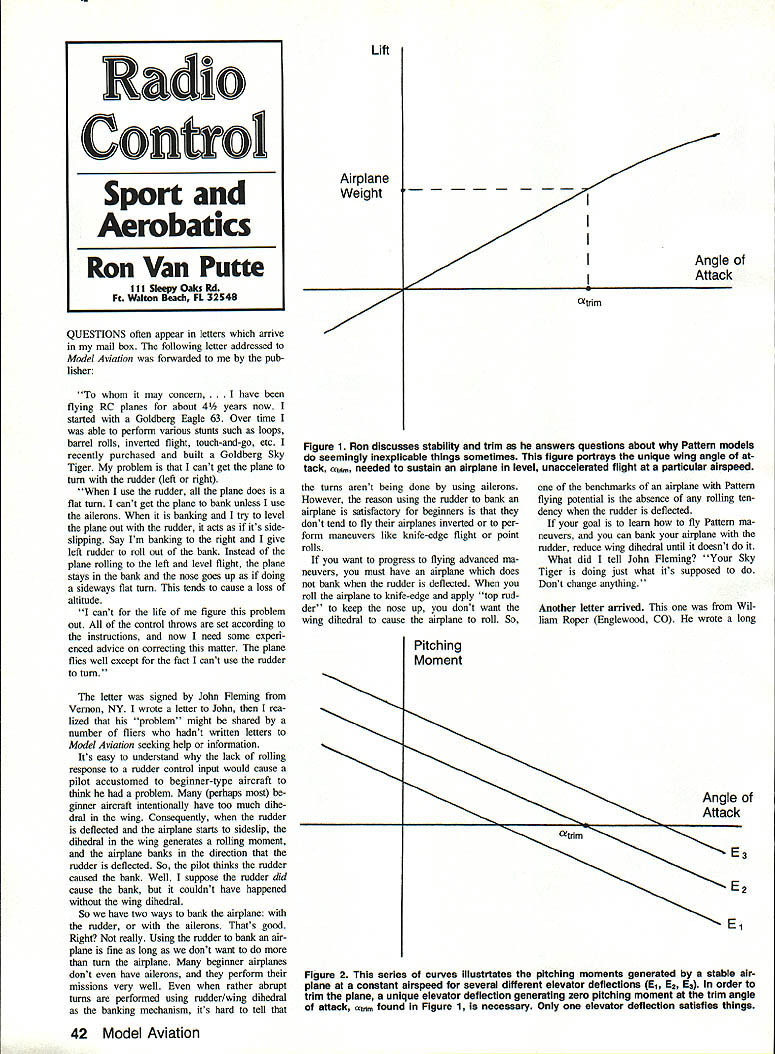
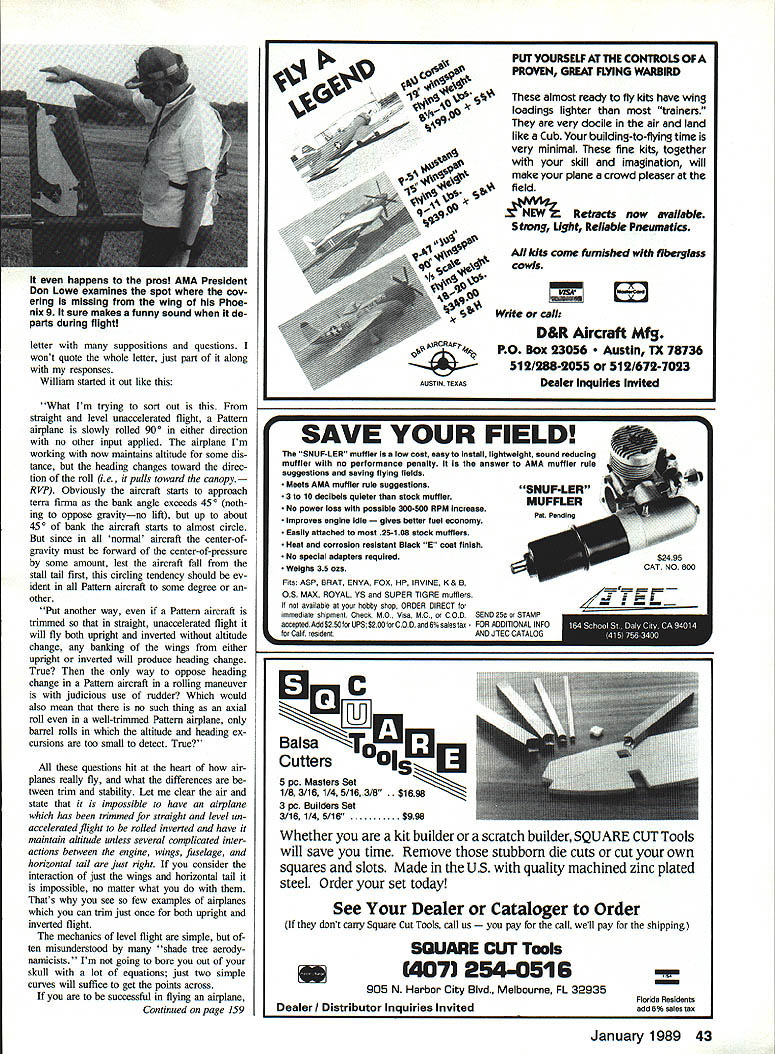
- Trim: the control settings required for a given flight condition (e.g., elevator position for steady, level flight at a given speed). For one airspeed and flight condition there is a unique angle of attack and a unique elevator deflection that produce zero pitching moment.
- Stability: the airplane's tendency to return to equilibrium after a disturbance. Stability determines how the airplane reacts if it is nudged away from trim.
- It is generally impossible to trim an airplane so it will maintain altitude both upright and inverted without additional design compromises. Trim is specific to a flight condition and speed; change the speed or configuration and the trim point changes.
Why a pattern ship might slowly roll or spiral
What William described is consistent with a spiral tendency (a directional/rolling coupling) rather than a mysterious single-trim problem. Causes include:
- Excessive wing dihedral (causes roll in response to yaw/sideslip)
- Too much vertical tail area or a fin located too far aft (strong directional stability interacting with dihedral)
- Inadequate roll damping
- Aft center of gravity (CG) position
- Incorrect wing or tail incidence, or wing/tail twist/warpage
How the airplane behaves:
- As bank increases, the vertical component of wing lift decreases. Beyond about a 45° bank, little vertical lift remains and the airplane must either exchange altitude for turning or use thrust components; otherwise it will descend and tighten the turn.
- Small imbalances in moments and forces at a given attitude will lead to a tendency to change attitude unless corrected by proper trim, CG and geometry.
Practical checklist to diagnose and correct rolling/spiral tendencies
- Check dihedral
- If the model rolls when you apply rudder, reduce wing dihedral for better axially symmetric response to rudder.
- Check CG
- Move the CG forward a little and see if the tendency decreases. An aft CG can reduce stability and promote spiral.
- Inspect vertical tail
- Excessive fin area or too-remote/ aft mounting can increase directional stability and, when combined with dihedral, promote spiral.
- Verify incidences and alignment
- Ensure wing and tail incidence angles are correct, and that there is no built-in twist or warpage causing asymmetric moments.
- Check for inadequate roll damping
- Some designs need more roll damping (e.g., through geometry or mass distribution) to prevent a steady increase in bank.
- Trim properly
- Trim the airplane at the desired airspeed so the net pitching moment about the CG is zero. Remember trim is unique for a flight condition; changes in speed, throttle or fuel load will change trim requirements.
Notes on the pitching-moment concept (figures referenced)
- Figure 1 (conceptual): a unique wing angle of attack is required to sustain an airplane in level, unaccelerated flight at a given airspeed; only one elevator setting satisfies that condition.
- Figure 2 (conceptual): a set of pitching-moment vs. angle-of-attack curves for several elevator deflections. Trim occurs where the pitching-moment curve crosses zero (unique elevator deflection for zero moment at that speed).
- The point: trimming (setting controls for steady flight) is different from stability (how the airplane behaves after disturbance). You must set trim, then correct stability/geometry issues if the airplane tends to roll or spiral.
Summary / Practical guidance
- If you fly trainer-type models and like their docile behavior, leave dihedral as is.
- If you want Pattern/aerobatic performance, reduce dihedral and pay close attention to CG, tail area/placement, incidence and structural straightness.
- Use the checklist above to diagnose persistent rolling or spiral tendencies and make incremental adjustments, testing after each change.
Transcribed from original scans by AI. Minor OCR errors may remain.

