

Radio Control: Sport and Aerobatics
Ron Van Putte
You'll probably be reading all about the RC F3A World Championships in this issue and will be as disappointed as I am about the results. Since our team finished third, and only one of our individual fliers was in the finals, it makes me wonder what happened. I hate to say, "I told you so," but I did in my September column. Apparently, the situation was even worse than I had feared.
We had expected that virtually all of the European fliers would be flying airplanes powered by two-cycle engines, since reports from contests there indicated that virtually no four-cycle engines were being flown. We also expected that the Japanese would fly two-cycle engines exclusively. So, where was the surprise?
Who expected that the judges would virtually ignore the "box"? The judges were left to their own devices to determine the limits of the "box" (no flags marked the 60° angles from the judges' position). Apparently, the judges decided on their own not to penalize fliers for excessively wide turnarounds (since there was no evidence of a conspiracy)—or they just didn't know where the limits were.
The failure to penalize for flying out of the "box" is really puzzling. We were told that a primary reason for the F3A (Turnaround) pattern was to reduce the area that competition was flown in because of the limited flying space available at fields in Europe.
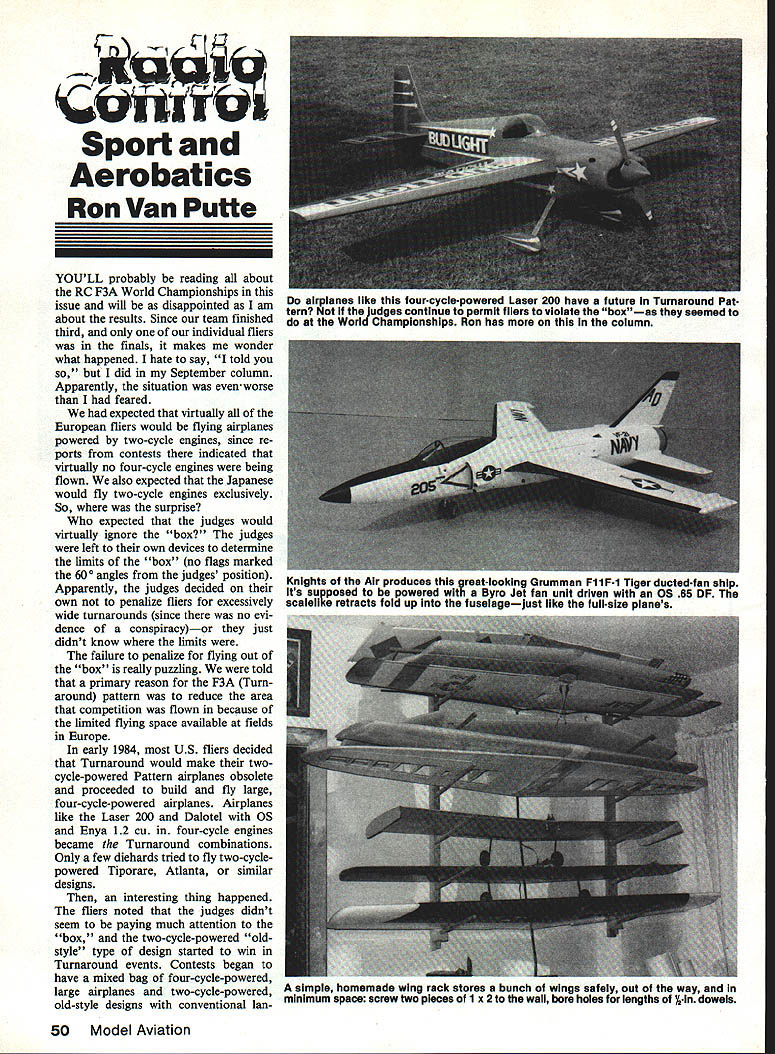
In early 1984, most U.S. fliers decided that Turnaround would make their two-cycle-powered Pattern airplanes obsolete and proceeded to build and fly large, four-cycle-powered airplanes. Airplanes like the Laser 200 and Dalotel with OS and Enya 1.2 cu. in. four-cycle engines became the Turnaround combinations. Only a few diehards tried to fly two-cycle-powered Tiporae, Atlanta, or similar designs.
Then an interesting thing happened. The fliers noted that the judges didn't seem to be paying much attention to the "box," and the two-cycle-powered "old-style" designs started to win in Turnaround events. Contests began to have a mixed bag of four-cycle-powered large airplanes and two-cycle-powered old-style designs with conventional landing gear.
A situation typical of the Masters Tournament last June fielded the World Championship team—we flew two two-cycle airplanes and one four-cycle airplane. Unfortunately, the Europeans and Japanese had plenty of experience flying Turnaround two-cycle airplanes, and the judges permitted overflying the box. Consequently, we got pounded at the World Championships. We did get outflown; we just got snookered.
An interesting question regarding the Turnaround pattern in this country: What airplane/engine combinations will be developed next year? Based on the World Championships, fliers will be moving away from four-cycle engines in favor of two-cycle engines, moving down in airplane size, wing areas around 800–850 square inches, if judges continue to permit violations of the box. However, if judges in this country stick to FAI rules, we could see development of airplanes that will be different from what the rest of the world will be flying. Isn't it an interesting quandary? Judging Turnaround in accordance with FAI rules could end up not having airplanes and pilots who would be competitive at the next World Championships, either. Strange.
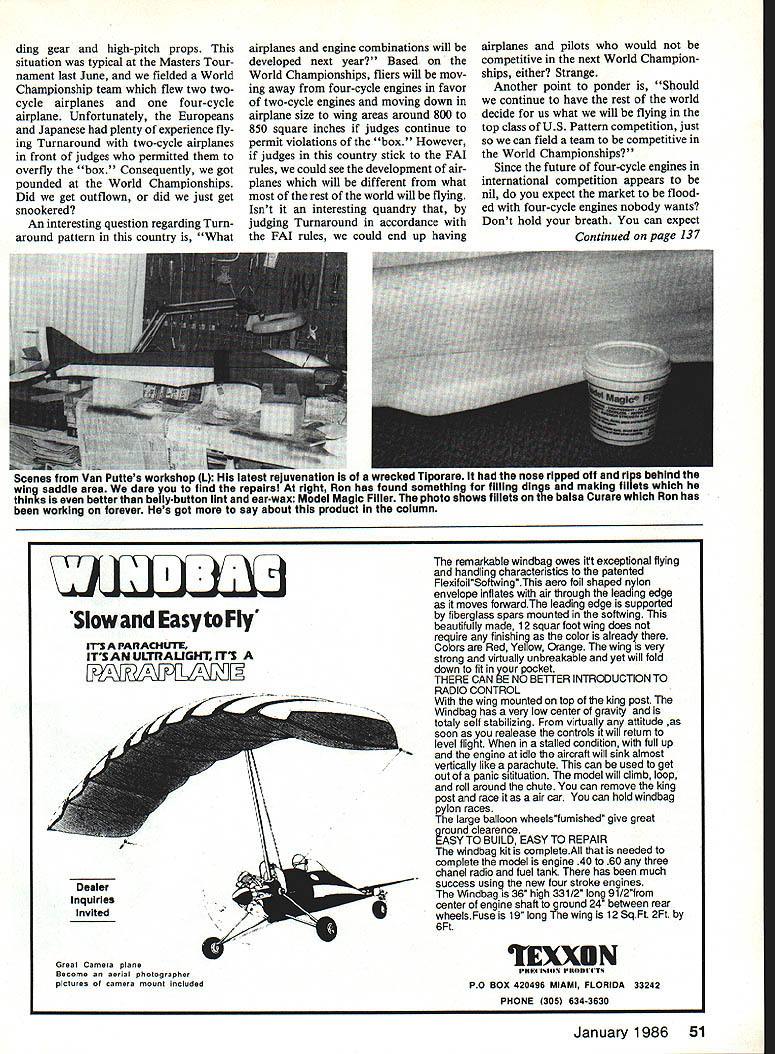
Another point to ponder: Should we continue to have the rest of the world decide for us what we'll be flying? Top-class U.S. Pattern competition just cannot field a team competitive at the World Championships. Since the future of four-cycle engines in international competition appears nil, expect the market to be flooded with four-cycle engines nobody wants. Don't hold your breath.
The use of four-cycle engines will continue to boom for sport fliers. There's a vast pool of buyers for four-cycle engines who like the power, fuel economy and pleasant sound they possess. The number of conversions of four-cycle engines to ignition will probably increase, too, because you end up with all the benefits of a four-cycle engine, plus cheaper fuel.
I'm always on the lookout for new products and just discovered another one. Actually, it discovered me, because I got a letter from Vern Wald of Model Magic Products, Inc. Vern wrote, "I was in the hobby searching for a good and easy fillet material for three years and used everything from [a commercial product, RVP] to belly-button lint and ear wax. Ear wax and lint worked best, but it was in very short supply, and my friends would not cooperate, so that's when I developed Model Magic Filler. It works better than anything else and has excellent strength and adhesion for an easily-sanded material. Look over the literature and give our products a try. If you like them—fine. If not—OH, WELL!"
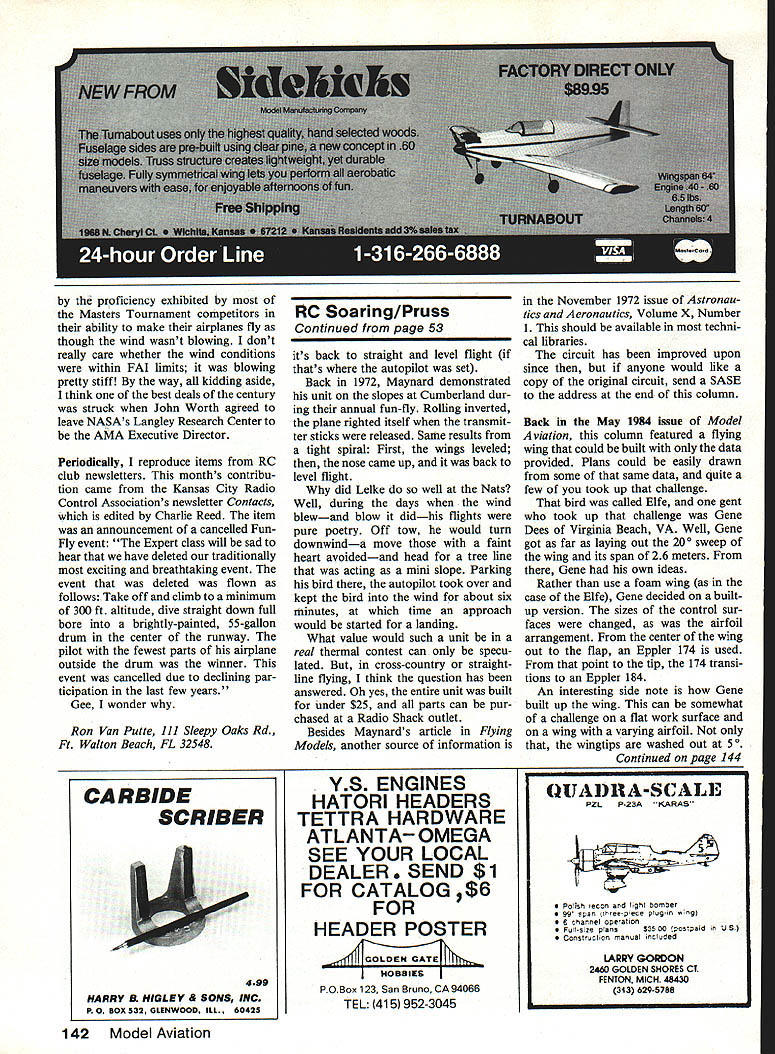
We've all read glowing testimonials from manufacturers about their own products, so I decided, with more than a few misgivings, to try Model Magic Filler. You know, it's good stuff! I've tried it for a variety of uses, and virtually everything they claim is true. It is light, tough, and sands easily. When it gets thick, a bit of water brings it back to whatever consistency you desire. It doesn't seem to shrink when it dries like spackling paste does. The only quarrel I have with it is that it doesn't spread as nicely as spackling. Getting a nice feather edge is tougher, but proper thinning helps. However, once it goes down, it stays.
I used it to make a large wing fillet on a balsa Curare I'm finishing (slowly), and you can see the result in the pictures which are included with this column. Good product. Besides, I like manufacturers who can refer to their products with humor! I never tried belly-button lint and ear wax.
While on the subject of letters, I got a letter from John Worth (AMA Executive Director) regarding the windy conditions at the RC Masters Tournament which I'd reported on. He wrote, "Just thought I'd write and advise concerning your note, in the October '85 MAC, concerning the RC Masters Tournament in Lake Charles, regarding the wind. The Jury (I was a member) monitored the wind, and at the worst it was gusting 15 to 22 mph. We were measuring directly with a wind gauge and double-checking with other means. Mostly, it was 12 to 15. In any case, we didn't record any readings which exceeded the FAI limit of 27 mph."
Hmmm! Only gusting 15 to 22 mph? I'm sure that John Worth is right, but when it's going to gust 10 to 15 mph, I make sure there's beer in the refrigerator and a good football game (tennis match, golf tournament, or bingo game) on TV and conveniently forget to put my RC gear on charge. Seriously, I was amazed by the proficiency exhibited by most of the Masters Tournament competitors in their ability to make their airplanes fly as though the wind wasn't blowing. I don't really care whether the wind conditions were within FAI limits; it was blowing pretty stiff! By the way, all kidding aside, I think one of the best deals of the century was struck when John Worth agreed to leave NASA's Langley Research Center to be the AMA Executive Director.
Periodically, I reproduce items from RC club newsletters. This month's contribution came from the Kansas City Radio Control Association's newsletter Contacts, which is edited by Charlie Reed. The item was an announcement of a cancelled Fun-Fly event:
"The Expert class will be sad to hear that we have deleted our traditional most exciting and breathtaking event. The event that was deleted was flown as follows: Take off and climb to a minimum of 300 ft. altitude, dive straight down full bore into a brightly-painted, 55-gallon drum in the center of the runway. The pilot with the fewest parts of his airplane outside the drum was the winner. This event was cancelled due to declining participation in the last few years."
Gee, I wonder why.
Ron Van Putte 111 Sleepy Oaks Rd. Ft. Walton Beach, FL 32548
Transcribed from original scans by AI. Minor OCR errors may remain.

