
Radio Control: Sport and Aerobatics
Ron Van Putte 111 Sleepy Oaks Rd. Ft. Walton Beach, FL 32548
Introduction: Turnaround Pattern — old resistance, new perspective
Many of you know I did not exactly welcome Turnaround Pattern at first. The reasons were complex, but my resistance was mainly a reaction to what appeared to be an attempt by a few individuals to cram something down our throats whether we wanted it or not. It felt like, "Eat your vegetables — they're good for you!" That attitude by some Turnaround promoters was resented by many of us and caused hard feelings for years.
Years have softened the edges of my feelings about Turnaround. I can think and talk about it now without getting riled up. I even attend and compete in an all-Turnaround contest once a year in Jackson, MS. That doesn't mean I'll ever fly in the new Expert Turnaround event if it is passed in the rules, but I can see the benefits of flying Turnaround more objectively now.
How Turnaround improves flying
Flying Turnaround makes a Pattern flier a better flier. The same is true of AMA Pattern compared with sport flying: both are tougher disciplines, and Turnaround is tougher still. The discipline and practice required to fly Turnaround carry over and improve a pilot's AMA Pattern flying.
There are numerous examples of pilots who improved dramatically after they started flying Turnaround. My personal example is Nat Penton of DeQuincy, LA. Nat and I used to trade wins in Expert at contests in Lafayette, Baton Rouge, Jackson and Pensacola. After Nat started flying Expert Turnaround, he improved very quickly — faster than I could keep up.
Unintended benefit: quieter, better-performing equipment
Another benefit of Turnaround nobody expected—or perhaps nobody heard coming—was the pressure to meet noise restrictions and to fly slower and stay in the box. That forced fliers to experiment with airframes, props, engines and muffling devices in ways we never imagined. The result: airplane combinations that perform better than ever, and are much quieter.
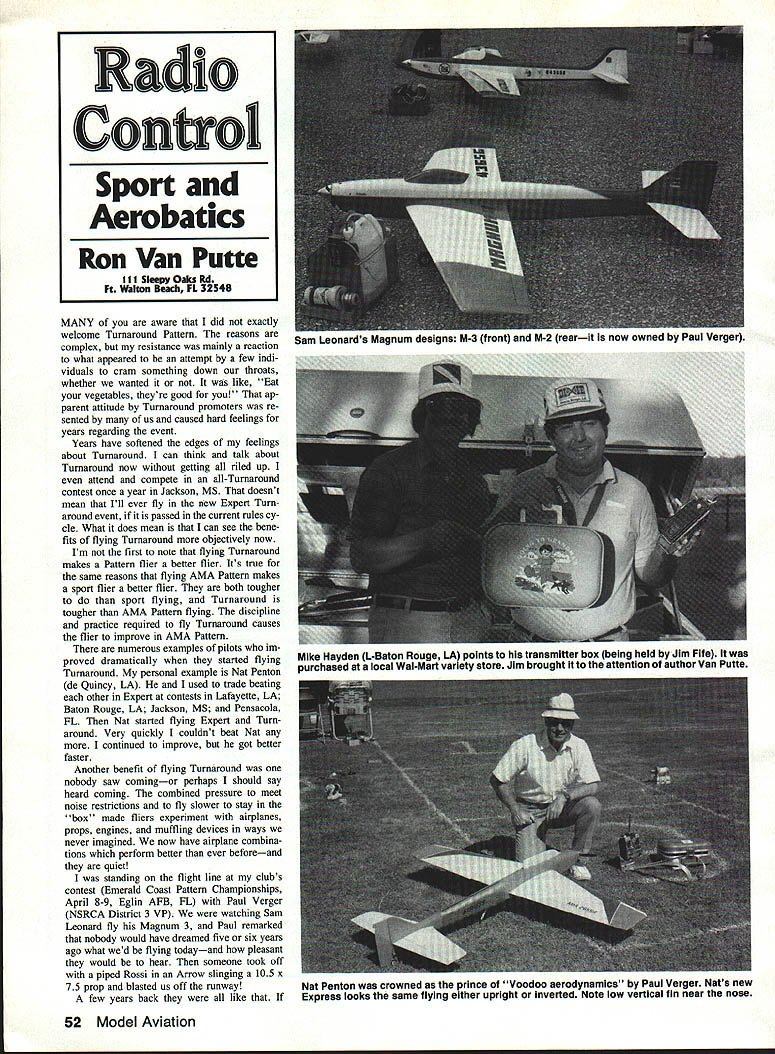
I was standing on the flight line at my club's contest (Emerald Coast Pattern Championships, April 8–9, Eglin AFB, FL) with Paul Verger (NSRCA District 3 VP) watching Sam Leonard fly his Magnum 3. Paul remarked that nobody would have dreamed five or six years ago what we'd be flying today — and how pleasant they would be to hear. Then someone took off with a piped Rossi in an Arrow slinging a 10.5 × 7.5 prop and blasted us off the runway!
For my part, I'm running an 11 × 10 prop on my YS, with about 16½ in. from the glow plug to the high point on the OPS pipe I'm using. It's not the quietest on the flight line, but it will easily pass the proposed 98 dB noise limit. So Turnaround has benefited me as an AMA Pattern flier.
NSRCA and the K‑Factor newsletter
Are you a member of the National Society of Radio Controlled Aerobatics (NSRCA)? If so, you already receive the K‑Factor newsletter and know how good it has gotten. There's a lot of excellent Pattern material in each issue, and the district vice-presidents are making great contributions. My last K‑Factor was 16 pages (8½ × 11, with small type), and it was a beautifully professional job.
K‑Factor's design, typography and printing are by Rick "Teddy" Bergeron of Bergeron Enterprises (443 Roberta Ave., Fullerton, CA 92632). Rick is a Pattern flier too, and he does a terrific job with the production.
SPAM — the Society for the Preservation of Antique Missiles
A February column by NSRCA District 8 VP Rick Allison contained a tongue-in-cheek suggestion that blew me away: a new organization called the Society for the Preservation of Antique Missiles (SPAM). SPAM could promote an AMA Nostalgia class in about ten years and celebrate vintage models like Tipos, Dirty Birdys, Deceptions, and similar designs.
Rick imagined us raiding old engine collections for:
- side‑exhaust Rossis,
- mills,
- nitro pipes,
- 10.5 × 7 DW props,
then heading way out into the desert where we wouldn't disturb anyone, pumping the Rhom Airs full, jerking up solid-lead props, winding old Kraft wheels and enjoying the experience. You can look for me in the corner — I'll be the guy selling earplugs out of the back of his van.
Many Pattern fliers can relate to Rick's nostalgia. A few folks got downright defensive when the article appeared, shouting, "Hey, wait a minute — I have a set of those wheels on my airplane!" The Kraft wheels I use are the only ones that hold up to the abuse our granite-aggregate asphalt runways dish out; one competitor said our runway felt like "double-ought" sandpaper.
A money-saving radio repair tip (from Radio South)
It's not often a service company suggests something that will cause it to make less money, but Radio South's Tony Stillman did just that. He suggested a potential way for RC fliers to save money and time on radio repair.
Tony has received hundreds of radios that appeared to be broken because one or more channels stopped working. The usual culprit: reversing switches set so their positions matched midway between one direction and the other. A hard bump can cause a reversing switch to move in the opposite direction but hang up midway, which makes that channel stop functioning.
Before you return a "broken" radio for repair, check the positions of the reversing switches and make sure none are hanging in the neutral/midway position.
Radio South's new address: 9003 North Davis Highway, Pensacola, FL 32504.
Travel anecdote — Tucson and La Casita de Molina
My job has lately sent me to several cities. Usually the trips are boring: fly in, check into a motel, see the contractor, and fly back the next day. But on a recent trip to Tucson, AZ, things were different.
I had received a letter from David Molina requesting a copy of a servo tester schematic I'd published. He asked me to call if I was ever in Tucson. The Air Force sent me there, so I called. It turned out David owns a Mexican restaurant called La Casita de Molina. We arranged to meet the next evening.
When I arrived he greeted me and took me into a side room. On a large table was a partially finished RC airplane. Shortly we were joined by several club members — the names I remember are Galen Williams, Dan Tom and Bear (Behr?). We had a great time eating (the food was excellent) and talking about RC until almost midnight, despite never having met before.
It was one of the best business trips I've had — because RC fliers made it special. If you're in Tucson, stop at La Casita de Molina on West Valencia and tell the very large (tall and broad) owner that you're an RC flier — and watch what happens.
Transcribed from original scans by AI. Minor OCR errors may remain.

