
Radio Control: Sport and Aerobatics
Ron Van Putte 111 Sleepy Oaks Rd. Ft. Walton Beach, FL 32548
Good news — Jed Mottola's Saito repaired
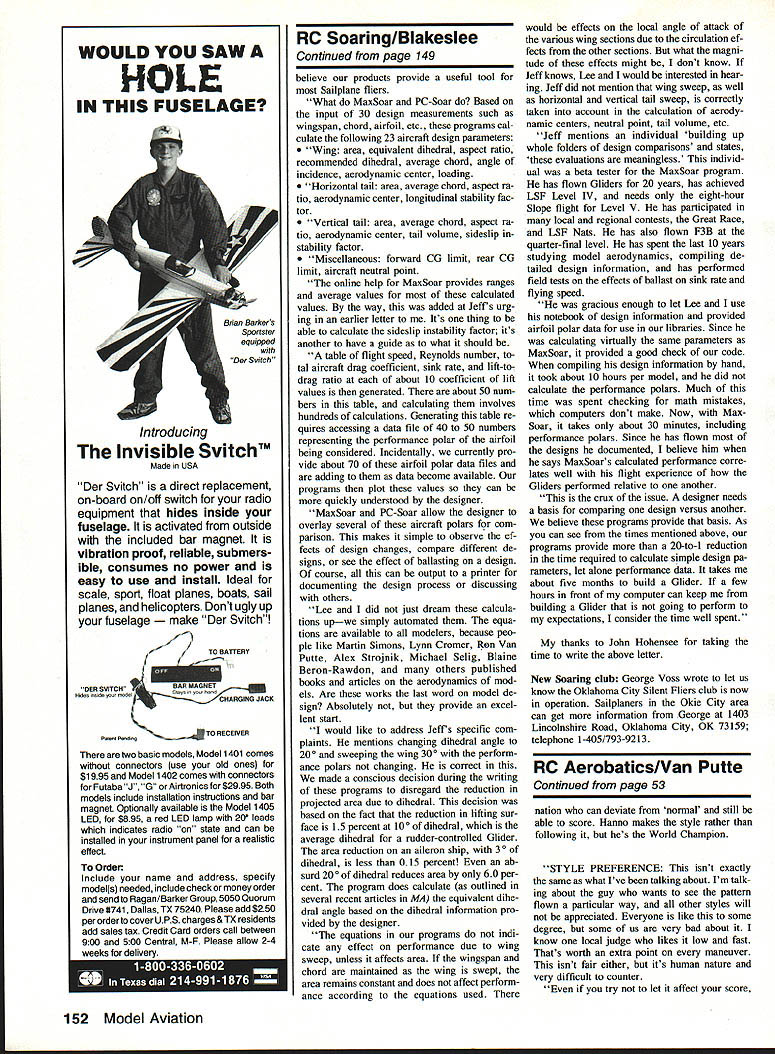
In my May column I asked readers to assist Jed Mottola (Fairlawn, NJ) in getting his Saito .90 twin repaired. After contacting several sources with no luck, Jed wrote to me for help. When my column reached the Model Aviation editorial office, an editor remembered that another staffer had just had a Saito repaired at A&M Aircraft Supply. A&M contacted Jed directly and offered repair help.
The result: Jed wrote and sent pictures — his Saito has been repaired. He reports receiving many helpful responses about repair sources. Thanks to everyone who responded; it's the helpful things we do for each other that make RC modeling rewarding.
A&M Aircraft Supply (repair source):
- A&M Aircraft Supply, 18015 Crest, Carrollton, TX 75006
Jed’s current equipment:
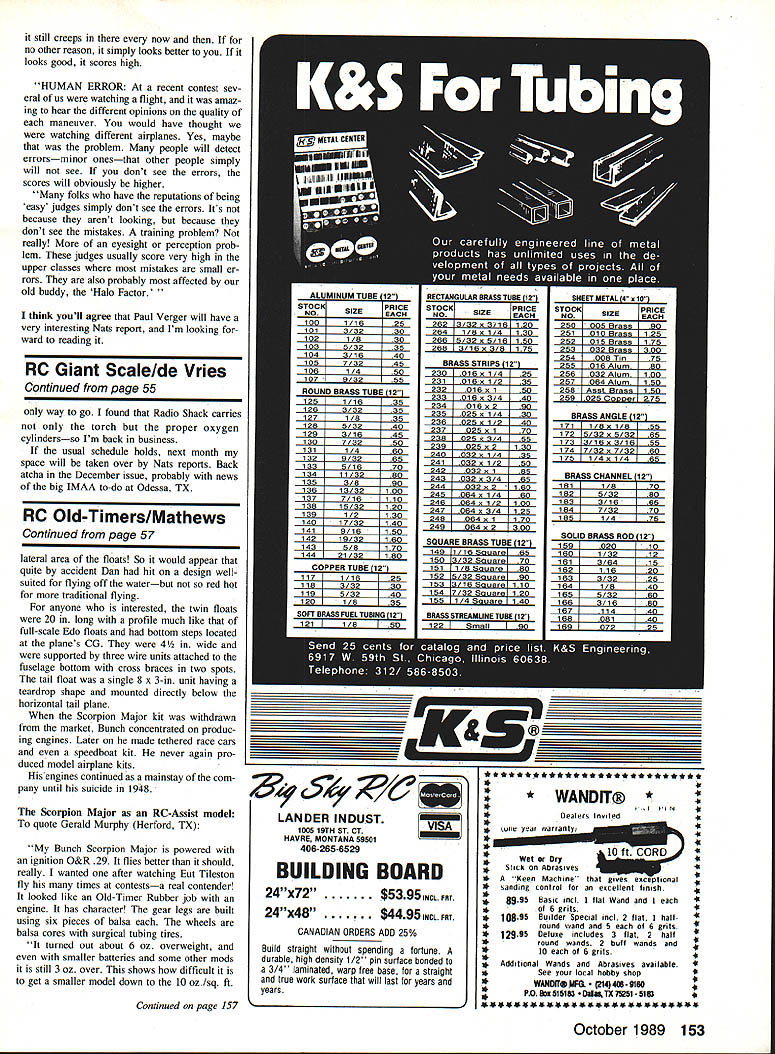
- His repaired Saito .90 now powers a 7-ft. span Sky Spy II (used for banner towing and aerial movies; dummy pilot made from back-to-back Polaroids).
- Jed also has an original-design ducted-fan model by R. Rossi (.81) in a homemade tube fuselage about 6 ft. long.
Letter from Michael Heuer — IAC rules procedure
I received a letter from Michael Heuer, president of the International Aerobatic Club (IAC). He appreciated the June column’s discussion of rules proposals and explained IAC’s current procedure for handling proposals, which balances membership input with the ability to make timely changes. He noted that IAC also tries to remain compatible with rules made at the FAI/CIVA level, especially regarding judging criteria.
IAC rules calendar (summary):
- July 1 — Deadline each year for submission of proposals for Known Compulsory sequences. The Rules Committee meets in August to consider proposals; the recommended Known sequences for each category (Sportsman through Advanced) are published in the September or October issue of Sport Aerobatics.
- October 15 — Deadline each year for actual proposals to change rules. These are considered over the winter (usually January or February), and the Rules Committee makes recommendations to the Board at the March spring meeting.
- March — Board adopts, rejects, or modifies recommendations (changes agreed to “in principle”).
- April — Final proposals are summarized in the April issue of Sport Aerobatics. Members may comment on proposals in detail.
Heuer emphasized they want to retain the ability to make quick changes when obviously warranted while fostering membership input.
Eclipse fuselage and wing build
Since the column appeared I purchased an Eclipse fuselage — a beautiful kit. I constructed a built-up wing using computer-aided graphics to compute rib shapes and a laser printer to obtain rib templates. The built-up wing proved lighter than the foam-wing version; Henry Piorun’s waffle-pattern core-lightening holes helped.
Manufacturer / kit availability:
- High Performance Models, 9556-116 St. North, Delta, BC V4C 6Z4, Canada
- HP Models, 494 Tyee Dr., Pt. Roberts, WA 98281
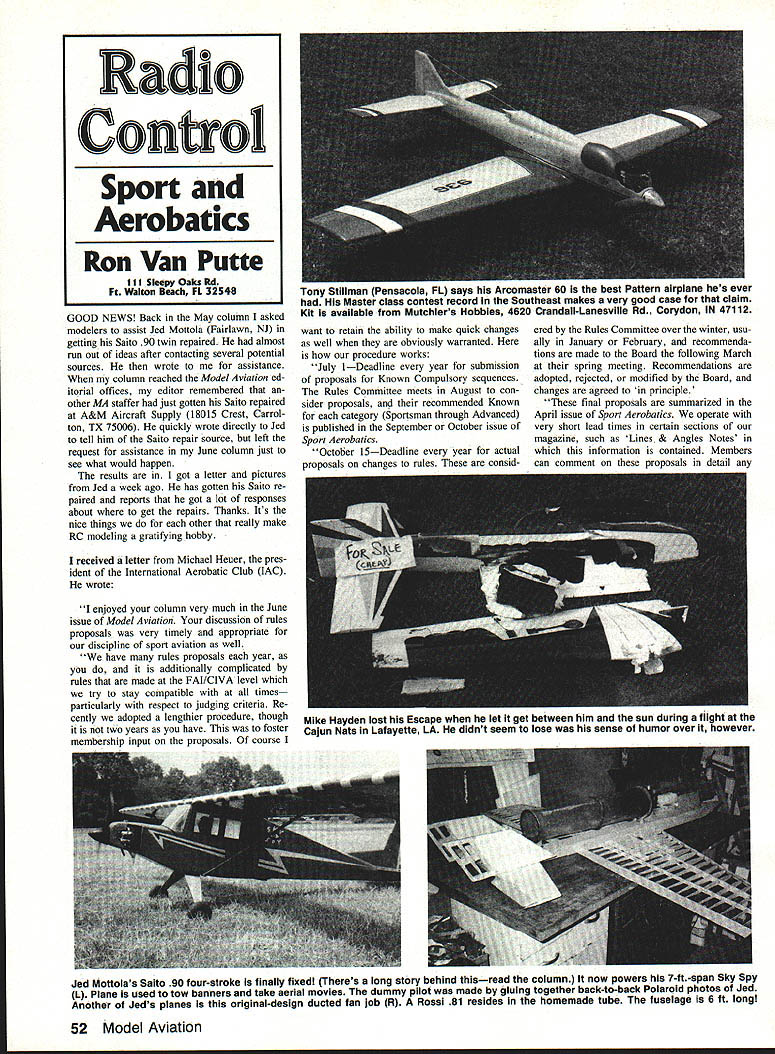
- Kit availability: Mutchler's Hobbies, 4620 Crandall-Lanesville Rd., Corydon, IN 47112
Nats coverage — Paul Verger
Last month I said I would miss this year’s Nats. Model Aviation asked me to recommend a substitute reporter. At the Masters Tournament I spoke with Paul Verger (Lafayette, LA). I had read Paul’s writing in the K‑Factor (NSRCA newsletter) and felt he could handle the assignment, so I recommended him to Publisher/Editor Carl Wheeley. Paul volunteered to cover the Nats.
Paul writes with a small‑town Louisiana comic persona but shows an intelligent, perceptive mind behind it. To illustrate, here are excerpts from Paul’s K‑Factor column on factors that affect judging:
- BIAS (the “Halo Factor”): Paul notes the halo effect exists but isn’t as large as some think. Top fliers fly smart as well as well, making their errors hard to detect. Being a “Big Dog” gets a judge’s attention so they watch carefully; mistakes will be noted by good judges.
- STYLE PREFERENCE: Judges (and fans) often prefer a particular way of flying the pattern. Some judges favor low-and-fast flights or other stylistic choices. Even judges who try to be objective can be influenced by style, and it often creeps into scoring.
- HUMAN ERROR: Observers can disagree widely about the quality of maneuvers; different people detect different errors. Some judges simply don’t see certain mistakes — not from lack of effort but from perception or eyesight differences. Judges who don’t see small errors tend to score higher in upper classes and may be more affected by the halo factor.
I think Paul will provide an interesting Nats report, and I’m looking forward to reading it.
Other notes
- Tony Stillman (Pensacola, FL) reports the Arcomaster 60 is the best pattern airplane he’s ever flown; his Master-class contest record in the Southeast supports that claim. Kit available from Mutchler’s Hobbies (address above).
- Final rules changes adopted by the IAC Board after the winter meetings were put into effect for the contest year. So far they’ve worked well and have received positive reviews from the membership.
- A reminder: membership input on rules proposals is appreciated and helps keep the sport healthy.
Time up.
Transcribed from original scans by AI. Minor OCR errors may remain.

