
Radio Control: Sport and Aerobatics
Ron Van Putte 111 Sleepy Oaks Rd. Ft. Walton Beach, FL 32548
POTPOURRI is the best word to describe this month's column. It's a catch‑up-with-odds-and-ends column — no single big theme, just several items that came up at the same time.
NSRCA: Contact and membership
I've mentioned the National Society of Radio Controlled Aerobatics (NSRCA) and its newsletter, the K‑Factor, many times. Several readers have asked for contact information:
- Suzi Stream, secretary/treasurer
- c/o NSRCA, 3723 Snowden Ave., Long Beach, CA 90808
- Annual dues: $20 (includes the K‑Factor and input to AMA RC Pattern rules via NSRCA's status as an AMA special interest group)
K‑Factor alone is worth the price of membership. If you're a Pattern flier, you should join NSRCA.
NSRCA: history and role
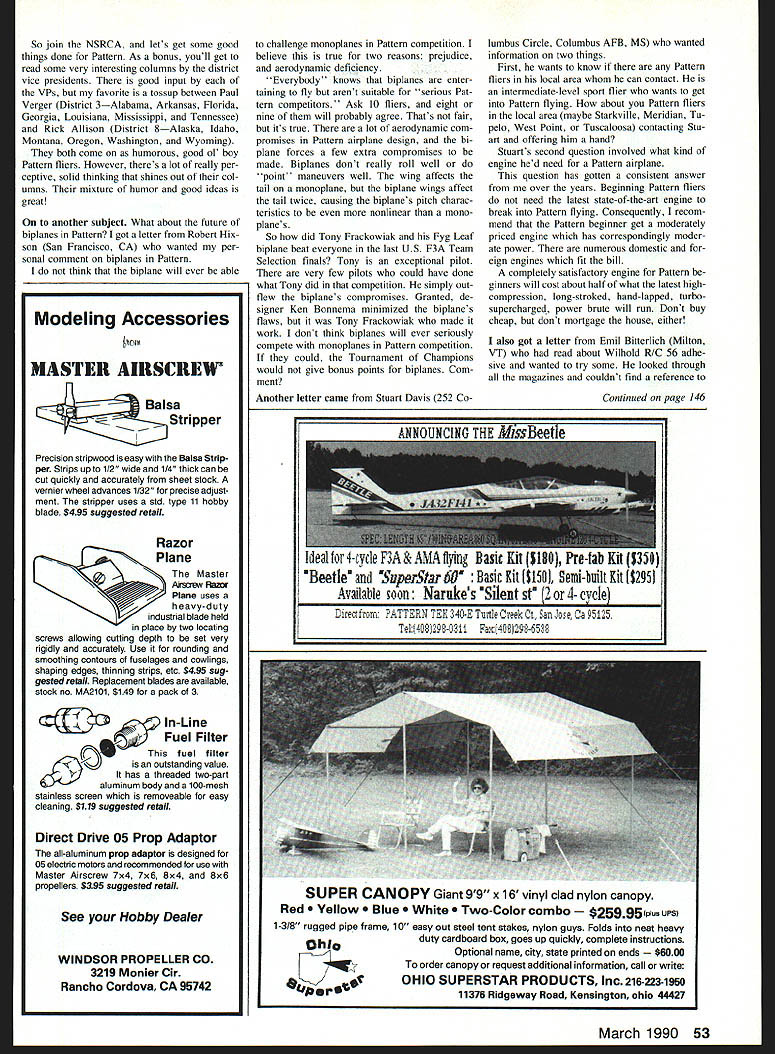
The NSRCA has an interesting history that many current members don't know. Contrary to some beliefs, it wasn't started by California Pattern fliers; it was started by Rhett Miller, Jr., of Tallahassee, FL. (Rhett Miller III — "Little Rhett" — is the one who won the highest level at the Nats in 1973–1976.) Most of the early members were from the Southeast.
The NSRCA was formed to influence Pattern flying in the United States, intended from the start to be an AMA special interest group like NMPRA (Pylon Racing) or NSS (Soaring). It stayed small for several years, but as membership grew AMA began to recognize NSRCA input on major competitions such as the Nats and FAI Team Selection finals.
Survey, rules changes, and leadership
Initiated by Bryan Henderson (Bedford, TX), NSRCA conducted a survey of members' views on rules changes. An astounding 88% responded (pollsters consider 10%–15% excellent). Results were used to draft proposed rules changes at a meeting in Chesapeake, VA, during the 1988 Nats. These recommendations were submitted to the RC Aerobatics Contest Board; all but one passed. The noise proposal had majority support but failed by one vote. I discussed that noise proposal in the January 1990 issue and won't repeat it here.
Bryan Henderson became NSRCA president about a year ago and set a tone of constructive action — his message: if you're unwilling to help improve Pattern competition, don't just gripe. The organization has matured and most members are pulling together to improve Pattern in the U.S.
NSRCA publications and district VPs
As a member you'll read interesting columns by the district vice presidents. My personal favorites are:
- Paul Verger — District 3 (Alabama, Arkansas, Florida, Georgia, Louisiana, Mississippi, Tennessee)
- Rick Allison — District 8 (Alaska, Idaho, Montana, Oregon, Washington, Wyoming)
Both mix humor with perceptive, solid thinking.
Biplanes in Pattern
I received a letter from Robert Hixson (San Francisco, CA) asking my view on the future of biplanes in Pattern.
I do not think biplanes will ever be able to challenge monoplanes in Pattern competition, for two reasons: prejudice and aerodynamic deficiency.
- Prejudice: Most fliers consider biplanes entertaining but not suitable for "serious Pattern." Ask ten fliers and eight or nine will likely agree.
- Aerodynamic compromises: Pattern airplane design already involves tradeoffs; a biplane adds more. Biplanes generally don't roll as well or perform "point" maneuvers as cleanly as monoplanes. The additional wing affects tail airflow and pitch characteristics, making them more nonlinear than a monoplane.
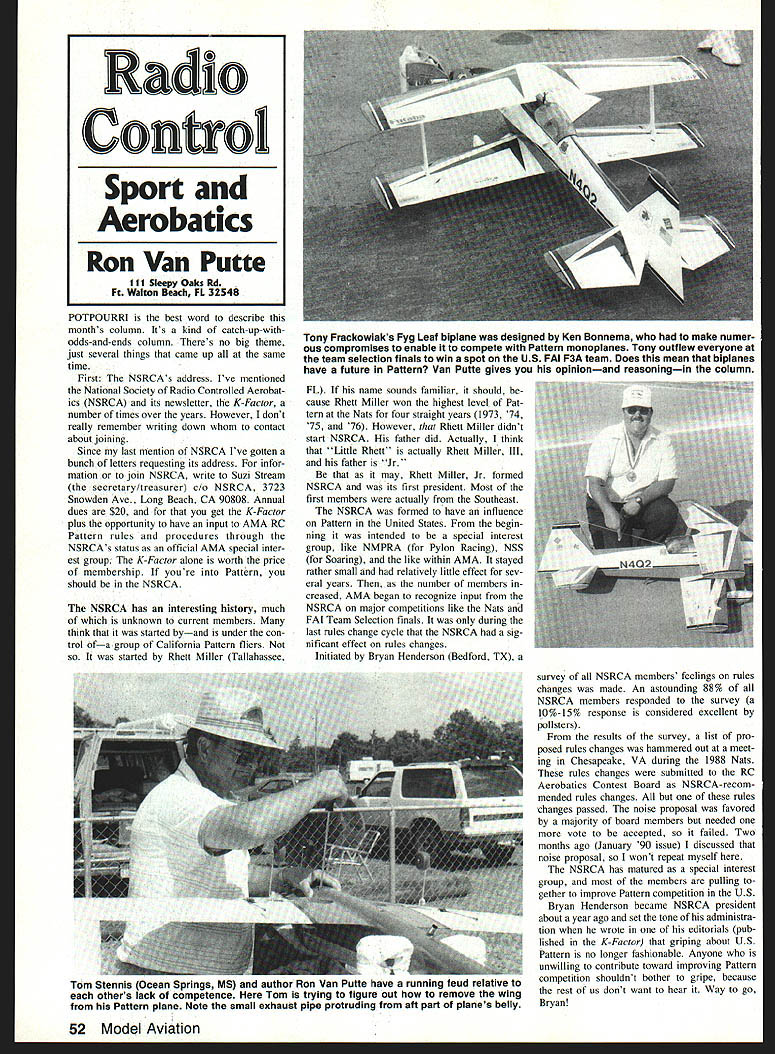
That said, Tony Frackowiak and his Flyleaf biplane (designed by Ken Bonnema) outflew the competition at the U.S. F3A Team Selection finals. Tony is an exceptional pilot and was able to overcome the biplane's compromises. That few pilots could have done what he did. If biplanes were truly competitive against monoplanes, the Tournament of Champions wouldn't give bonus points for biplanes.
Comments are welcome.
Local help and engine advice
Stuart Davis (252 Columbus Circle, Columbus AFB, MS) wrote asking two things:
- Are there any Pattern fliers in his area who can contact him? He's an intermediate sport flier wanting to get into Pattern. Pattern fliers in the Starkville, Meridian, Tupelo, West Point, or Tuscaloosa areas, please contact Stuart and offer a hand.
- What engine is needed for a Pattern airplane? My consistent recommendation: beginners do not need the latest state‑of‑the‑art engine. Choose a moderately priced engine with moderate power. A satisfactory beginner Pattern engine will cost about half what a top‑end, high‑compression, long‑stroke racing engine costs. Don't buy the cheapest junk, but don't mortgage the house either.
Other letters
Emil Bitterlich (Milton, VT) wrote after reading about Wyldhof R/C 56 adhesive and wanting to try some. He searched the magazines and couldn't find a reference to it.
If anyone has information about Wyldhof R/C 56 adhesive (sources, reviews, or experience), please pass it along so Emil and other readers can learn more.
---
Transcribed from original scans by AI. Minor OCR errors may remain.

