
Radio Control: Sport and Aerobatics
Ron Van Putte
Ever since the Nats article was published in the November 1985 issue, hardly a flying session at my club field or a contest goes by without someone asking why I chose not to identify the brand of radio that was involved in my radio-interference-caused crash at the 1985 Nats. The truth is, I did identify the brand of radio in the manuscript which was sent to Model Aviation. The associate editor chose to alter my words in order to avoid any potential legal problem with the radio manufacturer.
The same brand and model of radio were involved in all the Channel 40 FM crashes, and I thought that was more than coincidence. It was not as though I hadn't heard about difficulties flying that brand on FM, either. At virtually every contest I attended for almost two years, local fliers told me that they hadn't been able to fly on FM with that brand of radio. However, I didn't have so much as a glitch on that system, even in New Orleans, LA — a real radio-tester of an area if there ever was one. New Orleans rivals my old flying field near West Carrollton, OH that we used to call "Glitchville Acres."
Since I never had problems, I thought my system was immune to interference. In fact, when George Myers tested my transmitter at the Nats processing station, he told me that it was a really good one. Well, perhaps the receiver was the weak link. However, what was probably the deciding factor was that I'd never flown any airplane in a situation where it was near another transmitter while my transmitter was more than 1,000 feet away — until I got to the 1985 Nats. I'm convinced that one or more AM transmitters got to my FM receiver when the airplane was in a turnaround near the adjacent flying site.
Editor's note
(Van Putte had not had a chance to read George Myers' "Radio Technique" column in the January 1986 issue when he wrote this column. RMC/m.)
Since I don't like to crash expensive airplanes, I have done two things:
- I removed the Channel 40 FM module from the transmitter and converted it to an AM module using assorted bits of electronic parts, then installed the AM module to use on Quickie 500 racer and Fun Fly airplanes.
- I bought a Futaba PCM system like the big boys fly and installed it.
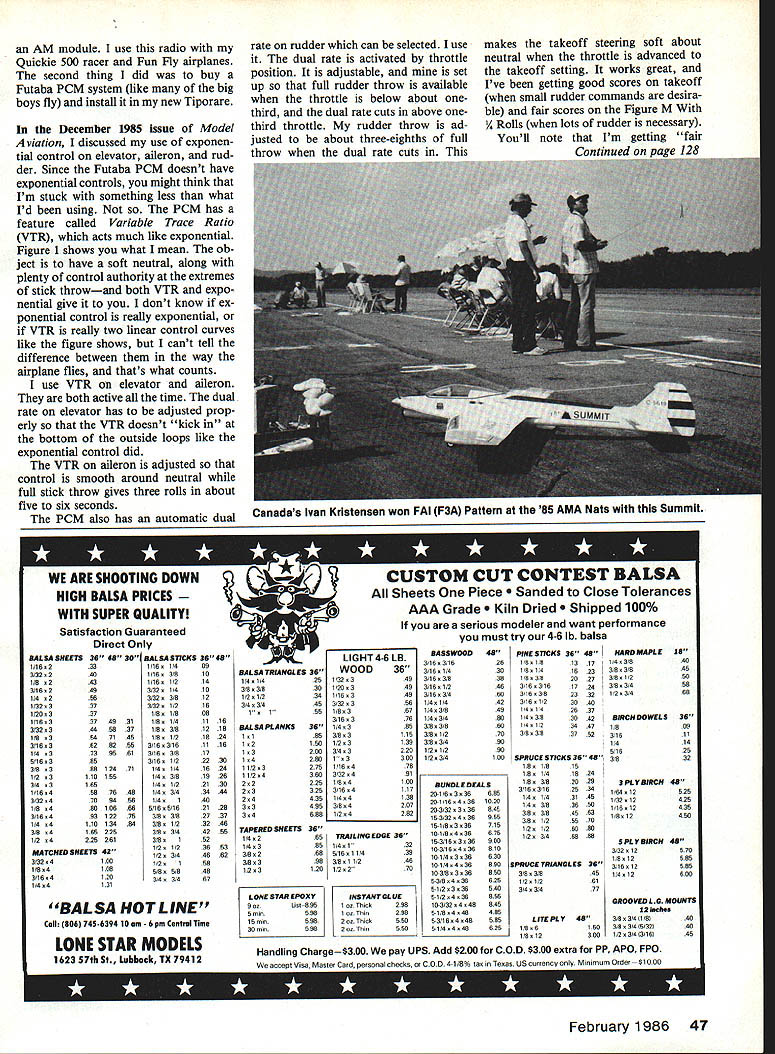
All older R/C systems — and most of today's lowest-price sets — have linear control response to transmitter stick movement. Some sets have had exponential (EXPO) control response available for the past several years. However, the Futaba PCM system features Variable Trace Ratio (VTR) response as a user option — it's much like EXPO.
Figure 1 shows what I mean. You get a soft neutral along with plenty of control authority at the extremes of stick throw. Both VTR and exponential give — I don't know — exponential control, really. VTR actually is two linear control curves, as the figure shows. You can't tell the difference between the way the airplane flies — that's what counts.
I use VTR on the elevator and aileron most of the time. With dual-rate elevator properly adjusted, VTR doesn't kick the bottom outside of loops like exponential control did. VTR aileron adjustment gives smooth control around neutral; full stick throw produces about three rolls in five to six seconds. PCM also has automatic dual-rate rudder which can be selected for use. Dual rate is activated by throttle position; adjustable set-up makes full rudder throw available with throttle below about one-third. Dual rate cuts rudder throw above one-third.
Rudder throw adjusted to about three-eighths full throw with the dual-rate cut makes takeoff steering soft around neutral. The throttle-advanced takeoff setting works great. I've been getting good scores on takeoffs with small rudder commands and fair scores on the Figure M with 3 Rolls (when lots of rudder is necessary). You'll note that I'm getting "fair" scores on the Figure M with 1/4 Rolls. It seems that the wind direction is never right, and I end up doing the maneuver in a crosswind. It's tough enough when the wind direction is down the runway, and nearly impossible to do well in a crosswind unless you're right on top of the elevator control. Who is, except for a few superior pilots? And the rest of us all hate them.
A little advice to potential purchasers of the Futaba PCM: read and reread the instruction book! I guarantee that you won't understand everything after the first reading. I kept discovering new things every time I went through it, because I'd missed items. Like most RC fliers, I have no need for many of the features that the transmitter offers, but I do use all that are appropriate.
An unexpected bonus was the ability to do programmable mixing. The plane I'm currently flying has the quirk of yawing to the right when hard elevator controls are used, such as in the Figure M with 4 Rolls, Square Loop, and Top Hat. So I mixed Up elevator into Left rudder and the yaw disappeared. The mix is currently activated just before performing those maneuvers, but I might try leaving it in because I only need a little and only on hard Up elevator. The way the programmable mixer works, Down elevator has no effect on the rudder. Nice feature.
In the December 1985 column, I mentioned the use of Sears' Filled Epoxy Cement (Catalog Number 980605) in the repair of fiberglass fuselages. Actually, I use it for a lot of other purposes, but that was the subject at the time it was mentioned. Several people have told me that they went to their local Sears store and tried to buy some, but were given the "idiot treatment." You know how it goes: "Never heard of it; that isn't even listed in the catalog." Well, it is true that I can buy it in Florida, and I bought it in Ohio 15 years ago. I can't explain why it doesn't seem to be available in some parts (maybe even most parts) of the country. Several years ago, I mentioned it and the same thing happened. I even bought some for Bud Wolfe out in Scottsdale, AZ and mailed it to him, but I don't want to do that as a habit. My suggestion is that if you go to the Sears store armed with the exact name and catalog number and raise a little Cain until they agree to get you some. In the meantime, I'll find out what Sears distribution center ships it to my Sears store and let you know.
Are you one of those fliers who finishes the last flight of the day, wipes off the airplane, disassembles it, packs it in the car and heads for home? I used to be like that, too, but not for the last several years. What's wrong with that procedure? Well, it depends on several factors, like where and how you keep your airplane between flying sessions, how long it is between flying sessions, and whether you lube your bearings for the engine.
If you don't empty the fuel tank completely and store the airplane nose-down, you could have fuel siphon from the tank to the engine. Raw fuel does nasty things to carpets, asphalt tiles, and many other floor coverings. In addition, if raw fuel is in contact with the bearings, the alcohol (which is hydrophilic) can "draw" water, which will rust the bearings. If you fly often, rusting probably won't be a problem, but if it is two weeks or more between your flying sessions, you're asking for bearing problems.
Even if you do empty the fuel tank after a flying session, it's a good idea to get rid of the fuel that's still in the engine. Many fliers use a straight after-run oil; I prefer to use a water-displacement lubricant from an aerosol can. The procedure I use was learned (stolen) from Steve Rojecki and only takes about a minute. After the tank is empty, turn on the radio and open the throttle. Load up the crankcase with lubricant, attach the starting battery to the engine and start the engine with an electric starter. It is possible to hand-start the engine, but it takes a while. The engine will run for a short blast using the propellant in the aerosol. Repeat the procedure several times; I usually do it four times. When you're done, there will be oil in the bearings (where the alcohol was), and the alcohol will be flushed out of the engine. No more rusted bearings.
It's especially important to properly treat your engine for storage for very long periods of time, like over the winter. It's October as this is being written, but it's about New Year's as you're reading it. So, if you haven't already winterized your engine, you should think seriously about whether you'd rather do it now or buy new bearings next spring.
Ron Van Putte 111 Sleepy Oaks Rd. Ft. Walton Beach, FL 32548
Transcribed from original scans by AI. Minor OCR errors may remain.

