
Radio Control: Sport and Aerobatics
Ron Van Putte 111 Sleepy Oaks Rd. Ft. Walton Beach, FL 32548
What's the fuss about noise?
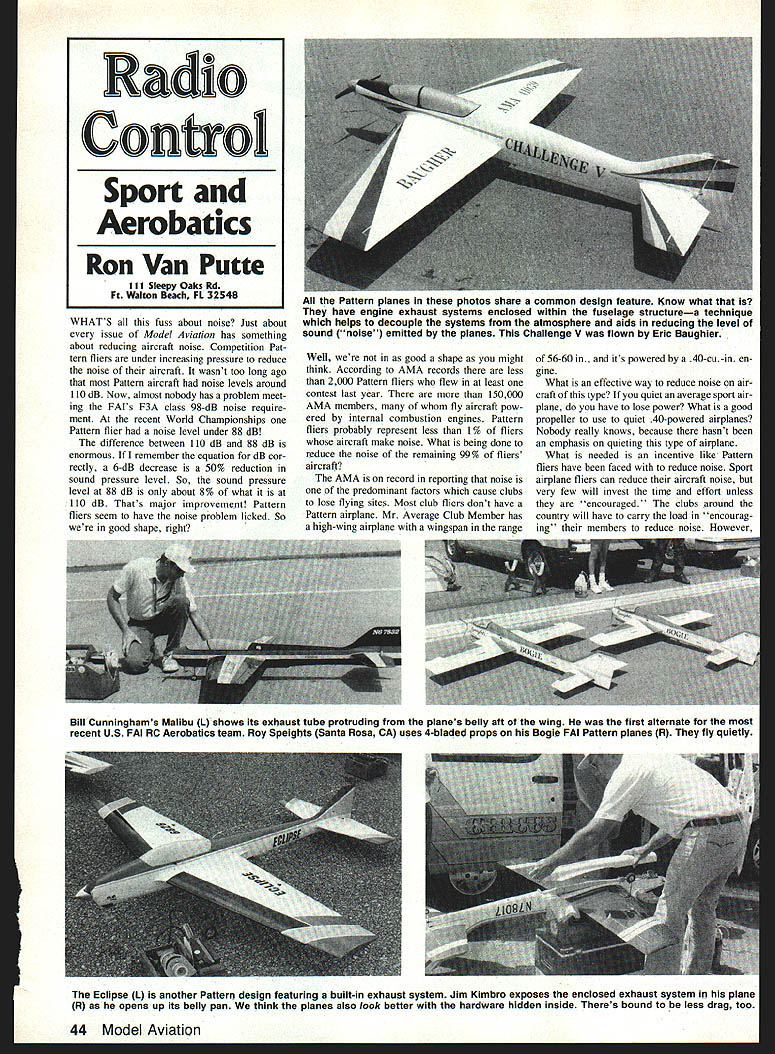
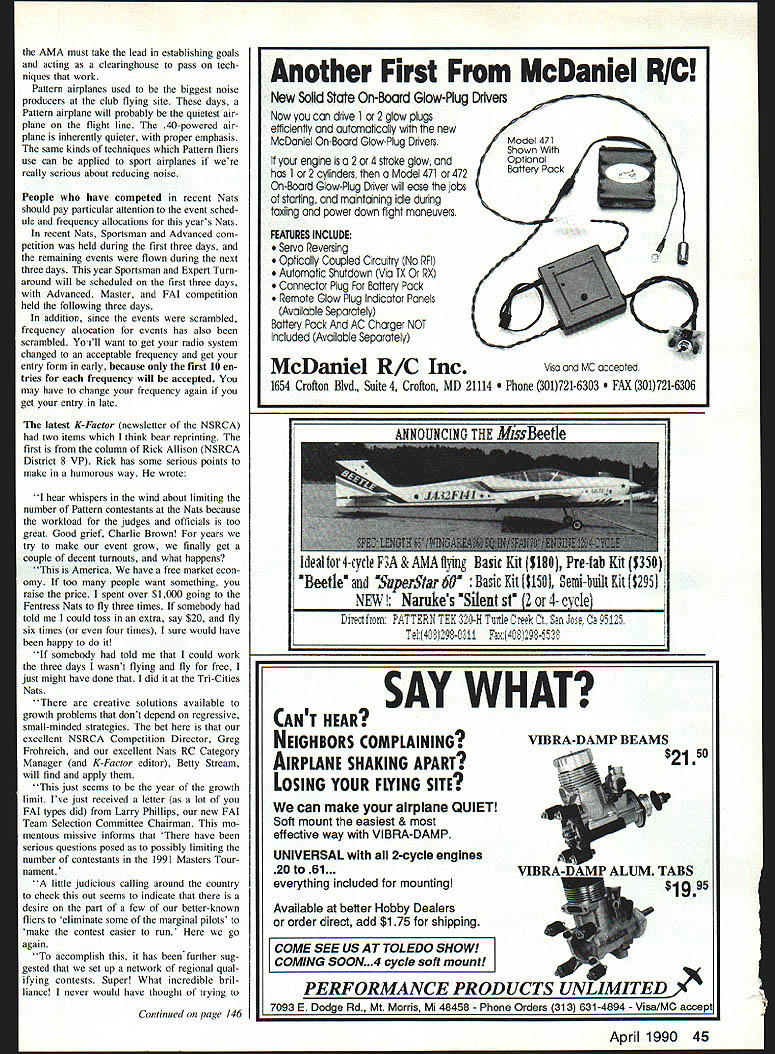
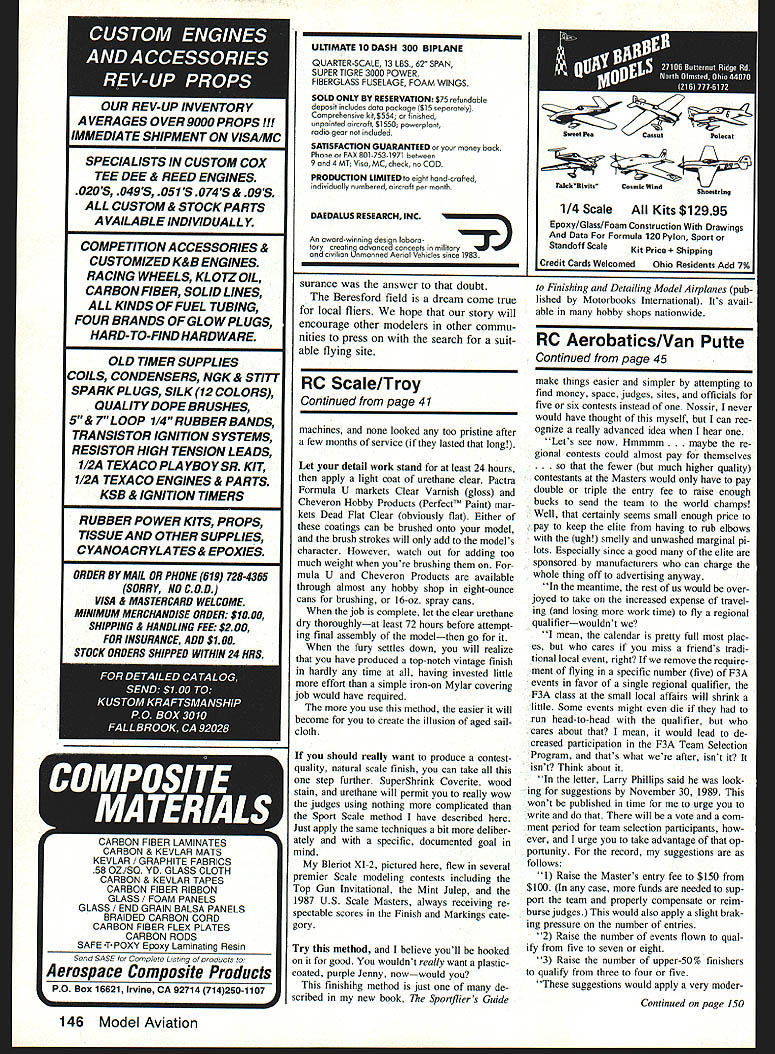
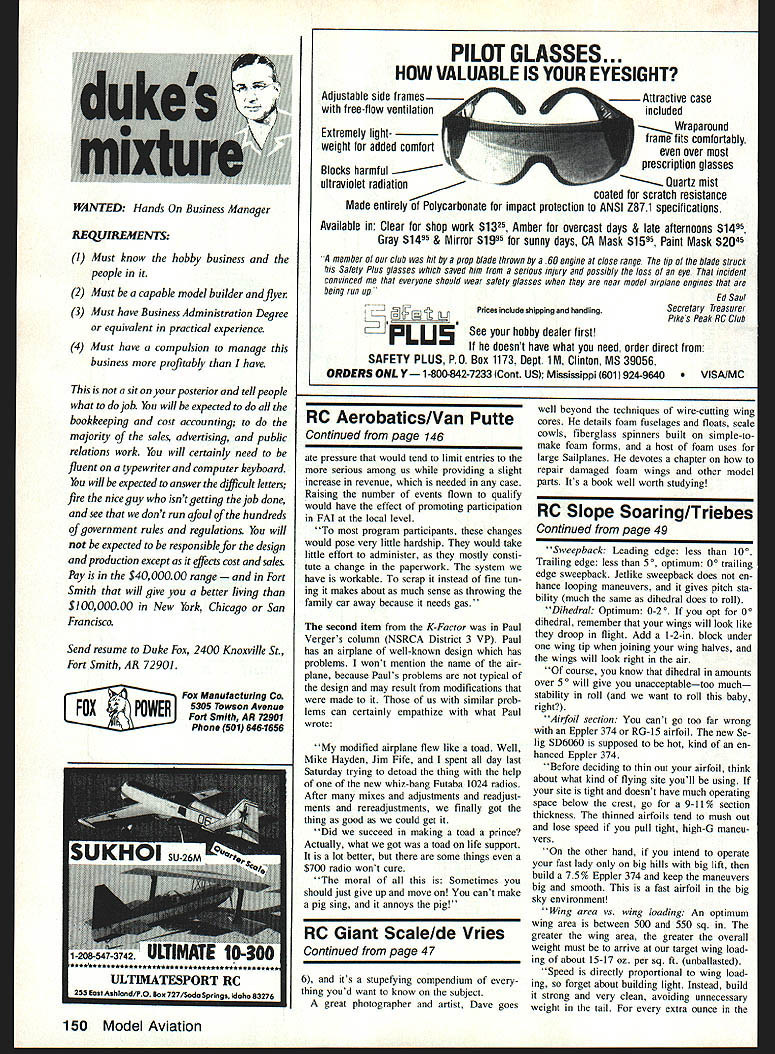
Just about every issue of Model Aviation has something about reducing aircraft noise. Competition Pattern fliers are under increasing pressure to reduce noise. Not long ago most Pattern aircraft measured around 110 dB. Now almost nobody has a problem meeting the FAI F3A class 98-dB requirement. At a recent World Championships one Pattern flier measured under 88 dB.
The difference between 110 dB and 88 dB is enormous. A 6-dB decrease is roughly a 50% reduction in sound pressure level, and a 22-dB decrease (110 to 88 dB) corresponds to a sound pressure level of about 8% of the original. That’s a major improvement. Pattern fliers seem to have the noise problem licked. So are we in good shape? Not entirely.
Who is affected?
According to AMA records, fewer than 2,000 Pattern fliers flew at least one contest last year. There are more than 150,000 AMA members, many flying internal-combustion-powered aircraft. Pattern fliers probably represent less than 1% of fliers whose aircraft make noise. What is being done to reduce noise from the other 99%?
The AMA reports noise as one of the predominant factors causing clubs to lose flying sites. Most club fliers fly sport airplanes (for example, a typical high-wing sport airplane with a 56–60 in. wingspan powered by a .40-cu.-in. engine). There has been little emphasis on quieting that type of airplane: what propeller to use, whether power must be sacrificed, or what exhaust/tuning techniques help most.
What can be done?
Pattern airplanes used to be the biggest noise producers at club flying sites. Today a properly set-up Pattern airplane will often be the quietest on the flight line. Several of the techniques Pattern fliers use can be applied to sport airplanes:
- Enclose or route exhaust systems within the fuselage to decouple and attenuate exhaust noise.
- Use proper muffling and exhaust exits positioned away from the airframe skin and control surfaces.
- Choose propellers and engine tuning that reduce peak noise without unnecessarily sacrificing performance.
A .40-powered airplane is inherently quieter than larger engines; with emphasis and simple adaptations, sport airplanes can be quieter without drastic loss of performance.
Role of the AMA and clubs
The AMA must take the lead in establishing goals and acting as a clearinghouse to pass on techniques that work. Sport airplane fliers can reduce aircraft noise but few will invest the time and effort unless encouraged. Local clubs will need to carry much of the load in encouraging members to adopt quieter practices.
Nats schedule and frequency allocations
People who have competed in recent Nats should pay particular attention to the event schedule and frequency allocations.
- In past years the Nats Sportsman and Advanced competition were held during the first three days and remaining events during the next three days.
- This year Sportsman, Expert, and Turnaround are scheduled the first three days; Advanced, Master, and FAI competition will be held the following three days.
- Because events were reorganized, frequency allocations were also changed. You should get your radio system changed to an acceptable frequency and submit your entry early: only the first 10 entries on a given frequency will be accepted. If you enter late you may have to change frequency again.
NSRCA K-Factor excerpts
The latest K-Factor (NSRCA newsletter) contains two items worth reprinting. Below are edited and corrected versions of the columns by Rick Allison (District 8 VP) and Paul Verger (District 3 VP).
Rick Allison (NSRCA District 8 VP)
Rick makes serious points in a humorous way:
"I hear whispers in the wind about limiting the number of Pattern contestants at the Nats because the workload for judges and officials is too great. Good grief, Charlie Brown — for years we try to make the event grow, finally get a couple decent turnouts, what happens?
"This is America. We have a free market economy. If people want something — raise the price. I spent over $1,000 going to the Fentress Nats to fly three times; somebody told me I could toss in an extra, say $20, and fly six times. If somebody had told me I could work the three days I wasn't flying and fly for free, I just might have done that. I did it at the Tri-Cities Nats.
"There are creative solutions available to growth problems that don't depend on regressive, small-minded strategies. Our excellent NSRCA Competition Director, Greg Froehlich, and our excellent Nats RC Category Manager (and K-Factor editor), Betty Sream, will find and apply them.
"This just seems to be the year of the growth limit. I've just received a letter (as a lot of you FAI types did) from Larry Phillipe, our new FAI Team Selection Committee Chairman. This letter has some serious questions posed as to possibly limiting the number of contestants in the 1991 Masters Tournament.
"A little judicious calling around the country to check this out seems to indicate that there is a desire on the part of a few of our better-known fliers to 'eliminate some of the marginal pilots' to 'make the contest easier to run.' Here we go again.
"To accomplish this, it has been further suggested that we set up a network of regional qualifying contests. Super! What incredible brilliance! I never would have thought of trying to make things easier and simpler by attempting to find money, space, judges, sites, and officials for four or six contests instead of one. No sir, I never would have thought of this myself, but I can recognize a really advanced idea when I hear one.
"Let's see now. Hmmmm . . . maybe the regional contests could almost pay for themselves — so that the fewer (but much higher quality) contestants at the Masters would only have to pay $100, and the entry fee would raise enough bucks to send the team to the world champs! Well, that certainly seems a small enough price to pay to keep the elite from having to rub elbows with the (ugh) smelly and unwashed marginal pilots. Especially since a good many of the elite are sponsored by manufacturers who can charge the whole thing off to advertising anyway.
"In the meantime, the rest of us would be overjoyed to take on the increased expense of traveling (and losing more work time) to fly a regional qualifier—wouldn't we?
"I mean, the calendar is pretty full most places, but who cares if you miss a friend's traditional local event, right? If we remove the requirement of flying in a specific number (five) of F3A events in favor of a single regional qualifier, the F3A class at the small local affairs will shrink a little. Some events might even die if they had to run head-to-head with the qualifier, but who cares about that? I mean, it would lead to decreased participation in the F3A Team Selection Program, and that's what we're after, isn't it? Think about it."
Rick also urged feedback on team selection proposals and offered his own suggestions (below).
Suggested measures to apply slight bracketing pressure while increasing revenue and local participation:
- Raise the Master's entry fee to $150 from $100 (to help fund the team and reimburse judges).
- Raise the number of events flown to qualify to five to seven, not eight.
- Raise the number of upper-50% finishers to qualify from three to four or five.
These changes would be modest, administratively simple, encourage local-level participation, and tend to limit entries to the more serious contestants without scrapping the existing system.
Paul Verger (NSRCA District 3 VP)
Paul wrote about troubleshooting a modified airplane that performed poorly:
"My modified airplane flew like a toad. Well, Mike Hayden, Jim Fite, and I spent all day last Saturday trying to detoad the thing with the help of one of the new whistles — Futaba 1024 radios. After many mixes and adjustments and readjustments we finally got the thing to perform reasonably well.
"Actually, what we got was a toad on life support. It is a lot better, but there are some things even a $700 radio won't cure.
"The moral of all this is: Sometimes you should just give up and move on! You can't make a pig sing, and it annoys the pig!"
Closing
The bottom line: Pattern fliers have demonstrated effective noise-reduction techniques (enclosed exhausts, careful prop and engine selection, tuning) that can be applied to sport airplanes. The AMA and local clubs should promote those techniques and set achievable goals. Competitors should watch Nats scheduling and frequency allocations closely and enter early. The NSRCA and its members continue to debate sensible ways to manage growth and maintain healthy competition without excluding dedicated participants.
Transcribed from original scans by AI. Minor OCR errors may remain.

