
Radio Control: Sport and Aerobatics
Ron Van Putte
111 Sleepy Oaks Rd. Ft. Walton Beach, FL 32548
One of these days I may learn to stay away from controversial topics. Probably not, though. It's fun to wait for the response to a column about certain topics. The downwind turn is a good example. Radio Control Modeler's Ken Willard and I have milked the downwind turn for many an article, and I doubt that any proponents from either side have changed sides.
My latest venture into controversy was published in the March issue of Model Aviation. I commented that I didn't think biplanes would ever be truly competitive in Pattern. I still don't think so. Nevertheless, not everyone agrees with me.
Letter: John Dedden (Missouri City, TX)
"Balderdash, me boy, balderdash! I certainly cannot agree with your statement. I do not think that the biplane will ever be able to challenge the monoplane in Pattern competition — and the rest of it.
"Certainly there are compromises — in both mono- and biplanes, and perhaps they are a bit more difficult to solve in bipes. Note that I say, 'perhaps.' I've seen many, many monoplanes of all sorts of shapes and sizes since the Fifties. Some did aerobatics quite well, some average, some poorly. But I've often found (as you also noted) that the pilot's proficiency can make a huge difference.
"I've flown Pattern types (monos) which could be made, for example, to do a one-, two-, or three-turn roll that looked like the model was on a wire. Some did it rather easily (especially those with rather high roll rates), while some required the pilot to use arms, legs, eyes, eyeballs, and assorted other parts for the model to approximate a reasonable axial roll. Again, though, a good roll is:
- in the eyes of the beholder;
- due to the proficiency of the pilot; and
- a product of the plane's dynamics and power.
"The same applies to any maneuver.
"Gee, Ron, if bipes are so bad, how come:
- the wee li'l Pitts always clean up at the international aerobatic competitions (vs. monos);
- the guys that flew in the TOC in Vegas seemed to primarily opt for bipes? (Hanno and Chip can't be all nuts — even with bonuses!); and
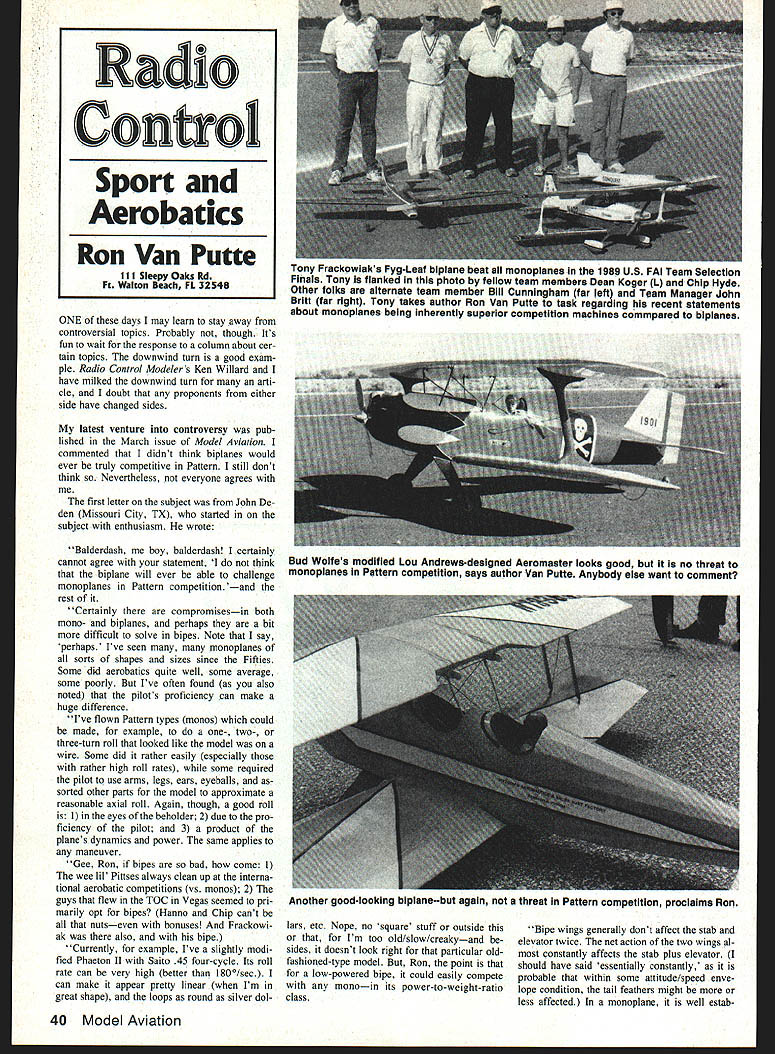
- Frackowiak was there also, and with his bipe."
"Currently, for example, I've slightly modified Phaeton II with Saito .45 four-cycle. Its roll rate can be very high (better than 180°/sec). I can make it appear pretty linear (when in great shape), and the loops are round as silver dollars. Nope — no 'square' stuff out or outside this or that, for I'm too old/slow/creaky — and besides, it doesn't look right for that particular old-fashioned-type model. But, Ron, the point is that for a low-powered bipe, it could easily compete with any mono in its power-to-weight-ratio class.
"Bipe wings generally don't affect the stab and elevator twice. The net action of the two wings almost constantly affects the stab plus elevator. (I should have said 'essentially constantly,' as it is probable that within some attitude/speed envelope condition the tail feathers might be more or less affected.) In a monoplane, it is well established — again depending on dynamics, design, and conditions — that the wing downwash may or may not affect the stabilizer. My 40 years of experience with real and model planes — both bipes and monos — doesn't quite match your statement.
"So, bonus or no bonus, I'll bet a 25¢ stamp to a cup of homemade coffee that as fliers and designers devote more thought, testing, and practice to the situation, you'll see more and more bipes as opposed to the current once-you've-seen-them-all-style monos in Pattern events."
Letter: Tony Frackowiak (Sierra Vista, AZ)
"I want to thank you for your kind comments on my piloting, but I think you are underestimating the abilities of Ken Bonnema's design. In the two areas in which you say that biplanes are weak, rolling and point maneuvers, the Fyg-Leaf and the Ultimate are extremely strong.
"I've never flown a plane that does better axial rolls than the Fyg-Leaf. In point rolls, the knife-edge capability of the Fyg-Leaf is better than any model I've flown. While it is true that there is a rolling input with application of rudder, the current radios allow this to be mixed out very easily. I've not felt this mixing in any other portion of the pattern. Point rolls and the reverse knife edge are ridiculously easy to perform compared to my monoplane.
"The other strong areas are spins and snap rolls. The Fyg-Leaf performs a true snap roll in the Avalanche that is very controllable, and the heading is easy to maintain. Spins are slower and also very controllable. This is due to the very low aspect ratio of a biplane and the low moments of inertia.
"What are the weaknesses of the Fyg-Leaf? It is more difficult to trim the aircraft for vertical climbing flight, but only on the pitch axis. This was primarily due to the lower power I had available in the Fyg-Leaf. I am now installing a .120 four-stroke in the model, and I expect verticals to improve dramatically. With the .61 installed, the lower power made high crosswinds more difficult to manage than with a fast monoplane. But if the judges are paying attention to the box in both distance and the ends, as they were at the team trials, the Fyg-Leaf has the advantage over the fast monoplanes.
"Basically I feel the Fyg-Leaf was an outstanding success. What other project can you think of that took such a completely different approach to FAI, and on the one and only attempt, with no modifications, won the U.S. team trials and was also a key member of the World Championships team? I could not have been happier or prouder of being a member of the team that accomplished that.
"My hat is off to Ken Bonnema and to Don Chapman for their engineering, design, and execution of the Fyg-Leaf complex. They cannot receive enough credit for having developed such an innovative aircraft.
"No, no member of the U.S. team won the individual World Champion title, but if you were there, you know that very few people have a chance at winning that contest. Also, maybe (I hope) we opened a few eyes to the fact that you do not have to keep flying the same 'cookie cutter' Pattern planes.
"Yes, the plane had to be piloted, and I was proud of how I flew it when I had to, but even the best pilot cannot win in team trials with an inadequate airplane."
Author's response
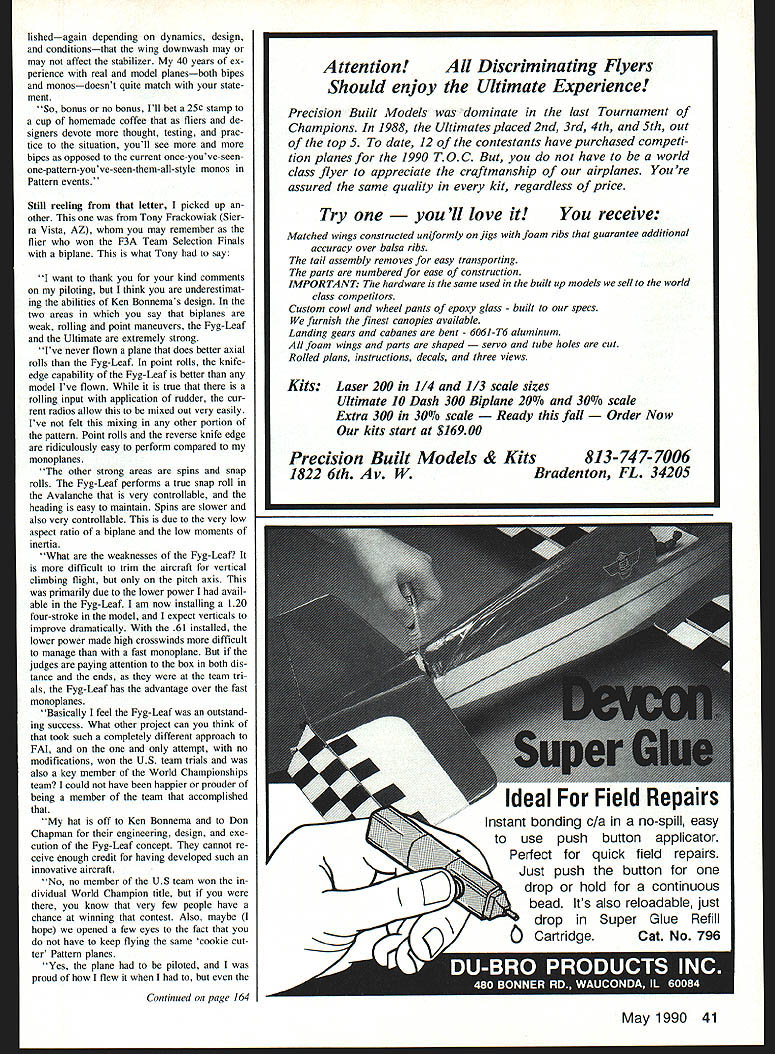
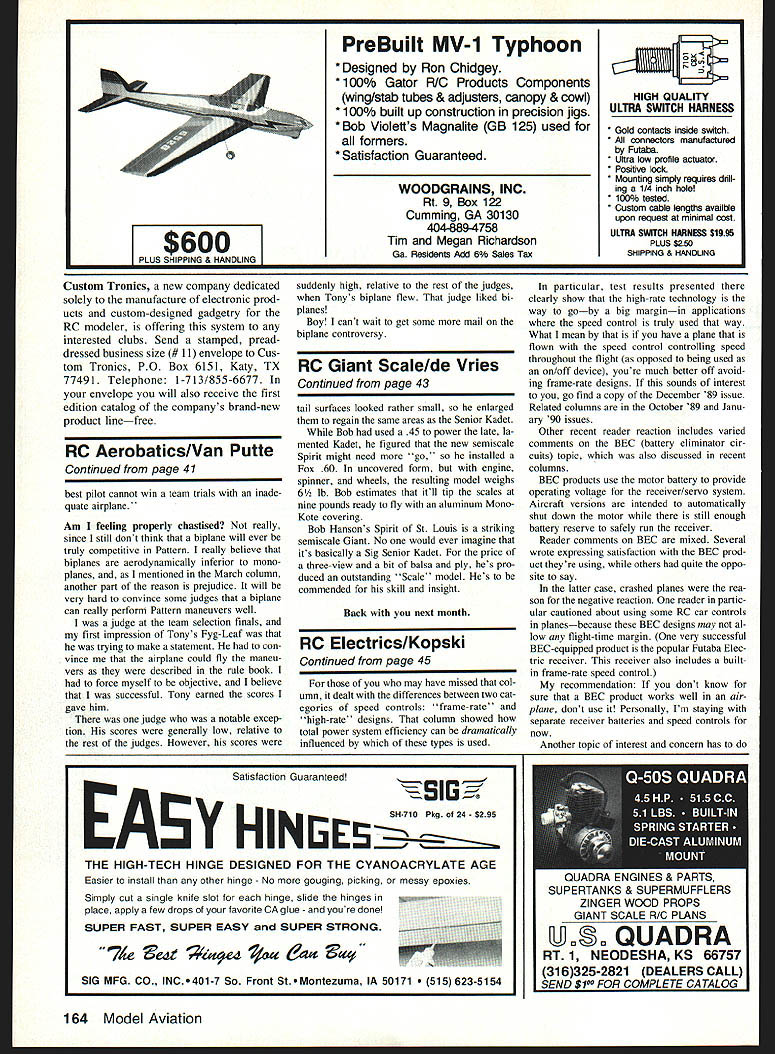
Am I feeling properly chastised? Not really, since I still don't think that a biplane will ever be truly competitive in Pattern. I really believe that biplanes are aerodynamically inferior to monoplanes, and, as I mentioned in the March column, another part of the reason is prejudice. It will be very hard to convince some judges that a biplane can really perform Pattern maneuvers well.
I was a judge at the team selection finals, and my first impression of Tony's Fyg-Leaf was that he was trying to make a statement. He had to convince me that the airplane could fly the maneuvers as they were described in the rule book. I had to force myself to be objective, and I believe that I was successful. Tony earned the scores I gave him.
There was one judge who was a notable exception. His scores were generally lower, relative to the rest of the judges. However, his scores were suddenly high, relative to the rest of the judges, when Tony's biplane flew. That judge liked biplanes!
Boy! I can't wait to get some more mail on the biplane controversy.
Transcribed from original scans by AI. Minor OCR errors may remain.

