
Radio Control: Sport and Aerobatics
Ron Van Putte 111 Sleepy Oaks Rd. Ft. Walton Beach, FL 32548
Update on the "toad"
An update on the "toad." You may remember that, in the April issue, I wrote about Paul Verger's attempts to "detoad" an unsatisfactory airplane by using all the magic of a Futaba 1024. Paul didn't end up with a prince—he had a toad on life support.
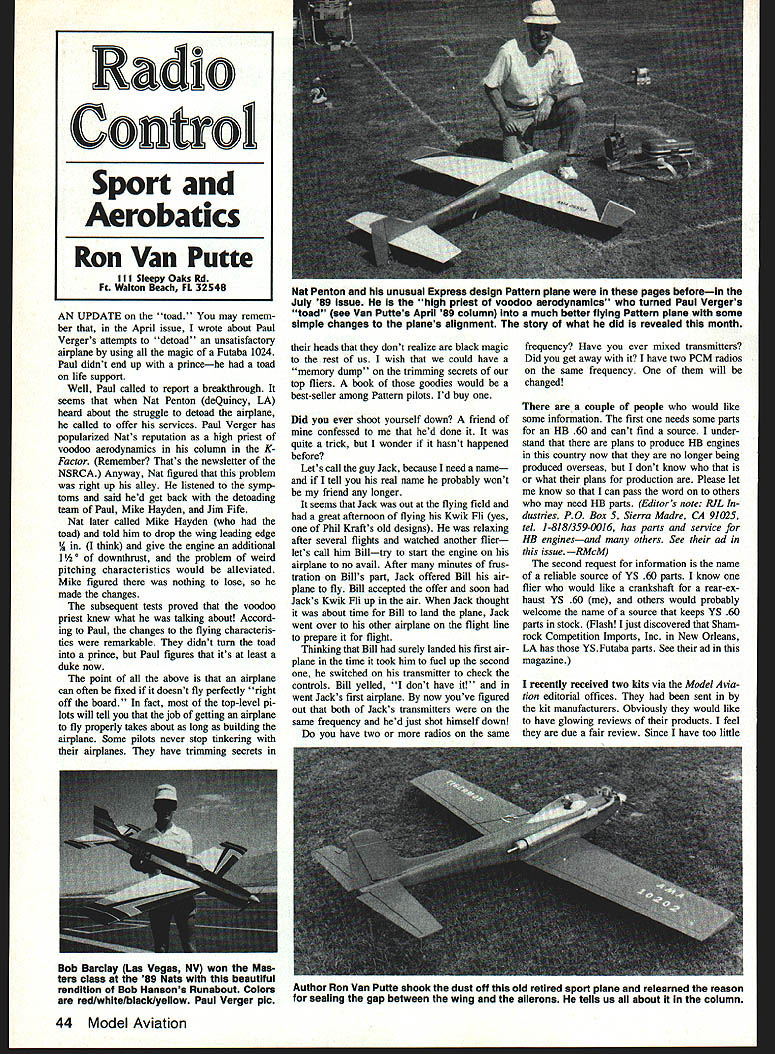
Nat Penton (DeQuincy, LA) heard about the struggle and called to offer his services. Paul Verger has popularized Nat's reputation as a high priest of voodoo aerodynamics in his K‑Factor column (the NSRCA newsletter). Nat listened to the symptoms and said he'd get back with the detoading team of Paul, Mike Hayden and Jim Fife.
Nat later told Mike Hayden (who had the toad) to drop the wing leading edge about 1/4" and to give the engine an additional 1/2° downthrust. Mike figured there was nothing to lose and made the changes. Subsequent tests proved the voodoo priest knew what he was talking about. According to Paul, the changes in flying characteristics were remarkable. They didn't turn the toad into a prince, but Paul figures it's at least a duke now.
The point is that an airplane can often be fixed if it doesn't fly perfectly "right off the board." Most top‑level pilots will tell you that getting an airplane to fly properly takes about as long as building it. Some pilots never stop tinkering; they have trimming secrets locked in their heads that seem like black magic to the rest of us. I wish we could have a "memory dump" of those secrets—a book of those goodies would be a best‑seller among Pattern pilots. I'd buy one.
Did you ever shoot yourself down?
A friend confessed he'd shot himself down. Let's call him Jack. Jack was at the flying field enjoying a great afternoon flying a Kwik Fli (Phil Kraft's old design). After several flights he relaxed and watched another flier—Bill—try to start his engine without success. After many minutes, Jack offered Bill his airplane to fly. Bill accepted and soon had Jack's Kwik Fli in the air.
When Jack thought it was time for Bill to land, he went over to his other airplane on the flight line to prepare it for flight. Thinking Bill had surely landed the first airplane, Jack switched on his transmitter to check the controls. Bill yelled, "I don't have it!" and ran to Jack's first airplane. By then you can see what happened: both of Jack's transmitters were on the same frequency and he'd just shot himself down.
Questions to consider:
- Do you have two or more radios on the same frequency?
- Have you ever mixed transmitters?
- Did you get away with it?
I have two PCM radios on the same frequency. One of them will be changed.
Parts requests
A couple of readers asked for information.
- HB .60 parts
One person needs parts for an HB .60 and can't find a source. I understand there are plans to produce HB engines in this country now that they are no longer being produced overseas, but I don't know the production plans. Please let me know so I can pass the word on to others who may need HB parts. (Editor's note: RIL Industries, P.O. Box 5, Sierra Madre, CA 91025; tel: 1‑818/359‑0016, has parts service for HB engines and many others. See their ad in this issue. — RMcM)
- YS .60 parts
Another reader wants a crankshaft for a rear‑exhaust YS .60. Flash! I discovered Shamrock Competition Imports, Inc., in New Orleans, LA, carries YS/Futaba parts. See their ad in this magazine.
Safety glasses
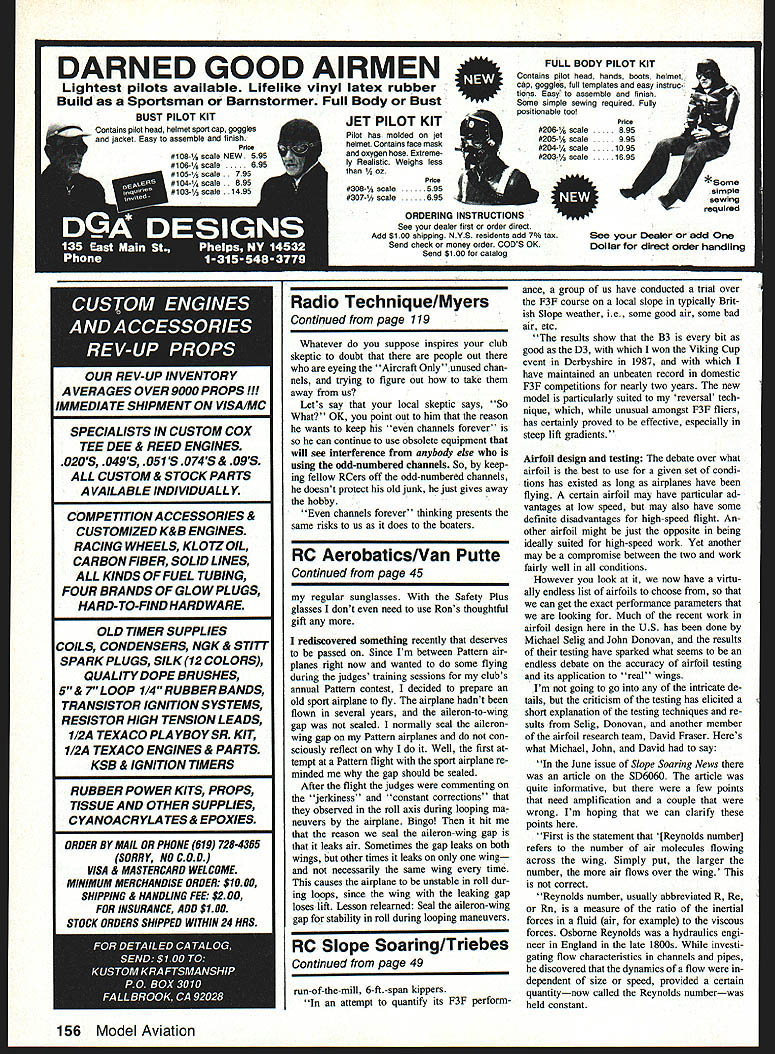
I recently started using Safety Plus glasses. With Safety Plus I don't even need to use my regular sunglasses any more—Ron's thoughtful gift has been very welcome.
Aileron‑wing gap: a simple lesson
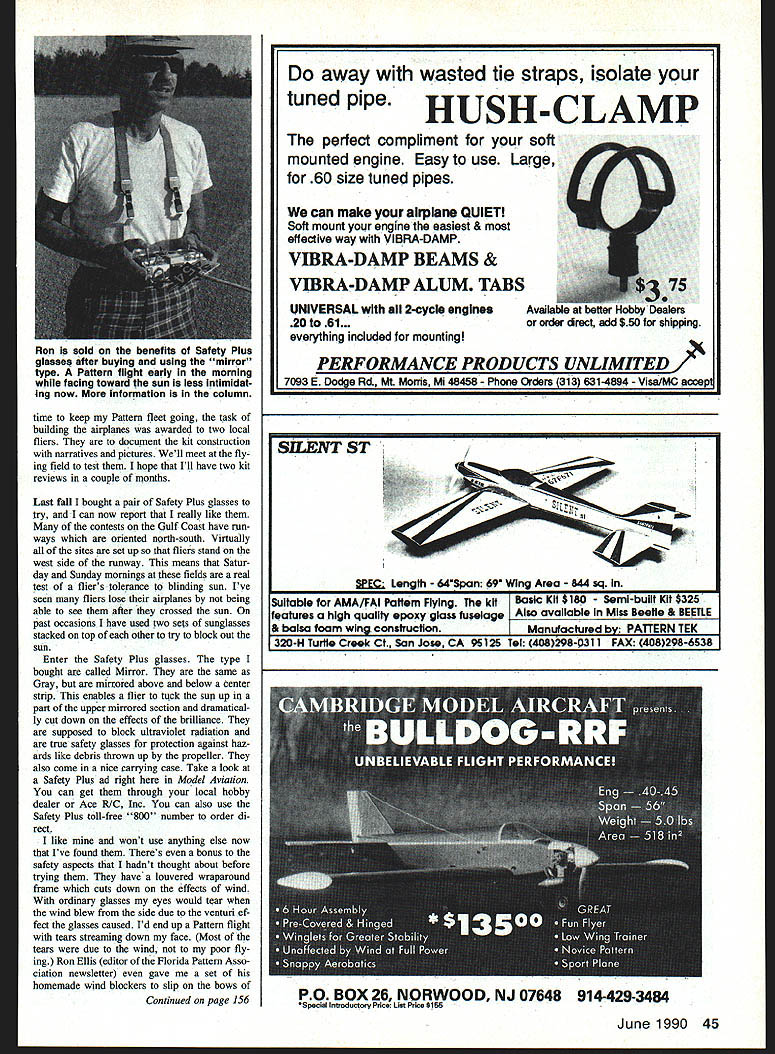
I rediscovered something worth passing on. Between Pattern airplanes right now, I prepared an old sport airplane to fly during judges' training sessions for my club's annual Pattern contest. The airplane hadn't been flown in several years and the aileron‑to‑wing gap was not sealed. I normally seal the aileron‑wing gap on my Pattern airplanes but hadn't thought about why I do it—until the first attempt at a Pattern flight with the sport airplane.
After the flight the judges commented on the "jerkiness" and "constant corrections" they observed in the roll axis during looping maneuvers. Then it hit me: the reason we seal the aileron‑wing gap is that it leaks air. Sometimes the gap leaks on both wings, but other times it leaks on only one wing, and not necessarily the same wing every time. This causes the airplane to be unstable in roll during loops, since the wing with the leaking gap loses lift.
Lesson learned: seal the aileron‑wing gap for stability in roll during looping maneuvers.
Transcribed from original scans by AI. Minor OCR errors may remain.

