
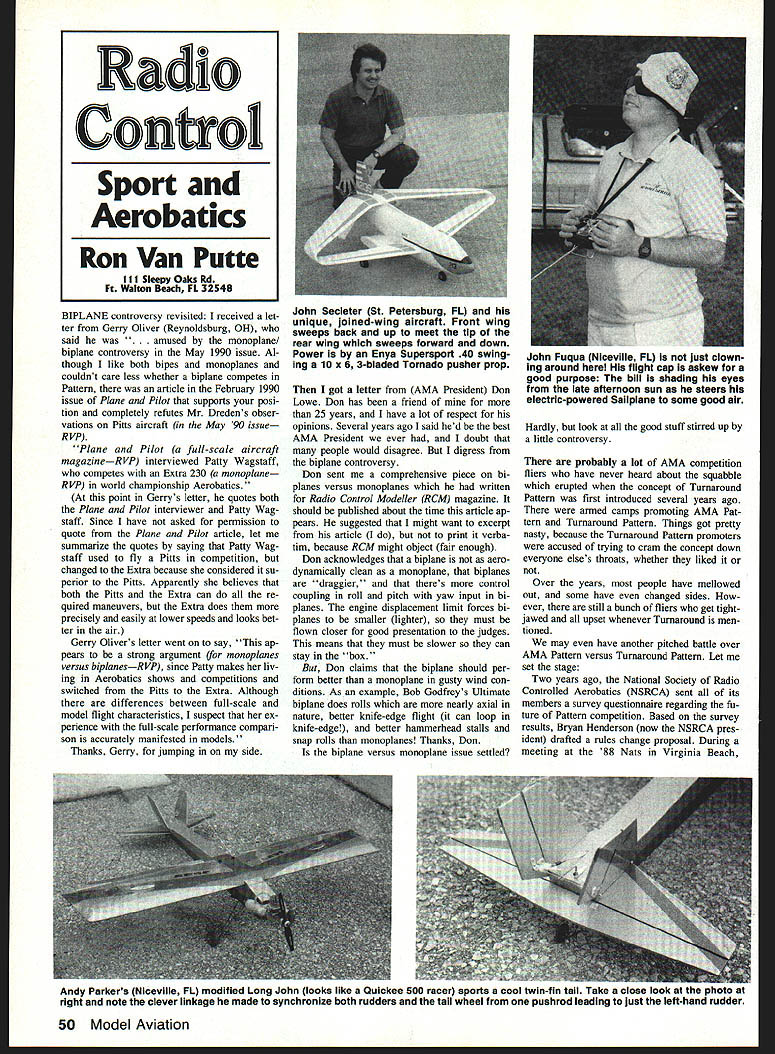
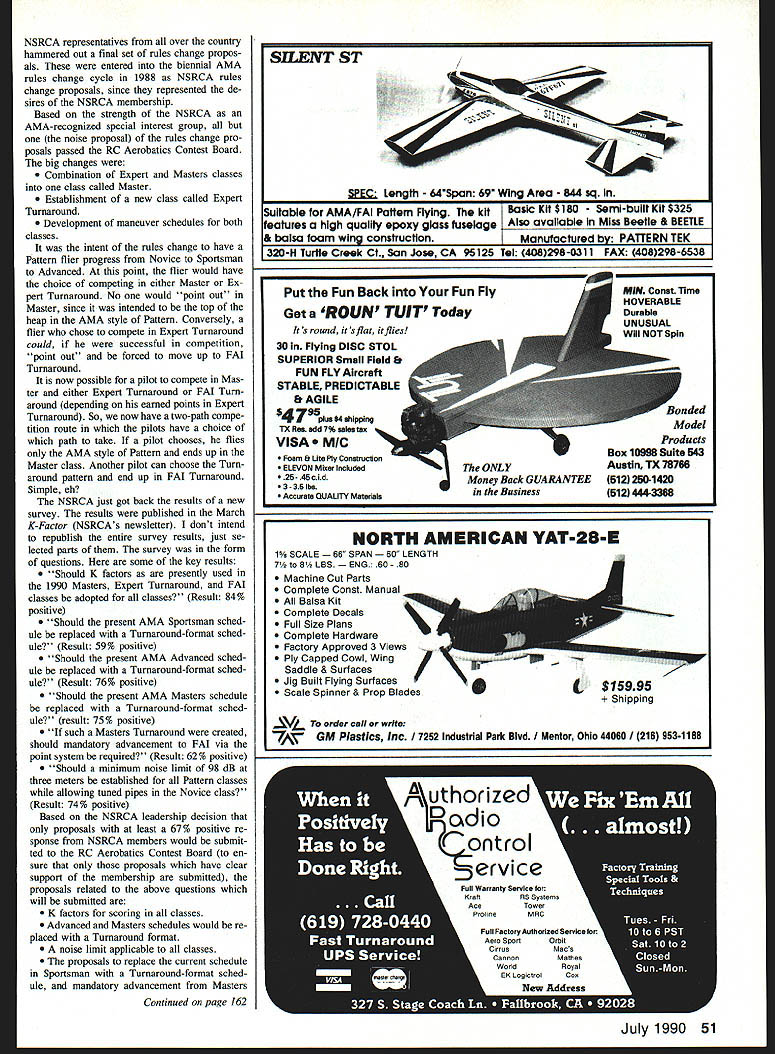
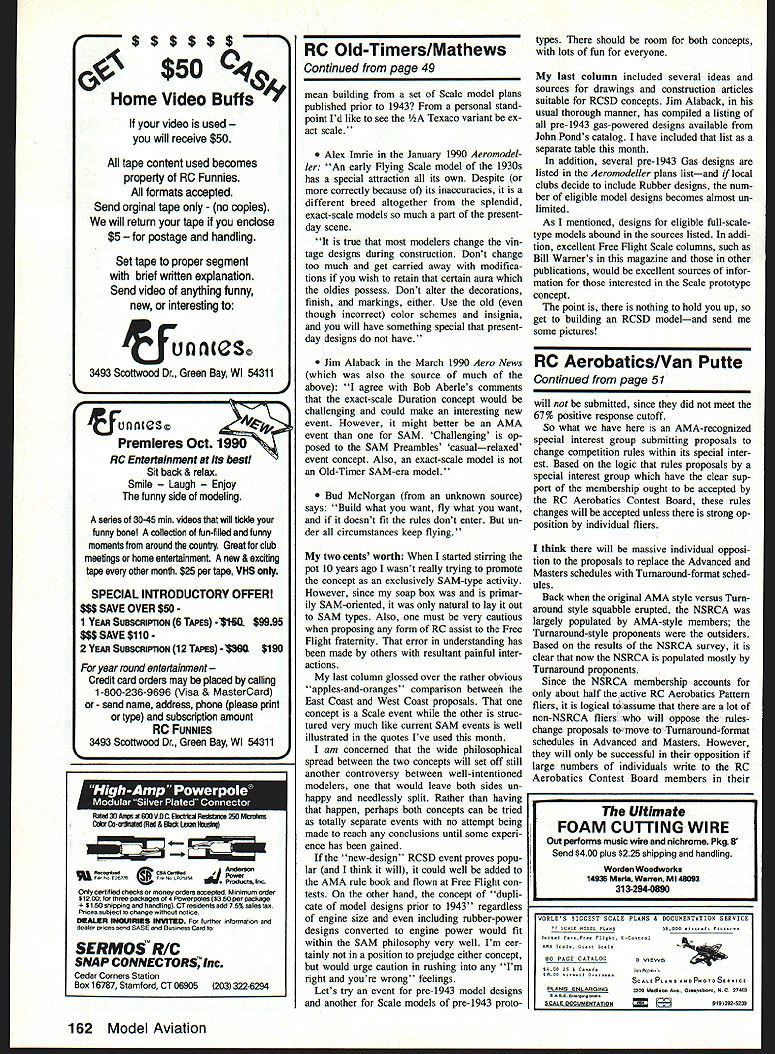
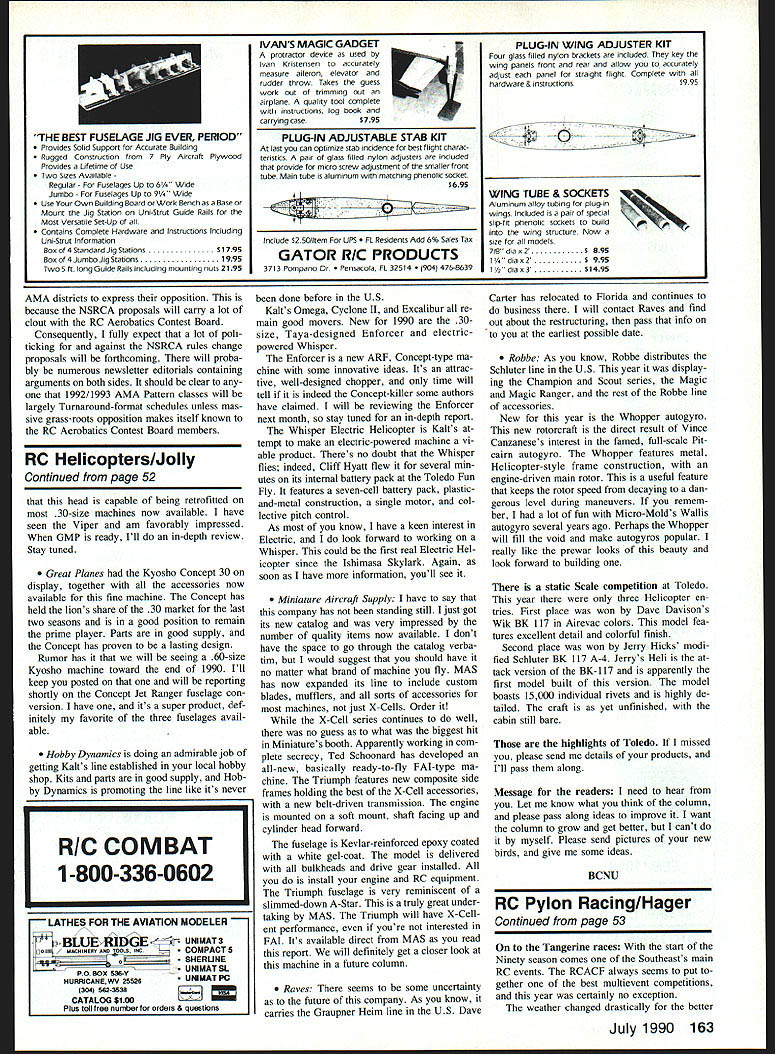
Radio Control: Sport and Aerobatics
Ron Van Putte
111 Sleepy Oaks Rd. Ft. Walton Beach, FL 32548
Biplane controversy revisited
I received a letter from Gerry Oliver (Reynoldsburg, OH), who said he was "amused by the monoplane/biplane controversy in the May 1990 issue." Although I like both bipes and monoplanes and couldn't care less whether a biplane competes in Pattern, there was an article in the February 1990 issue of Plane and Pilot that supports Gerry's position and completely refutes Mr. Dreden's observations on Pitts aircraft.
Plane and Pilot (a full-scale aircraft magazine) interviewed Patty Wagstaff, who competes with an Extra 230 (a monoplane) in world championship aerobatics. Patty used to fly a Pitts in competition and changed to the Extra because she considered it superior to the Pitts. Apparently she believes that both the Pitts and the Extra can do all the required maneuvers, but the Extra does them more precisely and easily at lower speeds and looks better in the air.
Gerry Oliver's letter concluded that this appears to be a strong argument for monoplanes versus biplanes, since Patty makes her living in aerobatics shows and competitions and switched from the Pitts to the Extra. Although there are differences between full-scale and model flight characteristics, I suspect her experience with the full-scale performance comparison is accurately manifested in models. Thanks, Gerry, for jumping in on my side.
Then I got a letter from AMA President Don Lowe. Don has been a friend of mine for more than 25 years, and I have a lot of respect for his opinions. Several years ago I said he'd be the best AMA President we'd ever had, and I doubt that many people would disagree. But I digress from the biplane controversy.
Don sent me a comprehensive piece on biplanes versus monoplanes which he had written for Radio Control Modeller (RCM) magazine. It should be published about the time this article appears. He suggested that I might want to excerpt from his article (I do), but not to print it verbatim because RCM might object. Don acknowledges that a biplane is not as aerodynamically clean as a monoplane, that biplanes are "draggier," and that there's more control coupling in roll and pitch with yaw input in biplanes. The engine displacement limit forces biplanes to be smaller (lighter), so they must be flown closer for good presentation to the judges. This means they must be slower so they can stay in the "box."
But Don claims that the biplane should perform better than a monoplane in gusty wind conditions. As an example, Bob Godfrey's Ultimate biplane does rolls that are nearly axial in nature, better knife-edge flight (it can loop in knife-edge), and better hammerhead stalls and snap rolls than monoplanes. Thanks, Don.
Is the biplane versus monoplane issue settled? Hardly. Look at all the good stuff stirred up by a little controversy; probably a lot of AMA competition fliers have never heard about the squabble which erupted when the concept of Turnaround Pattern was first introduced several years ago. There were armed camps promoting AMA Pattern versus Turnaround Pattern. Things got pretty nasty because Turnaround Pattern promoters accused others of trying to cram the concept down everyone else's throats, whether they liked it or not. Over the years people have mellowed out; some have changed sides; there's even still a bunch of fliers who get tight-jawed and upset whenever Turnaround is mentioned.
We may even have another pitched battle over AMA Pattern versus Turnaround Pattern. Let me set the stage.
Two years ago, the National Society of Radio Controlled Aerobatics (NSRCA) sent its members a survey questionnaire regarding the future of Pattern competition. Based on the survey results, Bryan Henderson (now the NSRCA president) drafted a rules change proposal. During a meeting at the 1988 Nats in Virginia Beach, NSRCA representatives from around the country hammered out a final set of rules change proposals and entered the biennial AMA rules change cycle in 1988. The NSRCA rules change proposals represented the desires of the NSRCA membership. Based on the strength of the NSRCA as an AMA-recognized special interest group, all but one (the noise proposal) of the rules change proposals passed the RC Aerobatics Contest Board.
The big changes were:
- Combination of Expert and Masters classes into one class called Master.
- Establishment of a new class called Expert Turnaround.
- Development of maneuver schedules for both classes.
It was the nature of the rules change to have a Pattern flier progress from Novice to Sportsman to Advanced. At this point, the flier would have the choice of competing in either Master or Expert Turnaround. No one would "point out" in Master, since it was intended to be the top of the heap in the AMA style of Pattern. Conversely, a flier who chose to compete in Expert Turnaround could, if he were successful in competition, "point out" and be forced to move up to FAI Turnaround.
It is now possible for a pilot to compete in Master and either Expert Turnaround or FAI Turnaround (depending on his earned points in Expert Turnaround). So we now have a two-path competition route in which the pilots have a choice of which path to take. If a pilot chooses, he flies only the AMA style of Pattern and ends up in the Master class. Another pilot can choose the Turnaround pattern and end up in FAI Turnaround.
The NSRCA just got back the results of a new survey. The results were published in the March K-Factor (NSRCA's newsletter). I don't intend to republish the entire survey results, just selected parts of them. The survey was in the form of questions. Here are some of the key results:
- "Should K factors as are presently used in the 1990 Masters, Expert Turnaround, and FAI classes be adopted for all classes?" (Result: 84% positive)
- "Should the present AMA Sportsman schedule be replaced with a Turnaround-format schedule?" (Result: 59% positive)
- "Should the present AMA Advanced schedule be replaced with a Turnaround-format schedule?" (Result: 76% positive)
- "Should the present AMA Masters schedule be replaced with a Turnaround-format schedule?" (Result: 75% positive)
- "If such a Masters Turnaround were created, should mandatory advancement to FAI via the point system be required?" (Result: 62% positive)
- "Should a Masters minimum noise limit of 98 dB at three meters be established for all Pattern classes while allowing tuned pipes in the Novice class?" (Result: 71% positive)
Based on the NSRCA leadership decision that only proposals with at least a 67% positive response from NSRCA members would be submitted to the RC Aerobatics Contest Board (to ensure that only those proposals which have clear support of the membership are submitted), the proposals related to the above questions which will be submitted are:
- K factors for scoring in all classes.
- Advanced and Masters schedules would be replaced with a Turnaround format.
- A noise limit applicable to all classes.
In Sportsman a Turnaround-format schedule, and mandatory advancement from Masters will not be submitted, since they did not meet the 67% positive response cutoff.
So what we have here is an AMA-recognized special interest group submitting proposals to change competition rules within its special-interest area. Based on the logic that rules proposals by a special-interest group which have the clear support of the membership ought to be accepted by the RC Aerobatics Contest Board, those rules will be accepted unless there is strong opposition by individual fliers.
I think there will be massive individual opposition to the proposals to replace the Advanced and Masters schedules with Turnaround-format schedules.
Back when the original AMA-style-versus-Turnaround-style squabble erupted, the NSRCA was largely populated by AMA-style members; the Turnaround-style proponents were the outsiders. Based on the results of the NSRCA survey, it is clear that now the NSRCA is populated mostly by Turnaround proponents.
Since the NSRCA membership accounts for only about half the active RC Aerobatics Pattern fliers, it is logical to assume that there are a lot of non-NSRCA fliers who will oppose the rules change proposals to move to Turnaround-format schedules in Advanced and Masters. However, they will only be successful in their opposition if large numbers of individuals write to the RC Aerobatics Contest Board members in their own regions.
Transcribed from original scans by AI. Minor OCR errors may remain.

