
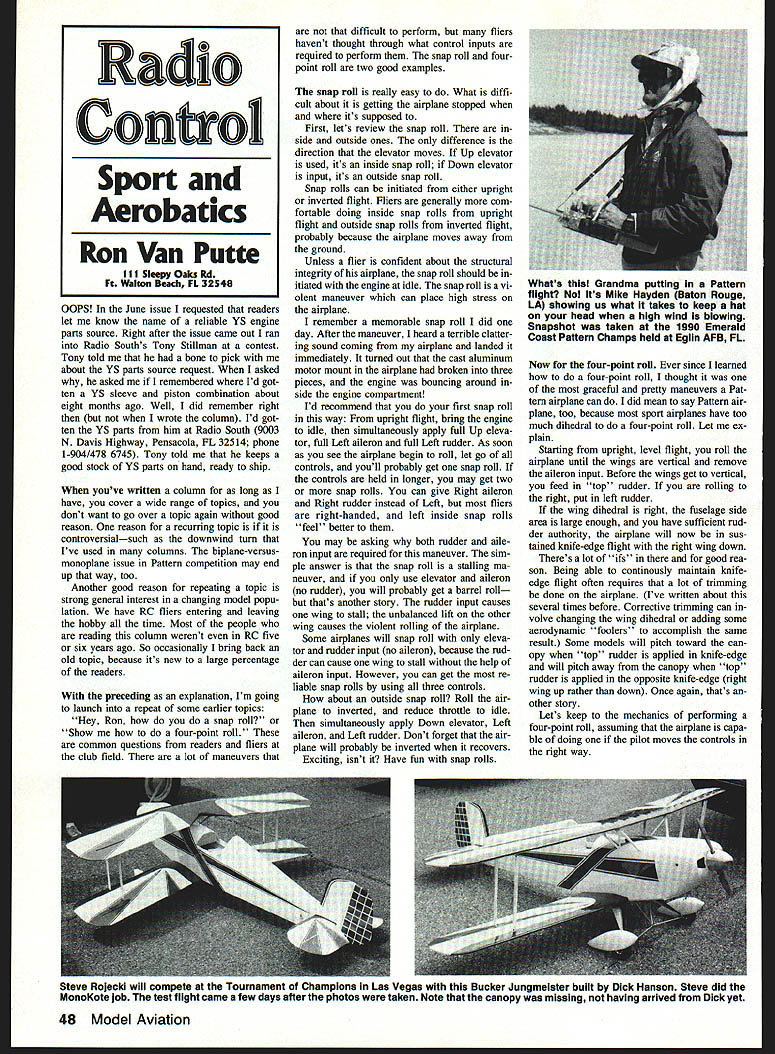
Radio Control: Sport and Aerobatics
Ron Van Putte
111 Sleepy Oaks Rd. Ft. Walton Beach, FL 32548
YS parts source (OOPS!)
In the June issue I asked readers to tell me a reliable YS engine parts source. Right after that issue came out I ran into Radio South's Tony Stillman at a contest. Tony told me he had a bone to pick with me about the YS parts source request. When I asked why, he asked if I remembered where I'd gotten a YS sleeve-and-piston combination about eight months earlier. I did remember (just not when I wrote the column): I got the YS parts from Radio South (9003 N. Davis Highway, Pensacola, FL 32514; phone 1-904/478-6745). Tony keeps a good stock of YS parts on hand, ready to ship.
Why repeat topics
When you've written a column for as long as I have, you cover a wide range of topics and don't want to repeat a topic without good reason. One reason is controversy—such as the downwind turn I've used in many columns. The biplane-versus-monoplane issue in Pattern competition may end up that way, too.
Another good reason is strong, general interest among a changing model population. We have RC fliers entering and leaving the hobby all the time. Most people reading this column weren't in RC five or six years ago. So occasionally I bring back an old topic because it's new to a large percentage of readers.
With that as explanation, I'm going to repeat some earlier topics.
Snap rolls
Common questions I get are: "Hey, Ron, how do you do a snap roll?" or "Show me how to do a four-point roll." Many maneuvers are not that difficult physically, but a lot of fliers haven't thought through the required control inputs. The snap roll and four-point roll are two good examples.
The snap roll is really easy to do. What is difficult is getting the airplane stopped when and where it's supposed to.
- There are inside and outside snap rolls. The only difference is elevator direction: Up elevator = inside snap; Down elevator = outside snap.
- Snap rolls can be done from upright or inverted flight. Fliers are generally more comfortable doing inside snaps from upright flight and outside snaps from inverted flight (probably because the airplane moves away from the ground).
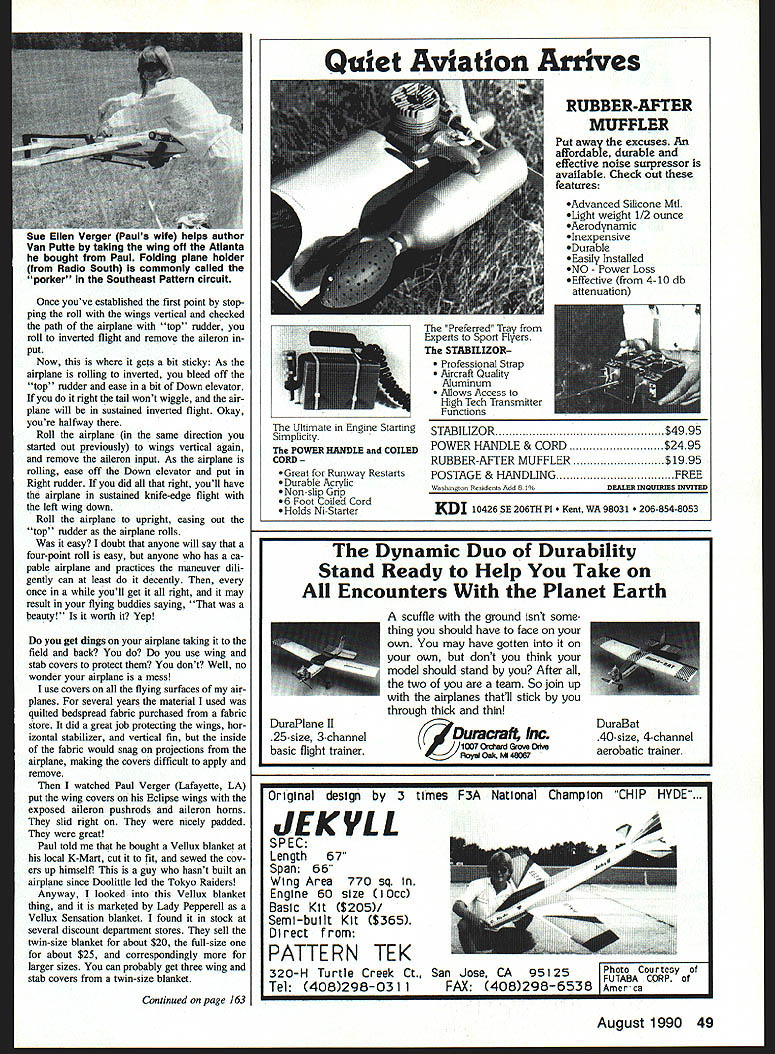
- Unless you're confident in your airplane's structural integrity, initiate snap rolls with the engine at idle. The snap roll is a violent, high-stress maneuver.
Recommended basic inside snap-roll sequence:
- From upright flight, bring the engine to idle.
- Simultaneously apply full Up elevator, full Left aileron, and full Left rudder.
- As soon as the airplane begins to roll, let go of all controls. You'll probably get one snap roll; holding the controls longer may produce two.
- You can substitute Right aileron and Right rudder instead of Left; most fliers are right-handed and prefer left-inside snaps.
Why use rudder and aileron? The snap roll is a stalling maneuver. If you only use elevator and aileron (no rudder), you'll probably get a barrel roll. Rudder input causes one wing to stall, and the unbalanced lift on the other wing causes the violent rolling. Some airplanes will snap with elevator and rudder only (the rudder alone may induce the wing stall); others need aileron input. Using all three controls gives reliable snaps.
Outside snap-roll basic sequence:
- Roll the airplane to inverted and reduce throttle to idle.
- Simultaneously apply Down elevator, Left aileron, and Left rudder.
- Remember: the airplane will probably recover inverted, so be prepared.
Have fun, and be careful with snap rolls.
Four-point roll
Ever since I learned the four-point roll, I thought it one of the most graceful maneuvers. Pattern airplanes can do it; sport airplanes with too much dihedral may have trouble. Let me explain the technique, assuming your airplane is capable and properly trimmed.
Basic concept: stop the roll briefly at four equally spaced points (wings vertical right, inverted, wings vertical left, upright) and use rudder/elevator trimming to maintain knife-edge and inverted flight at the stops.
Suggested sequence:
- From upright, roll the airplane until the wings are vertical (right wing down). Before the wings get vertical, feed in "top" rudder (rolling right, put in left rudder). If wing dihedral and fuselage side area give enough rudder authority, the airplane will go into sustained knife-edge flight (right wing down). Achieving sustained knife-edge often requires careful trimming.
- Once the roll is stopped with wings vertical and the path checked with "top" rudder, roll to inverted and remove aileron input. As the airplane rolls to inverted, bleed off the "top" rudder and ease in a bit of Down elevator. Done correctly, the tail won't wiggle and the airplane will maintain sustained inverted flight.
- Continue rolling in the same direction to wings vertical again (left wing down), and remove aileron input. As the airplane rolls, ease off Down elevator and put in Right rudder. If done right, you'll be in sustained knife-edge with the left wing down.
- Roll to upright, easing out the "top" rudder as the airplane rolls.
Was it easy? No. But with a capable airplane and diligent practice you can get it decent—and every once in a while you'll nail it and hear, "That was a beauty!" Worth the effort.
Wing and stabilizer covers
Do you get dings on your airplane taking it to the field and back? Do you use wing and stab covers to protect them? If not, no wonder your airplane looks used.
I use covers on all flying surfaces. For several years I used quilted bedspread fabric from a fabric store. It protected wings, horizontal stabilizer, and vertical fin well, but the fabric would snag on projections (aileron pushrods, horns), making the covers difficult to apply and remove.
Then I watched Paul Verger (Lafayette, LA) put wing covers on his Eclipse wings with exposed aileron pushrods; the covers slid right on. Paul said he bought a Velux blanket at K-Mart, cut it to fit, and sewed the covers himself.
You can probably get three wing-and-stab covers from a twin-size blanket. The Velux Sensation blankets (marketed by Lady Pepperell) are available in discount department stores: twin about $20, full about $25, and more for larger sizes.
RC Aerobatics/Van Putte
The Velux material is three layers of DuPont nylon fibers sandwiching two polyurethane foam layers. The outside feels like a deep-pile velvet and cannot snag on anything. My wife and I made up a set of covers in about an hour.
Whether you can buy the same material at a fabric store I don't know. If you can, it should be cheaper than the $7 my new set cost me. Check it out.
Transcribed from original scans by AI. Minor OCR errors may remain.

