
Radio Control
Sport and Aerobatics
Ron Van Putte 111 Sleepy Oaks Rd. Ft. Walton Beach, FL 32548
NATSPHOBIA has struck, and as this column is being written it's only two weeks before I leave for the Nats. The next issue will be Model Aviation's annual Nats issue, and this time there will be a change in how the Nats RC Pattern coverage will be handled. Usually either I cover the whole thing or a replacement columnist handles it all. However, in recent years the burden of handling the entire category has become greater for me, due to my multifaceted role as a judge, competitor, and columnist.
This year I will judge the first three days' competition (Sportsman and Expert Turnaround) and compete in the Master class during the next three days (Advanced, Master, and FAI). Attempting to get information on the competition, take pictures, and get the competitors' matrix data is very difficult while acting as a judge. So this year Paul Verger will report on all aspects of the Sportsman/Expert/Turnaround competition while I'm judging. You may remember that Paul did the reports on last year's Nats and the World Championships. I'll cover the Advanced/Master/FAI competition. We'll both try to get as many photos as we can so there'll be lots of good ones for the MA staff to pick from. Look for the Verger/Van Putte Nats Pattern report in the November issue (shall we call it the Van Putte/Verger Merger?).
For the last two years I've flown YS .60 RE engines in competition. The instruction manual that comes with the engine clearly states that fuel with at least 10% nitromethane content should be used. Well, I didn't. Because of my Scottish ancestry, 5% was good enough for me.
Witnesses will tell you that my engines suffered numerous flameouts, sometimes in critical situations. Flameouts caused several close calls and one crash. It was the crash that convinced me to increase the percentage of nitromethane in my fuel.
I usually use Red Max fuel, but I got four gallons of 15%-nitro fuel from Power Master (Santa Fe Springs, CA) to try, and can happily report that my engine has not flamed out since I started using it. I can't really tell that there is a performance increase at high speed, as my Atlanta seems to have the same vertical performance, but the engine keeps running reliably. In addition, the engine now ticks over at a throttle setting that I used previously to shut it down. So let me leave you with two recommendations:
- Use the engine manufacturer's recommended nitro content in the fuel.
- Give Power Master fuel a try if you live close enough to California for the freight charges to be manageable.
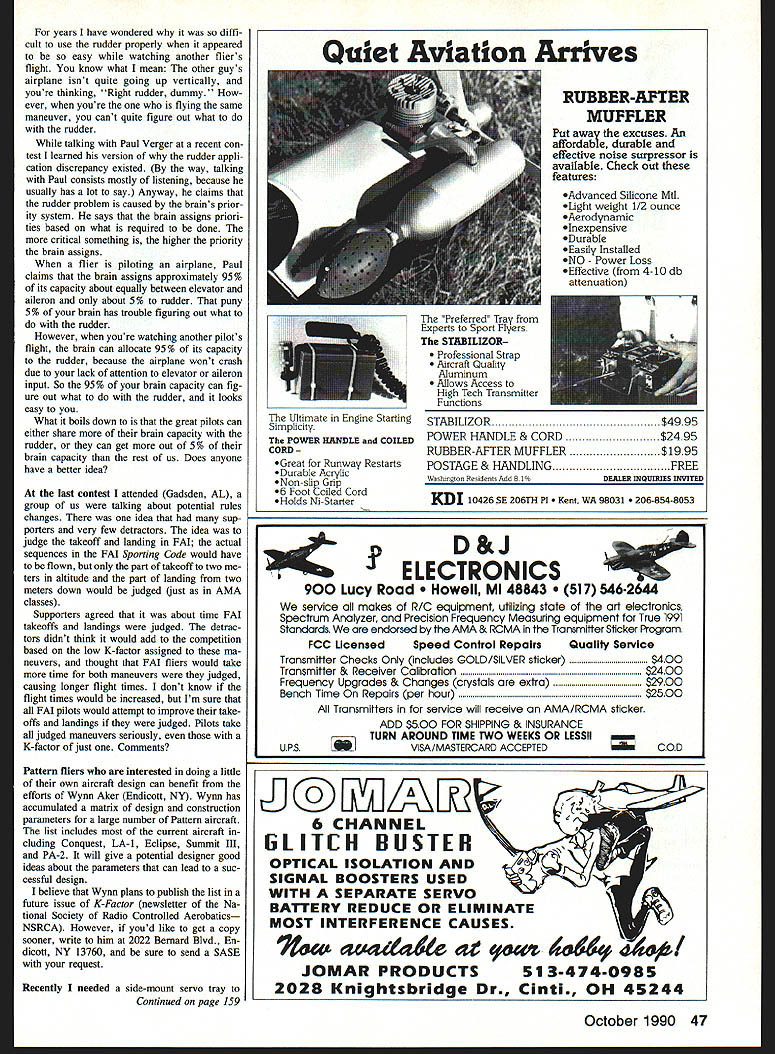
Anyone who has flown Pattern very much will tell you that the proper use of the rudder is the key to success in this type of flying. They will also tell you that learning to apply the rudder correctly is very difficult.
While talking with Paul Verger at a recent contest I learned his version of why the rudder application discrepancy exists. (By the way, talking with Paul consists mostly of listening, because he usually has a lot to say.) He claims that the rudder problem is caused by the brain's priority system. He says that the brain assigns priorities based on what is required to be done. The more critical something is, the higher the priority the brain assigns.
When a flier is piloting an airplane, Paul claims that the brain assigns approximately 95% of its capacity about equally between elevator and aileron and only about 5% to rudder. That puny 5% of your brain has trouble figuring out what to do with the rudder.
However, when you're watching another pilot's flight, the brain can allocate 95% of its capacity to the rudder, because the airplane won't crash due to your lack of attention to elevator or aileron input. So the 95% of your brain capacity can figure out what to do with the rudder, and it looks easy to you.
What it boils down to is that the great pilots can either share more of their brain capacity with the rudder, or they can get more out of 5% of their brain capacity than the rest of us. Does anyone have a better idea?
At the last contest I attended (Gadsden, AL), a group of us were talking about potential rules changes. There were two ideas that had many supporters and very few detractors. One idea was to judge the takeoff and landing in FAI; the actual sequences in the FAI Sporting Code would have to be flown, not only the part of takeoff to two meters in altitude and the part of landing from two meters down, but judged (just as in AMA classes).
Supporters argued that it was about time FAI takeoffs and landings were judged. The detractors didn't think it would add to the competition based on the low K‑factor assigned to these maneuvers, and thought that FAI fliers wouldn't take more time for both maneuvers when judged, causing longer flight times. I don't know if flight times would be increased, but I'm sure that all FAI pilots would attempt to improve their takeoffs and landings if they were judged. Pilots take all judged maneuvers seriously, even those with a K‑factor of just one. Comments?
Pattern fliers who are interested in doing a little of their own aircraft design can benefit from the efforts of Wynn Aker (Endicott, NY). Wynn has accumulated a matrix of design and construction parameters for a large number of Pattern aircraft. The list includes most of the current aircraft including Conquest, LA‑1, Eclipse, Summit III, and PA‑2. It will give a potential designer good ideas about the parameters that can lead to a successful design.
I believe that Wynn plans to publish the list in a future issue of K‑Factor (newsletter of the National Society of Radio Controlled Aerobatics — NSRCA). However, if you'd like to get a copy sooner, write to him at 2022 Bernard Blvd., Endicott, NY 13760, and be sure to send a SASE with your request.
Recently I needed a side‑mount servo tray to fit a Futaba 5130 retract servo in the nose of my new Atlanta, and after scrounging through my junk box I discovered that an old Kraft KPS-12 side-mount tray was a perfect fit. Obviously the other KPS-12 trays will accept the S130 servo (or the new S9101 or S1501 servos), too. Being curious, I researched further and discovered that the Futaba S28, S128, S38, S138, S48, and S148 servos also fit perfectly in Kraft KPS-14 servo trays.
I received a letter from Richard Forbes (Mississippi State University, MS) who referred to my article on snap rolls in the column for August 1990. He pointed out to me that, "You'll get better results on down-elevator (outside) snap rolls if you cross-control on rudder and aileron." He's right... and what he means is that you should put in either left rudder and right aileron or vice versa.
Periodically neat stuff is sent to me to try out. Recently Aerospace Composite Products (P.O. Box 16621, Irvine, CA 92714) sent me some new items.
- Kev-Cord: Composed of an eight-strand braided Kevlar filament inner core surrounded by a high-density vinyl jacket. It looks like RC hookup wire, but has enormous strength. Available in two sizes: .038 in. (85-lb tensile strength) and .054 in. (215-lb tensile strength). A 20-ft length sells for $7 and $9 respectively. It looks great for any model application requiring a precision pull‑rod actuator, such as a pull‑pull rudder.
- No‑Fray: Carbon fiber reinforcing tape sandwiched between two layers of tissue paper. Use it as received; epoxy or polyester resins soak through the tissue, saturating the carbon fiber and bonding the entire assembly. A 12-ft length retails for $9. No‑Fray can ease many of the hassles of working with carbon fiber.
- EZ Lam: A 2.1‑mil epoxy laminating resin for use with lightweight fiberglass, carbon fiber, or Kevlar cloth. They claim it flows easily into the cloth and cures to a hard, high‑strength glass finish which sands easily. It can be applied over bare Styrofoam, so it should have many applications. The 1‑1/2 pint kit retails for $18, and a 1‑1/4 quart kit is $26.
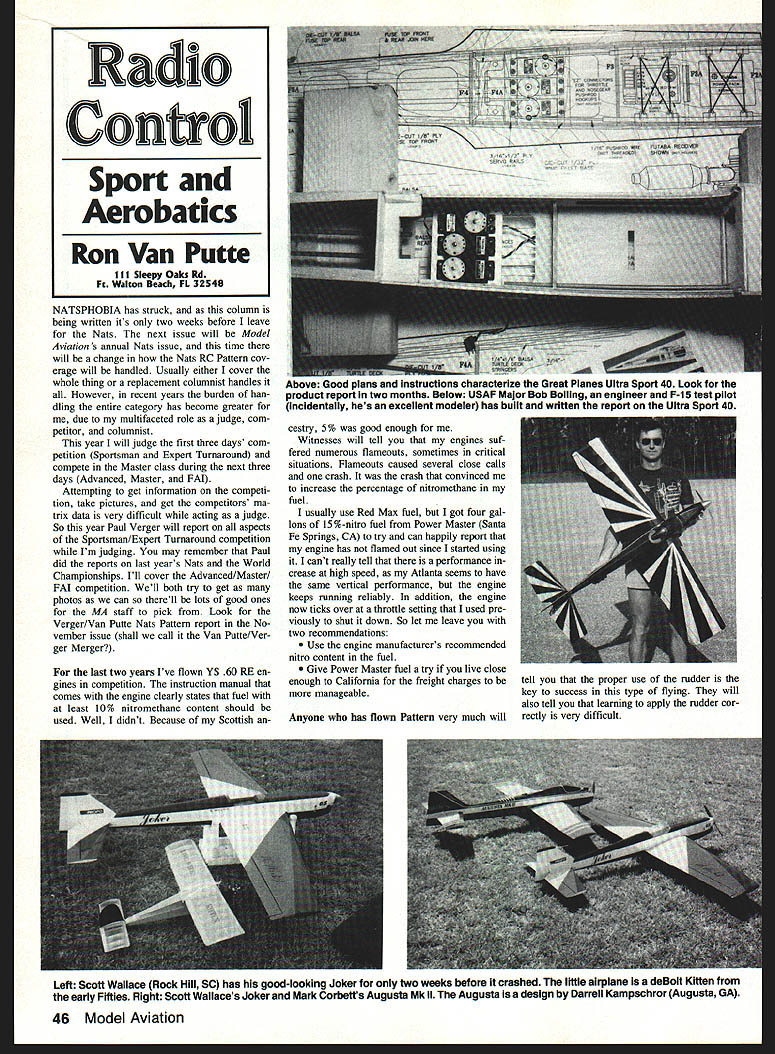
A product report is coming up in the column following the Nats issue. I'll report on the Great Planes Ultra Sport 40. Due to my heavy schedule, I asked a local flier, Bob Bolling, to build the kit and report on the airplane. Bob is an excellent builder and pilot; he's also an engineer and an F‑15 test pilot. He's put together a finer report. Look for it in two months.
Transcribed from original scans by AI. Minor OCR errors may remain.

