
Radio Control: Sport and Aerobatics
Ron Van Putte III 111 Sleepy Oaks Rd., Ft. Walton Beach, FL 32548
Product reviews
Periodically I receive R/C products from manufacturers. They'd obviously like to have a rave review published in Model Aviation, and sometimes I do just that—if I really like the product.
As often as not, I find things that I like and don't like about products. My reports include both the positive and negative sides of the products I review, and I think manufacturers understand that this policy establishes credibility for the reviews. The Model Aviation staff doesn't really like to publish reports about negative product features—I suppose they fear that advertising revenues may suffer—but the magazine does publish my reports.
Sometimes I ask local modelers to do kit reviews, because my schedule is usually pretty full. I ask them to be objective and to report on the good and bad features of the kit, just as I would do. This has worked out well in the past; so when I received a Great Planes Ultra Sport 40 kit, I asked a local modeler, Bob Bolling, to review it.
Bob is an Air Force fighter pilot who is currently flying the F-15 in flight tests at Eglin Air Force Base. Besides being an engineer, he's a good R/C sport pilot and a fine builder. He welcomed the opportunity to do a kit review—and did a fine job, as you'll now discover. Bob Bolling's report follows.
Great Planes Ultra Sport 40 — Kit review (Bob Bolling)
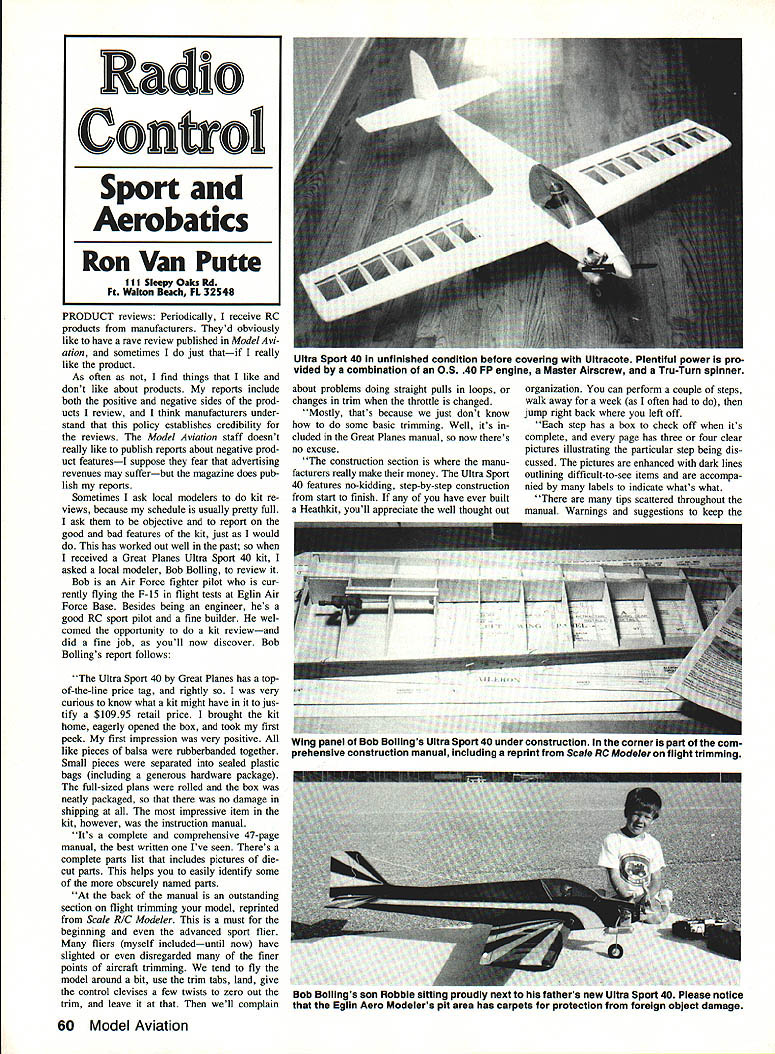
The Ultra Sport 40 by Great Planes has a top-of-the-line price tag, and rightly so. I was very curious to know what it might have in it to justify a $109.95 retail price. I brought the kit home, eagerly opened the box, and took my first peek. My first impression was very positive. All the pieces of balsa were rubber-banded together. Small pieces were separated into sealed plastic bags (including a generous hardware package). The full-sized plans were rolled, and the box was neatly packaged, so there was no damage in shipping at all. The most impressive item in the kit, however, was the instruction manual.
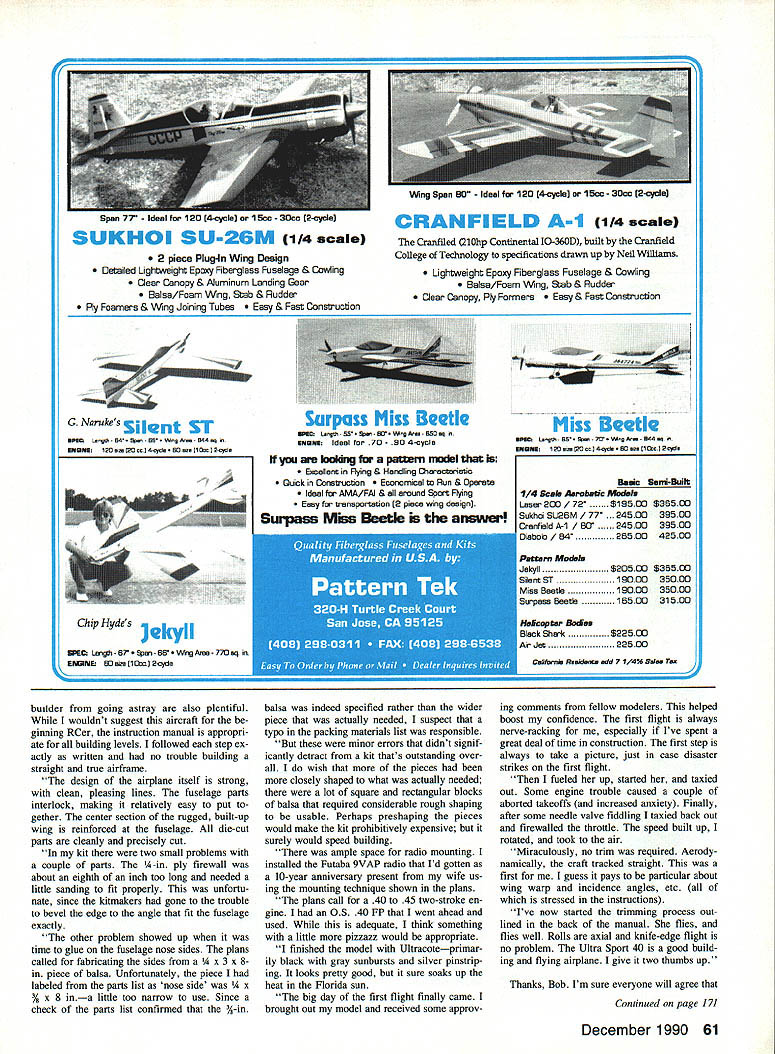
It's a complete and comprehensive 47-page manual, the best written one I've seen. There's a complete parts list that includes pictures of die-cut parts. This helps you to easily identify some of the more obscurely named parts.
At the back of the manual is an outstanding section on flight trimming of your model, reprinted from Scale R/C Modeler. This is a must for the beginning and even the advanced sport flier. Many fliers (myself included—until now) have slighted or even disregarded many of the finer points of aircraft trimming. We tend to fly the model around a bit, use the trim tabs, land, give the control devices a few twists to zero out the trim, and leave it at that. We'll complain about problems doing straight pulls in loops, or changes in trim when the throttle is changed.
Mostly, that's because we just don't know how to do some basic trimming. Well, it's included in the Great Planes manual, so now there's no excuse.
The construction section is where the manufacturers really make their money. The Ultra Sport 40 features no-nonsense, step-by-step construction from start to finish. If any of you have ever built a Heathkit, you'll appreciate the well-thought-out organization. You can perform a couple of steps, walk away for a week (as I often had to do), then jump right back where you left off.
Each step has a box to check off when it's complete, and every page has three or four clear pictures illustrating the particular step being discussed. The pictures are enhanced with dark lines outlining difficult-to-see items and are accompanied by many labels to indicate what's what. There are many tips scattered throughout the manual. Warnings and suggestions to keep the builder from making mistakes are scattered throughout the manual.
While I wouldn't suggest this aircraft for the beginning R/C'er, the instruction manual is appropriate for all building levels. I followed each step exactly as written and had no trouble building a straight and true airframe.
The design of the airplane itself is strong, with clean, pleasing lines. The fuselage parts interlock, making it relatively easy to put together. The center section of the rugged, built-up wing is reinforced at the fuselage. All die-cut parts are cleanly and precisely cut.
In my kit there were two small problems with a couple of parts. The 1/4-in. ply firewall was about an eighth of an inch too long and needed a little sanding to fit properly. This was unfortunate, since the kitmakers had gone to the trouble to bevel the edge to angle that fit the fuselage exactly.
The other problem showed up when it was time to glue on the fuselage nose sides. The plans called for fabricating the sides from a 1/4 x 3/8 x 8-in. piece of balsa. Unfortunately, the piece I had labeled from the parts list as "nose side" was 3/8 x 1/8 x 8 in.—a little too narrow to use. Since a check of the parts list confirmed that the 1/4-in. balsa was indeed specified rather than the narrower piece that was actually needed, I suspect that a typo in the packing materials list was responsible.
These were minor errors that didn't significantly detract from a kit that's outstanding overall. I do wish that more of the pieces had been more closely shaped to what was actually needed; there were a lot of square and rectangular blocks of balsa that required a considerable amount of rough shaping to be usable. Perhaps pre-shaping the pieces would make the kit prohibitively expensive, but it surely would speed building.
There was ample space for radio mounting. I installed the Futaba 9VAP radio that I'd gotten as a 10-year anniversary present from my wife using the mounting technique shown in the plans.
The plans call for a .40 to .45 two-stroke engine. I had an O.S. .46 FP that I went ahead and used. While this is adequate, the Ultra Sport 40 would do nicely with up to a .61 two-cycle. Performance improved with the larger engine and the added fuel weight.
Ground handling is good and the model taxis well. The nose gear is strong; the larger tires help in rough turf operations. Takeoffs are straightforward, with a slight tendency to weathercock at full power until some speed is attained.
Trim changes with throttle are minimal; I attribute that to the good thrust-line setup recommended in the plans. The elevator and rudder are adequately balanced, but I did add small balance weights to the ailerons to diminish control flutter at high speed.
In the air the Ultra Sport 40 is predictable and pleasant. Stall characteristics are benign and the model recovers well from mild stalls and snaps. Rolls are axial and knife-edge flight is straightforward.
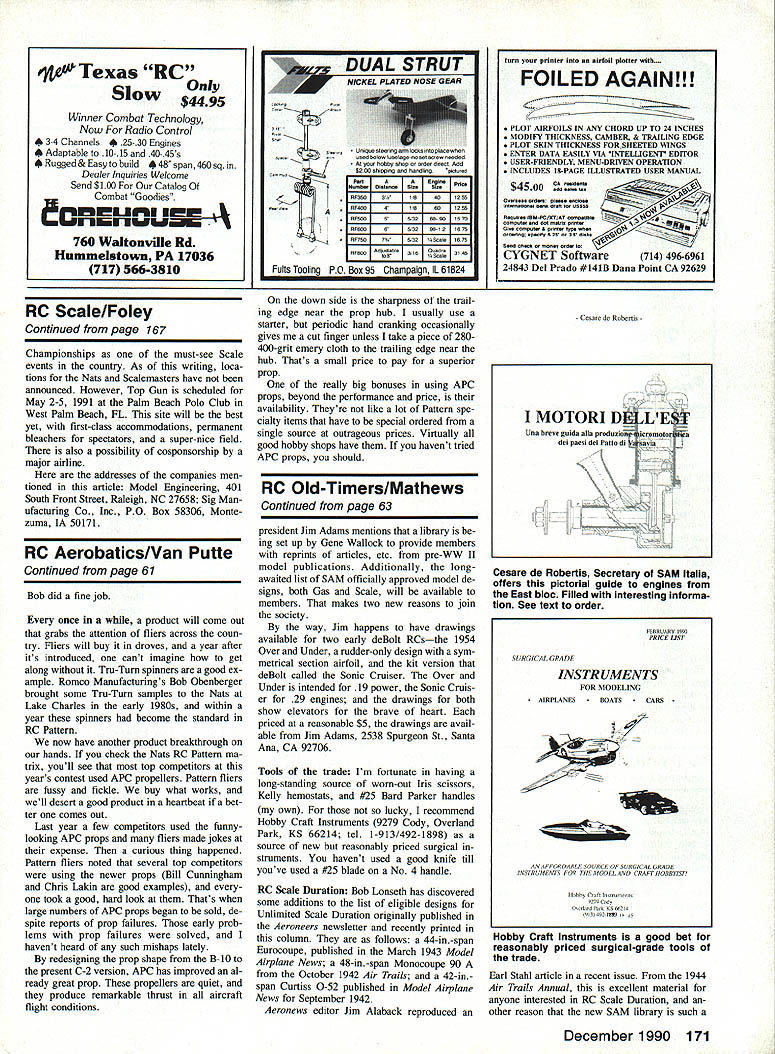
The Ultra Sport 40 is a good build-and-flying airplane. I give it two thumbs up.
Thanks, Bob. I'm sure everyone will agree that a well-built kit, good instructions and thoughtful design make for a rewarding sport ship.
Bob did a fine job.
APC propellers — a breakthrough
Every once in a while, a product will come out that grabs the attention of fliers across the country. Fliers will buy into it in droves, and a year after it's introduced, one can't imagine how to get along without it. Tru-Turn spinners are a good example. Romeo Manufacturing's Bob Osenberger brought some Tru-Turn samples to the Nats to sell to the race team in the early 1980s, and within a year they had become the standard in R/C Pattern.
We now have another product breakthrough on our hands. If you check the Nats R/C Pattern motors, you'll see that most top competitors at this year's contest used APC propellers. Pattern fliers are cautious and will deal only with what works, and they'll desert a good prop when a better one comes out.
Last year a few competitors used the funky-looking APC props and many had jokes at their expense. Then a curious thing happened. Pattern fliers noted that several top competitors were using the new props (Bill Cunningham and Chris Lakin are good examples), and they still won. The props had to be good, and a few of the pros began to use them too. There were reports of prop failures. Those reports were few, but there apparently were some early failures.
I haven't heard of any such mishaps lately.
By redesigning the prop shape from the B-10 to the present C-2 version, APC has improved an already great prop. These props are quiet, and they produce remarkable thrust in all aircraft flight conditions.
On the down side is the sharpness of the trailing edge near the prop hub. I usually use a starter, but periodic hand cranking occasionally gives me a cut finger unless I take a piece of 280–400 grit emery cloth to the trailing edge near the hub. That's a small price to pay for a superior prop.
One of the really big bonuses in using APC props, beyond the performance and price, is their availability. They're not like a lot of Pattern specialty items that have to be special-ordered from a single source at outrageous prices. Virtually all good hobby shops have them. If you haven't tried APC props, you should.
Transcribed from original scans by AI. Minor OCR errors may remain.

