
Radio Control: Sport and Aerobatics
Ron Van Putte
Answering the mail
Answering the mail is my first order of business. The September 1985 column contained a section about "Pattern sandbaggers" — the guys who don't move up to the next class after accumulating 100 points in their class. I received an interesting letter from Del Rykert of Batavia, NY. Excerpts and summary follow.
Del wrote that during his five years as a Pattern competitor he started in what was called Novice (now called Sportsman). His best placing at a local contest was third; that was the only trophy he saw before earning 100 points and moving up to Advanced. He points out that attending the Nats can dramatically inflate points — he came twelfth out of some 50 contestants at the Nats, earned a lot of points, and was pushed up. His concern is that this system can push people up who haven't had the chance to place locally and thereby reduce local attendance and the sense of “glory” that motivates many competitors.
Del suggested a compromise between the old and new scoring systems so that everyone would have a better chance to see a first or second before being advanced. He also proposed that, to streamline an AMA tracking system, perhaps only those who finish first, second, or third need be reported — since that is where sandbaggers are likely to be found.
Sandbagging and scoring — my response
Del's viewpoint is worth considering. Getting a trophy is nice, but his experience may not be typical. Placing twelfth out of 50 in Sportsman still indicates a very capable flier, so I was surprised he hadn't placed better at local contests — he must have a strong local group in Batavia.
In practice, contest directors already report the top five placings in each event to the AMA and also record the total number of contestants in each class. Del is correct that top-place results are where sandbaggers would most likely appear.
It wouldn't be difficult to compute advancement points for the top five finishers, load them into a computer, and add them to previously entered points. Imagine the surprise of a sandbagger receiving a congratulations letter from the AMA informing him of promotion to the next class at the beginning of the next year. If someone entered a class they were no longer entitled to compete in the following year, a computerized system would catch it and the competitor could be notified.
If you know fliers who should get such feedback, tell the AMA RC Aerobatics Contest Board member from your district. Look for the board member's name in the Competition Directory section of the Competition Newsletter — it’s printed in every issue of Model Aviation.
Sears Filled Epoxy Cement
After recommending Sears Filled Epoxy Cement, I expected letters from fliers in places where it wasn't available. I received many such notes, and when I checked my local store I found they don't carry it anymore either. Apparently Sears recently dropped the item from some stores and from the catalog. If anyone has information on where it can still be obtained, please let me know.
Looking back: Pattern at the 1967 Nats
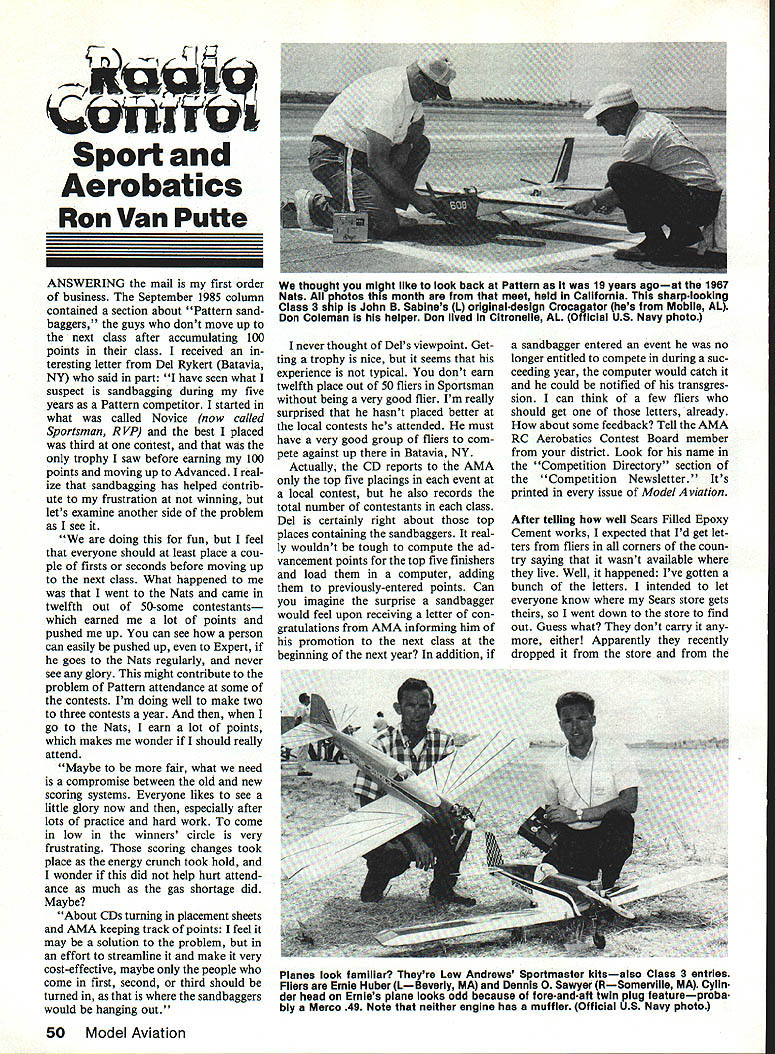
Model Aviation published photos this month from the 1967 Nats, held in California. Notes of interest:
- John B. Sabine (Mobile, AL) flew an original-design Crocagator (Class 3). Don Coleman was his helper; Don lived in Citronelle, AL. (Official US Navy photo.)
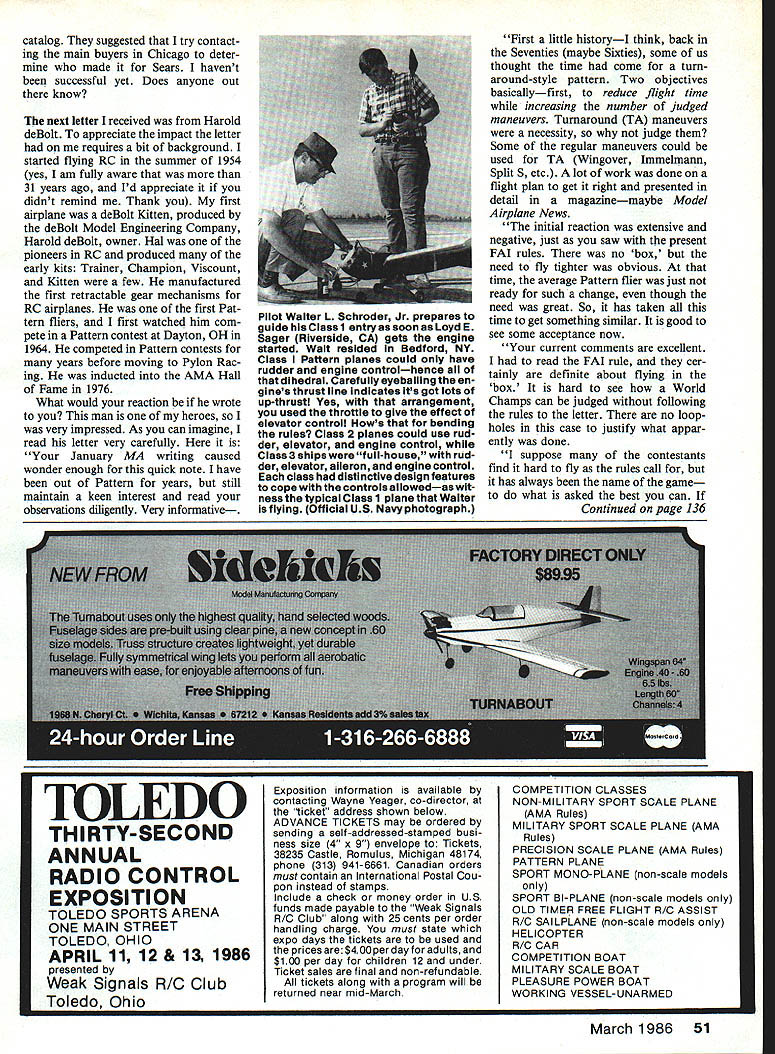
- Several planes looked like Lew Androw's Sportmaster kits.
- Other Class 3 entrants included Ernie Huber (Beverly, MA) and Dennis O. Sawyer (Somerville, MA).
- Ernie's engine had a fore-and-aft twin-plug feature, probably a Merco .49; note neither engine shown had a muffler. (Official US Navy photo.)
Letter from Harold DeBolt
I also received a noteworthy letter from Harold DeBolt. A bit of background: Hal DeBolt started flying RC in the summer of 1954. He was one of the pioneers of RC, producing early kits and components:
- Early kits: Trainer, Champion, Viscount, Kitten
- Produced one of the first retractable-gear mechanisms for RC airplanes
I first watched him compete in a Pattern contest at Dayton, OH, in 1964. His letter recounts some history and thoughts on pattern flying and rule changes. Excerpts:
"First a little history — I think, back in the Seventies (maybe Sixties), some of us thought the time had come for a turn‑around‑style pattern. Two objectives basically — first, to reduce flight time while increasing the number of judged maneuvers. Turnaround (TA) maneuvers were a necessity, so why not judge them? Some of the regular maneuvers could be used for TA (Wingover, Immelmann, Split S, etc.). A lot of work was done on a flight plan to get it right and presented in detail in a magazine — maybe Model Airplane News.
"The initial reaction was extensive and negative, just as you saw with the present FAI rules. There was no 'box,' but the need to fly tighter was obvious. At that time, the average Pattern flier was just not ready for such a change, even though the need was great. So, it has taken all this time to get something similar. It is good to see some acceptance now.
"Your current comments are excellent. I had to read the FAI rule, and they certainly are definite about flying in the 'box.' It is hard to see how a World Champs can be judged without following the rules to the letter. There are no loopholes in this case to justify what apparently was done.
"I suppose many of the contestants find it hard to fly as the rules call for, but it has always been the name of the game — to do what is asked the best you can."
Something has been tough along the way; we have had to find ways to improve our designs or ourselves, not circumvent the rules.
Transcribed from original scans by AI. Minor OCR errors may remain.

