
Radio Control: Sport and Aerobatics
Ron Van Putte 111 Sleepy Oaks Rd. Ft. Walton Beach, FL 32548
Correction / Clarification
FIRST, a correction: In the Nats-issue column I mentioned that Chip Hyde borrowed Mike Klein's airplane after his midair with Wayne Apostolico at the Nats. Mike McConville (West Chester, OH) wrote to tell me that, "Just for the record, Chip flew my airplane, not Mike Klein's, after his midair at the Nats."
Mike added a lament:
"I've been competing for 12 years now and won the 1981 Nats in Expert class. I was the 1984 U.S.A. alternate to the Tournament of Champions and placed fourth FAI in the 1988 Nats. Yet my life goal remains unfulfilled — I have never gotten a picture or even a kind word in your column.
"Just in case you'd like to fulfill my life, I have enclosed a few photos of my Desire. It's my original design. Wing area is 840 sq. in., span is 64 in., fuselage length is 66 in., and weight is 8 lb. The pipe is internal, over the one-piece wing. Elevator and rudder servos are accessed through a hatch on the bottom of the fuselage behind the wing. The receiver, battery, fuel tank and throttle servo are accessed by removing a panel above the pipe."
Be sure to mention that you saw his Desire in my column the next time you see Mike.
Small world
My daughter Kathy is an electrical engineer with General Electric at the Evendale (Cincinnati area) plant. Walking down a corridor one day, she spotted RC airplane pictures on the wall in one of the cubicles. She introduced herself to the cubicle occupant, who turned out to be Mike McConville. They both live in West Chester, OH — it's no raging metropolis.
I also got a letter from Wynn Aker (Endicott, NY). He reported, "I also happened to meet one Kathy Hadley — yes, your daughter, I believe. I also work at General Electric and we have worked together somewhat in the past. She saw a prop hanging in my office and pointed out her relationship to the hobby through you."
Soft-mount firewall method (contributed)
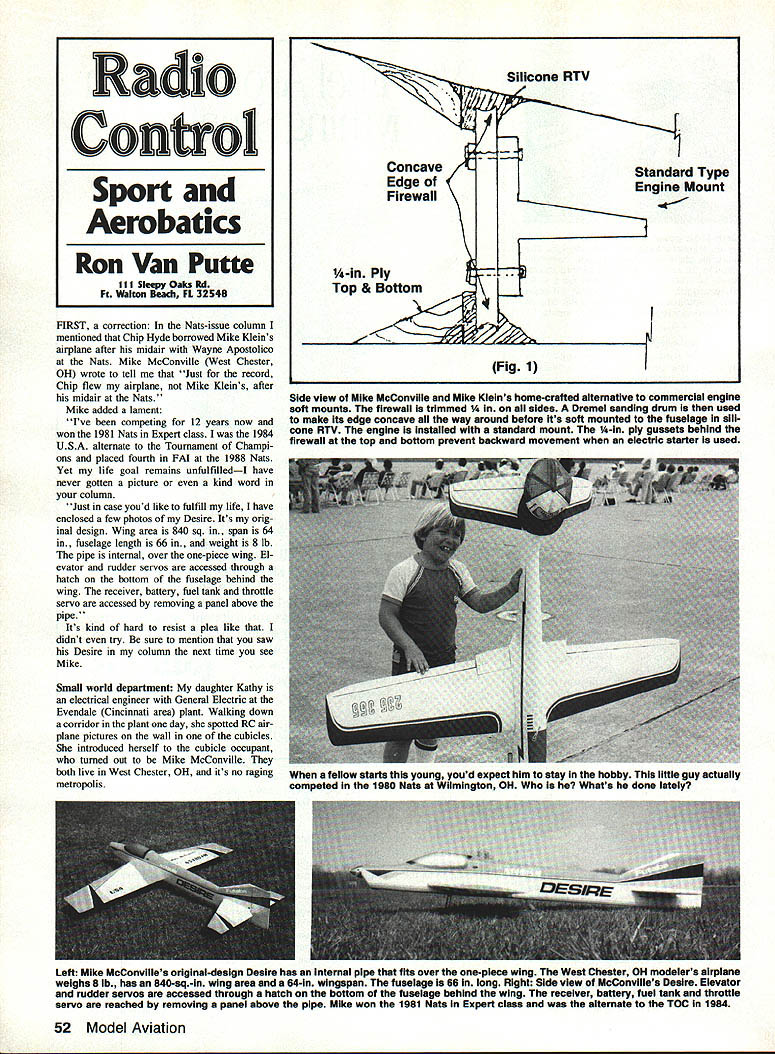
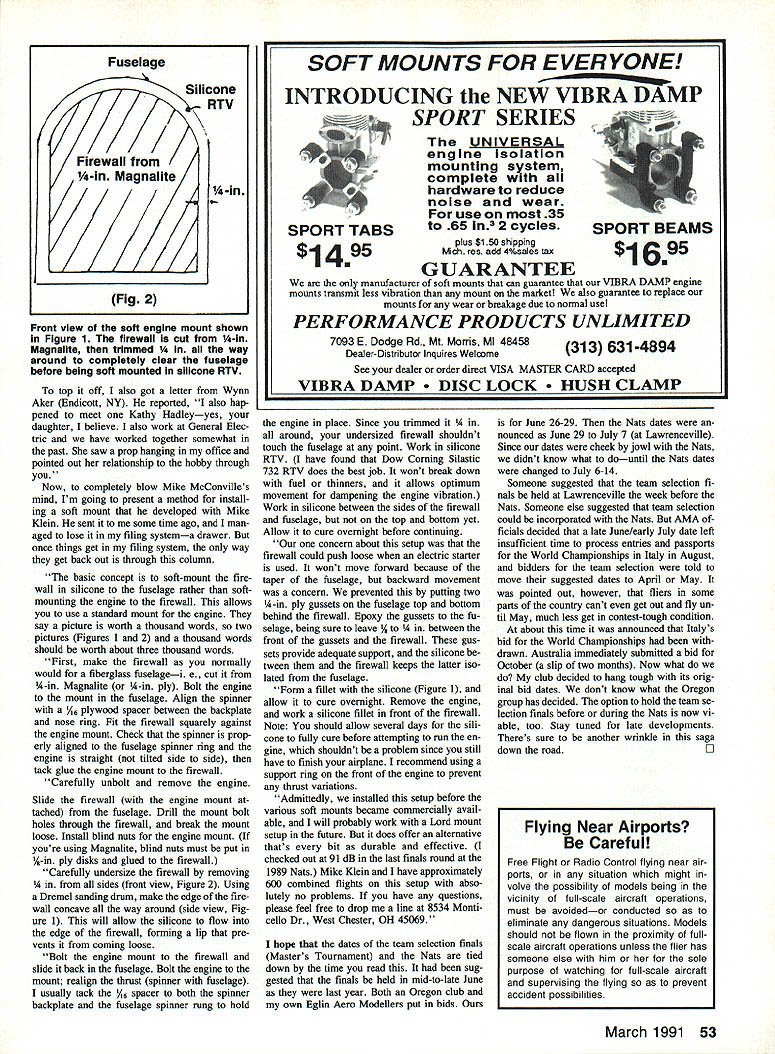
The following method for installing a soft-mount firewall was contributed to the column. The basic concept is to soft-mount the firewall in silicone RTV to the fuselage, rather than soft-mounting the engine to the firewall. This allows the use of a standard engine mount. Figures 1 and 2 (not shown) accompany the original submission.
- Make the firewall as you normally would for a fiberglass fuselage: cut 1/8-in. Magnalite and 1/4-in. plywood.
- Bolt the engine mount to the engine and fit it to the fuselage. Align the spinner; use a 1/16-in. plywood spacer between the backplate and the nose ring.
- Fit the firewall squarely against the engine mount. Check that the spinner/prop are properly aligned with the fuselage/spinner ring and that the engine is straight (not tilted side to side).
- Tack-glue the engine mount to the firewall. Carefully unbolt and remove the engine.
- Slide the firewall and engine mount (attached to the fuselage) out enough to drill the mount bolt holes through the firewall and then break the mount loose.
- Install blind nuts on the engine mount. If using Magnalite blind nuts, glue 1/8-in. ply disks to the firewall under the blind nuts.
- Carefully undersize the firewall by removing the sides (see front view, Figure 2). Using a Dremel sanding drum, make the edge of the firewall concave all the way around. This allows silicone to flow to the edge and form a lip that helps prevent the silicone from coming loose.
- Bolt the engine mount to the firewall and slide the assembly back into the fuselage. Bolt the engine mount in place and realign thrust and spinner to the fuselage. Tack a 1/16-in. spacer to both the spinner backplate and the fuselage spinner ring to help hold the engine in place.
- Since the firewall has been trimmed about 1/4 in. all around, it should not touch the fuselage at any point. Work silicone RTV (recommended: Dow Corning Silastic 732 RTV) between the sides of the firewall and the fuselage, but not yet on the top and bottom. Allow this to cure overnight.
- To prevent backward movement of the firewall when using an electric starter, epoxy two 1/8-in. ply gussets to the fuselage top and bottom behind the firewall. Leave 1/8 to 1/4 in. between the front of the gussets and the firewall so the silicone remains the isolation layer.
- Form a silicone fillet between the gussets and the firewall (Figure 1) and allow it to cure overnight. Remove the engine and work a silicone fillet in front of the firewall.
- Allow several days for the silicone to fully cure before attempting to run the engine. Use a support ring on the front of the engine to prevent any thrust variations.
Notes and results:
- Dow Corning Silastic 732 RTV is recommended because it resists fuel and thinners and allows good dampening movement.
- The contributors installed this setup before various commercial soft mounts became available and may consider using a Lord mount in the future, but the silicone-mounted firewall provides an alternative that is durable and effective.
- The setup checked at 91 dB in the last finals round at the 1989 Nats.
- Mike Klein and the contributor report approximately 6,000 combined flights on this setup with no problems.
If you have questions about this method, the contributor provided the contact address: 8534 Monticello Dr., West Chester, OH 45069.
Team selection finals and Nats dates
I hope the dates of the team selection finals (Master's Tournament) and the Nats are tied down by the time you read this. It had been suggested that the finals be held in mid-to-late June as they were last year. Both an Oregon club and my own Eglin Aero Modellers put in bids. Ours was for June 26–29. Then the Nats dates were announced as June 29 to July 7 (at Lawrenceville). Since our dates were checked by Jovi with the Nats, we didn't know what to do — until the Nats dates were changed to July 6–14.
Someone suggested holding the team selection finals at Lawrenceville the week before the Nats; someone else suggested incorporating team selection with the Nats. AMA officials decided that a late June/early July date left insufficient time to process entries and passports for the World Championships in Italy in August, and bidders for the team selection were told to move their suggested dates to April or May. It was pointed out, however, that fliers in some parts of the country can't even get out and fly until May, much less get into contest-tough condition.
At about this time it was announced that Italy's bid for the World Championships had been withdrawn. Australia immediately submitted a bid for October (a slip of two months). Now what do we do? My club decided to hang tough with its original bid dates. We don't know what the Oregon club will do, but there are some indications that the Texas club may drop out. Stay tuned for late developments — there's sure to be another wrinkle in this saga down the road.
Transcribed from original scans by AI. Minor OCR errors may remain.

