
Radio Control: Sport and Aerobatics
Ron Van Putte
Introduction
Periodically an RC newcomer reminds me that virtually everything about RC is news to him. Such was the case when I received a letter from Robert Mertens, Reinbeck, IA, who thanked me for publishing a picture of a wing-storage rack in the January '86 column and suggested a possible improvement: use 1/2-inch I.D. water-pipe insulation slipped over 1/2-inch dowels to give the wings a cushioned rest. He also asked how to solve the problem of fuselage storage.
I made the wing rack about 15 years ago and have often thought about cushioning the dowels, but haven't gotten around to it. The picture of the rack was originally taken simply to finish a roll of film, so it almost didn't get taken and nearly didn't get picked for publishing. Apparent interest from beginners caused me to start thinking about other subjects that would be news to them — aircraft-building and repair techniques, RC equipment installation, engine selection and care, flight training guides, and RC product information. Over the next few months I intend to review many of these topics.
Wing storage tip
- Slip 1/2-inch I.D. water-pipe insulation over 1/2-inch dowels to cushion wings resting on the rack.
- Seam binding is another inexpensive cushion option; it's strong and resists tearing.
Fuselage storage
Since Mertens asked about fuselage storage, here are methods I use and recommend.
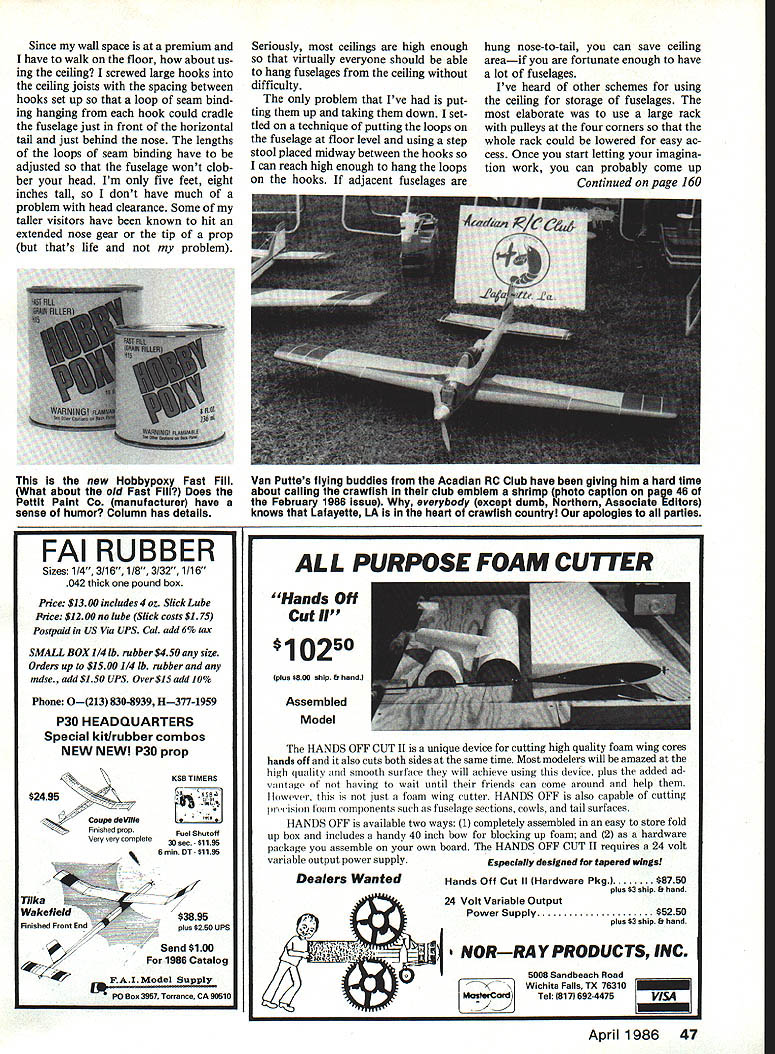
#### Wall hanging (tail-up)
- Mount large steel hooks in a wall stud or joist.
- Use loops of seam binding to hang the fuselage by the tail, cradling it securely.
- Before hanging, make sure the fuel tank is empty and that after-run oil has been applied to the engine. Fuel left in the tank can siphon into the engine, drain to the front bearings, and cause corrosion.
- Drawback: wall space is often limited and hanging takes up vertical real estate.
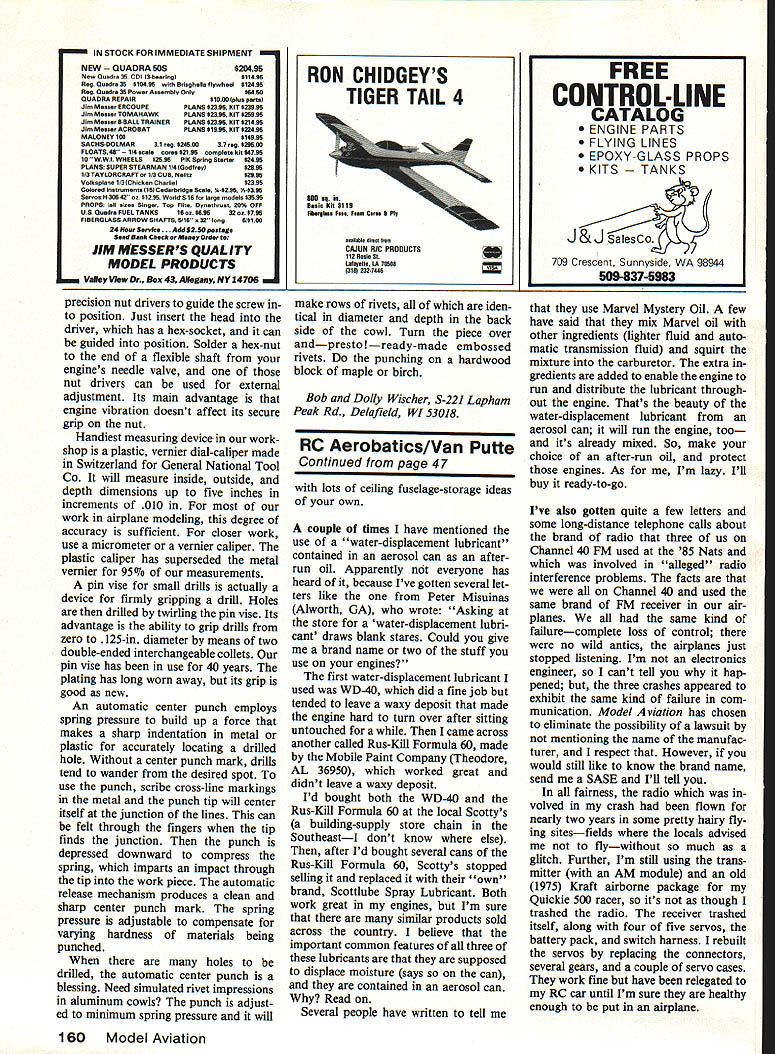
#### Ceiling hanging (preferred when wall space is scarce)
- Screw large hooks into ceiling joists. Space the hooks so a loop of seam binding on each hook cradles the fuselage just in front of the horizontal tail and just behind the nose.
- Adjust loop lengths so the fuselage won't hit heads or protruding gear. At 5'8" I have little trouble, but taller visitors have banged nose gear or prop tips.
- To put planes up or take them down: place the loops on the fuselage at floor level, stand on a step stool midway between the hooks, then hang the loops. Hanging adjacent fuselages nose-to-tail saves ceiling area.
- If you have many fuselages, consider more elaborate pulley or lowering systems.
#### Pulley rack (more elaborate)
- A large rack mounted on pulleys at the four corners can be lowered for easy access. Once you start brainstorming, you'll likely come up with other useful ceiling-storage ideas.
After-run oil (water-displacement lubricants)
A few readers asked about the "water-displacement lubricant" I recommend as an after-run oil.
- WD-40: the first I used. It displaces moisture well but can leave a waxy deposit that makes the engine harder to turn after long storage.
- Rus-Kill Formula 60 (Mobile Paint Co., Theodore, AL): worked great for me and didn't leave the waxy deposit. It was sold at a local building-supply store (Scotty's) until they replaced it with their own brand.
- Scottlube Spray Lubricant: the store brand replacement that works well.
- Marvel Mystery Oil: many readers use it; some mix it with lighter fluid and automatic-transmission fluid so it flows more readily through the engine. The advantage of an aerosol water-displacement spray is that it's already formulated to run the engine and distribute lubricant.
Choose an after-run oil you trust and use it to protect your engines. If you prefer not to mix ingredients yourself, buy a ready-made aerosol product.
Radio equipment and interference
Several people wrote asking about the brand of radio used by three of us on Channel 40 FM at the '85 Nats that was involved in alleged interference problems.
- All three airplanes were on Channel 40 and used the same brand of FM receiver. Each experienced the same failure mode: a complete loss of control (no wild antics—just a sudden stop in responsiveness).
- Model Aviation omitted the manufacturer's name to avoid possible legal issues; I respect that decision. If you'd like to know the brand, send me a SASE and I'll tell you.
- In my case, the receiver had been flown for nearly two years in difficult sites without prior glitches. The receiver failed along with four or five servos, the battery pack, and the switch harness. I rebuilt the servos (replacing connectors, several gears, and a couple of cases). They work, but I've relegated them to an RC car until I'm sure they're reliable in an airplane.
- I'm not an electronics engineer, so I can't explain precisely why the failure occurred, only that the pattern suggested a receiver fault.
Closing
Many aspects of RC — building and repair techniques, equipment installation, engine care, flight training, and product knowledge — are routine to experienced flyers but new to beginners. Over the coming months I'll be revisiting these topics and others to help newcomers get up to speed.
Transcribed from original scans by AI. Minor OCR errors may remain.

