
Radio Control: Sport and Aerobatics
Ron Van Putte
A few days ago I got a telephone call from Bob Pinkus (Dayton, OH) who wanted to talk about the use of aerosol after-run oil. I had mentioned in previous columns that I like to use it because the engine runs on it and distributes the oil throughout its parts. He said that he didn't understand why its use wouldn't also cause corrosion, because one of the chemical by-products of combustion is water.
That set me back for a while. I didn't have an answer for him except to say that I hadn't experienced any bearing corrosion since starting the use of aerosol after-run oil (moisture-displacement lubricant). Two days later it struck me—when you burn the after-run oil, the exhaust never gets to the bearings! The part that burns is exhausted from the engine. It's the lubricant that's in the crankcase that gets distributed to the bearings. It works.
Radio interference at the Nats
When I offered to tell people what radio I was using at the Nats when I was shot down by "alleged" interference, I expected a strong response. So I warned the postman, and he put in a request for a larger vehicle. It was necessary, too; I've been getting writer's cramp answering the mail. Most people were glad to hear, because it wasn't using the brand of radio they own. A few got bad news.
However, even though some people got the bad news, they need to understand that the circumstances that led me down probably happen very infrequently. I had been flying that radio in some pretty nasty places for two years before being shot down at the 1985 Nats. The two situations I hadn't encountered before flying in the 1985 Nats were the 1983 Nats and the 1984 Nats. I'd never flown an FM-transmitter-controlled airplane in front of AM transmitters 1,000+ feet away. That kind of situation rarely occurs at most flying sites but happens quite often at the Nats.
I hope that there are ways to avoid being shot down while using an FM transmitter at future Nats. Of course, one way is to own a PCM FM transmitter—and I now do. However, for people who own conventional FM transmitters, I hope that those who understand RC electronics more than I do can come up with a field layout and/or flying procedures which will keep others from going through what three of us suffered on Channel 40 FM at the 1985 Nats. George Myers' "Radio Technique" column in the January 1986 issue went into the problem which shot me down. It may be a little heavy going for some fliers, but it's well worth reading. He had more information in his February 1986 column, too.
Alternatives to Sears Filled Epoxy
I've also gotten a lot of letters about the discontinuance of Sears Filled Epoxy. Many commiserated with me; a few who had liked it searched for—and found—a suitable substitute.
- Ron Clem (San Diego, CA) wrote: "I found out about a product called J.B. Weld (P.O. Box 483; Sulphur Springs, TX 75482) and bought some. Well, the name's changed, but I believe the product is the same, as it has the same consistency, color, pot life, etc., and it's available through most Pep Boys auto parts stores and probably other auto parts stores as well."
- Eldon Wilson (San Angelo, TX) wrote: "...there is the same item put out by Duro brand products, and I have found it in most auto supply houses. Duro calls it E-POX-E Cement Filler; two parts—one black, one white; and when mixed it's very putty-like and can be thinned with rubbing alcohol. In the putty state, it will set under water."
- Richard Forbes (Mississippi State, MS) wrote: "A product which appears (and performs) identically is: Duro Master Mend E-POX-E System Concrete and Metal Filler TM-85. Ten ounces (five oz. epoxy and five oz. hardener) is $4.75 at my local building supply."
Hey, that's great. Isn't it typical that people in our hobby are glad to share good ideas and product information? I have no idea whether any of the above products are available where I live, but when I run out of my Sears Filled Epoxy, I'll look them up. If anyone else comes up with another replacement, let me know, and I'll pass it along as well.
Turnaround pattern proposal (Jim Ewing)
Another letter came from Jim Ewing (Charlottetown, Prince Edward Island, Canada), who included a copy of a proposal for an expanded Turnaround Pattern program. Jim suggests that there is "a need for additional Turnaround schedules or classes to step on the ladder from rank beginner to Master's Class." He proposes four schedules to enable a flier to progress to the highest class and calls the classes Sportsman, Novice, Intermediate, and Master.
Jim reasons that "In all competitions, it is necessary to keep the beginner in mind to ensure a healthy growth in the activity." He believes that Turnaround will inevitably become the norm in the next few years, but acknowledges that it may coexist with the present-style pattern. In either case, there is going to be a need for additional Turnaround schedules or classes to be steps in the ladder from the rank beginner to Master's Class.
He proposes that the existing Sportsman class would be the first step in the Turnaround series of competitions and that two new classes should be inserted: Novice Turnaround and Intermediate Turnaround. The proposed Novice Turnaround would have nine manoeuvres and would be sufficient for any newcomer to the Turnaround to handle, as the overall style of flying is more demanding. Choosing nine manoeuvres also makes for a nice progression through the classes: nine in Novice, 15 in Intermediate, and 21 in Master's—a six-manoeuvre increase per class.
#### Novice Turnaround (proposed manoeuvres)
- Three Inside Loops
- Half-Reverse Cuban Eight
- Straight Inverted Flight
- Stall Turn
- Cobra Roll
- Immelmann Turn
- One Horizontal Roll
- Split S
- Cuban Eight
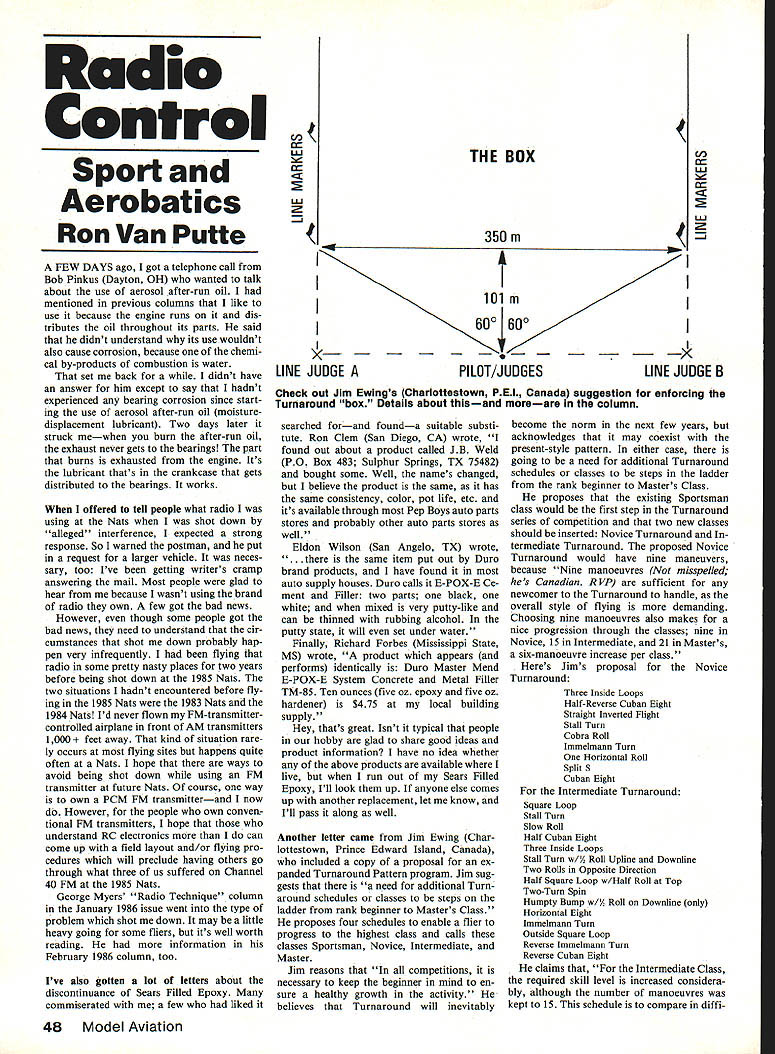
Check out Jim Ewing's suggestion for enforcing the Turnaround "box." Details about this—and more—are in the column.
#### Intermediate Turnaround (proposed manoeuvres)
- Square Loop
- Slant Turn
- Slow Roll
- Half Cuban Eight
- Three Inside Loops
- Half Turn with Roll Up/Downline
- Two Rolls in Opposite Direction
- Half Square Loop with Half Roll at Top
- Two Turn Spin
- Humpty Bump with Roll on Downline (only)
- Horizontal Eight
- Immelmann Turn
- Inside/Outside Loop
- Outside Square Loop
- Reverse Immelmann Turn
- Reverse Cuban Eight
Both outside and square manoeuvres are used. Although it is inevitable to have some duplicate manoeuvres between classes, an attempt was made to give some variety as well as a few new twists on other manoeuvres. The opposite rolls from upright, the Two-Turn Spin and the unique Humpty Bump demonstrate this. "In both schedules, the manoeuvres were carefully chosen for a smooth, constant flow. Center manoeuvres which require a long path, such as Straight Inverted Flight and the Slow Roll, had to be matched with turnaround manoeuvres which take up little horizontal distance. This helps to facilitate 'staying in the box.'"
Defining and enforcing the Turnaround "box"
"Although the 'box' has been mentioned with regard to Turnaround, and it has even been partially defined, I don't believe it has been defined and enforced enough. At present it consists of three angles measured from the pilot's/judge's position: 60° to the right, 60° to the left, and 60° to the vertical. The original intent of Turnaround was to reduce the area required to accomplish a full set of pattern manoeuvres as well as to slow the aircraft down to better depict more realistic flight. This also reduces the noise footprint, which is getting to be a major concern throughout the entire world of modelling.
"With only angles defining the box, it is obvious that the farther out you fly, the longer the path you can take to stay within the prescribed angle. For example, if you fly your model on a path 200 meters from you, you will have a flight path 693 meters (2,273 feet) in length and a usable vertical height of about 34.65 meters (113.65 feet). Absolutely ridiculous! This is certainly not within the initial intent of Turnaround flying and the box. Edges of the box must be defined and enforced. These requirements are quite stringent in full-scale aerobatics. The length of this box is 1,000 meters.
"To be consistent with the 60° definition already in place, let us choose a reasonable distance out to define a 'reasonable box.' If a flying distance of 100 meters were chosen, this would define a box length of about 346.4 meters and a width of about 134.8 meters. It would also mean a usable height of 175 meters (574 feet). This is more than adequate, as you should be limiting your flying to 500 feet or less anyway. Almost all aircraft intended for Turnaround flying should be able to perform well within the confines of these measurements.
"To further refine these dimensions, let us consider aircraft speed. Since the new style of plane flies more slowly, let us say 70 mph, it should take about 11.2 seconds to cross a 350-meter box. This is more than adequate. Even the faster planes, let us say 100 mph, would take about 7.8 seconds to cross the box, which is still adequate. If your plane has an average horizontal speed greater than this, you are probably flying in the wrong kind of plane for Turnaround in the first place!
"So, let us design the box the way it was intended by giving a horizontal length of 350 meters and a vertical height of 175 meters. This would be the equivalent of flying your plane at a distance of approximately 101 meters. These dimensions should be totally acceptable for our models flying the Turnaround pattern and should help discourage the 'big footprint.' The only additional requirement that will dictate line-of-sight for box or line judges (as in tennis) is that they would need to be required to sit in line with the box edge (see diagram), and award downgrades or disqualifications for manoeuvres outside the box."
As many of you already know, I don't care for Turnaround pattern as a competitor, but I can (and will) participate as a judge and supporter of the concept. I think Jim Ewing had some excellent ideas.
Comments?
Ron Van Putte 111 Sleepy Oaks Rd. Ft. Walton Beach, FL 32548.
Transcribed from original scans by AI. Minor OCR errors may remain.

