
Radio Control: Sport/Aerobatics
Ron Van Putte
My mailbox contained a letter which reminded me that old news is still news to someone who hasn't heard it before. The letter was from Robert Krieger (Buffalo, IA), who wrote: "Looking over the Model Aviation December 1980 issue I got stuck on the statistics in your column." (This was the article on the 1980 Nats. The statistics he refers to are the matrices of facts about the top 10 finishers in each class.) "Of the forty you listed, 35% used OS engines, 27% Rossi, and 20% Supertigre—why? What is it about these engines that these people like?
"This is my first year in RC, and I'm addicted, so naturally I'm wondering why all these good fliers are using these particular engines. Also, the Tiporare, Curare and Phoenix class aircraft stood out as favorites—any opinion as to why?"
Several times during the six years I've been writing this column, the subjects of aircraft and engine choices for competition have come up. However, there are a lot of modelers who never read those columns—for various reasons. There are also probably a few who forgot what was written before, so let me tackle the subject one more time. The real problem with answering questions about the best choice of airplanes and engines is that there is more than one answer. The "correct" answer depends on the individual. You wouldn't expect that the best airplane and engine combination for a world-class flier would be the same as the one for a beginner in Pattern competition. Granted, the two examples are extremes, but the point is that the proper choice of an airplane and engine are functions of the flier's level of competition.
Choosing Airplanes and Engines
The best way to put things in perspective is to decide what the flier really needs in order to compete successfully in his class. You'll be surprised to determine just what is not needed. Everyone has a tendency to go out and buy what the "big guys" have. However, to do that indiscriminately is a waste of time and money. Most Pattern fliers are not Master-class fliers. If you examine the distribution of fliers by class, you will see that the most populous class is Novice. Pre-Novice is a growing class, and although the number of fliers in that class will never equal those in Novice, proper airplane and engine selection is even more important to them.
It's not really all that difficult to pick an airplane or engine if one thought is kept in mind—what do I need for my level of competition? The airplanes in the Pre-Novice and Novice classes have very little need for vertical performance. As far as vertical performance is concerned, the most demanding maneuver in these patterns is the Immelmann turn. If an airplane/engine combination is capable of performing a satisfactory Immelmann turn, it will be able to perform the stall turn, both looping maneuvers, and all the remaining maneuvers in the Pre-Novice/Novice patterns with ease.
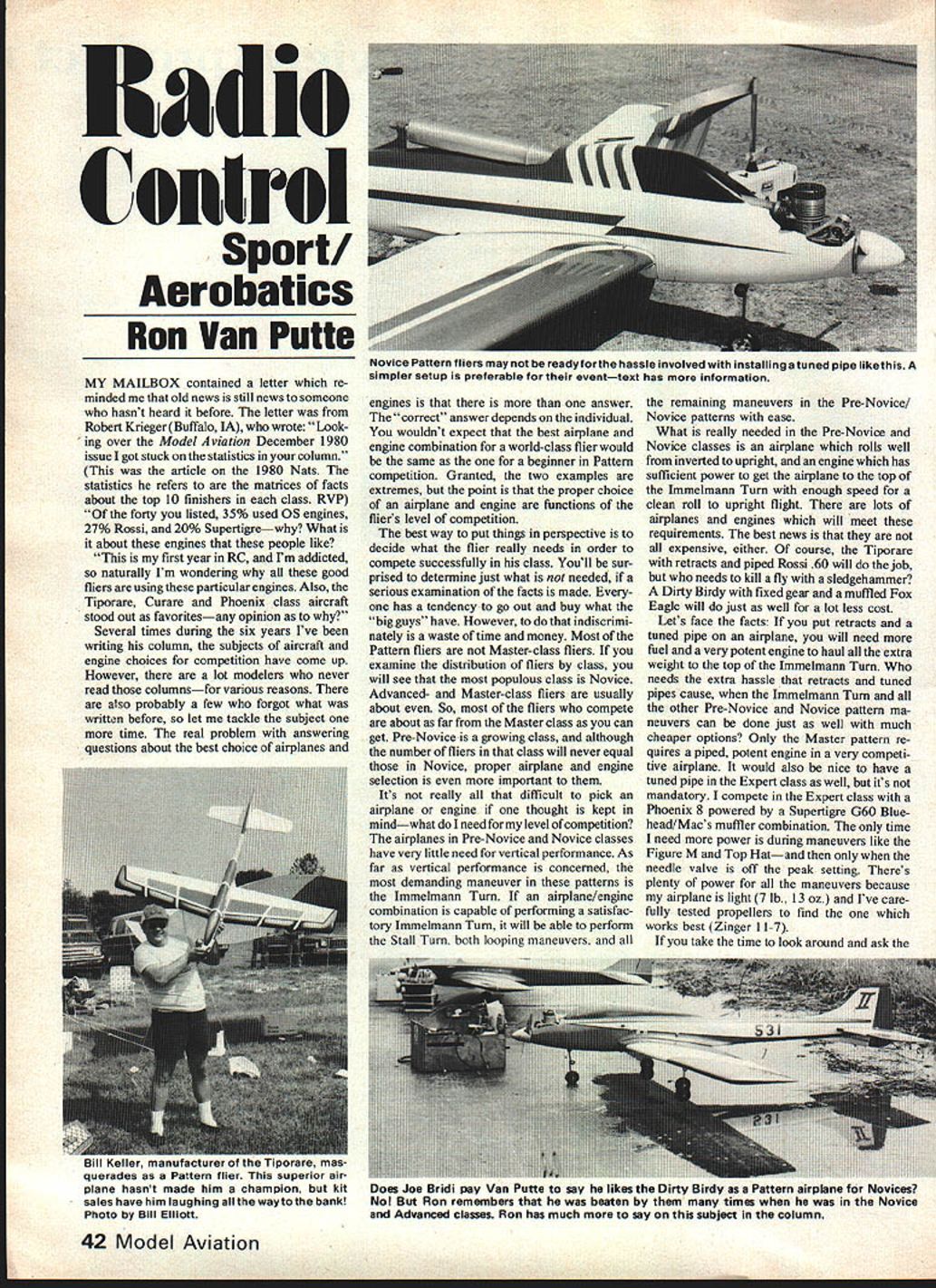
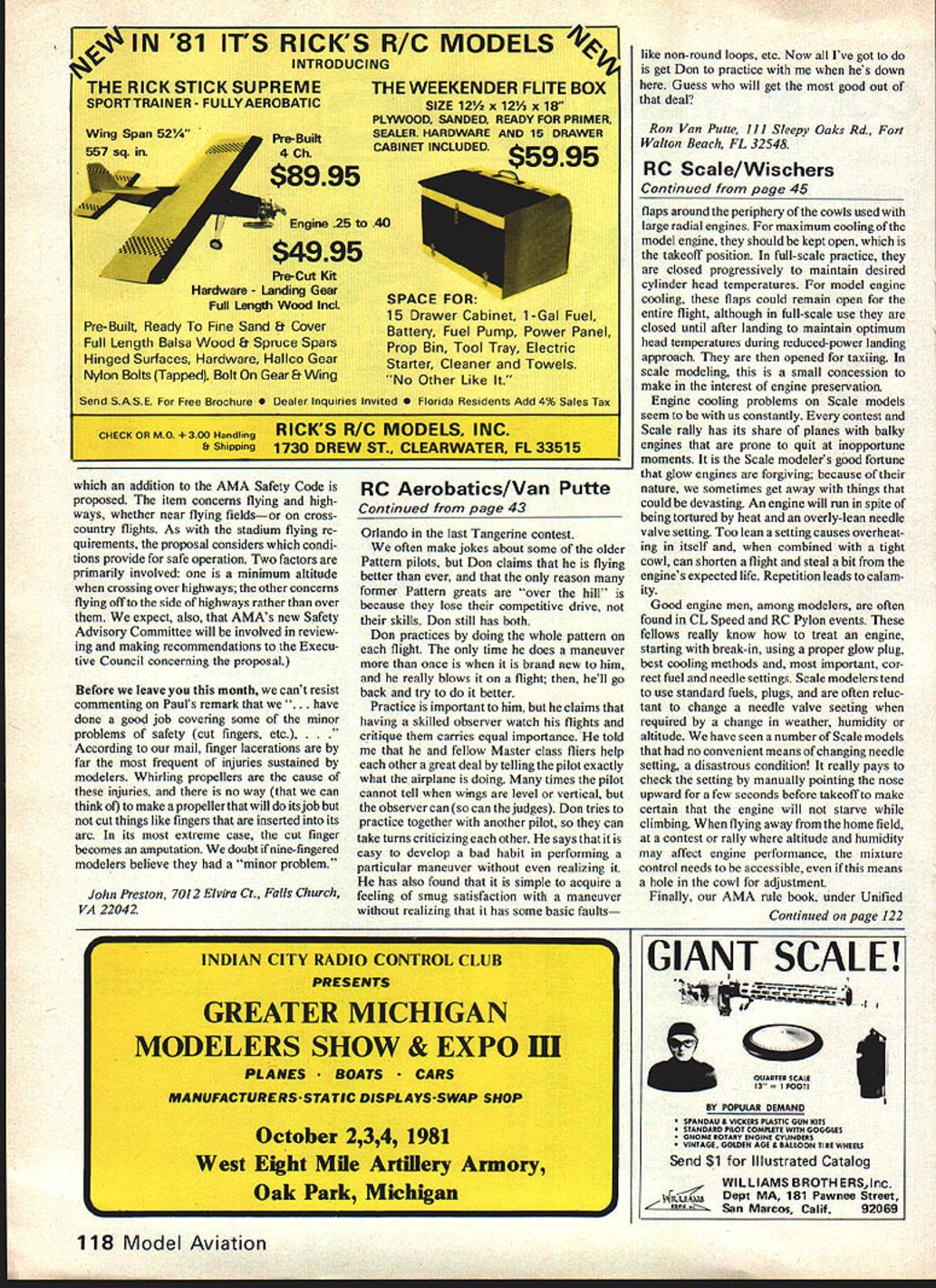
What is really needed in the Pre-Novice and Novice classes is an airplane which rolls well from inverted to upright, and an engine which has sufficient power to get the airplane to the top of the Immelmann turn with enough speed for a clean roll to upright flight. There are lots of airplanes and engines which will meet these requirements. The best news is that they are not all expensive, either. Of course, the Tiporare with retracts and a piped Rossi 60 will do the job, but who needs to kill a fly with a sledgehammer? A Dirty Birdy with fixed gear and a muffled Fox Eagle will do just as well for a lot less cost.
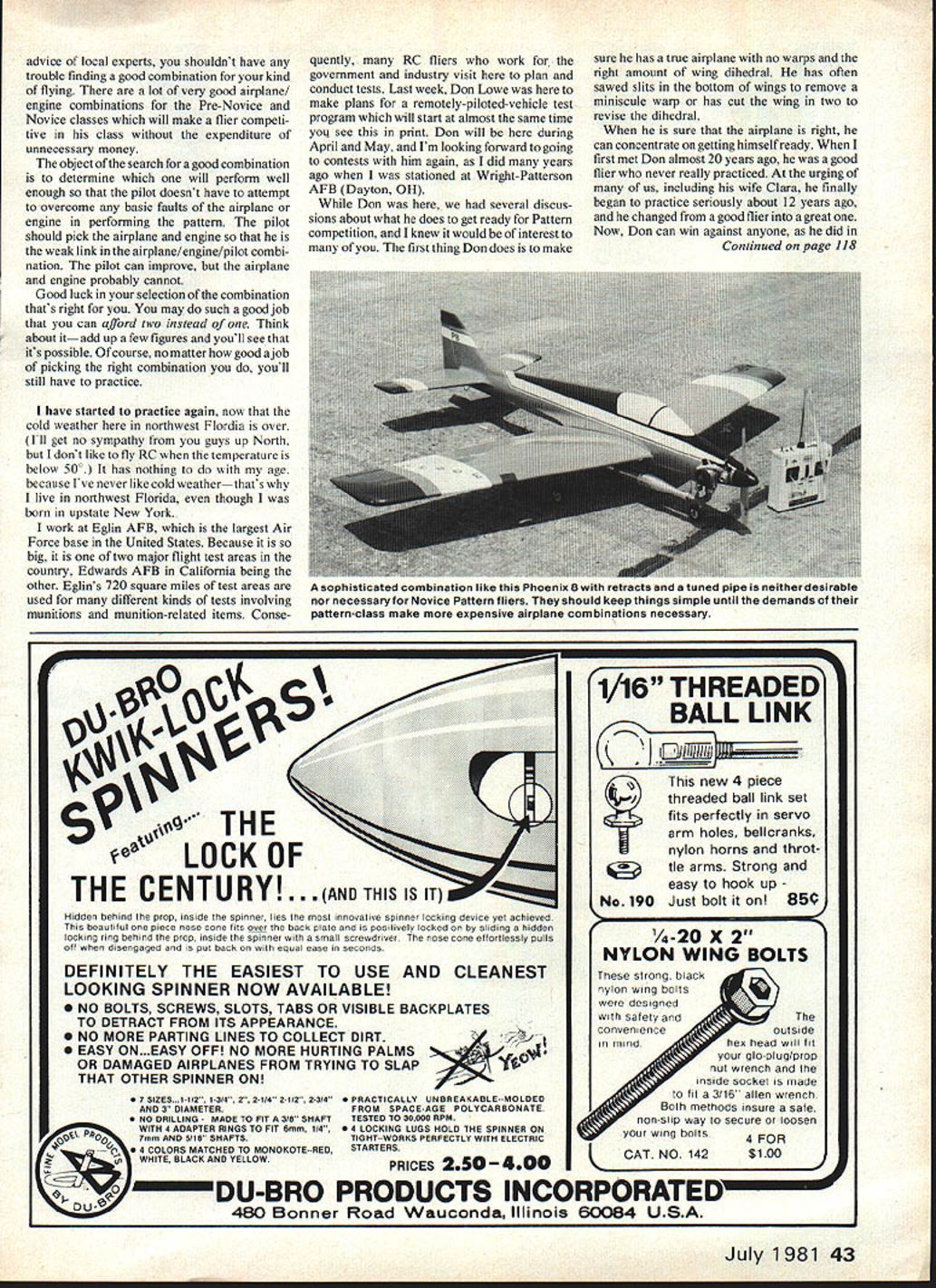
Let's face the facts: if you put retracts and a tuned pipe on an airplane, you will need more fuel and a very potent engine to haul all the extra weight to the top of the Immelmann turn. Who needs the extra hassle that retracts and tuned pipes cause, when the Immelmann and all the other Pre-Novice and Novice pattern maneuvers can be done just as well with much cheaper options? Only the Master pattern requires a piped, potent engine in a very competitive airplane. It would also be nice to have a tuned pipe in the Expert class as well, but it's not mandatory. I compete in the Expert class with a Phoenix 8 powered by a Supertigre G60 Bluehead/Mac's muffler combination. The only time I need more power is during maneuvers like the Figure M and Top Hat—and then only when the needle valve is off the peak setting. There's plenty of power for all the maneuvers because my airplane is light (7 lb., 13 oz.), and I've carefully tested propellers to find the one which works best (Zinger 11-7).
If you take the time to look around and ask the advice of local experts, you shouldn't have any trouble finding a good combination for your kind of flying. There are a lot of very good airplane/engine combinations for the Pre-Novice and Novice classes which will make a flier competitive in his class without the expenditure of unnecessary money.
The object of the search for a good combination is to determine which one will perform well enough so that the pilot doesn't have to attempt to overcome any basic faults of the airplane or engine in performing the pattern. The pilot should pick the airplane and engine so that he is the weak link in the airplane/engine/pilot combination. The pilot can improve, but the airplane and engine probably cannot.
Good luck in your selection of the combination that's right for you. You may do such a good job that you can afford two instead of one. Think about it—add up a few figures and you'll see that it's possible. Of course, no matter how good a job of picking the right combination you do, you'll still have to practice.
Practice and Preparation
I have started to practice again, now that the cold weather here in northwest Florida is over. (I'll get no sympathy from you guys up north, but I don't like to fly RC when the temperature is below 50°.) It has nothing to do with my age, because I've never liked cold weather—that's why I live in northwest Florida, even though I was born in upstate New York.
I work at Eglin AFB, which is the largest Air Force base in the United States. Because it is so big, it is one of two major flight test areas in the country, Edwards AFB in California being the other. Eglin's 720 square miles of test areas are used for many different kinds of tests involving munitions and munition-related items. Consequently, many RC fliers who work for the government and industry visit here to plan and conduct tests. Last week, Don Lowe was here to make plans for a remotely piloted vehicle test program which will start at almost the same time you see this in print. Don will be here during April and May, and I'm looking forward to going to contests with him again, as I did many years ago when I was stationed at Wright-Patterson AFB (Dayton, OH).
While Don was here, we had several discussions about what he does to get ready for Pattern competition, and I knew it would be of interest to many of you. The first thing Don does is to make sure he has a true airplane with no warps and the right amount of wing dihedral. He has often sawed slits in the bottom of wings to remove a minuscule warp or has cut the wing in two to revise the dihedral.
When he is sure that the airplane is right, he can concentrate on getting himself ready. When I first met Don almost 20 years ago, he was a good flier who never really practiced. At the urging of many of us, including his wife Clara, he finally began to practice seriously about 12 years ago, and he changed from a good flier into a great one. Now, Don can win against anyone, as he did in Orlando in the last Tangerine contest.
We often make jokes about some of the older Pattern pilots, but Don claims that he is flying better than ever, and that the only reason many former Pattern greats are "over the hill" is because they lose their competitive drive, not their skills. Don still has both.
Don practices by doing the whole pattern on each flight. The only time he does a maneuver more than once is when it is brand new to him, and he really blows it on a flight; then he'll go back and try to do it better.
Practice is important to him, but he claims that having a skilled observer watch his flights and critique them carries equal importance. He told me that he and fellow Master-class fliers help each other a great deal by telling the pilot exactly what the airplane is doing. Many times the pilot cannot tell when wings are level or vertical, but the observer can (so can the judges). Don tries to practice together with another pilot, so they can take turns criticizing each other. He says that it is easy to develop a bad habit in performing a particular maneuver without even realizing it. He has also found that it is simple to acquire a feeling of smug satisfaction with a maneuver without realizing that it has some basic faults like non-round loops, etc.
Now all I've got to do is get Don to practice with me when he's down here. Guess who will get the most good out of that deal?
Ron Van Putte 111 Sleepy Oaks Rd. Fort Walton Beach, FL 32548
Transcribed from original scans by AI. Minor OCR errors may remain.

