
Radio Control: Sport/Aerobatics
Ron Van Putte
FOR THE PAST several issues, most of each monthly article was taken up by a single subject. For a change of pace, this month I'll cover several different subjects. There's no particular reason for it, except that a bunch of ideas popped into my head while reviewing a packet of club newsletters that AMA sent to me. Before moving on to the various subjects, I'd like to share a gem which was included in the Cape Ann RC Model Club newsletter, edited by Lowell A. Warren:
"Linguistic Item—Difference between a Glitch and a Glinch: A Glitch is a momentary signal of radio interference affecting control of the plane. A Glinch is the priceless momentary expression on the pilot's face during and slightly after the Glitch." (So that's what it's called!)
Having been a newsletter editor for the Western Ohio Radio Kontrol Society for four years and for the Eglin Aero Modellers here in Florida for two years, I can appreciate the hard work that goes into turning out a club newsletter. Even a one-page newsletter has to be gathered, the master typed (or even handwritten), and the copies produced; then they have to be addressed, stamped and mailed. The job usually falls on one club member who enlists his wife (and occasionally his kids) to help. Club members enjoy receiving a newsletter, but rarely offer assistance.
That's why I was so surprised when I received a copy of Flightline, newsletter of the Greater Cincinnati Radio Control Club. It is the best newsletter I've ever seen—partly because it is chock full of good items, and partly because it has a professional appearance, but mostly because there were contributions from 14 club members! Congratulations to the Greater Cincinnati Radio Control Club and Flightline Editor J. Wambach, Jr. for a superior job—I hope the club members appreciate the great newsletter they have.
Practice, engine trouble and a fuel-filter fix
Last night I was out practicing after work for a Pattern contest which will be held next weekend. Strangely, I had engine problems. Actually it was doubly strange, because I usually don't have engine problems, and when I do, it is usually at a contest. So, here I was at the practice field with all the time I needed to figure out what was wrong. It turned out to be a leaky carburetor, but before discovering that I had pulled the engine and tank. During the process I checked the fuel filter and was reminded that I'd never mentioned my method of fixing leaky fuel filters.
Many fuel filters are supplied with a fiber washer. After a short while, these washers become hard and brittle and begin to leak air into the fuel line. Go to your local hardware store and ask to see the assortment of neoprene O-rings found in the plumbing section. You'll find rings that are a perfect fit for the filter housing. Neoprene O-rings have never caused detectable deterioration when used with fuel and the filter doesn't leak air. It would be nice if filter manufacturers would supply neoprene O-rings instead of crummy fiber washers.
Ideas for manufacturers and inventors
This brings up another item. We've got our own pet wishes about RC products — I usually start out describing them by saying, "Wouldn't it be nice if..." We've often come up with a new idea, built a working example for our own use, and don't like to go through the hassle of doing the job over again when we want another version.
A good example of a device like this is the Ball Link. I don't know who originally came up with the idea, but I'm glad Dewey Broberg and Du-Bro market it because I'd hate to try to make one from scratch. Pointing manufacturers to ideas they can market is another way designers can get recognition. If you have a good idea, send it to several likely manufacturers—the designer rarely gets publicity that way. As an example, I didn't invent the Ball Link.
If you prefer another route, send your idea to me. I'll cover the idea in the column, give full credit to the source, and suggest ways manufacturers can get the idea and the inventor can get credit. Let me hear from you because I know there are hundreds of great ideas out just waiting to be publicized.
Dihedral, sideslip and rolling stability
RC fliers are pretty good aerodynamicists regardless of background because they've developed skills, experience and observations that often make them respected authorities in their clubs. They write articles in club newsletters about the airplanes they fly. Most of the time what you see about aerodynamics in club newsletters is very good, but once in a real while there is a clinker—an incorrect explanation which nevertheless appears to explain the situation. Recently I saw an explanation of how dihedral works in developing roll stability for an airplane. Unfortunately the explanation was wrong. I've heard and read the same wrong explanation many times and I think it's time to clarify what really happens. I will also explain how wing dihedral can be used with the rudder to turn an airplane.
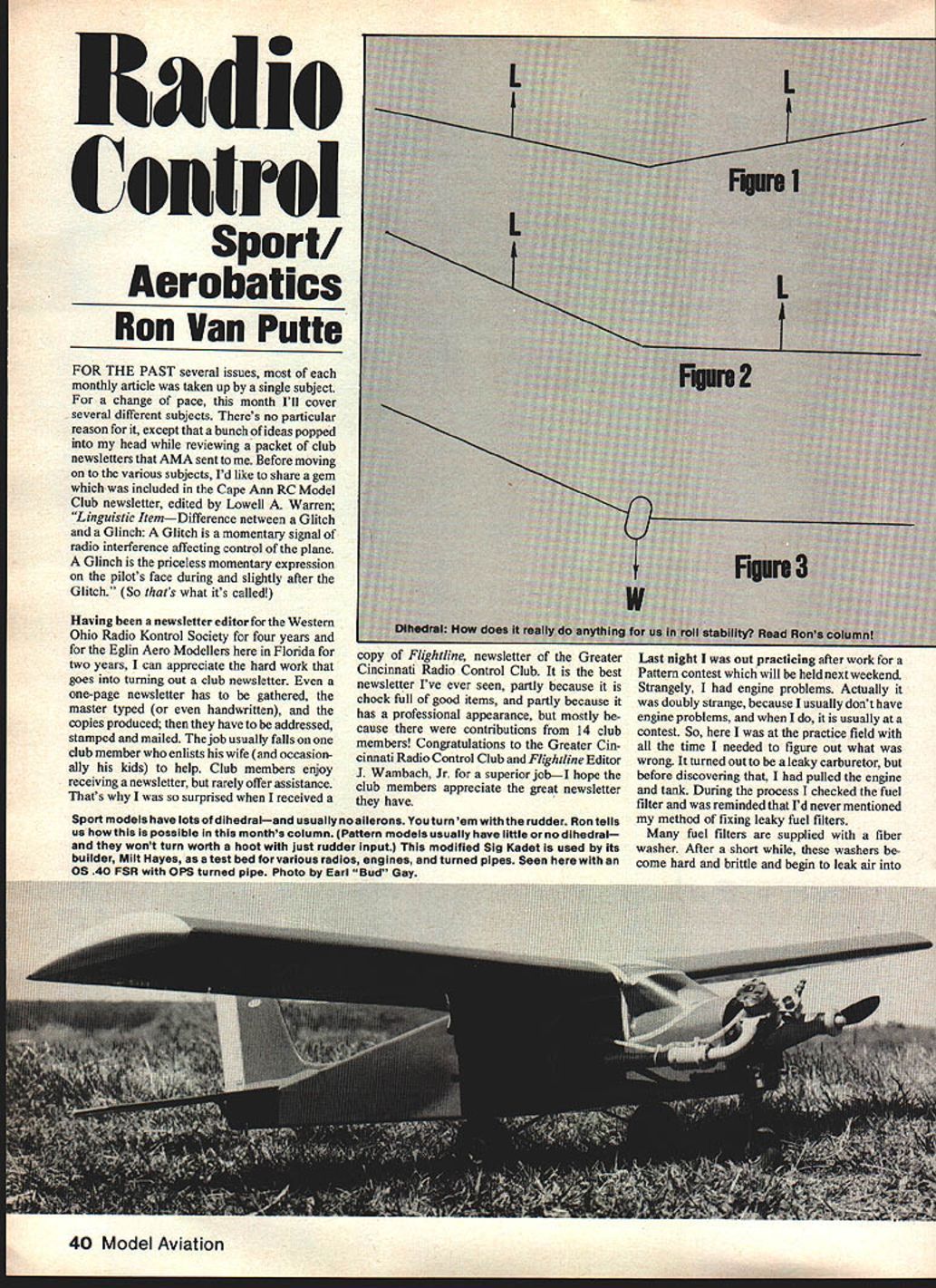
First, let me cover the wrong explanation of the dihedral effect. The incorrect reasoning assumes that lift always acts purely upward. In that reasoning, when the wings are level the rolling effect of lift cancels out, but when the wing is rolled the lift on one wing panel is said to act on an effectively smaller surface area, generating a restoring rolling moment. While this reasoning appears to explain why dihedral can be used to generate roll stability, it is wrong. Lift on a wing is not just acting in the vertical direction. In fact, an airplane has no idea that it has rolled. You could hold an airplane in an airstream and roll it about a fuselage axis aligned with the local air velocity, and no rolling moment would be generated.
So how does dihedral work?
Dihedral effect requires two factors: dihedral and sideslip. What happens is that when the airplane rolls, the component of airplane weight in the direction of the low wing causes the airplane to slip in that direction. The sideslip causes a change in effective angle of attack of the wing panels. You can easily visualize the difference in angle of attack by holding a book open in a V and moving it in a sideslip. The different angles of attack on the two panels cause a rolling moment to be generated which tends to roll the wings back to level attitude. When the wings are level, there is no longer a component of the weight trying to slip the airplane, so it stops sideslipping, and the rolling moment goes away. That's how dihedral stabilizes an airplane in roll.
Using the rudder to roll with dihedral
Now, what about how a rudder can be used to roll an airplane with dihedral in the wings? The rudder is used to yaw the airplane, causing a sideslip. As before, the sideslip generates a rolling moment, and the airplane rolls in the direction that the rudder is moved.
By the way, you may have heard that the reason the airplane rolls with rudder is because the yawing of the airplane causes one wing to speed up and the other to slow down, and the speed difference causes different amounts of lift to be generated, which rolls the airplane. While this does happen, it has a much smaller effect than that which dihedral has. This can easily be demonstrated by attempting to roll most Pattern airplanes with rudder. Pattern airplanes have little dihedral effect and they just skid along as the rudder is deflected.
Transmitter retrofit: Ace Silver Seven encoder kit
Last week I bought myself a late Christmas (early birthday?) present and am anxious to build and try it out. I had been drooling over all the options available with transmitters featuring the new Signetics NE5044 encoder integrated circuit, but I didn't really want to give up my Kraft KP-72 transmitter because of the great sticks and convenient trim pot locations. So, I made a compromise and bought the Ace Silver Seven encoder kit to replace the Kraft encoder.
As usual, Fred Marks has done a fine job for Ace in developing the kit and the instructions for assembly, adjustment and troubleshooting. Even so, Ace suggests that only experienced kit builders attempt to retrofit the encoder in another transmitter. However, I've had experience assembling Ace and Royal servo kits, troubleshooting servo problems, building a Royal receiver, and installing dual-rate switches in my KP-72 transmitter. Consequently, I am optimistic that my fair amount of experience will carry me through the job. Of course, I intend to do everything the instructions say and thoroughly read what George Myers wrote in his column on the Silver Seven transmitter in the August 1980 issue of Model Aviation.
If things work out well, you'll hear all about what a great job I did. If they don't work out, I'll probably "forget" to mention it.
Contact
Ron Van Putte 111 Sleepy Oaks Rd. Fort Walton Beach, FL 32548.
Transcribed from original scans by AI. Minor OCR errors may remain.

