
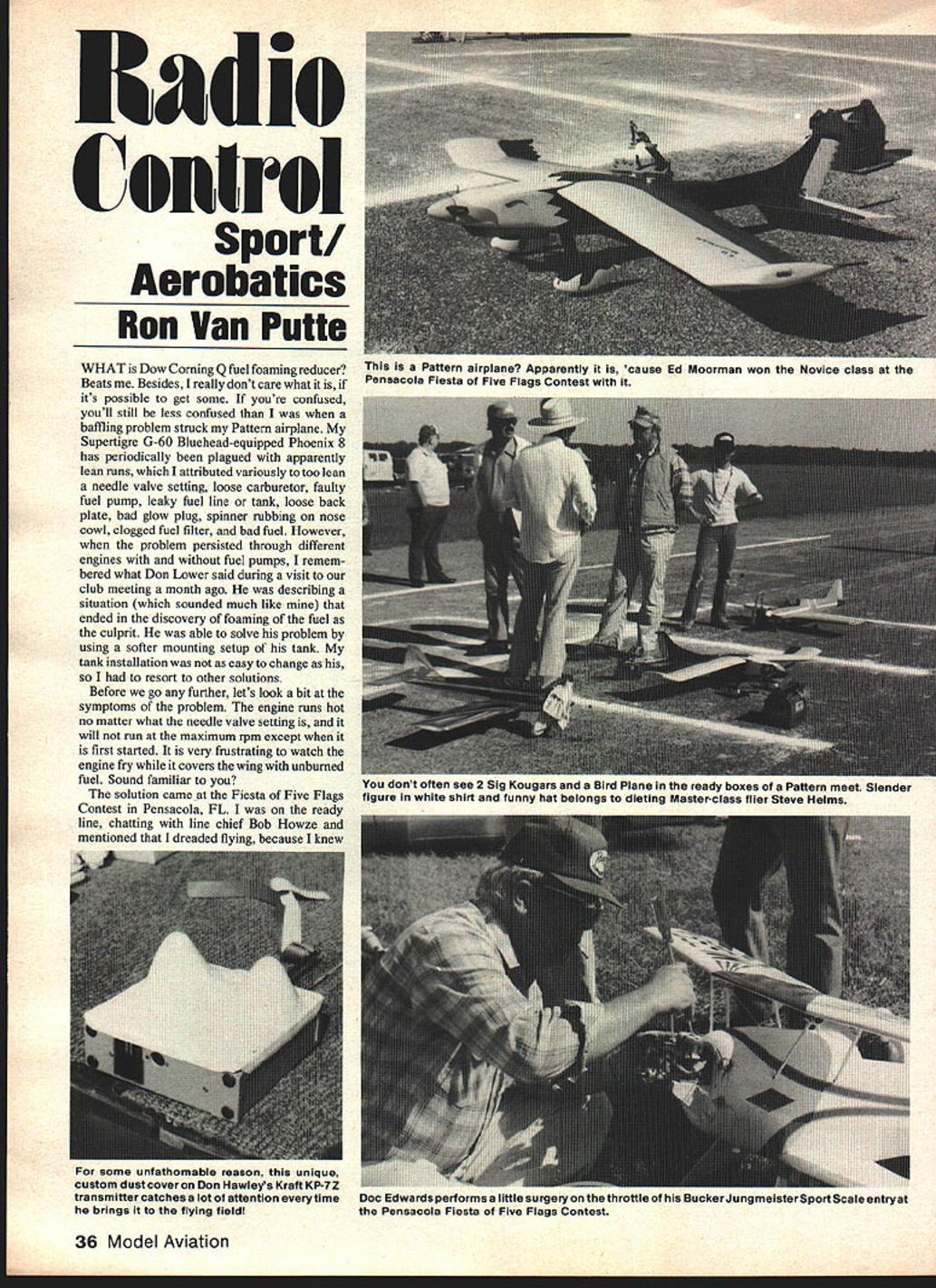
Radio Control: Sport/Aerobatics
Ron Van Putte
Fuel-foaming problem
What is Dow Corning Q fuel foaming reducer? Beats me — and I don't much care what it is if it's possible to get some. I was confused when a baffling problem struck my Pattern airplane. My Supertigre G-60 Bluehead–equipped Phoenix 8 has been periodically plagued with apparently lean runs. I had attributed the trouble variously to:
- too-lean needle valve setting
- loose carburetor
- faulty fuel pump
- leaky fuel line or tank
- loose back plate
- bad glow plug
- spinner rubbing on nose cowl
- clogged fuel filter
- bad fuel
When the problem persisted through different engines with and without fuel pumps, I remembered what Don Lowe said during a visit to our club meeting a month earlier. He described a situation very similar to mine that ended with the discovery of fuel foaming as the culprit. He solved his problem by using a softer mounting setup for his tank, but my tank installation was not as easy to change, so I had to try other solutions.
Symptoms
Typical symptoms of foaming-related problems are:
- Engine runs hot regardless of needle valve setting.
- Engine will not sustain maximum rpm except immediately after start.
- The engine may overrun and foul the wing with unburned fuel.
If that sounds familiar, foaming is a likely suspect.
Solution: Dow Corning Q
At the Fiesta of Five Flags contest in Pensacola, FL, line chief Bob Howze told me he'd had the same problem and found a cure. He returned with some Dow Corning Q foaming reducer and added four drops of the translucent, oily fluid to a gallon of fuel. The tendency to foam virtually disappeared and my engine problem was solved.
Unfortunately, Dow Corning Q does not seem to be available anymore. Dow Corning apparently makes a range of foaming reducers (A through Q), but Bob said none worked as well as Q for him. He was able to get a small quantity just after they stopped making it. Bob also noted that Q works best in model fuels with about 10% or more nitro. If anyone knows where to obtain Dow Corning Q or an equivalent product, please let me know.
Tuned pipe: testing and impressions
While Don Lowe was here for five weeks of testing at an Eglin AFB range, he suggested improvements to my flying technique and recommended trying a tuned pipe. I bought an OPS muffled pipe from Radio South and bolted it to the side of my Phoenix 8 above the wing. It was easy to tune using the included directions.
Performance changes I observed:
- With the original Mac's flow-through muffler, the engine turned about 12,600 rpm on a Zinger 11x7 prop, burning home‑brew 10% nitro fuel.
- With the tuned pipe, it now turns about 13,700 rpm.
- The airplane is noticeably faster and vertical performance is significantly improved.
- Maneuvers like the Figure M and Top Hat are much easier to do well because the plane holds speed better.
- Looping maneuvers require very little aileron correction — likely because the airplane travels at a more constant speed.
My engine is mounted vertically with the pipe running down the right side of the fuselage. Despite the ugly blob of pipe and exhaust along the side, I could not detect any significant adverse effect on Knife-Edge characteristics. I had expected to need more left rudder when rolled 90° clockwise, but that didn't happen. Surprisingly, I now need a bit more right rudder on the last point of a Four-Point Roll than before.
Fuel consumption
A tuned pipe definitely increases fuel consumption. My Supertigre G-60 used to burn about 10 oz. of fuel for a complete Expert-class Pattern flight; with the pipe it burns about 14 oz. That works out to roughly nine Pattern flights per gallon of fuel. Good thing I make my own fuel.
Bottom line: I don't like the looks or the increased fuel consumption of a piped engine, but I do like how it makes the Expert pattern easier to do well. I still don't think the benefits justify using a tuned pipe in Novice or Advanced classes.
Landing-gear advice: eliminating bouncy landings
At the field, an experienced flier asked my advice because he couldn't keep his airplane from bouncing unless he performed a perfect landing. He had two things wrong with his landing-gear setup; either one could cause bouncy landings.
- Nose-high attitude
- The airplane sat nose-high on the gear, giving the wing a positive angle of attack. Lift is generated while the airplane is moving, so a "hot" landing can cause the model to attempt to take off again.
- The higher the nose-up attitude, the lower the speed at which it will try to lift off.
- Fix: set the fuselage parallel to the runway or slightly nose-down. Slight nose-down helps kill lift as the airplane rotates onto the nose gear and makes the model stick to the runway. Excessive nose-down will make rotation off the ground abrupt and takeoffs unpleasant.
- Main-gear struts angled aft
- He had angled the main gear struts back for appearance. When the struts are angled back, a vertical landing load causes the strut to bend further back and up, making the airplane "squat." If the nose gear doesn't compress the same way, the angle of attack increases and the model tends to take off again.
- The hotter the landing, the worse the bounce. The result can be a "boing, boing, boing" down the runway.
- Fix: keep main gear struts vertical — landings should improve dramatically.
May all your loops be round, unless they are supposed to be square or triangular.
Ron Van Putte 111 Sleepy Oaks Dr. Fort Walton Beach, FL 32548
Transcribed from original scans by AI. Minor OCR errors may remain.

