
Radio Control: Sport/Aerobatics
Ron Van Putte
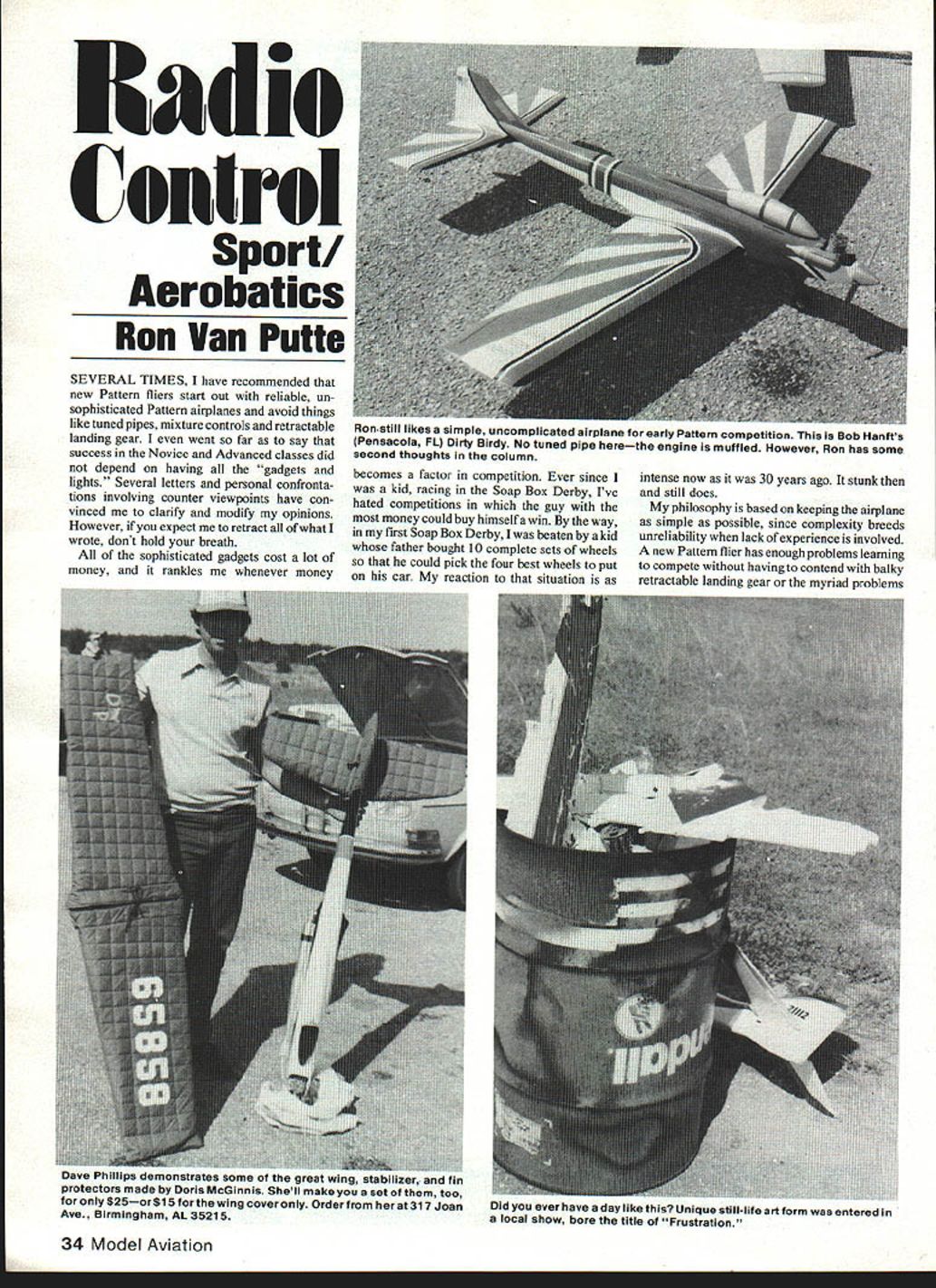
SEVERAL TIMES, I have recommended that new Pattern fliers start out with reliable, unsophisticated Pattern airplanes and avoid things like tuned pipes, mixture controls and retractable landing gear. I even went so far as to say that success in the Novice and Advanced classes did not depend on having all the "gadgets and lights." Several letters and personal confrontations involving counter viewpoints have convinced me to clarify and modify my opinions. However, if you expect me to retract all of what I wrote, don't hold your breath.
All of the sophisticated gadgets cost a lot of money, and it rankles me whenever money becomes a factor in competition. Ever since I was a kid, racing in the Soap Box Derby, I've hated competitions in which the guy with the most money could buy himself a win. By the way, in my first Soap Box Derby I was beaten by a kid whose father bought 10 complete sets of wheels so that he could pick the four best wheels to put on his car. My reaction to that situation is as intense now as it was 30 years ago. It stunk then and still does.
My philosophy is based on keeping the airplane as simple as possible, since complexity breeds unreliability when lack of experience is involved. A new Pattern flier has enough problems learning to compete without having to contend with balky retractable landing gear or the myriad problems associated with pipes, headers, pumps and mixture controls. I hate to think about Pattern flights spoiled because a flier is concerned about a mechanical problem — loss of concentration causes maneuvers to turn out looking bad. A competition airplane should reflect the experience of the flier; its selection should be based on what someone feels comfortable with.
I recognize the counter argument that the Novice and Advanced classes, rather than the Expert and Master classes, are the place to learn to overcome problems associated with sophisticated equipment. However, I have witnessed Novice class fliers give up Pattern flying in frustration because gadgets were driving them nuts.
A difficult counter argument is that a fixed-gear airplane with a muffled engine can be competitive — if two fliers are of equal ability, the one with the simple airplane or the one with the gadgets will probably win. This is not always true for two reasons. First, airplanes generally fly more smoothly with retractable landing gear and piped engines. Smoother flying results in higher maneuver scores. Second, some judges are convinced that a flier with a simple airplane must be a poor flier. Bad judges' opinions aside, that's the way some people think.
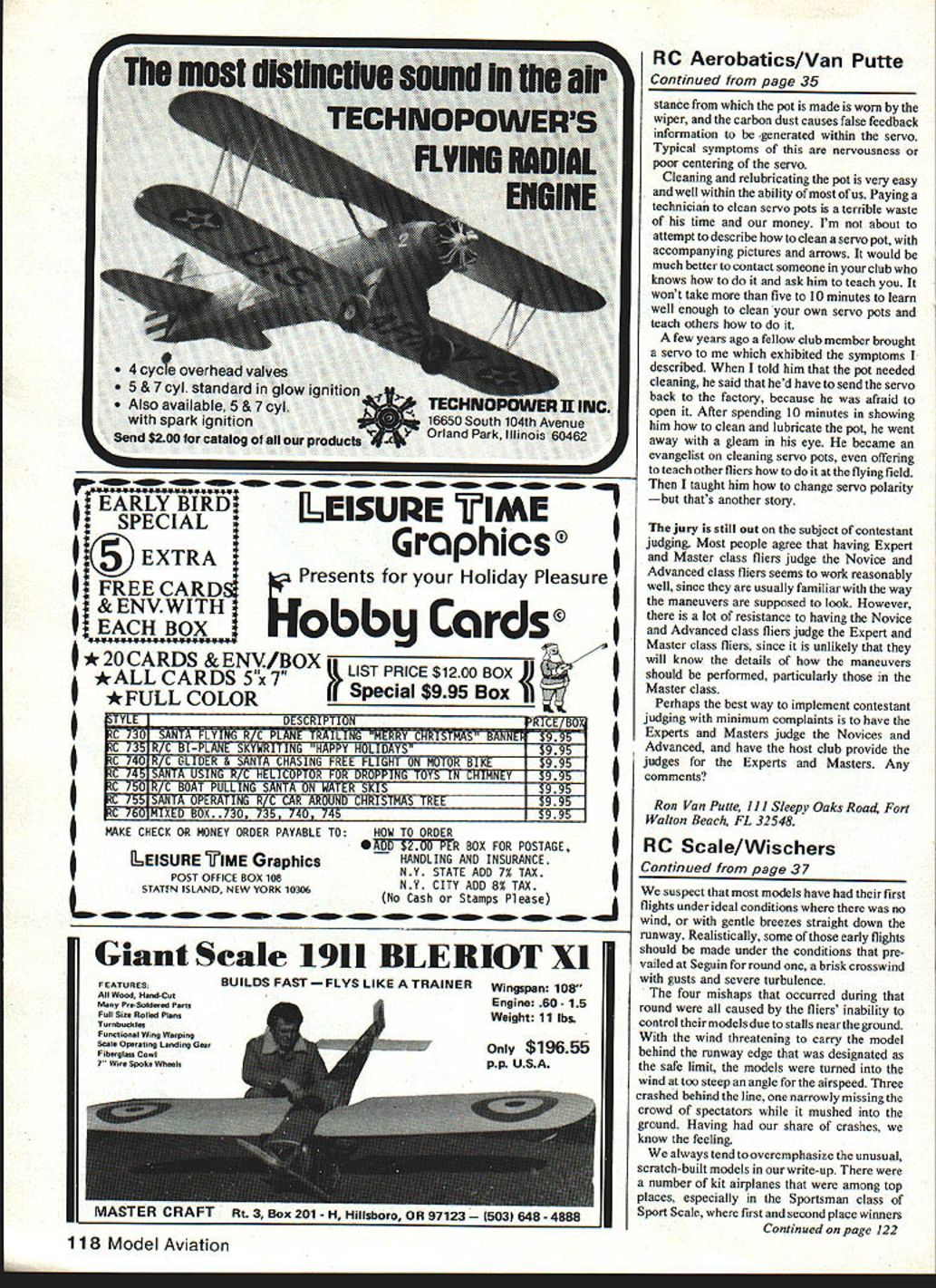
The decision facing a new Pattern flier will depend on experience and wallet. If a flier has the experience and ability to handle the complexity involved and his wallet can support the cost, it means go gadgets. However, one must be aware that gadgets will contribute problems associated with competition and should be avoided if they will cause more trouble than they solve. It's a tough decision to make because a small amount of ego is involved in deciding whether one's experience and ability are sufficient to tackle the complexity.
- Considerations when choosing gadgets:
- If you have the experience and ability to handle complexity, and can afford it, gadgets may be appropriate.
- Avoid gadgets if they will introduce more problems than they solve or jeopardize your concentration during a flight.
- Base your airplane selection on what makes you comfortable and confident.
Blind Nuts (Reader Suggestion)
In the August column I solicited ideas on items you'd like to see produced. Several great suggestions have come in the past month. I'd like to share the first. Donald Le Boeuf, Belle Chasse, LA wrote about blind nuts — plastic inserts that keep screws from loosening due to vibration. Super idea.
For years I've been using lock nuts with plastic inserts as a backup when installing the motor mount to the firewall. It would be a lot handier to have both in the same unit. Certainly the cost would be higher than a standard blind nut, but I would gladly pay the difference in applications where locking screws are necessary. Thanks, Don.
Official Flight Definition and Rule Enforcement
A festering problem has been uncovered recently and reported in the K-Factor newsletter, National Society of Radio Controlled Aerobatics. The 1980-81 AMA rule book contains a definition of "official flight" (see page 40, section 3810). The definition has revised the earlier rules. As redefined, an official flight occurs as a result of a single attempt. Look it up yourself; see the conditions specified. The Contest Board made the AMA rules consistent with FAI competition rules.
However, apparently some Contest Directors choose to ignore the rule change and allow contestants who encounter difficulties actually caused by factors beyond the competitor's responsibility to go to the end line for another attempt. This leniency often infuriates other contestants who may have driven hundreds of miles to compete, who expect the competition to be run according to the rule book.
No one wishes another contestant to have a problem like a blown glow plug or a loose prop nut caused by an engine backfire, but the rules place the responsibility for this type of problem on the contestant to handle during the three-minute starting time. It's part of competing. Of course, radio difficulties caused by interference are exempt from the rule—as they should be. But radio problems within the contestant's equipment are his responsibility and should be discovered prior to his attaching the battery clip to the glow plug—or suffer the consequences of a missed round.
Contest Directors should decide if all AMA rules are to be followed to the letter. Exceptions to the rule book should be publicized prior to the contest and discussed at the pilots' briefing. The consequences of not following the rule book can be very ugly, as many a beleaguered Contest Director can attest.
Servos: Maintenance and Cleaning
The servo is probably the most neglected part of the airplane outside of the engine. We expect them to keep plugging away and are surprised when they have problems. Many of us even brag that we have flown hundreds of flights and never had a servo fail. When you think about it, it's kind of like bragging that you've driven a car 100,000 miles and never replaced the oil filter or changed the oil. It's dumb not to give servos a good check once in a while.
Although many of the problems which servos can have are outside our ability to correct, we can handle cleaning of the potentiometer. The pot is subject to wear, especially on the controls which are used a lot, like elevator and aileron. What happens is that the carbon substance from which the pot is made is worn by the wiper, and the carbon dust causes false feedback information to be generated within the servo. Typical symptoms of this are nervousness or poor centering of the servo.
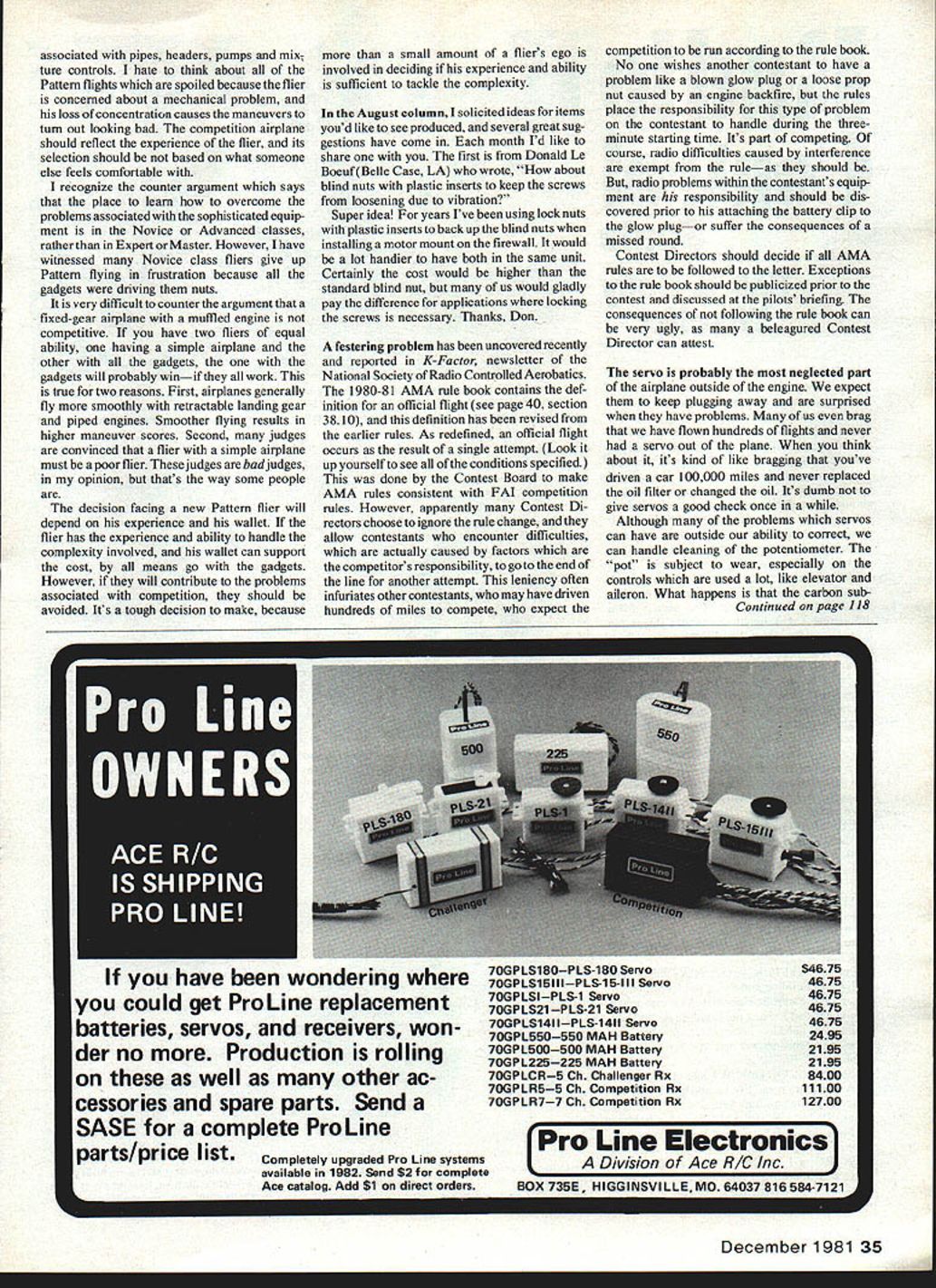
Cleaning and relubricating the pot is very easy and well within the ability of most of us. Paying a technician to clean servo pots is a terrible waste of his time and our money. I'm not about to attempt to describe how to clean a servo pot, with accompanying pictures and arrows. It would be much better to contact someone in your club who knows how to do it and ask him to teach you. It won't take more than five to 10 minutes to learn well enough to clean your own servo pots and teach others how to do it.
A few years ago a fellow club member brought a servo to me which exhibited the symptoms I described. When I told him that the pot needed cleaning, he said that he'd have to send the servo back to the factory, because he was afraid to open it. After spending 10 minutes in showing him how to clean and lubricate the pot, he went away with a gleam in his eye. He became an evangelist on cleaning servo pots, even offering to teach other fliers how to do it at the flying field. Then I taught him how to change servo polarity — but that's another story.
Contestant Judging
The jury is still out on the subject of contestant judging. Most people agree that having Expert and Master class fliers judge the Novice and Advanced class fliers seems to work reasonably well, since they are usually familiar with the way the maneuvers are supposed to look. However, there is a lot of resistance to having the Novice and Advanced class fliers judge the Expert and Master class fliers, since it is unlikely that they will know the details of how the maneuvers should be performed, particularly those in the Master class.
Perhaps the best way to implement contestant judging with minimum complaints is to have the Experts and Masters judge the Novices and Advanced, and have the host club provide the judges for the Experts and Masters. Any comments?
Ron Van Putte, 111 Sleepy Oaks Road, Fort Walton Beach, FL 32548.
Transcribed from original scans by AI. Minor OCR errors may remain.

