
Radio Control: Sport/Aerobatics
Ron Van Putte
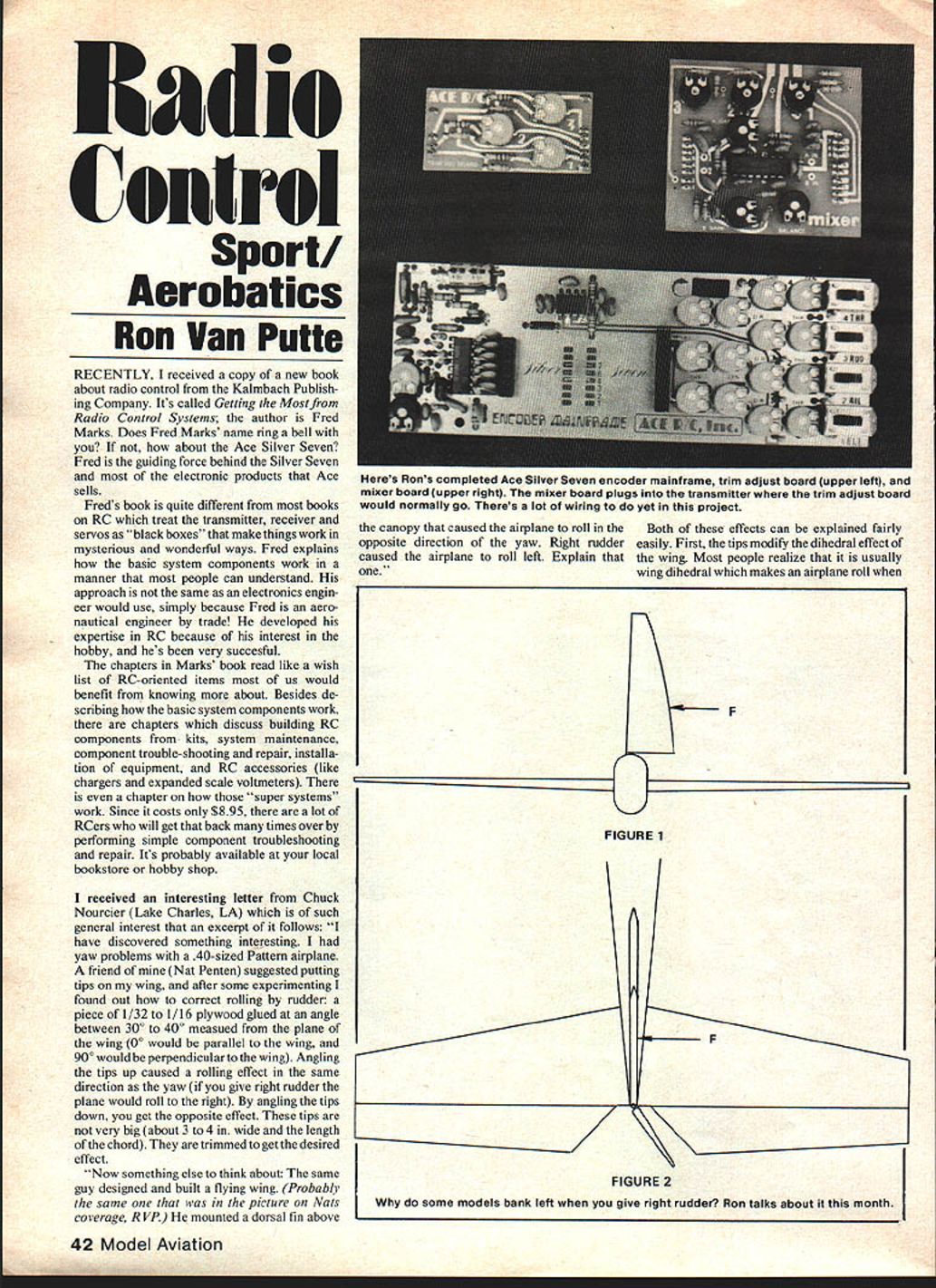
I recently received a copy of a new book about radio control from Kalmbach Publishing Company: Getting the Most from Radio Control Systems by Fred Marks. Does the name Fred Marks ring a bell? If not, how about the Ace Silver Seven? Fred is the guiding force behind the Silver Seven and most of the electronic products that Ace sells.
Book review: Getting the Most from Radio Control Systems
Fred's book is quite different from most RC books that treat the transmitter, receiver, and servos as "black boxes" that work in mysterious ways. Fred explains how the basic system components work in a manner that most people can understand. His approach is not the same as an electronics engineer would use—he is an aeronautical engineer by trade. He developed his RC expertise through the hobby and has been very successful.
The chapters read like a wish list of RC-oriented topics most of us would benefit from knowing more about. Besides describing how the basic system components work, the book covers:
- Building RC components from kits
- System maintenance
- Component troubleshooting and repair
- Installation of equipment
- RC accessories (chargers, expanded-scale voltmeters, etc.)
- How "super systems" work
At $8.95, many RCers will recoup the cost several times over by performing simple troubleshooting and repairs themselves. It is probably available at your local bookstore or hobby shop.
Letter excerpt: Chuck Nourcier (Lake Charles, LA)
I received an interesting letter from Chuck Nourcier that is of general interest. An excerpt follows:
"I have discovered something interesting. I had yaw problems with a .40-sized pattern airplane. A friend of mine (Nat Penten) suggested putting tips on my wing, and after some experimenting I found out how to correct rolling by rudder: a piece of 1/32" to 1/16" plywood glued at an angle between 30° to 40° measured from the plane of the wing (0° would be parallel to the wing, and 90° would be perpendicular to the wing). Angling the tips up caused a rolling effect in the same direction as the yaw (if you give right rudder the plane would roll to the right). By angling the tips down, you get the opposite effect. These tips are not very big (about 3 to 4 in. wide and the length of the chord). They are trimmed to get the desired effect.
"Now something else to think about: The same guy designed and built a flying wing. He mounted a dorsal fin above the canopy that caused the airplane to roll in the opposite direction of the yaw. Right rudder caused the airplane to roll left. Explain that one."
Explanation: Tip plates, dihedral, and flying-wing behavior
Both of these effects can be explained fairly easily.
Tip plates and dihedral
- The wing tips modify the effective dihedral of the wing. Most people realize that wing dihedral usually makes an airplane roll when it yaws.
- Pattern fliers often cut the wing in half to change dihedral. Rudder-only airplanes get dihedral effect by tip plates if the wing doesn't have enough dihedral.
- Tip plates installed above the plane of the wing increase the effective dihedral; tips down reduce it.
- Practical test: put a pattern airplane in level flight and give right rudder — if the airplane rolls right, less dihedral is needed; tip plates should be installed below the plane of the wing. Conversely, if it rolls left, tip plates should be above the wing.
- Tip plates are an easier alternative to cutting a wing and reassembling it.
Flying-wing response (rolling opposite to yaw)
- This effect is usually noted on airplanes with very short fuselages and very large vertical fins. The cause is the way the yawing moment is generated by the vertical fin.
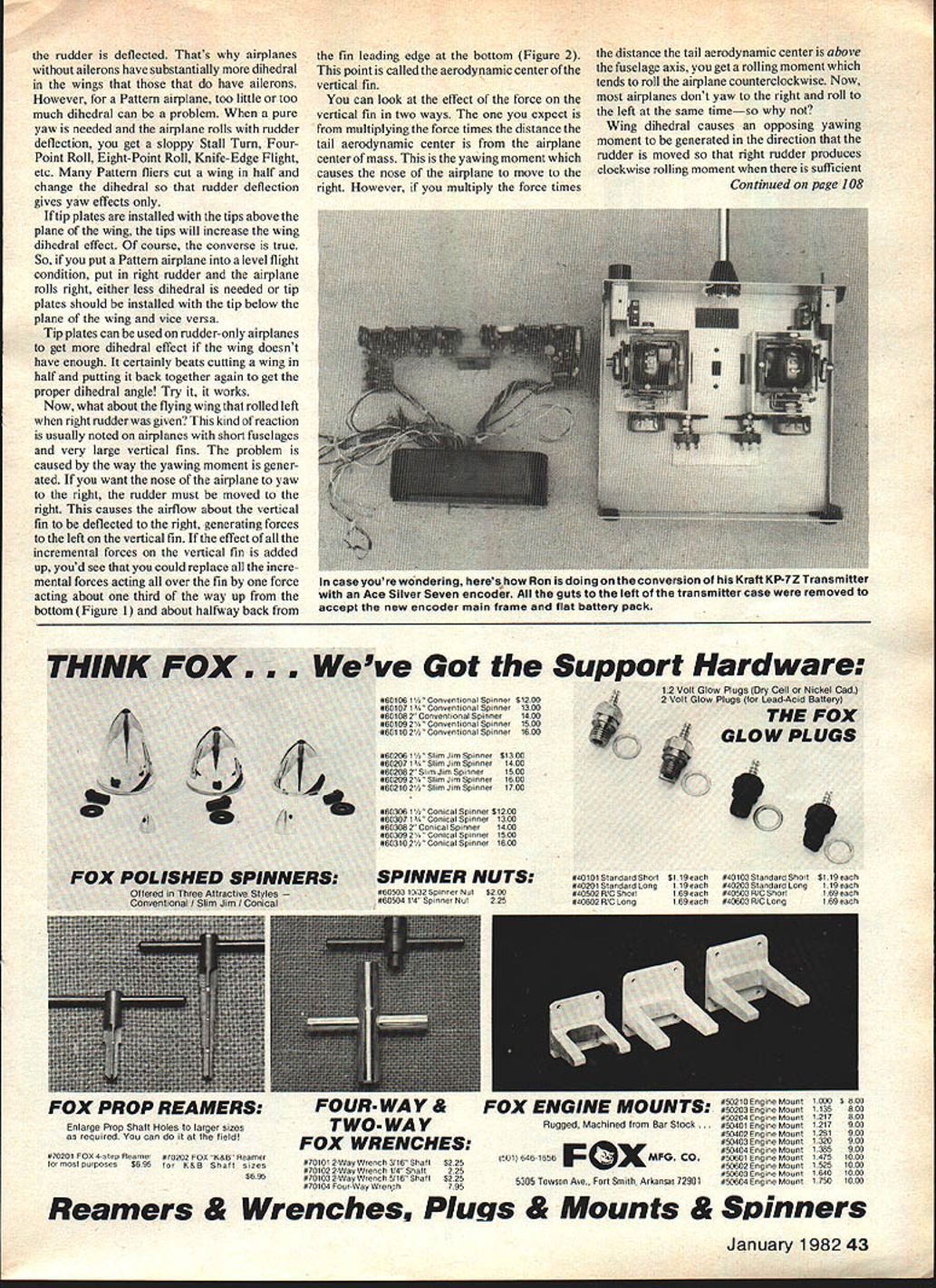
- When the rudder is deflected right to make the nose yaw right, the airflow about the vertical fin is deflected right, generating forces to the left. The incremental forces on the vertical fin can be represented by a single resultant force acting at a specific point on the fin—the aerodynamic center of the vertical fin (approximately one-third of the way up from the bottom or about halfway back from the fin leading edge).
- You can look at the effect two ways:
- Multiply the force by the distance from the tail aerodynamic center to the airplane center of mass to get the yawing moment.
- Multiply the force by the distance the tail aerodynamic center is above the fuselage axis to get a rolling moment, which may tend to roll the airplane counterclockwise.
- If the rolling moment generated by the fin is larger than the dihedral-induced rolling moment, the airplane may roll opposite to the yaw (e.g., right rudder producing a left roll).
Corrective measures
- Increase wing dihedral to generate a rolling moment that opposes the fin-induced roll.
- Move the vertical fin aerodynamic center closer to the fuselage axis by adding a ventral fin (putting some of the vertical fin below the fuselage).
Pattern fliers have a special need: they don't want any rolling moment when the rudder is deflected. That's why many pattern airplanes have ventral fins and carefully set wing dihedral so the two rolling moments cancel when the rudder is used.
Notes on the Nats and Lakehurst
I just got my copy of the 1981 Nats issue (November), and I was somewhat disappointed with the published list of results. Once again this year, only the top 10 pattern finalists in each event made the list. Like many contestants, I wanted to find out exactly where I finished. Let's hope there's enough room in the next Nats issue to publish the complete list of contestant placings.
By the way, the next Nats will probably be a lot cooler than some recent sites. Lakehurst NAS often benefits from onshore breezes from the Atlantic, which moderate summer temperatures. I remember attending a pattern contest there ten years ago when it was 90° in Washington and about 65° in Lakehurst, with very strong winds. Don Lowe and I took turns sharing an old grubby blanket he kept in his car.
For those who have never seen a blimp hangar, Lakehurst is a real treat. Some of the largest blimp hangars in the world are there. They are so big they can have their own weather—on the right days it has rained inside the biggest hangar when it wasn't raining outside.
Dow Corning anti-foaming agent update
I received an update on the Dow Corning anti-foaming agent for fuel. John Perault (La Grange, IN) called the Model Aviation editorial office and reported that the Q anti-foaming agent was discontinued in 1976. It has been replaced by DB-100, which lists for $8 per gallon but is not sold to individuals—only to companies. It is available from Dow Corning distributors in 5-gallon cans for about $300. You can call Dow Corning at (800) 248-2345, tell them what you need, and they will direct you to the nearest distributor. The local distributor may send you a free sample; mine did. Many thanks to John Perault for calling long distance at his own expense.
Ron Van Putte 111 Sleepy Oaks Rd. Fort Walton Beach, FL 32548
Transcribed from original scans by AI. Minor OCR errors may remain.

