
Radio Control SPORT/AEROBATICS
Ron Van Putte
This month I'd like to tie up a few loose ends. In several previous columns, a couple of topics generated comments and questions from readers that may be of general interest. The first is the result of a letter from Gary Sutton (Ashby, NE), who had a question about dihedral. He reported, "I can fly my Sig Kadet upside down and make very gradual turns. Turning your drawing upside down, I can't see how this works."
Dihedral and inverted flight
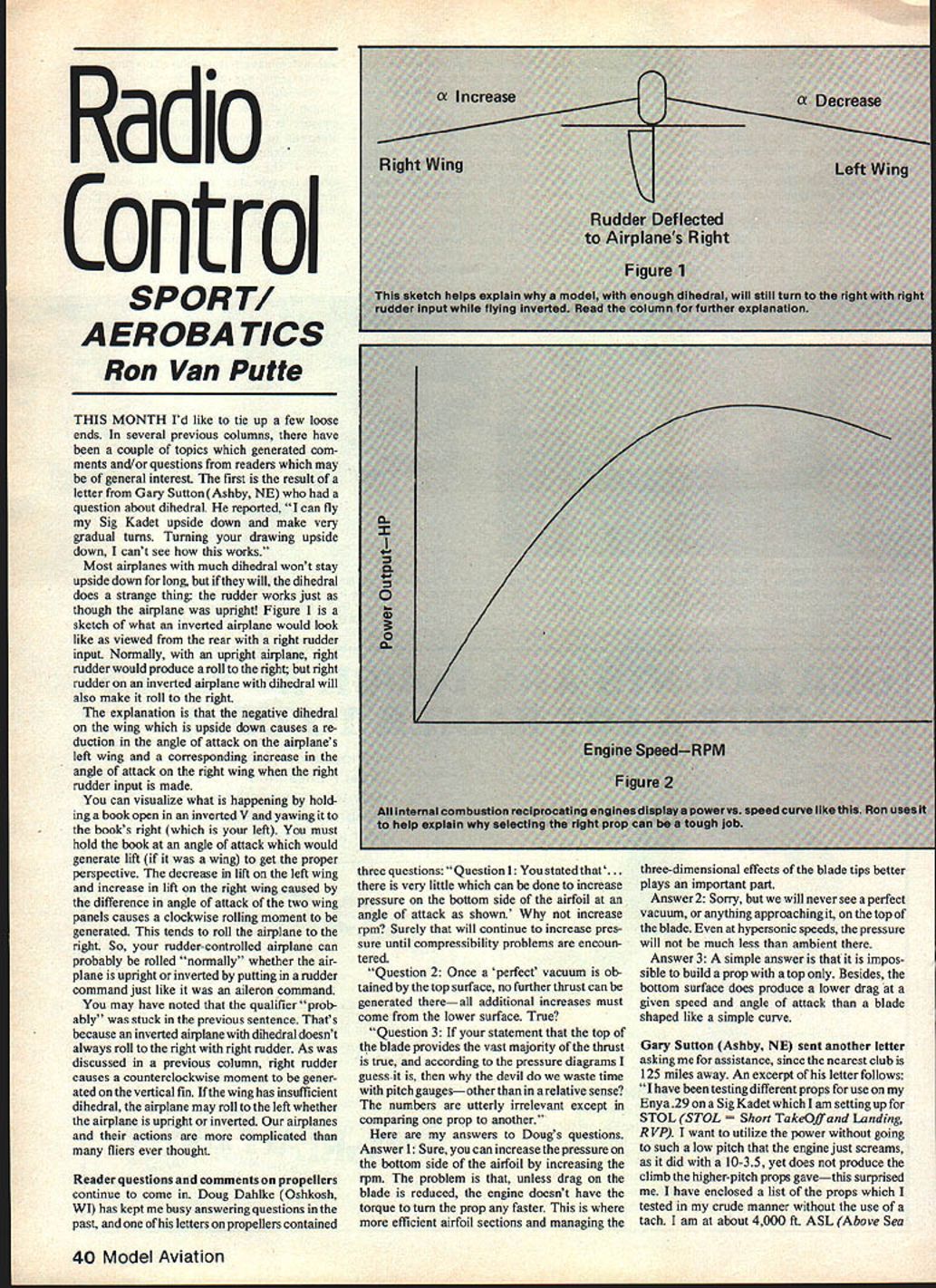
Most airplanes with much dihedral won't stay inverted for long, but if they will, the dihedral does a strange thing: the rudder works just as though the airplane were upright. Figure 1 is a sketch of what an inverted airplane would look like as viewed from the rear with a right rudder input. Normally, with an upright airplane, right rudder would produce a roll to the right; but right rudder on an inverted airplane with dihedral will also make it roll to the right.
The explanation is that the negative dihedral on the wing (the wing panels being upside down) causes a reduction in angle of attack on the airplane's left wing and a corresponding increase in angle of attack on the right wing when a right rudder input is made.
You can visualize what is happening by holding a book open in an inverted V and yawing it to the book's right (which is your left). Hold the book at an angle of attack that would generate lift (if it were a wing) to get the proper perspective. The decrease in lift on the left wing and increase in lift on the right wing, caused by the difference in angle of attack of the two wing panels, creates a clockwise rolling moment. This tends to roll the airplane to the right. So your rudder-controlled airplane can probably be rolled "normally" whether upright or inverted by putting in a rudder command just like it was an aileron command.
You may have noted that the qualifier "probably" was used. That's because an inverted airplane with dihedral doesn't always roll to the right with right rudder. As discussed in a previous column, right rudder causes a counterclockwise moment to be generated on the vertical fin. If the wing has insufficient dihedral, the airplane may roll to the left whether it is upright or inverted. Our airplanes and their actions are more complicated than many fliers ever thought.
Propeller questions from readers
Reader questions and comments on propellers continue to arrive. Doug Dahlke (Oshkosh, WI) has kept me busy answering questions in the past, and one of his letters contained three questions:
- "I stated that there is very little which can be done to increase pressure on the bottom side of the airfoil at an angle of attack as shown. Why not increase rpm? Surely that will continue to increase pressure until compressibility problems are encountered."
- "Once a 'perfect' vacuum is obtained on the top surface, no further thrust can be generated there—all additional increases must come from the lower surface. True?"
- "If your statement that the top of the blade provides the vast majority of the thrust is true, and according to the pressure diagrams I guess it is, then why the devil do we waste time with pitch gauges—other than in a relative sense? The numbers are utterly irrelevant except in comparing one prop to another."
Here are my answers to Doug's questions.
Answer 1: Yes, you can increase pressure on the bottom side of the airfoil by increasing rpm. The problem is that, unless drag on the blade is reduced, the engine won't have the torque to turn the prop any faster. This is where more efficient airfoil sections and managing the three-dimensional effects of the blade tips become important.
Answer 2: Sorry, but we will never see a perfect vacuum, or anything approaching it, on the top of the blade. Even at hypersonic speeds, the pressure will not be much less than ambient there.
Answer 3: A simple answer is that it is impossible to build a prop with a top only. Besides, the bottom surface does produce useful lift (or lower drag) at a given speed and angle of attack compared with a blade shaped like a simple curve.
Propeller testing: Gary Sutton's experiments
Gary Sutton (Ashby, NE) sent another letter asking for assistance, since the nearest club is 125 miles away. An excerpt of his letter follows: "I have been testing different props for use on my Enya .29 on a Sig Kadet which I am setting up for STOL (Short Takeoff and Landing). I want to utilize the power without going to such a low pitch that the engine just screams, as it did with a 10-3.5, yet does not produce the climb the higher-pitch props gave — this surprised me. I have enclosed a list of the props which I tested in my crude manner without the use of a tach. I am at about 4,000 ft. ASL (Above Sea Level), using 15% fuel and a spring scale tied to the tail of my plane. The Enya .29 calls for a 10-in. prop, but the 11-in. ones seem to give the best static thrust. Do I lose power once in the air with the larger props? Do you have any suggestions which might help my takeoff performance?"
Gary included a list of 13 propellers he tested. The highest static thrust (2.6 lb.) was with an 11-5 Top Flite Super Maple prop. All the other props tested had static thrust from 2.2 to 2.3 lb., with the exception of a 10-3.5 Top Flite nylon prop, which tested at 1.75 lb.
An excerpt of what I wrote back to him follows.
"You must really be in the 'boonies' if the nearest club is 125 miles away. It must be a problem to get supplies if there aren't any hobby shops or other modelers around. That's what makes the extent of your experiments so surprising. You have done a lot of work on the subject. As you have already discovered, there are no simple answers to the problem. Unfortunately, the lack of a tachometer will inhibit getting the correct answer, but it won't prevent you from getting it. It will just take a little longer.
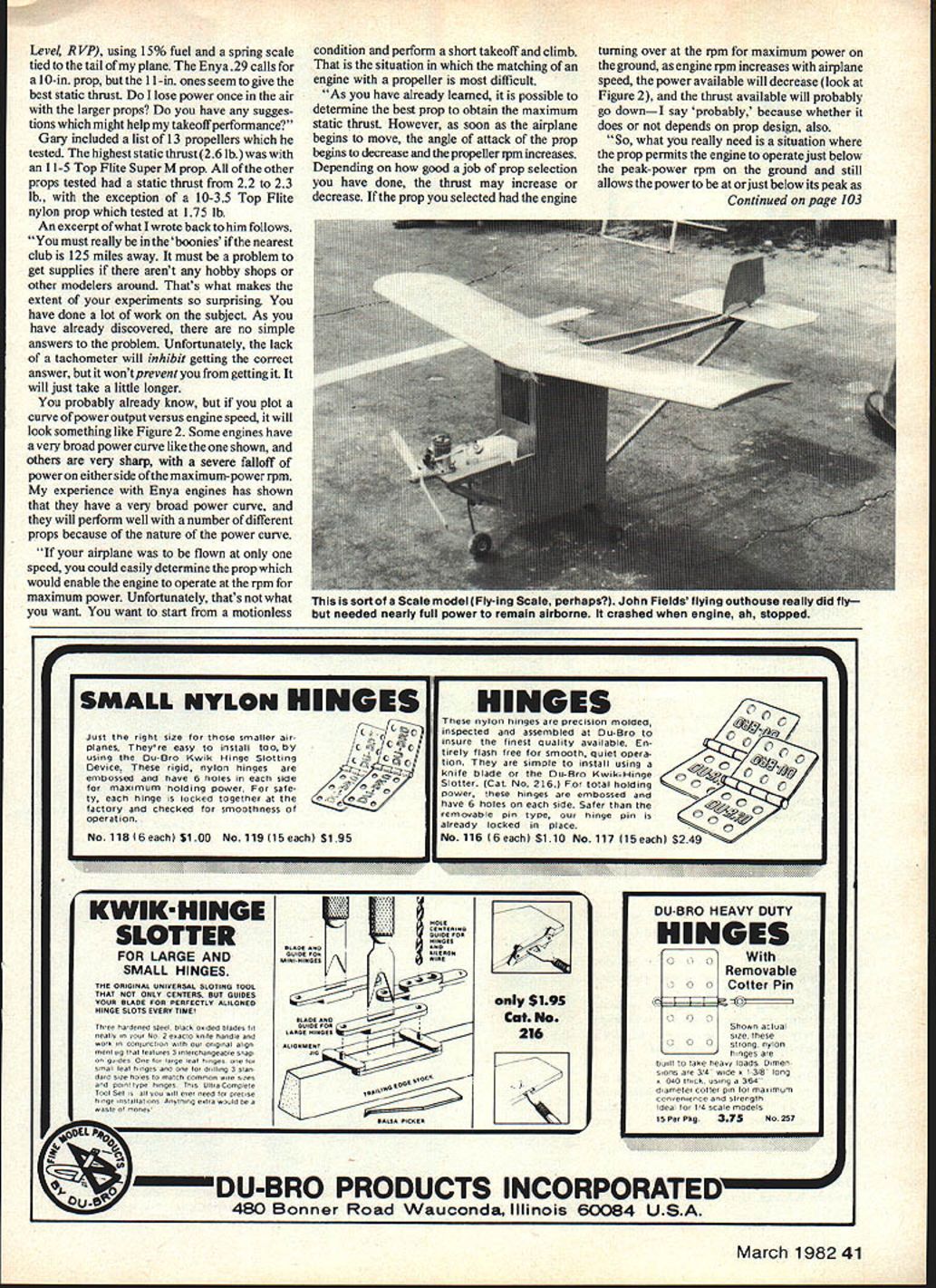
"You probably already know, but if you plot a curve of power output versus engine speed, it will look something like Figure 2. Some engines have a very broad power curve like the one shown, and others are very sharp, with a severe falloff of power on either side of the maximum-power rpm. My experience with Enya engines has shown they have a very broad power curve, and they will perform well with a number of different props because of the nature of the power curve.
"If your airplane were to be flown at only one speed, you could easily determine the prop that would enable the engine to operate at the rpm for maximum power. Unfortunately, that's not what you want. You want to start from a motionless condition and perform a short takeoff and climb. That is the situation in which matching an engine with a propeller is most difficult.
"As you have already learned, it is possible to determine the best prop to obtain the maximum static thrust. However, as soon as the airplane begins to move, the angle of attack of the prop begins to decrease and the prop rpm increases. Depending on how good a job of prop selection you have done, the thrust may increase or decrease. If the prop you selected had the engine turning at the rpm for maximum power on the ground, then as engine rpm increases with airplane speed, the power available will decrease (look at Figure 2), and the thrust available will probably go down — I say 'probably' because whether it does depends on prop design, also.
"So, what you really need is a situation where the prop permits the engine to operate just below the peak-power rpm on the ground, and still allows the power to be at or just below its peak as the airplane accelerates. It helps if the rpm increases to the peak-power rpm and moves through it. Obviously, an engine with a broad power curve is a definite advantage for STOL operation, because the power output won't vary much with rpm.
"What I've written so far hasn't really answered your question. The only one who can answer it satisfactorily is you—by doing the kinds of experiments you have done already. The most practical way to attack the situation is to determine what prop gives the most static thrust (as you've done) and then try a prop with the same pitch and larger diameter. After determining the static thrust of the larger-diameter prop, try trimming the tips a little bit at a time until you get it down to the diameter of your previous prop. Since the Top Flite 11-5 Super Maple was superior statically, try a 12-5 and go from there."
"After reading what I just wrote, I started shaking my head. Must be a potent Enya .29 you have to swing an 11-5 prop! I used to fly an Enya .45 with 11-6 props years ago, and that was a much bigger engine than your .29. Good luck!"
From the newsletters
From the many club newsletters sent to me by way of AMA HQ, I found a gem to share with you. It was contained in Prop Wash, newsletter of the Heart of Texas Model Aircraft Club (Waco, TX), but I suspect it came from elsewhere. An edited version follows:
To: All aircraft manufacturers, research facilities and military squadrons. From: The National Board of Aircraft Improvement. Subject: More effective military and civilian aircraft constructions and utilization.
The following directives are to be implemented immediately to reduce cost, improve efficiency and improve front-line readiness.
- All funding and research will cease on the bullet-proof balloon project.
- Concrete will not be used for any airframes despite its availability.
- Wagers shall not be conducted between designers within the hearing of test pilots.
- All pilots are encouraged to raise wheels only after the aircraft is airborne.
- Use of sandbags in engine test facilities is encouraged. Use of sand is desirable even though straw makes bags easier to handle.
- Parachutes should be packed before leaving the ground. Attempting to do it in the air is asking for trouble.
Ron Van Putte 111 Sleepy Oaks Rd. Fort Walton Beach, FL 32548
Transcribed from original scans by AI. Minor OCR errors may remain.

