
Radio Control: Sport/Aerobatics
Ron Van Putte
IT HAS BEEN my long-held contention that it takes two key ingredients to make a club grow and flourish. The first ingredient is an intelligent and active leadership, the second is a good club newsletter. Assuming that there are enough good leaders, I'd say that RC clubs around the country are in great shape.
The AMA has been sending me copies of RC-oriented newsletters which are received at AMA headquarters and they are outstanding! Some of them are even magazine quality. Several high quality ones that come to mind are the DCRC Newsletter from Washington, D.C.; the Worksheet from Dayton, Ohio; the BIRDS Eye Views from Rancho Palos Verdes, Calif.; the Flypaper from Pittsburgh, Penn.; and the Newsletter from Toledo, Ohio. It is certainly nicer for the reader to receive a well-laid-out, multi-color, well-written newsletter like ones mentioned, but the important thing about a newsletter is that it gets out information required to hold a club together. Even if the newsletter is badly typed, poorly reproduced, or full of grammatical or spelling errors, it still does the job.
If your club has a newsletter, your editor is probably one of the hardest workers in the club because even a very simple newsletter takes a lot of time and effort to put together and get out. It has been my experience that the time required to acquire news and write, type, reproduce, collate, staple, stamp, address, and mail a newsletter averages six to eight hours a month. Sound high? Try adding up a few nominal figures and you will be a believer.
Since your newsletter editor is investing a lot of his time for you that he could be using to build or fly a new aircraft (or fix something around the house that his wife has been bugging him about), why don't you thank the guy and offer to assist him by contributing something he can use?
Here are a couple of "goodies" from the hundreds of RC newsletters the AMA sent to me over the past few months. From the Pit Stop—newsletter of the Yuba City Flying Aces in Yuba City, Calif.:
"What is a modeler? Who is this strange creature who will withstand the slings and arrows of an outraged wife or mother who doesn't appreciate the balsa dust on the carpet or the spilled glue on the new tile floor in the family room? What is it that makes this person shrug philosophically as he makes the long trip out to pick up the pieces of what was so recently a beautiful model aircraft as he makes mental plans for the next bigger, better, faster, more detailed successor in a long line of construction projects?
"The modeler first of all is your neighbor, or the guy down the street. He is the local business executive who is trying to learn to fly on a much-repaired trainer. He is the kid next door who brings you out of your easy chair when he cranks up the engine on his plastic trainer at 10:00 p.m. during your favorite TV show. He is your son or daughter who comes into 'borrow' to get that hot new engine to beat the other guy at the next contest. She is the youngster with determination in her eye and triumph in her heart when she wins the control-line contest over the local high-school super-star.
"The modeler is one who has found an outlet for a competitive spirit — a fascination in watching his own creation perform intricate aerobatics as a morning sun glistens on the newly-covered wings — an inner serenity and the ability to accept temporary defeats and learn from mistakes. He has learned that those 'toy airplanes' obey the same laws as their full-size brethren, and demand a workable knowledge of aerodynamics before he can fully understand and appreciate their capabilities and intricacies.
"The modeler also has learned that like all good things in life, his hobby can be demanding, expensive, exasperating, and full of frustration; but can still exert a hold that is impossible to escape.
"The modeler has found that things such as dodging local obstructions on landings and takeoffs in a cow pasture is more than amply rewarded by the sheer joy of flight — of seeing the wings of his radio-controlled model as it soars overhead between showers on a cool Sunday morning in the spring.
"The modeler has felt the same sense of accomplishment and pride that is his as the youngster he has taken under his wing finally makes that first successful solo flight.
"The modeler in short, can be you, or me, or anyone who enjoys membership in one of the greatest hobbies ever invented. We who are believers recommend it most highly, and we await your entry into our world of enjoyment."
In coming months there will be more from newsletters around the country; many newsletters are too good to be shared only by the members of the club. Contest season began with a rush here in the Southeast. Starting in mid‑April, a pattern flier could compete in contests virtually every weekend through the middle of July. Needless to say, I don't have time to go to all of them, but three in the last six weeks isn't too bad!
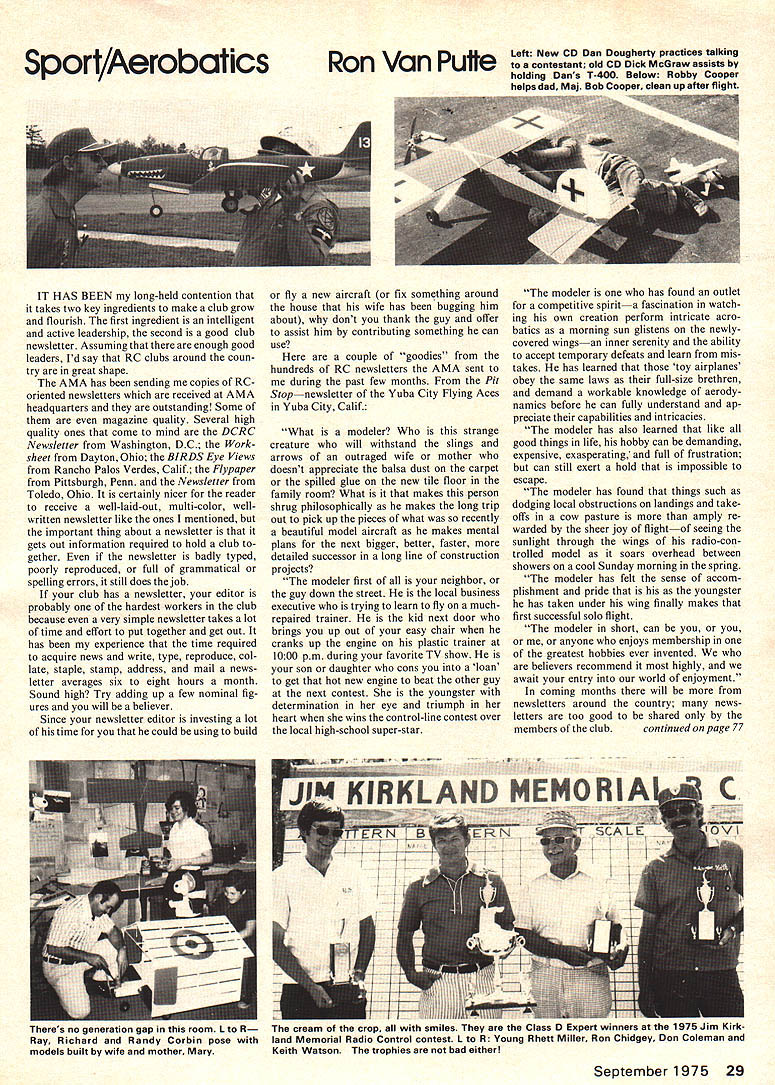
The Dogwood Pattern Festival in Marietta, Ga. on April 12, 13 drew over 50 competitors in pattern and sport scale. C.D. Dan Dougherty didn't know whether to cheer or sneak quietly away to hide since he had only expected 25 or so! Everything went surprisingly well, though. After cold and wind on Saturday, Sunday was warm and calm. Winners were: Class D Expert — Keith Watson, Class D Novice — Bob Underwood, Class B — Dick Burton, Class A — Ron Van Putte, and Sport Scale — Bill Bothwell. Bill Johnston (Kraft Southeast) gave away a new Kraft receiver to the flier of a Kraft radio who had the highest percentage of the maximum possible score for his class. Keith Watson won with 83 percent.
The Rocket City Radio Control Club in Huntsville, Ala. should consult a weather almanac in the future. The past three contests there have been "blessed" with rain. Their May 3, 4 contest was no exception. With over 80 competitors, a constant rain, and no assurance of better weather, the contest was started in a downpour. Many chose to pass, but over 60 percent flew during the first round. Fortunately, the weather cleared up Saturday afternoon and Sunday was beautiful after the early morning haze burned off. Winners were: Class D Expert — Dave Brown, Class D Novice — George Morgan, Class B — Don Bowman, Class A — Jerry Barber, and Sport Scale — Julian Morrison. By the way, Don Lowe and Fred Kugel drove all the way down to Huntsville only to have a mid‑air while practicing during the evening before the contest. Pieces from their Phoenix VI airplanes were scattered over a hundred‑yard long track. When Don's left wing tip was found it still had Fred's right horizontal stabilizer sticking in the front of it! Everyone was trying to figure out how Don missed Fred's wing since the airplanes were traveling in opposite directions.
Flash Report: The Jim Kirkland Memorial RC contest for 1975 is history. Freak weather on Saturday, May 31 threatened to spoil a fine contest, but the high winds and rain on Saturday gave way to sunshine and light breezes on Sunday. At Lough a contest date conflict with the Baton Rouge contest limited entrants, but the southeast came to Eglin AFB to butt heads. Something must be done to prevent conflicts like this from occurring. The contests were only about 300 miles apart, even though they were in different districts.
C.D. Dick McGraw had everything finely tuned and the entire contest went smoothly. One contestant who was late for his 8:00 a.m. Sunday start remarked, "You announced an 8:00 a.m. start, but I didn't think you meant it."
The free shrimp dinner was popular again this year, but the number of contestants and club members who attend has outgrown the present facility. Next year's dinner will be held at a larger site.
Winners were: Class A — Dave Wilson, Class B — John Clark, Class D Novice — Russell Spencer, Class D Expert — Rhett Miller, and Sport Scale — John Jackson. Special trophy winners were: High Class A flight — Dick Austin, High Class B flight — John Clark, and Best Civil Sport Scale — John Jackson (Stephens Aerosport).
One suggestion regarding this column was that it would be useful to include a serialized account of what control inputs are required to do certain maneuvers — starting from simple ones, through the entire pattern. Your comments on this would be appreciated.
By the way, I intend to open "Pandora's Box" in the near future and discuss the flying characteristics of aircraft of the various types. If past experience is any gauge, I will receive many letters from "experts" all over the country. Opinions are fine, but if you do write to me on the subject, please state who you really know and how many models you've flown. My address is: Ron Van Putte, 12 Connie Dr., Shalimar, Fla. 32579.
Transcribed from original scans by AI. Minor OCR errors may remain.

