
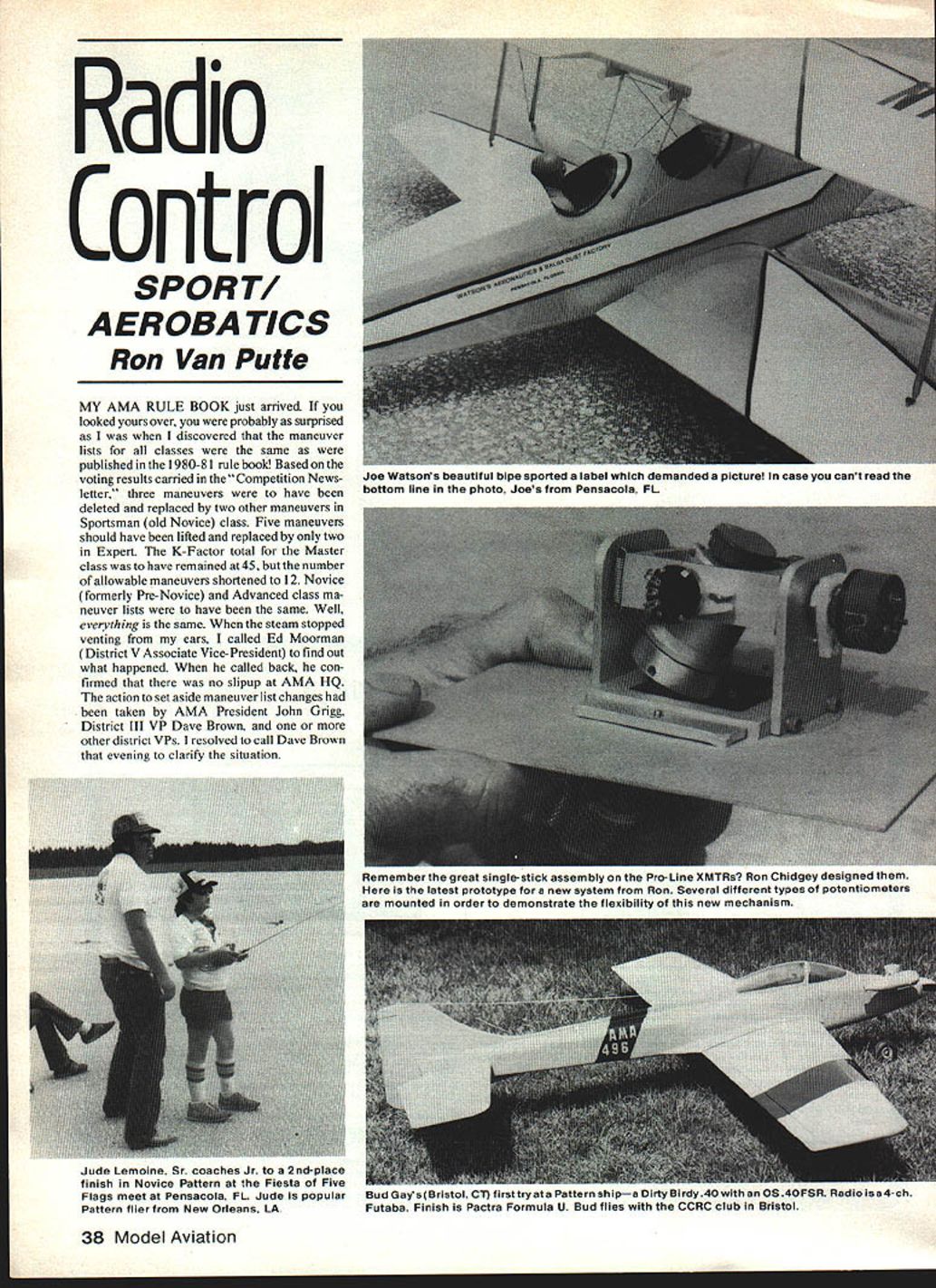


Radio Control: Sport/Aerobatics
Ron Van Putte
My AMA rule book just arrived. If you looked yours over, you were probably as surprised as I was to discover that the maneuver lists for all classes were the same as those published in the 1980–81 rule book. Based on the voting results carried in the Competition Newsletter, the following changes had been expected:
- In Sportsman (old Novice): three maneuvers deleted and replaced by two others.
- In Expert: five maneuvers deleted and replaced by two others.
- In Master: the K‑Factor total was to remain at 45, but the number of allowable maneuvers would be shortened to 12.
- Novice (formerly Pre‑Novice) and Advanced class maneuver lists were to be the same.
Well, everything is the same. When the steam stopped venting from my ears, I called Ed Moorman (District V Associate Vice‑President) to find out what happened. When he called back, he confirmed there was no slipup at AMA HQ. The action to set aside the maneuver-list changes had been taken by AMA President John Grigg, District III VP Dave Brown, and one or more other district VPs. I resolved to call Dave Brown that evening to clarify the situation.
After supper out in the shop, the telephone rang — Dave Brown called on another subject. Coincidence, I thought. Dave confirmed what Ed had told me and explained the action was deemed necessary because potential conflict protests might have arisen. Along the way several rule proposals were presented; there was confusion between proposals RC‑18 and RC‑25. Some Contest Board members didn't fully understand what the voting meant, and that confusion caused the decision to set aside the maneuver-list changes. Unfortunate, because the proposed changes in the Sportsman and Expert maneuver lists were major steps toward improving pattern classes. The next formal change in patterns cannot be made for two years.
However, Contest Directors might consider using the new maneuver lists in local contests. As long as contest fliers and the Competition Newsletter inform entrants that the revised maneuver lists will be flown, it is acceptable to AMA.
As far as I can tell, other rule changes went through unscathed. The one with the biggest potential effect requires equal opportunity for contestants to fly in front of judges. Rule (page 43, para. 207) says: "Substitution of judges precludes equal exposure of contestants and shall be avoided. If adverse weather conditions preclude equal exposure of contestants, the results of flights shall be disqualified." Most Contest Directors will probably try to avoid problems by working fewer sets of judges and by making sure a particular judging set gets to see contestants as quickly as possible. Tougher judges will maximize the number of rounds that may be counted toward determining winners.
The reason Dave Brown called was also to straighten out some statements I'd made in the June 1982 issue of Model Aviation. I wrote that Aresti‑style judging would be used in the next FAI RC Aerobatic World Championships. That was incorrect. The Aresti pattern will be used in the 1985 World Championships, not the 1983 event. I also implied that the airplane used in the Las Vegas Tournament of Champions (TOC) would be suitable for the Worlds; in actuality, the TOC airplane would likely only qualify for the 1985 World Championships because it probably wouldn't meet the size, weight, and engine‑displacement limitations for 1983.
During the remainder of the telephone call, Dave attempted to reason with me about my attitude toward the Aresti style of pattern. If you have ever been "reasoned with" by Dave Brown, you know just how I felt after the call was over. (Now I know how a salmon feels after swimming upriver during spawning season.)
Basically, Dave feels (as I do) that the 1984–1985 rules should require the Aresti pattern for the Master class only. He doesn't think it should be required for all classes (neither do I). He does think, however, that the Aresti pattern will eventually become the standard for all classes because fliers will ask for it. He expects Expert fliers will request it first, and the trend will spread from there. He may be right; but it should be a change that comes from the fliers rather than being imposed from outside.
I don't believe Novice or Sportsman class fliers will request the Aresti pattern in large numbers. Novice and Sportsman fliers need the turnarounds to get squared away for the next maneuvers; they are not ready to be judged by the Aresti system.
Dave feels there are many ways to speed up Aresti‑style flying so contests needn't consist of only two or three rounds in a weekend. Since only one flier can be "in the box" at a time, and most flying fields are not big enough to have more than one "box," one way to speed up flying is to reduce the time per flight. Fortunately, the Aresti style consumes maneuvers at a fantastic rate. I've recently heard estimates of about 3.5 minutes of "in the box" time to complete schedules of 20 or more maneuvers. With short times like that, if engine start, takeoff, and landing consume about 2.5 minutes, we can expect roughly 10 flights per hour from one flight line. Since most current contests usually have two flight lines each averaging about six flights per hour, perhaps we won't lose many rounds in a weekend contest using the Aresti pattern. My earlier estimates (June 1982 column) were based on the assumption that flight times for current versus Aresti patterns would be equal; Dave Brown pointed out the fallacy in that assumption during our (mostly one‑sided) telephone conversation.
Dave and I also discussed potential sites for the 1983 FAI RC Aerobatic World Championships. Apparently there are two possible sites in the United States at this time:
- Pensacola, FL (only about 50 miles west of where I live).
- Kentucky Dam State Park in western Kentucky (about 40 miles east of Paducah).
Both sites either have or are preparing bids. The reality, though, is that it is unlikely either will win, because the FAI/CIAM community hopes someone in England will bid. If they do, the World Championships will probably go to England — it's been a long time since they have hosted a WC, many fliers live closer to the U.K., and travel costs could be substantially reduced.
If you're like me, you don't like to fly when it gets cold outside. Yes, Florida gets cold, too. I usually put my airplanes away for months at a time and sometimes forget to take proper steps to protect my engines. I forgot last winter, and when warm weather arrived (75° or more) I discovered the Super Tigre G60 in my Phoenix 8 was overheating. The problem was corroded bearings. Have you had overheating problems this season? Check the bearings.
Ron Van Putte 111 Sleepy Oaks Rd. Ft. Walton Beach, FL 32548
Transcribed from original scans by AI. Minor OCR errors may remain.

