
Radio Control
SPORT/AEROBATICS
Ron Van Putte
It had been quite a while since the folks at AMA HQ had sent me any RC-oriented newsletters when a large box arrived from them, chock full of newsletters. After spending a week's worth of spare time reading them, I finally reached the bottom of the box. The next day, a large envelope stuffed with newsletters arrived; two days later I finished reading them. What remained from the marathon reading sessions was a group of gems which were too good not to share, so this month's column features the "best of the newsletter excerpts."
From Flare-Out, newsletter of the Twin City Radio Controllers, Inc. (Minneapolis, MN), edited by William Altenhofen, comes an article entitled "Don't Believe Everything You Hear at Club Meetings," by Dewey Godditt. Now, Dewey may be a figment of someone's fertile imagination or he may be real, but here's what he wrote:
"Someone brought a really gorgeous airplane to a club meeting a while ago. It had a sunburst color scheme on the top of the wing and stab and a checkerboard on the bottom. The fuselage was an elaborate flow of pinstripes in about five colors. He said he painted it by masking the pattern with plastic electric tape, and then he laid down each color with a badger-hair brush.
"Well, I decided right then that I wanted a fancy paint job like that for my Smog Hog. So, I went down to the pet store and asked for a badger-hair brush. They told me that they don't get much call for hair brushes for badgers, but they assured me that a regular dog brush would work just as well. So I bought a dog brush. It was a big job with stiff nylon bristles, a wooden back, and a plastic handle. I bought a can of dope with a big opening in it so that I could dip the brush into it, and I painted on the first color.
"It didn't work very well, though. The bristles scratched the surface, and the paint went on really streaked—not at all like the uniform coverage I saw on the plane at the meeting. Big globs of paint dripped all over the place, the brush pulled up some of the tape, and the paint ran under it. Then the bristles started to dissolve; they came loose and stuck to the wing. Eventually the handle dissolved, and the brush fell into the paint can with a kathoop.
"About then I realized that I was the victim of a hoax. There just ain't no way to get a good paint job with a hair brush. I'm not going to listen to anything I hear at club meetings anymore."
After I picked myself off the floor, I started to read the Davison Aviator News, newsletter of the Davison (MI) Aviators, which is edited by Don Parks. Included in the January 1982 issue was Part 3 of a series of articles on building techniques (which I believe was written by Don Parks). In the middle of a good article which described, among other things, a fellow modeler who did his building on an old pool table having a 4 x 8 sheet of plywood on top of the slate was the following: "A straighter table could not be found—it even had side-boards. A recent experience with things rolling off my bench reminded me of that table with the side-boards."
"I had just mixed up some five-minute epoxy and put it on a wing center section. I was standing by my bench holding the parts together when I decided to sit down. As I picked up the wing section and turned to go and sit down with it, I apparently bumped an X-Acto knife that was lying there. Well, it rolled off the bench (of course I had just put in a new No. 11 blade!) and went through my tennis shoe and into my foot like a spear.
"Now what? I couldn't let go of the wing, and that darn spear hurt! I did what any other red-blooded American male would do; I hollered for help! Everyone came running. By the time they arrived, I had managed to let go of the wing with one hand long enough to pull out the knife.
"One of my sons got the shoe and sock off and went after a washcloth and cold water to stop the bleeding. My wife cleaned and bandaged the wound—all done while I was still holding the wing section straight, waiting for the epoxy to cure. I'm happy to report that the wing came through it all in fine shape. Me too!"
Up in Peoria, IL, Mike Montefusco edits the newsletter for the Peoria RC Modelers. The May 1982 issue published an article by Bill Little entitled "I Learned About RC Flying From That," from which the following excerpt was taken.
"The mistakes we make in RC are seldom disastrous or potentially fatal, but I thought of all the horrible blunders I have committed while learning to fly RC. As I cogitated, the thought occurred to me that we might begin a similar column in our newsletter.
"Early in my truncated career in aviation—and I do mean early (back in 1943)—I had excellent eyesight. My depth perception was unparalleled. I could line up the sticks at 20 ft. within a millimeter (yes, we even had those things then). It is unfortunate, but one of the sad commentaries on age is that the first thing to go is your vision. I did, however, retain my farsightedness.
"When you couple loss of depth perception with an almost uncanny ability to land anywhere but on the nice, newly mowed strip, all sorts of interesting things happen. A few years ago I had built an Ugly Stik and covered it with orange MonoKote—the better to see it anywhere in the sky. I was just getting used to the left-hand traffic pattern at Detweiler and landing from the north when the wind shifted and someone yelled, 'We're landing from the south.'
"This abrupt change in plans occurred—yes, you guessed it—while I was in the air. I recall saying to myself over and over as I drove down to get the airplane, 'I really thought I was past those trees.' Well, of course that's the end of the story. I did get the minor damage repaired and had it flying again in a week."
In the future, I'll continue to publish excerpts from newsletters when I think they will be of general interest. As a former newsletter editor, I remember how great it felt to find an article from one of my newsletters in a magazine. The work I did as newsletter editor resulted in my being asked to do this column more than seven years ago.
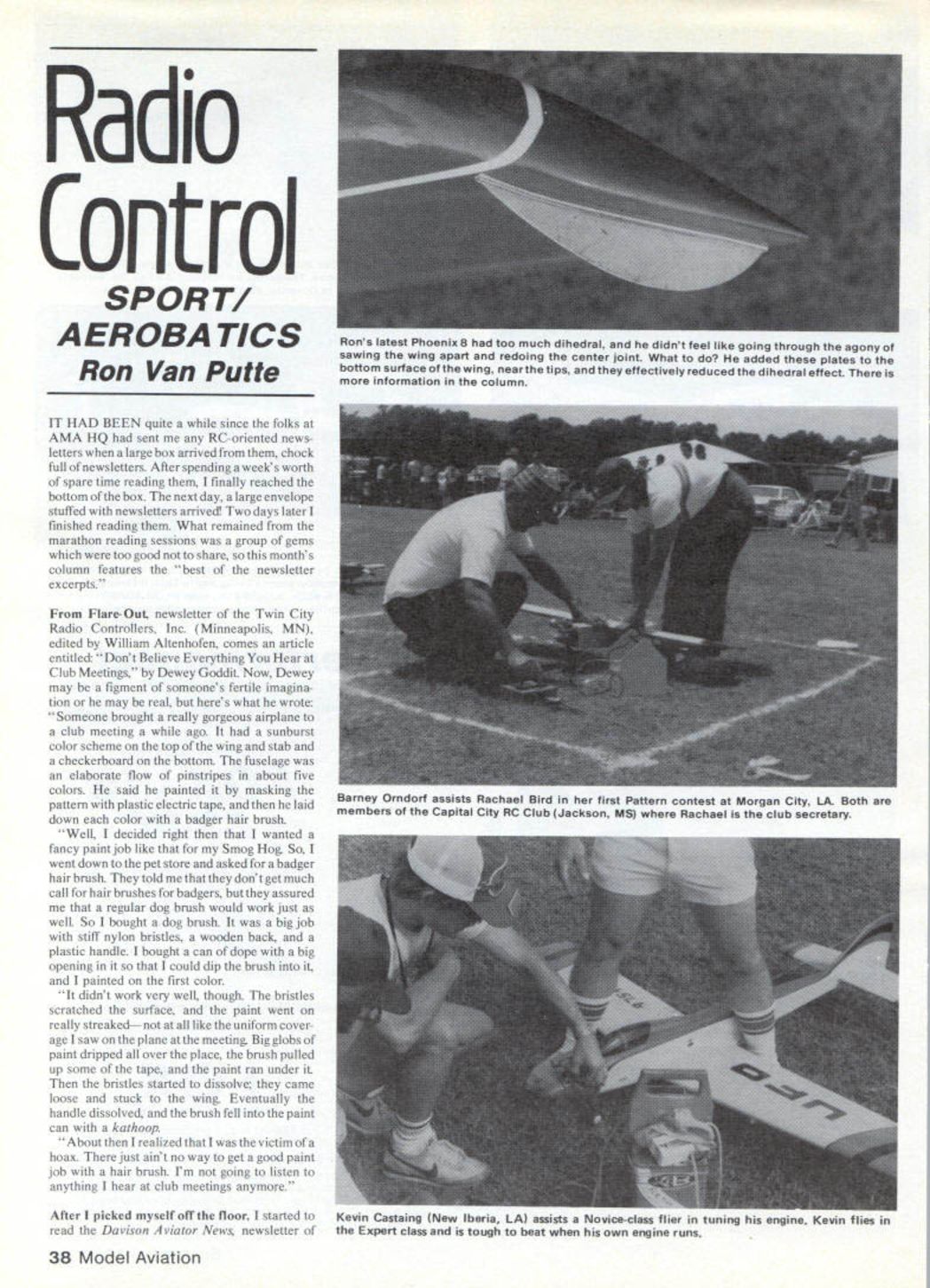
My newest Phoenix 8 airplane had the disturbing characteristic of rolling out of the last points of the Eight-Point Roll and out of the last point on the Four-Point Roll when top rudder was applied. An analysis of the situation indicated that the wing had too much dihedral effect. It could have reduced the dihedral by cutting the wing down the middle and reassembling it. (That's just what Don Lowe would have done. He often changes dihedral on the wings of his airplanes several times to get the dihedral just right.) I didn't relish all the work necessary to accomplish that. So, I decided to add small tip fences to the bottom of the wing. Since I didn't know how big to make them, I made them removable so that several different sizes could be tried until the one which worked best was discovered. As it turned out, the first plates I tried worked just fine.
The plates were made from 1/16-in. three-ply aircraft plywood. The exact wing contour fit was achieved by making a template from card stock and trimming it with scissors until it fit perfectly. Pieces of 1/32-in. three-ply plywood, 1/4-in. wide, were stuck to the bottom of the plate using Hot Stuff. The plates were then stuck to the bottom of the wing by using Ace RC 1/16 by 1/4-in. double-sided vinyl mounting tape. I left the tips unpainted until I was sure that they did the job.
The change in the point-roll maneuvers was amazing. Now a knife-edge can be held almost indefinitely before rolling out. If you are lazy like I am and have a wing with excess dihedral, you can fix it the same way.
Ron Van Putte 111 Sleepy Oaks Rd. Ft. Walton Beach, FL 32548
Transcribed from original scans by AI. Minor OCR errors may remain.

