
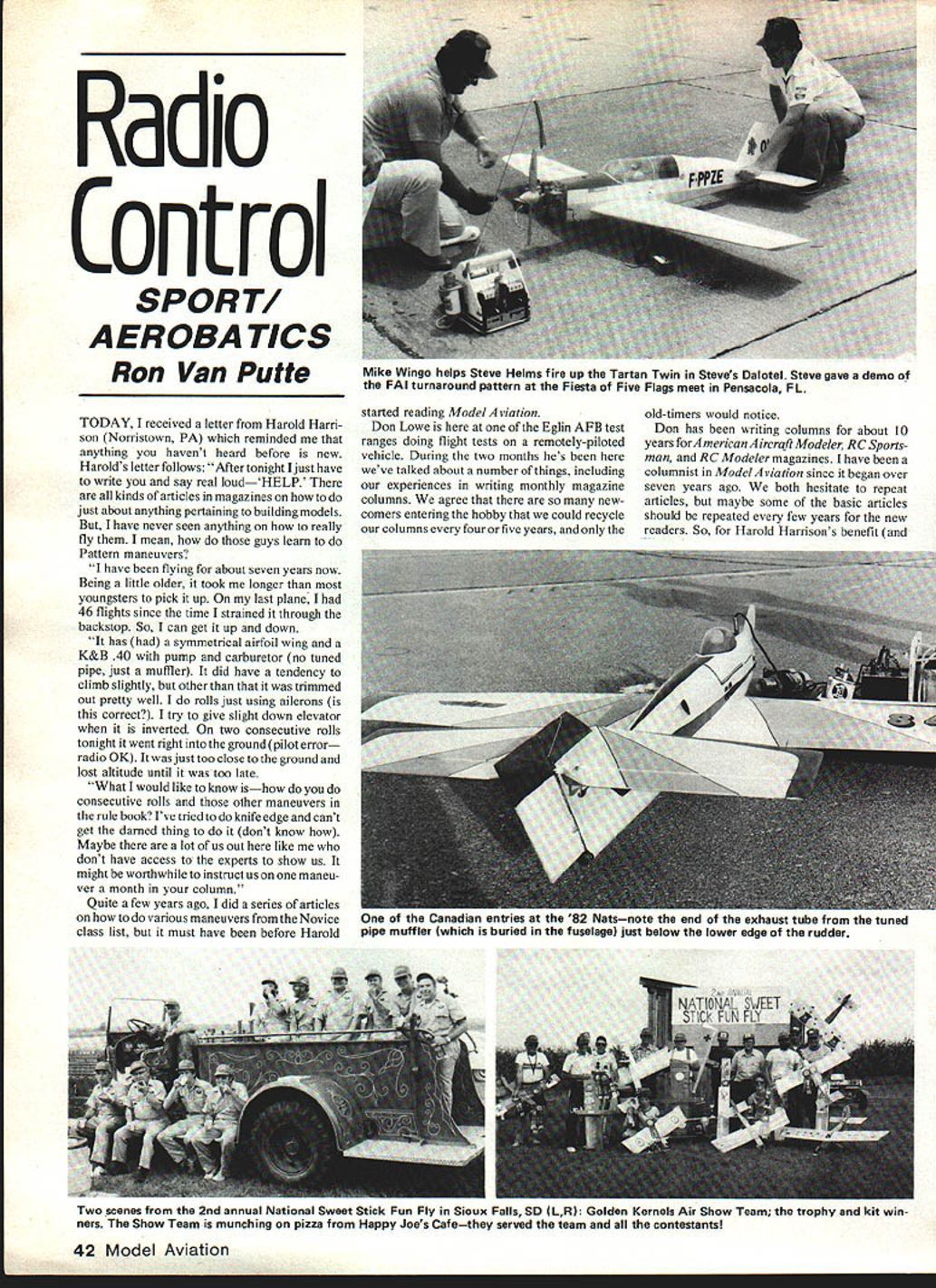
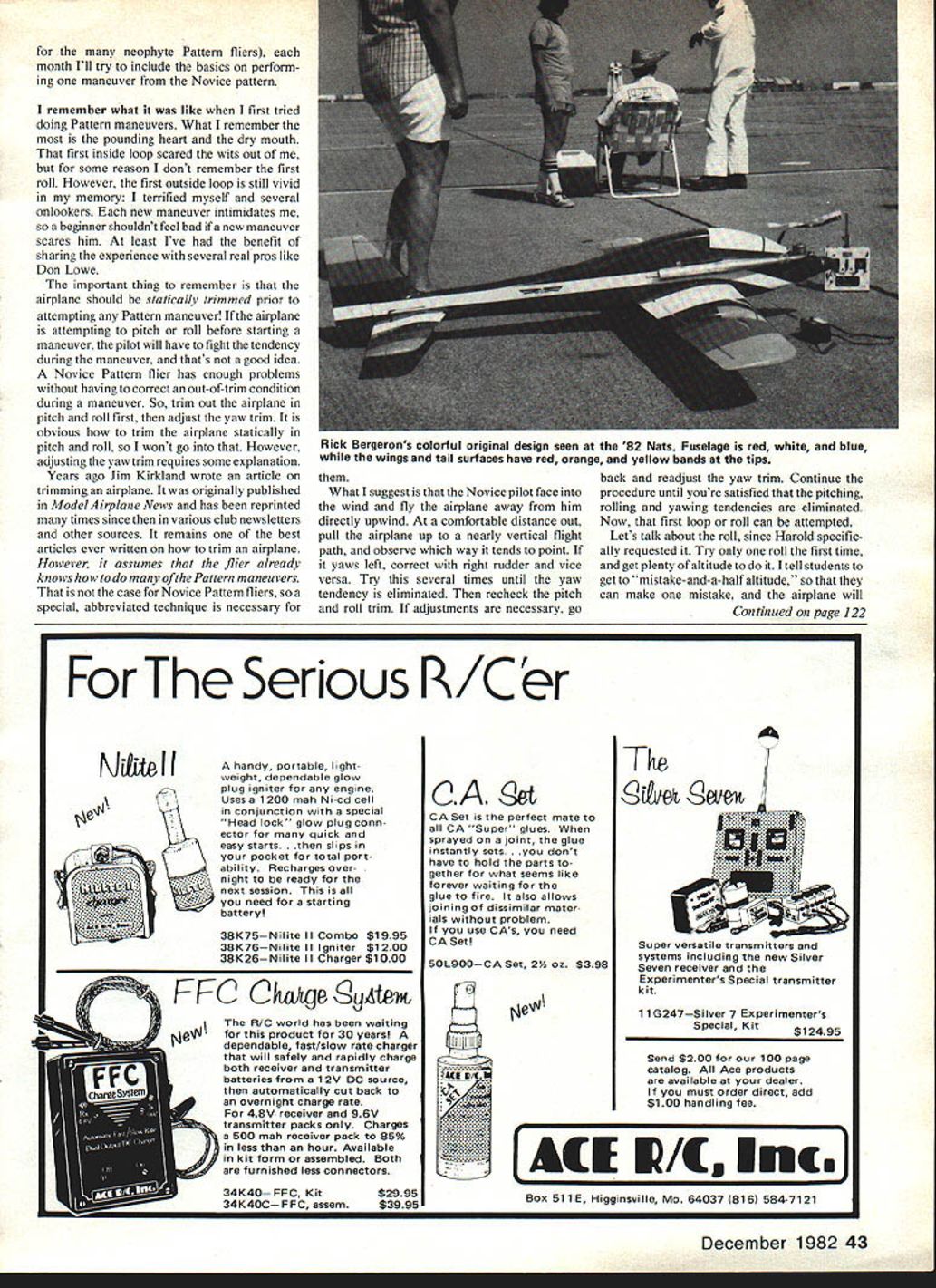
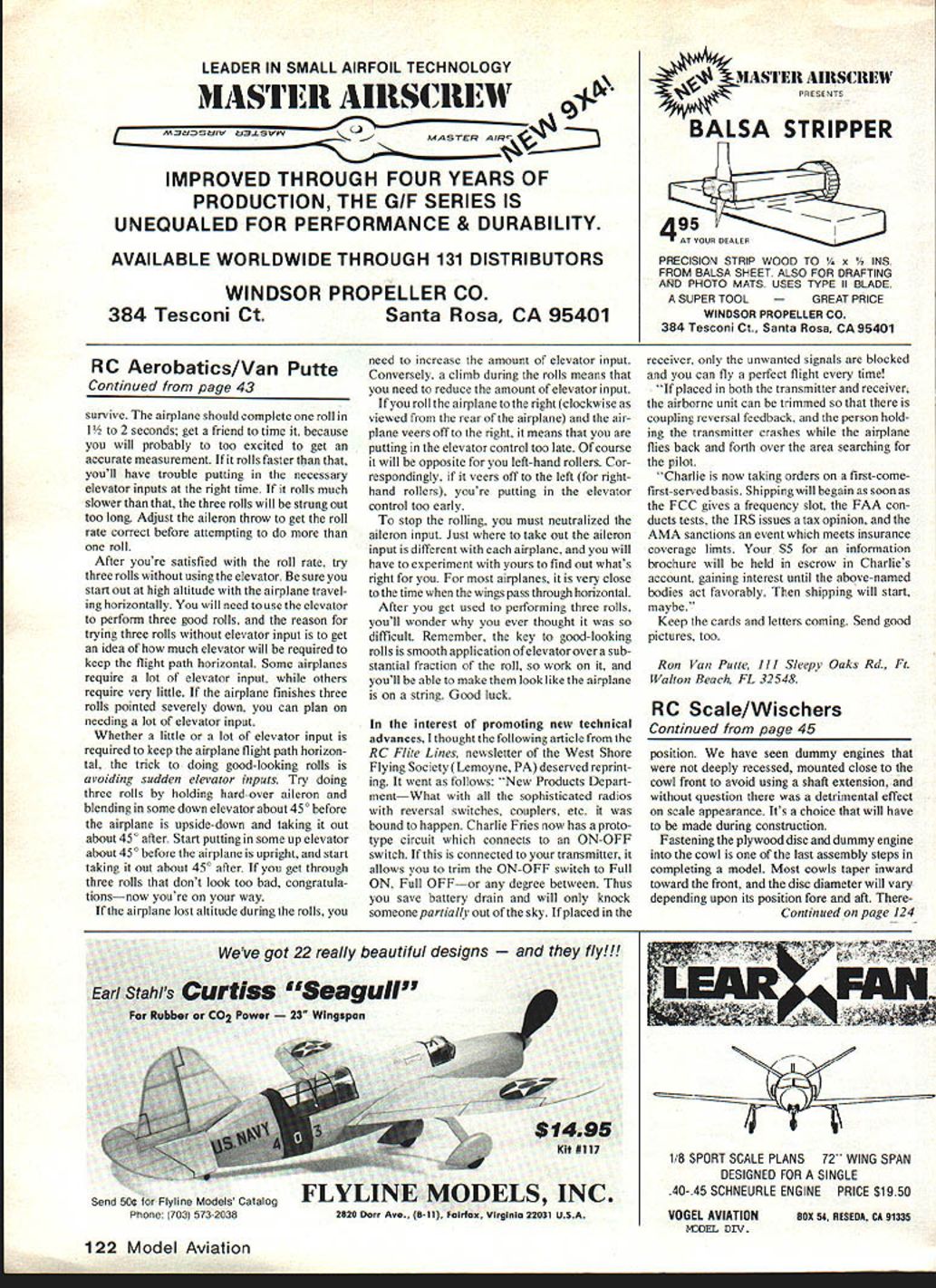
Radio Control: SPORT/AEROBATICS
Ron Van Putte
Letter from Harold Harrison
Today I received a letter from Harold Harrison (Norristown, PA) which reminded me that anything you haven't heard before is new. Harold's letter follows:
"After tonight I just have to write you and say real loud — 'HELP.' There are all kinds of articles in magazines on how to do just about anything pertaining to building models. But I have never seen anything on how to really fly them. I mean, how do those guys learn to do Pattern maneuvers?
"I have been flying for about seven years now. Being a little older, it took me longer than most youngsters to pick it up. On my last plane, I had 46 flights since the time I strained it through the backstop. So, I can get it up and down.
"It has (had) a symmetrical airfoil wing and a K&B .40 with pump and carburetor (no tuned pipe, just a muffler). It did have a tendency to climb slightly, but other than that it was trimmed out pretty well. I do rolls just using ailerons (is this correct?). I try to give slight down elevator when it is inverted. On two consecutive rolls tonight it went right into the ground (pilot error — radio OK). It was just too close to the ground and lost altitude until it was too late.
"What I would like to know is — how do you do consecutive rolls and those other maneuvers in the rule book? I've tried to do knife edge and can't get the damned thing to do it (don't know how). Maybe there are a lot of us out here like me who don't have access to the experts to show us. It might be worthwhile to instruct us on one maneuver a month in your column."
Quite a few years ago I did a series of articles on how to do various maneuvers from the Novice class list, but it must have been before Harold started reading Model Aviation.
Don Lowe is here at one of the Eglin AFB test ranges doing flight tests on a remotely-piloted vehicle. During the two months he's been here we've talked about a number of things, including our experiences in writing monthly magazine columns. We agree that there are so many newcomers entering the hobby that we could recycle our columns every four or five years, and only the old-timers would notice.
Don has been writing columns for about 10 years for American Aircraft Modeler, RC Sportsman, and RC Modeler magazines. I have been a columnist in Model Aviation since it began over seven years ago. We both hesitate to repeat articles, but maybe some of the basic articles should be repeated every few years for the new readers. So, for Harold Harrison's benefit (and others), I'll try to include the basics of performing maneuvers in the Novice pattern.
Remember what it was like the first time you tried doing Pattern maneuvers? What I remember is the pounding heart, dry mouth — the first inside loop scared the wits out of me. For some reason I don't remember the first roll. However, the first outside loop is still a vivid memory — I terrified myself and several onlookers. A new maneuver intimidates the beginner; he shouldn't feel bad if a new maneuver scares him. At least I've benefited by sharing experience with several real pros like Don Lowe.
Static trimming — the starting point
An important thing to remember: the airplane should be statically trimmed prior to attempting a Pattern maneuver. If the airplane is attempting to pitch or roll before starting the maneuver, the pilot will have to fight the tendency during the maneuver; that's no good. The Novice Pattern flier has enough problems without an out-of-trim condition during the maneuver. So, trim out the airplane's pitch and roll first.
Adjusting yaw trim requires some explanation. Years ago Jim Kirkland wrote an article on trimming the airplane originally published in Model Airplane News; it has been reprinted many times in various club newsletters and other sources and remains one of the best articles ever written on trimming an airplane. However, it assumes the flier already knows the Pattern maneuvers. In the case of Novice Pattern fliers, a special abbreviated technique is necessary.
What I suggest:
- Facing the wind, fly the airplane directly upwind to a comfortable distance.
- Pull the airplane up nearly vertical in the flight path and observe which way it tends to point or yaw.
- If it yaws left, correct with right rudder; if it yaws right, correct with left rudder.
- Try several times until the yaw tendency is eliminated.
- Recheck pitch and roll trim adjustments; if necessary, readjust yaw trim and repeat until pitching, rolling, and yawing tendencies are eliminated.
Rolls — how to start
Now the first loop or roll can be attempted. Let's talk about roll since Harold specifically requested it.
- Try only one roll the first time, and get plenty of altitude to do it. I tell students to get to "mistake-and-a-half" altitude, so they can make one mistake and the airplane will survive.
- The airplane should complete one roll in about 1½ to 2 seconds; get a friend to time it, because you will probably be too excited to measure accurately. If it rolls faster than that, you'll have trouble putting in the necessary elevator inputs at the right time. If it rolls much slower, multiple rolls will be strung out too long.
- Adjust the aileron throw to get the roll rate correct before attempting more than one roll.
After you're satisfied with the roll rate, try three rolls without using the elevator. Be sure you start out at high altitude with the airplane traveling horizontally. You will need to use elevator to perform three good rolls; the reason for trying three rolls without elevator input first is to get an idea of how much elevator will be required to keep the flight path horizontal. Some airplanes require a lot of elevator input, while others require very little. If the airplane finishes three rolls pointed severely down, you can plan on needing a lot of elevator input.
Whether a little or a lot of elevator input is required to keep the airplane flight path horizontal, the trick to doing good-looking rolls is avoiding sudden elevator inputs. Try this technique:
- Hold hard-over aileron for the roll.
- Blend in some down elevator about 45° before the airplane is inverted, and take it out about 45° after inversion.
- Start putting in some up elevator about 45° before the airplane is upright, and start taking it out about 45° after.
- Smooth, gradual blending of elevator over a substantial fraction of the roll is the key.
If the airplane loses altitude during the rolls, increase the amount of elevator input. Conversely, a climb during the rolls means reduce elevator input. If you roll the airplane to the right (clockwise as viewed from the rear) and the airplane veers off to the right, you are putting in the elevator too late. If it veers off to the left (for right-hand rollers), you're putting in the elevator too early.
To stop the rolling, neutralize the aileron input. Exactly when to take out the aileron varies with each airplane; for most airplanes it is very close to the time when the wings pass through horizontal. After you get used to performing three rolls, you'll wonder why you ever thought it was so difficult. Work on smooth elevator application and you'll make them look like the airplane is on a string. Good luck.
Reprint — RC Flite Lines humor
In the interest of promoting new technical advances, I thought the following article from RC Flite Lines, newsletter of the West Shore Flying Society (Lemoyne, PA) deserved reprinting. It went as follows:
"New Products Department — What with all the sophisticated radios with reversal switches, couplers, etc., it was bound to happen. Charlie Fries now has a prototype circuit which connects to an ON–OFF switch. If this is connected to your transmitter, it allows you to trim the ON–OFF switch to Full ON, Full OFF — or any degree between. Thus you save battery drain and will only knock someone partially out of the sky. If placed in the receiver, only the unwanted signals are blocked and you can fly a perfect flight every time!
"If placed in both the transmitter and receiver, the airborne unit can be trimmed so that there is coupling reversal feedback, and the person holding the transmitter crashes while the airplane flies back and forth over the area searching for him.
"Charlie is now taking orders on a first-come-first-served basis. Shipping will begin as soon as the FCC gives a frequency split, the FAA conducts tests, the IRS issues a tax opinion, and the AMA sanctions an event which meets insurance coverage limits. Your $5 for an information brochure will be held in escrow in Charlie's account, gaining interest until the above-named bodies act favorably. Then shipping will start, maybe."
Keep the cards and letters coming. Send good pictures, too.
Ron Van Putte 111 Sleepy Oaks Rd. Ft. Walton Beach, FL 32548.
Transcribed from original scans by AI. Minor OCR errors may remain.

