
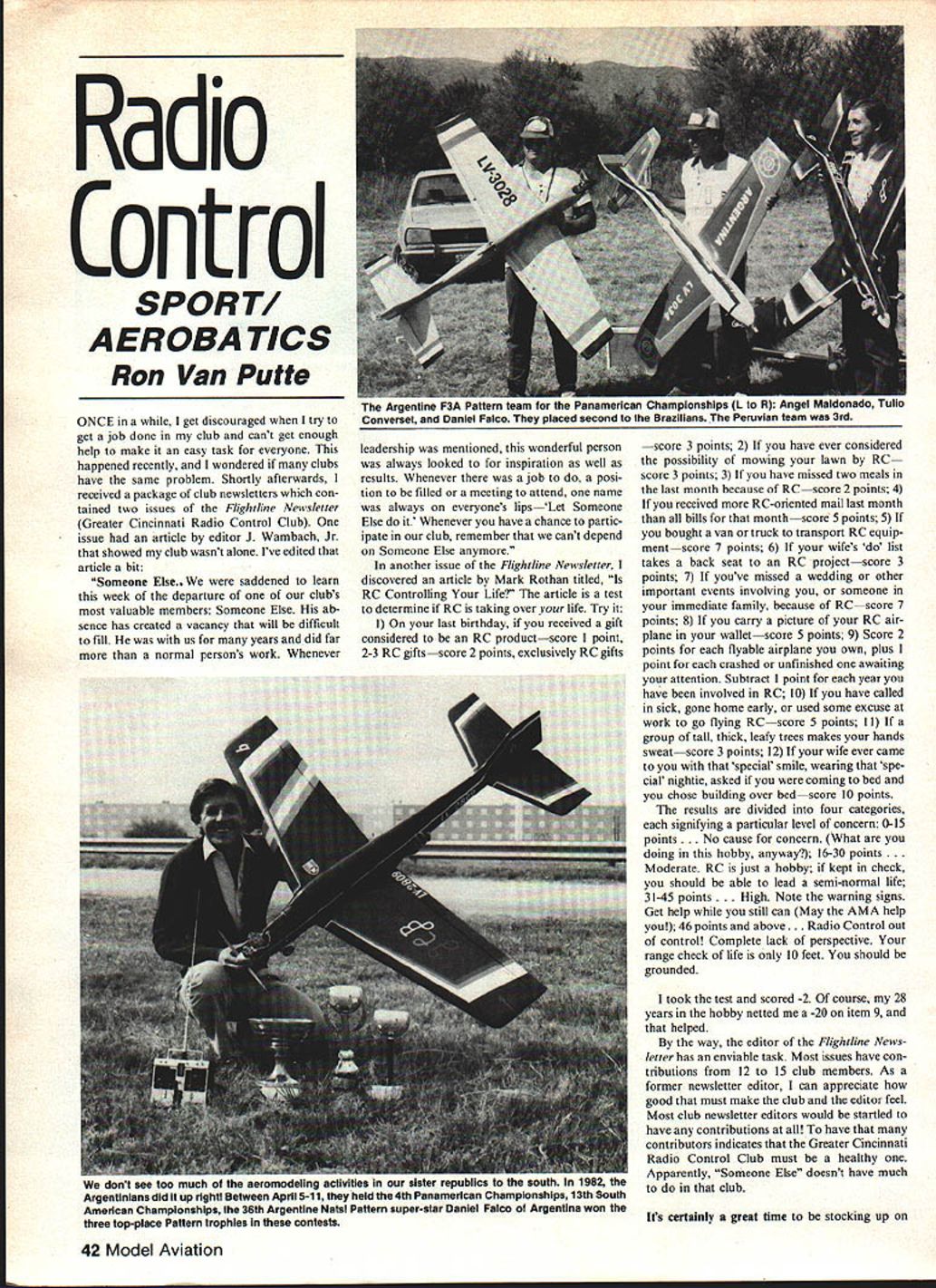
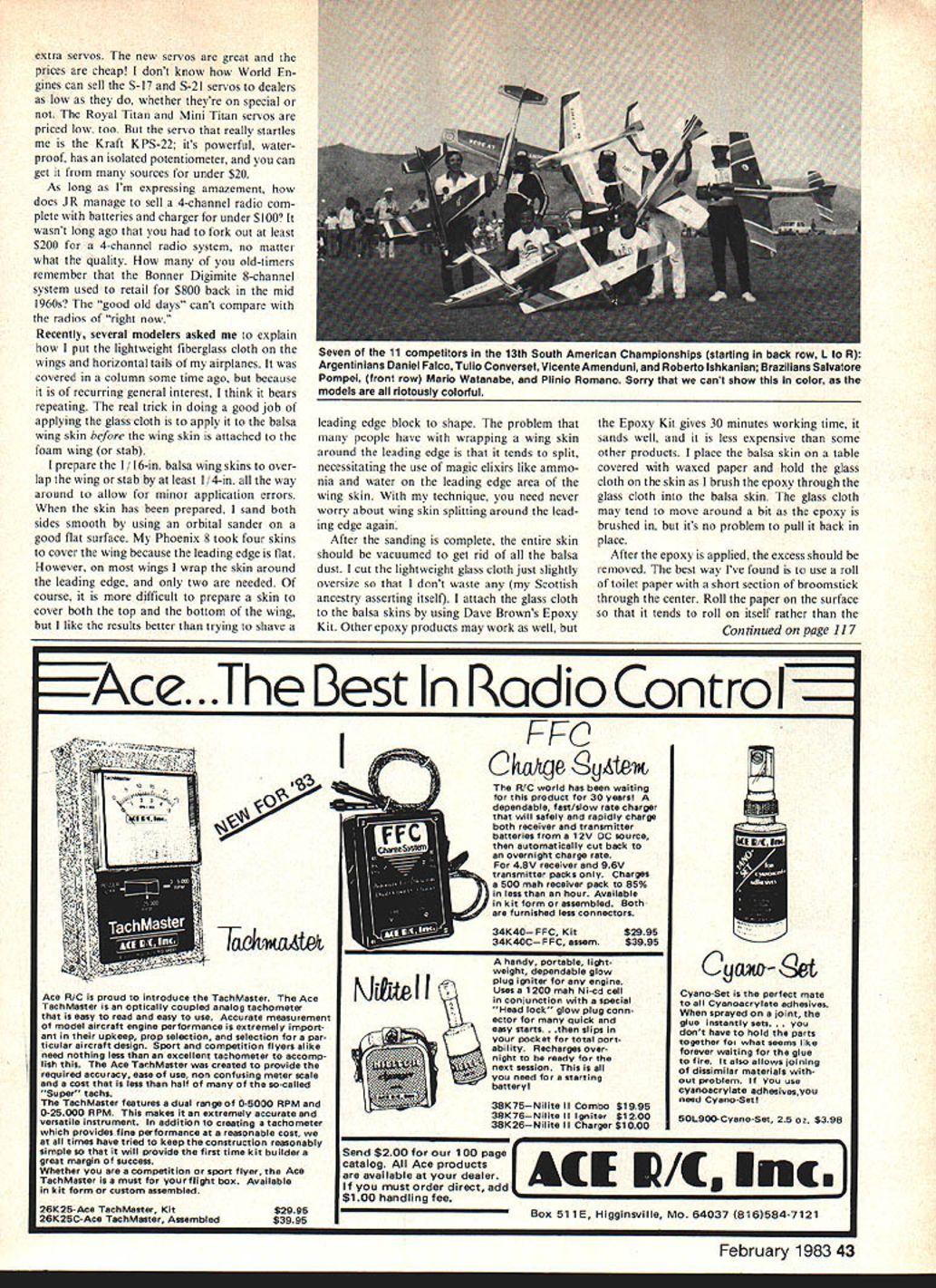
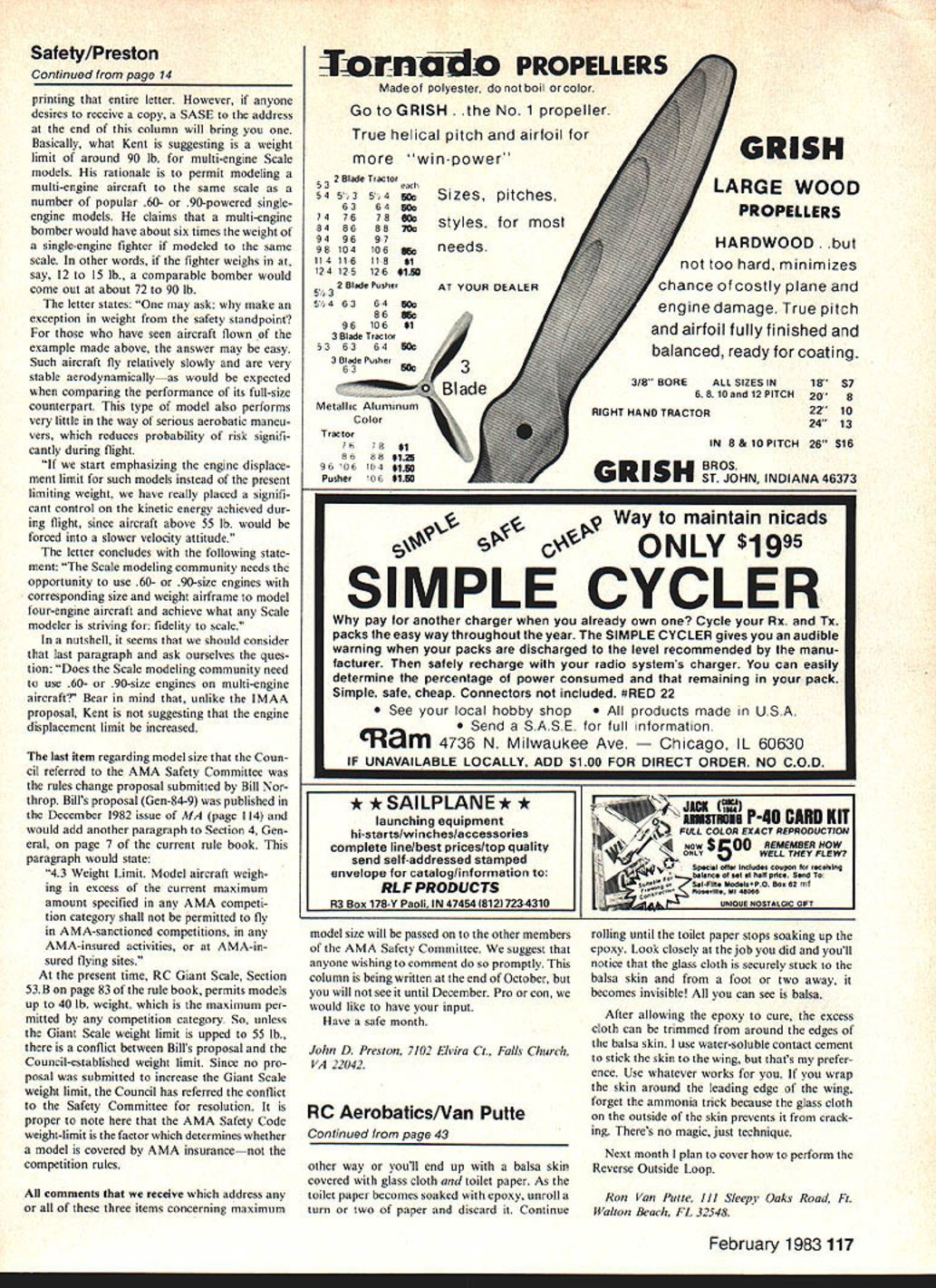
Radio Control: Sport/Aerobatics
Ron Van Putte
Once in a while I get discouraged when I try to get a job done in my club and can't get enough help to make it an easy task for everyone. This happened recently, and I wondered if many clubs have the same problem. Shortly afterward, I received a package of club newsletters which contained two issues of the Flightline Newsletter (Greater Cincinnati Radio Control Club). One issue had an article by editor J. Wambach, Jr. that showed my club wasn't alone. I've edited that article a bit:
"Someone Else. We were saddened to learn this week of the departure of one of our club's most valuable members: Someone Else. His absence has created a vacancy that will be difficult to fill. He was with us for many years and did far more than a normal person's work. Whenever leadership was mentioned, this wonderful person was always looked to for inspiration as well as results. Whenever there was a job to do, a position to be filled or a meeting to attend, one name was always on everyone's lips—'Let Someone Else do it.' Whenever you have a chance to participate in our club, remember that we can't depend on Someone Else anymore."
In another issue of the Flightline Newsletter, I discovered an article by Mark Rothan titled "Is RC Controlling Your Life?" The article is a test to determine if RC is taking over your life. Try it:
- On your last birthday, if you received a gift considered to be an RC product—score 1 point; 2–3 RC gifts—score 2 points; exclusively RC gifts—score 3 points.
- If you have ever considered the possibility of mowing your lawn by RC—score 3 points.
- If you have missed two meals in the last month because of RC—score 2 points.
- If you received more RC-oriented mail last month than all bills for that month—score 5 points.
- If you bought a van or truck to transport RC equipment—score 7 points.
- If your wife's "to do" list takes a back seat to an RC project—score 3 points.
- If you've missed a wedding or other important event involving you, or someone in your immediate family, because of RC—score 7 points.
- If you carry a picture of your RC airplane in your wallet—score 5 points.
- Score 2 points for each flyable airplane you own, plus 1 point for each crashed or unfinished one awaiting your attention. Subtract 1 point for each year you have been involved in RC.
- If you have called in sick, gone home early, or used some excuse at work to go flying RC—score 5 points.
- If a group of tall, thick, leafy trees makes your hands sweat—score 3 points.
- If your wife ever came to you with that "special" smile, wearing that "special" nightie, asked if you were coming to bed and you chose building over bed—score 10 points.
The results are divided into four categories, each signifying a particular level of concern:
- 0–15 points: No cause for concern. (What are you doing in this hobby, anyway?)
- 16–30 points: Moderate. RC is just a hobby; if kept in check, you should be able to lead a semi-normal life.
- 31–45 points: High. Note the warning signs. Get help while you still can (May the AMA help you!).
- 46 points and above: Radio Control out of control! Complete lack of perspective. Your range check of life is only 10 feet. You should be grounded.
I took the test and scored −2. Of course, my 28 years in the hobby netted me a −20 on item 9, and that helped.
By the way, the editor of the Flightline Newsletter has an enviable task. Most issues have contributions from 12 to 15 club members. As a former newsletter editor, I can appreciate how good that must make the club and the editor feel. Most club newsletter editors would be startled to have any contributions at all! To have that many contributors indicates that the Greater Cincinnati Radio Control Club must be a healthy one. Apparently, "Someone Else" doesn't have much to do in that club.
It's certainly a great time to be stocking up on extra servos. The new servos are great and the prices are cheap! I don't know how World Engines can sell the S-17 and S-21 servos to dealers as low as they do, whether they're on special or not. The Royal Titan and Mini Titan servos are priced low, too. But the servo that really startles me is the Kraft KPS-22; it's powerful, waterproof, has an isolated potentiometer, and you can get it from many sources for under $20.
As long as I'm expressing amazement, how does JR manage to sell a 4-channel radio complete with batteries and charger for under $100? It wasn't long ago that you had to fork out at least $200 for a 4-channel radio system, no matter what the quality. How many of you old-timers remember that the Bonner Digimite 8-channel system used to retail for $800 back in the mid-1960s? The "good old days" can't compare with the radios of "right now."
Recently, several modelers asked me to explain how I put the lightweight fiberglass cloth on the wings and horizontal tails of my airplanes. It was covered in a column some time ago, but because it is of recurring general interest, I think it bears repeating. The real trick in doing a good job of applying the glass cloth is to apply it to the balsa wing skin before the wing skin is attached to the foam wing (or stab).
I prepare the 1/16-in. balsa wing skins to overlap the wing or stab by at least 1/4 in. all the way around to allow for minor application errors. When the skin has been prepared, I sand both sides smooth by using an orbital sander on a good flat surface. My Phoenix 8 took four skins to cover the wing because the leading edge is flat. However, on most wings I wrap the skin around the leading edge, and only two are needed. Of course, it is more difficult to prepare a skin to cover both the top and the bottom of the wing, but I like the results better than trying to shave a leading edge block to shape. The problem that many people have with wrapping a wing skin around the leading edge is that it tends to split, necessitating the use of magic elixirs like ammonia and water on the leading edge area of the wing skin. With my technique, you need never worry about wing skin splitting around the leading edge again.
After the sanding is complete, vacuum the entire skin to get rid of all the balsa dust. I cut the lightweight glass cloth just slightly oversize so that I don't waste any (my Scottish ancestry asserts itself). I attach the glass cloth to the balsa skins by using Dave Brown's Epoxy Kit. Other epoxy products may work as well, but the Epoxy Kit gives 30 minutes working time, it sands well, and it is less expensive than some other products. I place the balsa skin on a table covered with waxed paper and hold the glass cloth on the skin as I brush the epoxy through the glass cloth into the balsa skin. The glass cloth may tend to move around a bit as the epoxy is brushed in, but it's no problem to pull it back in place.
After the epoxy is applied, the excess should be removed. The best way I've found is to use a roll of toilet paper with a short section of broomstick through the center. Roll the paper on the surface so that it tends to roll on itself rather than the other way, or you'll end up with a balsa skin covered with glass cloth and toilet paper. As the toilet paper becomes soaked with epoxy, unroll a turn or two of paper and discard it. Continue rolling until the toilet paper stops soaking up the epoxy. Look closely at the job you did and you'll notice that the glass cloth is securely stuck to the balsa skin and from a foot or two away, it becomes invisible— all you can see is balsa.
After allowing the epoxy to cure, trim the excess cloth from around the edges of the balsa skin. I use water-soluble contact cement to stick the skin to the wing, but that's my preference. Use whatever works for you. If you wrap the skin around the leading edge of the wing, forget the ammonia trick because the glass cloth on the outside of the skin prevents it from cracking. There's no magic, just technique.
Next month I plan to cover how to perform the Reverse Outside Loop.
Ron Van Putte 111 Sleepy Oaks Road Ft. Walton Beach, FL 32548.
Transcribed from original scans by AI. Minor OCR errors may remain.

