
Radio Control: Sport/Aerobatics
Ron Van Putte
I don't always have a chance to read all the articles in every magazine the moment it arrives in my mailbox. Some articles I set aside for later reading. Such was the case with Glenn Carter's Soapbox article, "More Thoughts on the RC Turn-Around Pattern," published in the December 1982 issue of Model Aviation. I recently had a chance to read Glenn's article, and it made me feel irritated to be faced with this false dilemma: whether to fly the AMA pattern with airplanes that "can perform eight- and 16-point rolls by just nudging the ailerons" or to fly IMAC (International Miniature Aerobatic Club) rules with a "Scale Pitts or CAP-21 at 50 mph and doing the Aresti maneuvers" (which require) "some very challenging piloting."
In the first place, if there are any airplanes that can perform eight- and 16-point rolls with aileron input only, I want to see it done. In the second place, I resent the implication that today's AMA patterns and airplanes do not require much in the way of piloting skill. If that's the case, why are there so many of us who can't beat Brown, Koger, Bonetti, Radcliff, Helms, Lowe and so on?
Many of us do not want to fly the slower-flying airplanes that it would take to win consistently when competing in the turn-around pattern. For some of us, an official move to the turn-around pattern would terminate our participation in AMA-sanctioned contests. If the majority of pattern fliers want the turn-around pattern, that's probably the way it will go. However, it galls us when someone implies that you're a "real pilot" only if you fly the turn-around pattern using a slow-flying airplane. That's like telling someone he's a real golfer only if he plays in Scotland with wood-shafted clubs and a feather-stuffed ball.
There's another factor in Glenn's article that bothers me. He says IMAC is the "aeromodeling counterpart of the IAC" and "The International Aerobatic Club (IAC) represents all aerobatic activities for the U.S." He also says that "The National Society of Radio Controlled Aerobatics (NSRCA) is a special interest group of AMA RC Pattern fliers." The implication is that IMAC represents the U.S. in aeromodeling aerobatic activities while the NSRCA is nothing but a special interest group. However, the NSRCA runs the RC Masters Tournament in which the U.S. team is selected for the RC World Aerobatic Championships. So, IMAC doesn't represent the U.S. in aeromodeling aerobatic activities and the NSRCA is far more than just a special interest group. If the two groups ever get together on aerobatic competition, it will only be after one organization stops denigrating the other.
I received a letter from James Lollar (Ada, OK) who wrote: "I was quite pleased with your decision, in the December 1982 issue, to give a description and some advice on doing various Pattern maneuvers. I think this will be very helpful to people like myself who do not fly with a club or group very often. In addition, I might ask that you give some information on procedures for entering and flying in a sanctioned AMA Pattern contest. I have flown in some fun flys but never in organized contests."
Now, that's something I never thought of! After all my years of competing in pattern contests (14–15 years), I never considered that some fliers might not know what to do at their first one. It would be difficult to describe all the procedures for entering and flying in a contest, but a few dos and don'ts should cover most of them.
Preparation and reading
A novice pattern flier can control preparation even if there are other things he can't control at a contest. Thorough reading of the AMA rule book applying to RC pattern competition is mandatory. Proper preparation and answers to many questions about what is expected will probably be found in the AMA rule book. Time spent practicing the appropriate class pattern a few times will make things a lot easier when the novice contestant steps in front of the judges, knees shaking and transmitter antenna bobbing up and down.
Arrival and registration
Making sure exactly when the contest is held will aid arriving on time. A letter to the Contest Director is a good idea to get directions and any additional information not included in the Competition Newsletter. There is probably a contest flyer available; the Contest Director would be glad to send it to prospective contestants. Don't forget to include a SASE when you write him.
A contestant should be sure to arrive at the contest site in time to preflight the airplane and register before the pilots' briefing is conducted. The Contest Director wants to get everyone registered as soon as possible so he can figure out frequencies, place flight lines and determine the number of fliers per line. It's simple courtesy and good sense.
It's a good idea to get the airplane ready to fly before registering because somebody has to be called to the line first. If a flier is called to the line and he's not ready, it's his prerogative to ask to be put at the end of the flight order, but he won't win any popularity contests with the CD! Get ready, then register. A flier should have his AMA license, FCC license, and money ready when he registers.
Pilots' briefing
The pilots' briefing is an opportunity for the Contest Director to tell the contestants what is expected of them, to inform them of any deviations from the rule book, and to solicit questions from the fliers. Make full use of it; it is frustrating for CDs to be asked a question after the contest starts on a subject that was discussed during the pilots' briefing.
Score sheets and flight line etiquette
Most contestants are expected to pick up sufficient score sheets and to fill out the appropriate blanks before appearing at the flight line. I always carry a pen with me so I don't have to scrounge for one at the last minute.
Some CDs use a public address system to announce the flight order and to keep contestants aware of who is up and who the two fliers following him are. However, many contests don't use such a system and rely on the requirement for the pilot to present himself at the flight line when he's supposed to be there (it's in the rule book). In such cases, the flier is required to find out where the flight order is posted, determine the names of the fliers who are immediately ahead of him, and note when they go up to the flight line.
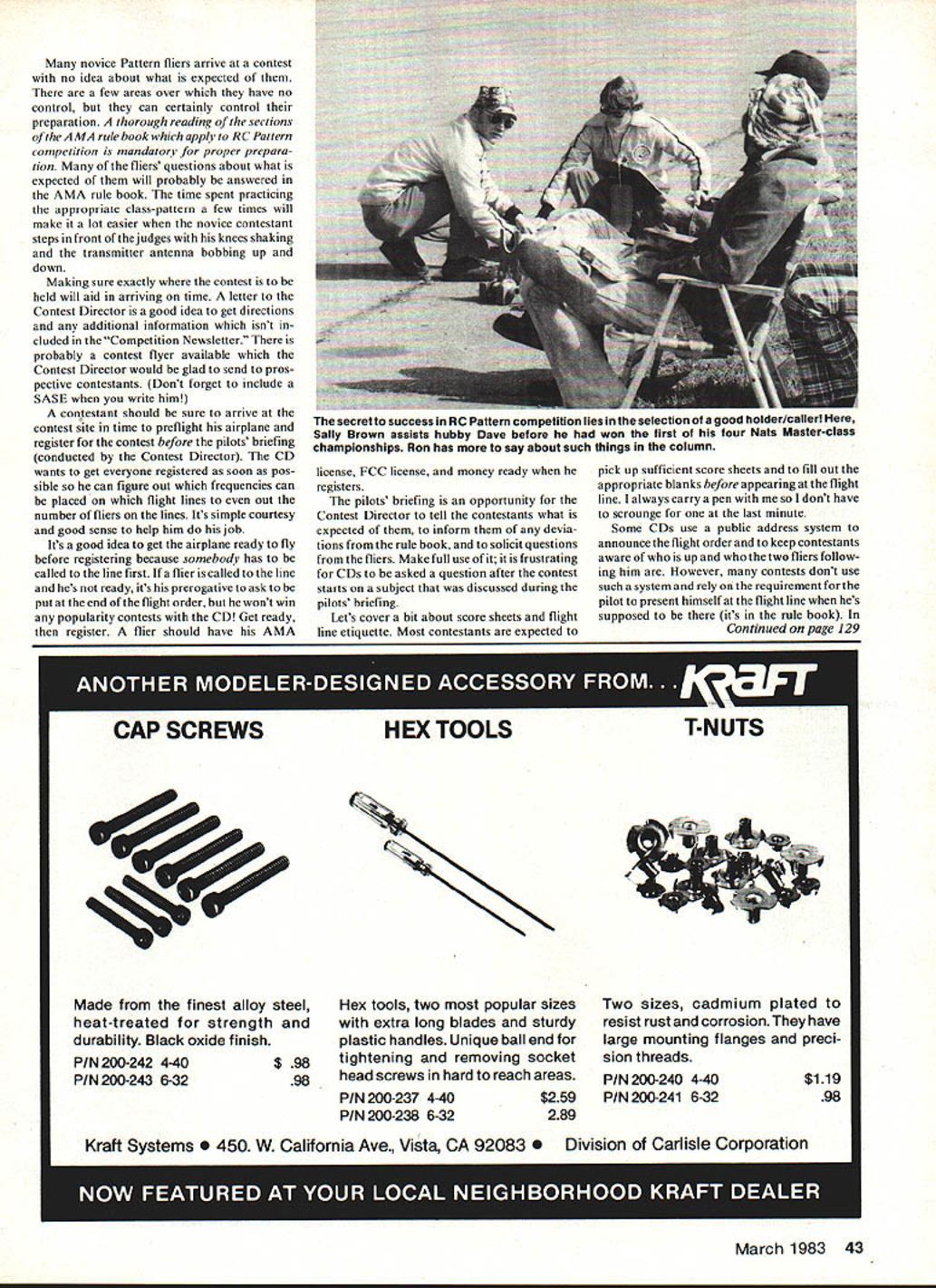
When a flier goes to the flight line, he should have a "caller" with him to assist in carrying the airplane, transmitter and associated equipment; to hold the airplane while the flier starts it when his time comes; to carry the airplane to the head of the takeoff run; to call the maneuver sequence for the pilot (who will forget everything, including his own name, in the heat of competition); to give the pilot verbal assistance on maneuver placement, airplane heading and wind direction; and to retrieve the airplane at the end of the flight.
Most fliers ask a friend to be a caller, but a novice may not know anyone at the contest. In that case, a flier who has a super-looking airplane should be asked, because he will probably know what's going on, and it's a good way to meet other fliers. It's not a bad idea to ask someone who is a great flier to assist as a caller—because, since judges are fallible and subject to influence, they tend to assume that anyone associating with a great flier must be one too and deserves high scores. That's known as basking in someone else's "halo effect," but a lot of pilots use it. Seriously, some of the best advice can be obtained from great pilots, and smart novice pattern fliers make good use of it by asking them to be callers.
At the flight line
The pilot should hand his fresh score sheets to the judges as soon as the previous flight's score sheets are picked up. Then the airplane should be placed on the runway near the judges with the engine exhaust pointing anywhere but at the judges! Smart pilots check for proper radio operation after putting the airplane on the runway but before attaching the glow-plug battery. In this way, if a radio problem is discovered, the pilot has the option of asking to be put at the end of the flight order. If the glow-plug battery is connected first, the discovery of a radio problem means the loss of one round of flying.
Once the engine is started, the caller should carry the airplane to the head of the runway, where the pilot should "blow out" the engine by advancing the throttle to high for a few seconds. The pilot should position himself where he will not interfere with the judges' view of the flight, but close enough so the judges can hear him call the maneuvers. I usually try to stand upwind of the judges so that the wind will carry my voice back to them.
I ask the caller to tell me the next maneuver as soon as I finish one. This way, there is plenty of time to tell the judges what the next maneuver is and to get the airplane ready to do it. I usually tell the judges, "My next maneuver is a Triple Weiler-dill." Then I perform the turn-around, normally a Split-S maneuver. This is followed by saying, "This is the heading for a Triple Weiler-dill." Finally, I say, "Maneuver starting now" and "Maneuver complete." The pilot and the caller should not comment on the quality of the maneuver. The judges will take care of that on the score sheets. After the flight is complete, the judges should be thanked—after all, they work so that we can play.
Helpful checklist
- Read the AMA pattern competition rules thoroughly.
- Practice the appropriate class pattern several times before the contest.
- Contact the Contest Director for directions and contest flyer (include SASE).
- Arrive early to preflight, prepare the airplane and register before the pilots' briefing.
- Bring AMA license, FCC license and entry fee/money.
- Bring pens and extra score sheets; fill out required blanks ahead of time.
- Arrange for a caller who knows the procedures and can assist during the flight.
That's enough to get a novice pattern flier started at his first contest without feeling foolish. Confidence that what you're doing is correct is a big help in a new situation, like the first pattern contest.
Next month I will cover the Reverse Outside Loop which was promised for this month.
Ron Van Putte 111 Sleepy Oaks Rd. Ft. Walton Beach, FL 32548.
Transcribed from original scans by AI. Minor OCR errors may remain.

