

Radio Control Sport/Aerobatics
Ron Van Putte
AFTER TWO MONTHS of special features it is a relief to get back to a regular column. Covering the Masters Tournament and the Nats Pattern/Pylon/Scale events was interesting and fun, but the deadlines for article submission were so close to the events that it tended to get to you. For example, I returned from the Nats on Monday evening, August 11, and mailed my Nats coverage to Washington on Thursday morning, August 14. During that 2½ days over 4,000 words had to be written and typed and 68 pictures were selected from the more than 500 which were taken. I'm glad it's over, but since I can feel the waves of pity coming in from all over the country already; perhaps it's time to move on to other things.
What kinds of airplanes draw the most interest at your flying site? If your field is anything like mine, the attention-getters are sport or scale airplanes. My new Phoenix 6 drew some initial interest, but no more than another flier's Falcon 56. By comparison, you can always plan on a crowd around the club innovator's airplanes.
The imaginative people always make the rest of us feel conservative. How do you suppose the witnesses to Al Signorino's first flights of Snoopy's Dog House must have felt? You can bet that there were a lot of "prophets of doom" who had to eat their words, even if it didn't fly well at the start. At least Al had the imagination and the guts to try and that should make all of us encouraged to try similar projects.
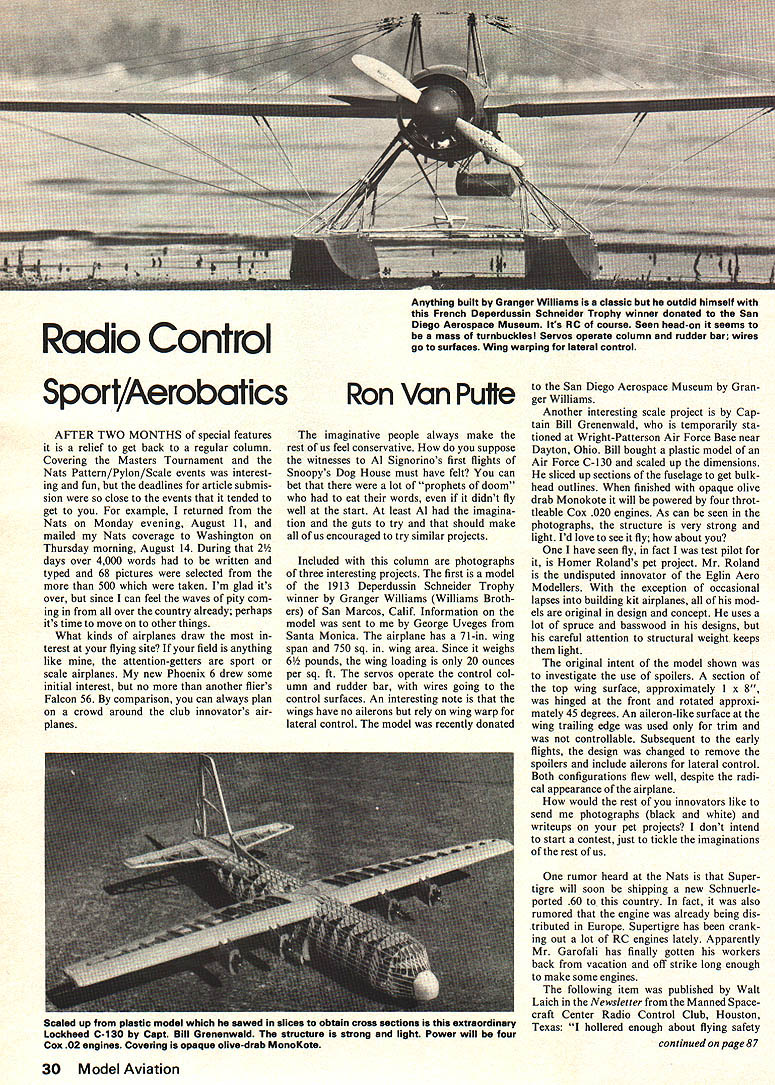
Included with this column are photographs of three interesting projects. The first is a model of the 1913 Deperdussin Schneider Trophy winner by Granger Williams (Williams Brothers) of San Marcos, Calif. Information on the model was sent to me by George Uveges from Santa Monica. The airplane has a 71-in. wing span and 750 sq. in. wing area. Since it weighs 6½ pounds, the wing loading is only 20 ounces per sq. ft. The servos operate the control column and rudder bar, with wires going to the control surfaces. An interesting note is that the wings have no ailerons but rely on wing warp for lateral control. The model was recently donated to the San Diego Aerospace Museum by Granger Williams.
Another interesting scale project is by Captain Bill Grenenwald, who is temporarily stationed at Wright-Patterson Air Force Base near Dayton, Ohio. Bill bought a plastic model of an Air Force C-130 and scaled up the dimensions. He sliced up sections of the fuselage to get bulkhead outlines, finished the structure in opaque olive drab Monokote and will be powered by four throttleable Cox .020 engines. As can be seen in the photographs, the structure is very strong and light. I'd love to see it fly.
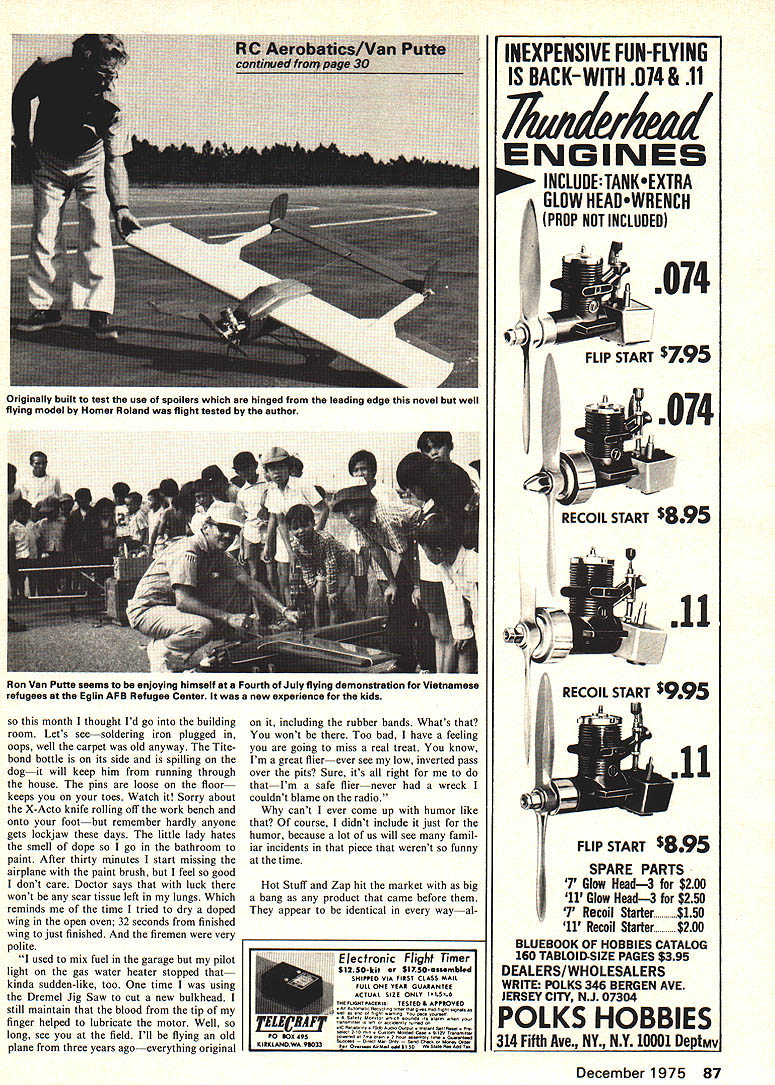
One I have seen fly, in fact I was test pilot for it, is Homer Roland's pet project. Mr. Roland is the undisputed innovator of the Eglin Aero Modellers. With the exception of occasional lapses in building kit airplanes, models of original design concept use a lot of spruce and basswood in his designs, but careful attention to structural weight keeps them light.
The original intent of the model shown was to investigate the use of spoilers. A section of the top wing surface, approximately 1 x 8", was hinged at the front and rotated approximately 45 degrees. An aileron-like surface at the wing trailing edge was used only for trim and was not controllable. Subsequent to the early flights, the design was changed to remove the spoilers and include ailerons for lateral control. Both configurations flew well, despite the radical appearance of the airplane.
How would the rest of you innovators like to send me photographs (black and white) and writeups on your pet projects? I don't intend to start a contest, just to tickle the imaginations of the rest of us.
One rumor heard at the Nats is that Supertigre will soon be shipping a new Schnuerle-ported .60 to this country. In fact, it is also rumored that the engine was already being distributed in Europe. Supertigre has been cranking out a lot of RC engines lately. Apparently Mr. Garofali has finally gotten his workers back from vacation and off strike long enough to make some engines.
The following item was published by Walt Laich in the Newsletter from the Manned Spacecraft Center Radio Control Club, Houston, Texas: "I hollered enough about flying safety on it, including the rubber bands. What's that? You won't be there. Too bad, I have a feeling you are going to miss a real treat. You know, I'm a great flier—ever see my low, inverted pass over the pits? Sure, it's all right for me to do that—I'm a safe flier—never had a wreck I couldn't blame on the radio.
Why can't I ever come up with humor like that? Of course, I didn't include it just for the humor, because a lot of us will see many familiar incidents in that piece that weren't so funny at the time.
So this month I thought I'd go into the building room. Let's see—soldering iron plugged in, oops, well the carpet was old anyway. The Titebond bottle is on its side and is spilling on the dog—it will keep him from running through the house. The pins are loose on the floor—keeps you on your toes. Watch it! Sorry about the X‑Acto knife rolling off the work bench onto your foot—but remember hardly anyone gets lockjaw these days. The little lady hates the smell of dope so I go in the bathroom to paint. After thirty minutes I start massing the airplane with the paint brush, but I feel so good I don't care. Doctor says that with luck there won't be any scar tissue left in my lungs. Which reminds me of the time I tried to dry a doped wing in the oven; over 32 seconds from finished wing to just finished. And the firemen were very polite. Though their manufacturers might disagree.
Both have a wide variety of uses and many we'll be trying later on haven't even been thought of yet. My latest was to stick wing skins together for my new Phoenix 6. I prepared the skins in the normal way, applied tape to the joint on the inside of the skin, and put Hot Stuff on the joint from the reverse side. Sanding the skins was much easier than normal and I got a much better-looking wing. One caution though, be sure all the joints are very close because neither Hot Stuff nor Zap will build a fillet across a wide gap.
The United States Pattern Judges Association is well on the road to acting as a viable part of the National Society of Radio Control Aerobatics. The USPJA was formed by NSRCA president Joe Bridi, and the organization promises to be one of the best things ever done by the NSRCA. All of the judges at the Master's Tournament were members of the USPJA and many more major events, like the Tournament of Champions at Las Vegas, will also be judged by USPJA members.
There are many problems related to making a concept like the USPJA work but it is already headed in the right direction. What the organization needs now is active interest and support of a broad spectrum of NSRCA members. If you are interested, write the secretary/treasurer Bill Semler, 21103 South New Hampshire Ave., Torrance, Calif., 90502, to let him know how you feel about the organization, to offer suggestions, and/or to volunteer to do work for the USPJA in your area.
(My address is 12 Connie Dr., Shalimar, Fla. 32579.)
Transcribed from original scans by AI. Minor OCR errors may remain.

