
Radio Control: Sport/Aerobatics
Ron Van Putte
Anniversary
Another column — this one marks the beginning of my ninth year as a columnist for Model Aviation. I have been with the magazine since the first issue came out in 1975. In those early days the magazine had only about 80 pages, and the only parts in color were the covers. In truth, Model Aviation couldn't begin to compare with a couple of the other model magazines back then. Old pro Bill Winter (who was then the editor) knew all there was to know about putting out a quality magazine—but many of us had to learn.
I was talking to Associate Editor Ross McMullen the other day and told him how delighted I, as a reader, was with the job that the people in the front office (like he and Publisher/Editor Carl Wheeley and Art Director Herb Silbermann) (Editor's note: Let's not forget Andrea Peterson and Johnnie Shipley!) had done in turning Model Aviation into a quality magazine. I'm proud of Model Aviation and if you feel the same way, let those talented, hard-workers in the editorial office hear about it.
Photos
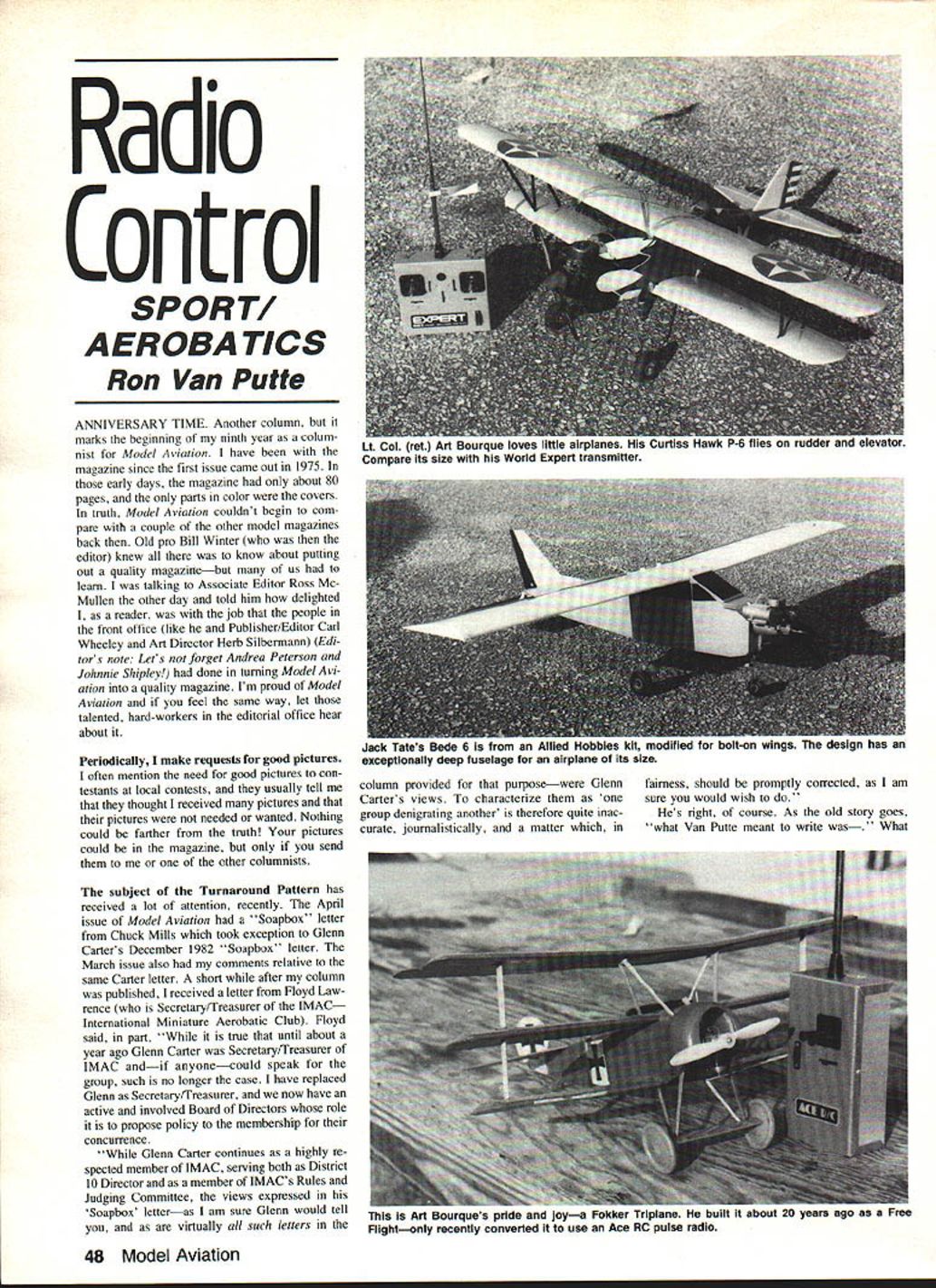
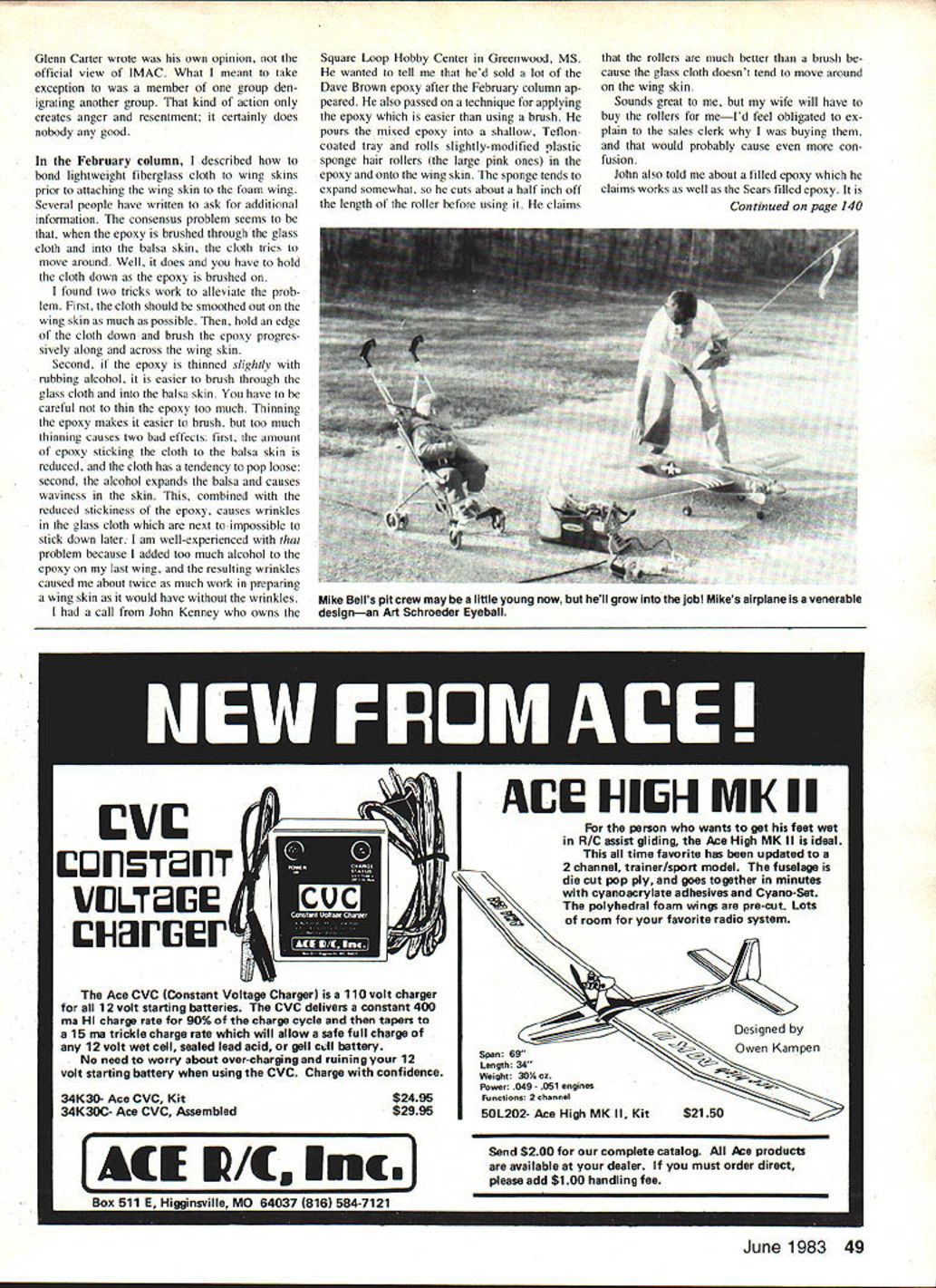
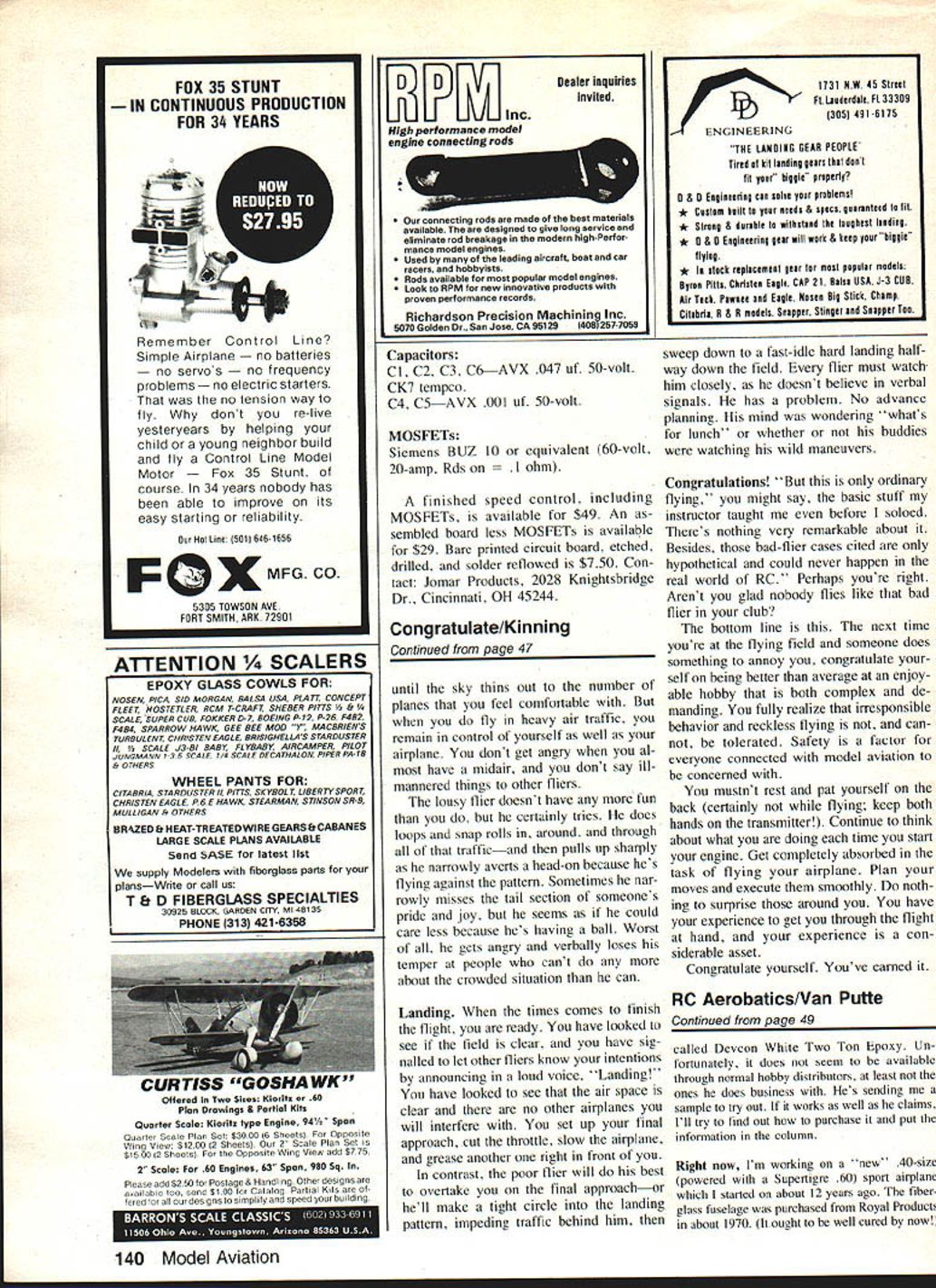
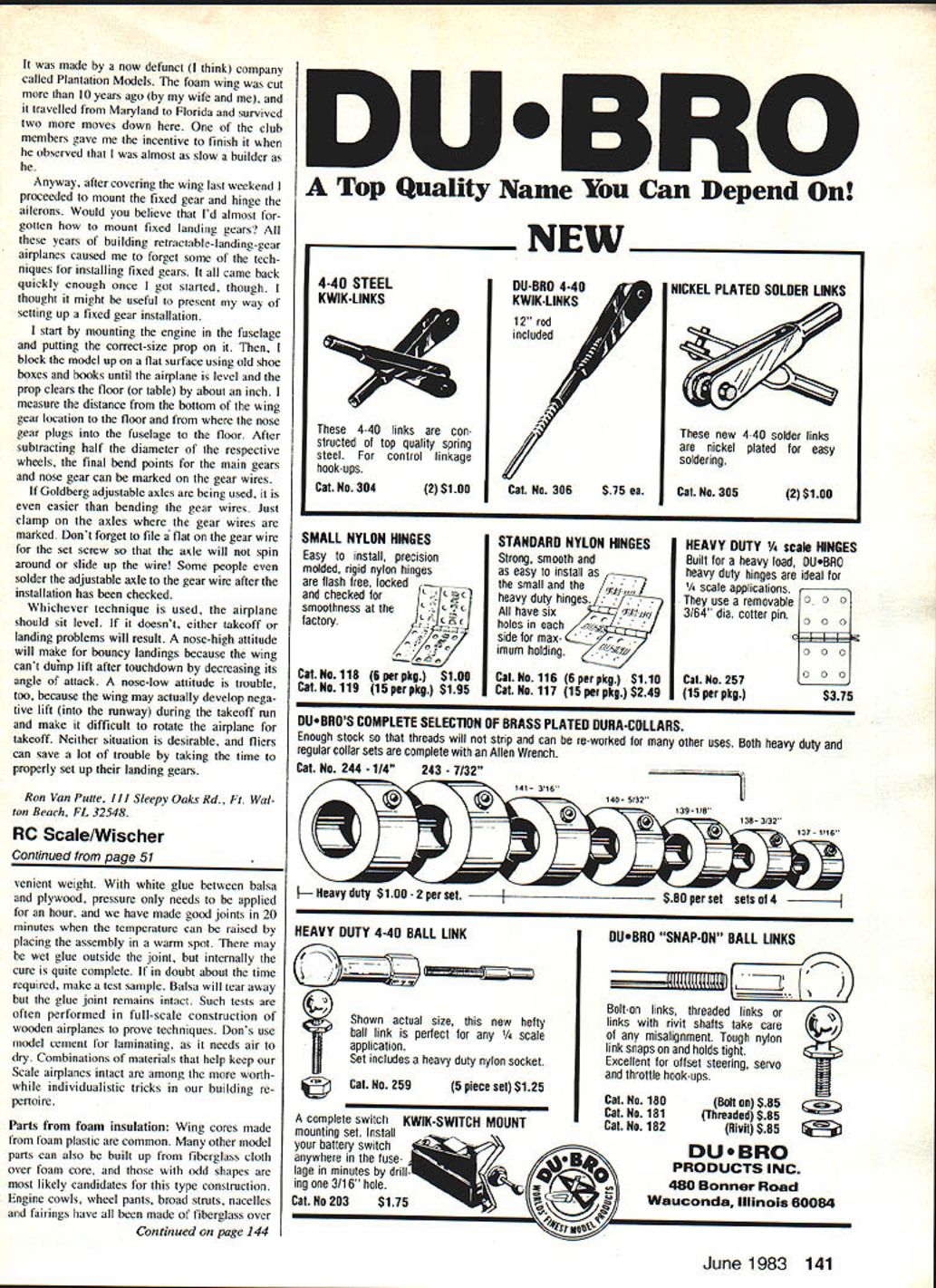
Periodically I make requests for good pictures. I often mention the need for good pictures to contestants at local contests, and they usually tell me that they thought I received many pictures and that their pictures were not needed or wanted. Nothing could be farther from the truth! Your pictures could be in the magazine, but only if you send them to me or one of the other columnists.
Turnaround Pattern and IMAC
The subject of the Turnaround Pattern has received a lot of attention recently. The April issue of Model Aviation had a "Soapbox" letter from Chuck Mills which took exception to Glenn Carter's December 1982 "Soapbox" letter. The March issue also had my comments relative to the same Carter letter.
A short while after my column was published, I received a letter from Floyd Lawrence (Secretary/Treasurer of IMAC — International Miniature Aerobatic Club). Floyd said, in part:
"While it is true that until about a year ago Glenn Carter was Secretary/Treasurer of IMAC — and if anyone could speak for the group, such is no longer the case. I have replaced Glenn as Secretary/Treasurer, and we now have an active and involved Board of Directors whose role it is to propose policy to the membership for their concurrence.
"While Glenn Carter continues as a highly respected member of IMAC, serving both as District 10 Director and as a member of IMAC's Rules and Judging Committee, the views expressed in his 'Soapbox' letter — as I am sure Glenn would tell you, and as are virtually all such letters in the column provided for that purpose — were Glenn Carter's views. To characterize them as 'one group denigrating another' is therefore quite inaccurate, journalistically, and a matter which, in fairness, should be promptly corrected, as I am sure you would wish us to do."
He's right, of course.
Fiberglass Wing Skin Bonding
My February column described bonding lightweight fiberglass cloth wing skins prior to attaching the wing skin to a foam wing. Several people have written asking for additional information. The consensus problem seems to be epoxy brushing through the glass cloth to the balsa skin, which allows the cloth to move around. There are ways to hold the cloth down; epoxy-brushing techniques have found two tricks that help alleviate the problem:
- Smooth the cloth out on the wing skin as much as possible. Hold the edge of the cloth down and brush epoxy progressively along and across the wing skin.
- Thin the epoxy slightly with rubbing alcohol to make it easier to brush through the glass cloth to the balsa skin.
Be careful not to thin the epoxy too much. Excessive thinning has two bad effects: first, the amount of epoxy sticking the cloth to the balsa skin is reduced and the cloth has a tendency to pop loose; second, alcohol expands the balsa and causes waviness of the skin. Combined with the reduced stickiness of the epoxy, this causes wrinkles in the glass cloth that are next to impossible to stick down later. I'm well experienced with this problem because I added too much alcohol to the epoxy on the last wing; the resulting wrinkles caused about twice as much work preparing the wing skin as would have been necessary without the wrinkles.
I called John Kenney, owner of Square Loop Hobby Center, Greenwood, MS. He told me he'd sold a lot of Dave Brown epoxy after the February column appeared and also passed on a technique for applying epoxy more easily: pour mixed epoxy into a shallow Teflon-coated tray and roll slightly modified plastic sponge hair rollers (large pink ones) in the epoxy onto the wing skin. The sponge tends to expand, so he cuts about a half inch off the length of the roller before using it. He claims that the rollers are much better than a brush because the glass cloth doesn't tend to move around on the wing skin.
Sounds great to me, but my wife will have to buy the rollers for me — I'd feel obligated to explain to the sales clerk why I was buying them, and that would probably cause even more confusion.
John also told me about a filled epoxy which he claims works as well as the Sears filled epoxy. It is called Devcon White Two-Ton Epoxy. Unfortunately, it does not seem to be available through normal hobby distributors, at least not the ones he does business with. He's sending me a small sample to try out. If it works as well as he claims, I'll try to find out how to purchase it and put the information in the column.
Current Project
Right now I'm working on a "new" 40-size sport airplane (powered with a Super Tigre .60) which I started about 12 years ago. The fiberglass fuselage was purchased from Royal Products in about 1970 (it ought to be well cured by now). The wing is a straight, constant-chord sheeted wing with rounded tips. It's built strong enough to stand aerobatics, but it's not a true pattern ship. I'm getting it ready for some mild aerobatics and I'm going to try to use the Ace pulsed system in it.
The kit was made by a now-defunct (I think) company called Plantation Models. The foam wing was cut more than 10 years ago (by my wife and me), and it traveled from Maryland to Florida and survived two more moves down here. One of the club members gave me the incentive to finish it when he observed that I was almost as slow a builder as he.
After covering the wing last weekend I proceeded to mount the fixed gear and hinge the ailerons. Would you believe that I'd almost forgotten how to mount fixed landing gear? All these years of building retractable-landing-gear airplanes caused me to forget some of the techniques for installing fixed gear. It all came back quickly enough once I got started, though. I thought it might be useful to present my way of setting up a fixed-gear installation.
Fixed-Gear Setup — My Method
- Mount the engine in the fuselage and put the correct-size prop on it.
- Block the model up on a flat surface (using old shoe boxes and books) until the airplane is level and the prop clears the floor (or table) by about an inch.
- Measure the distance from the bottom of the wing gear location to the floor and from where the nose gear plugs into the fuselage to the floor.
- After subtracting half the diameter of the respective wheels, mark the final bend points for the main gears and nose gear on the gear wires.
- Bend or install the gear wires to the marked points and check the fit.
If Goldberg adjustable axles are being used, it is even easier than bending the gear wires. Just clamp on the axles where the gear wires are marked. Don't forget to file a flat on the gear wire for the set screw so that the axle will not spin around or slide up the wire! Some people even solder the adjustable axle to the gear wire after the installation has been checked.
Whichever technique is used, the airplane should sit level. If it doesn't, either takeoff or landing problems will result:
- A nose-high attitude will make for bouncy landings because the plane can't dump lift after touchdown by decreasing its angle of attack.
- A nose-low attitude is trouble, too, because the wing may actually develop negative lift (into the runway) during the takeoff run and make it difficult to rotate the airplane for takeoff.
Neither situation is desirable, and fliers can save a lot of trouble by taking the time to properly set up their landing gear.
Ron Van Putte 111 Sleepy Oaks Rd. Ft. Walton Beach, FL 32548.
Transcribed from original scans by AI. Minor OCR errors may remain.

