
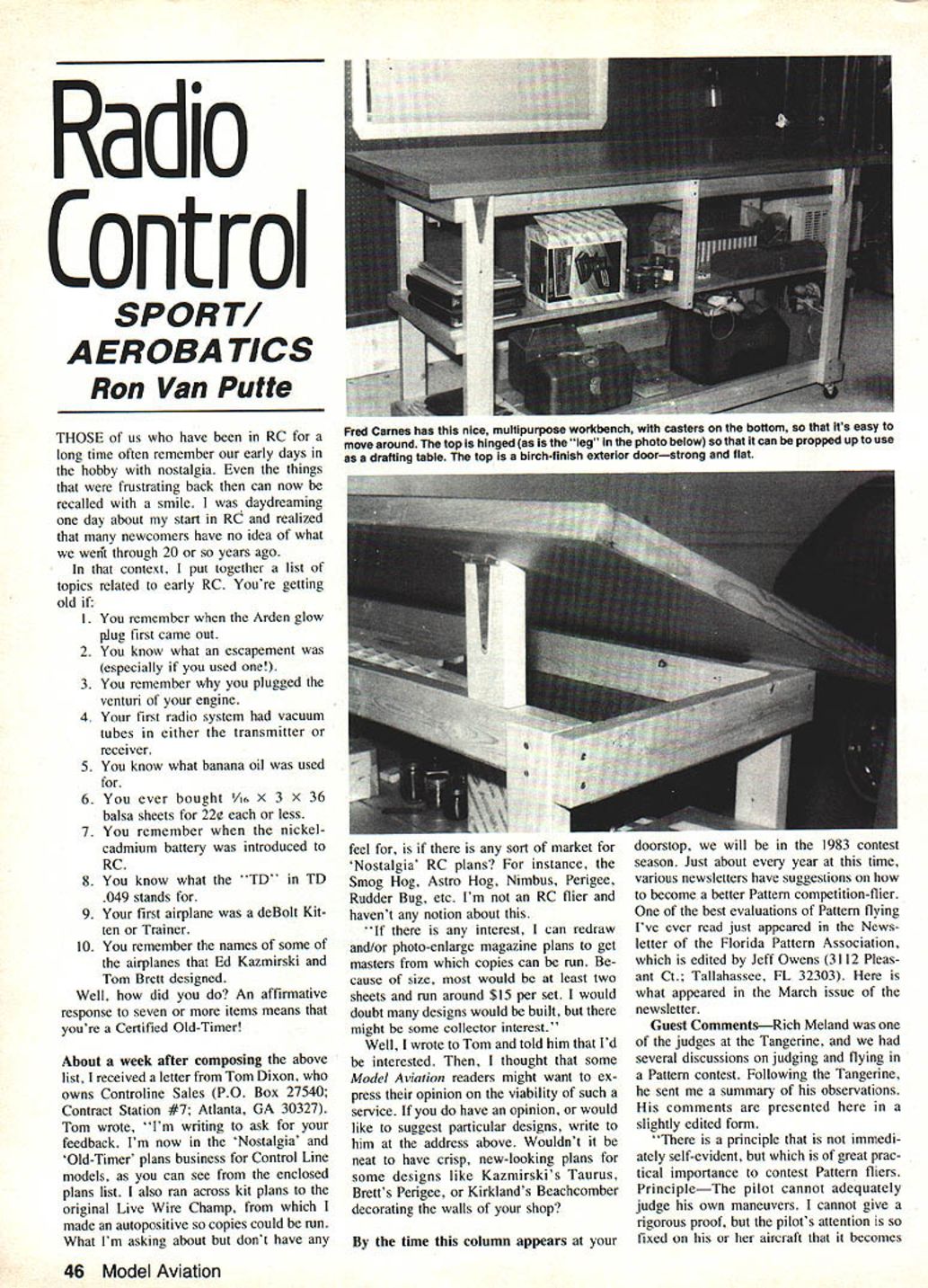

Radio Control: SPORT/AEROBATICS
Ron Van Putte
THOSE of us who have been in RC for a long time often remember our early days in the hobby with nostalgia. Even the things that were frustrating back then can now be recalled with a smile. I was daydreaming one day about my start in RC and realized that many newcomers have no idea of what we went through 20 or so years ago.
In that context, I put together a list of topics related to early RC. You're getting old if:
- You remember when the Arden glow plug first came out.
- You know what an escapement was (especially if you used one!).
- You remember why you plugged the venturi of your engine.
- Your first radio system had vacuum tubes in either the transmitter or receiver.
- You know what banana oil was used for.
- You ever bought 1/16 x 3 x 36 balsa sheets for 22¢ each or less.
- You remember when the nickel-cadmium battery was introduced to RC.
- You know what the "TD" in TD .049 stands for.
- Your first airplane was a deBolt Kitten or Trainer.
- You remember the names of some of the airplanes that Ed Kazmirski and Tom Brett designed.
Well, how did you do? An affirmative response to seven or more items means that you're a Certified Old-Timer!
About a week after composing the above list, I received a letter from Tom Dixon, who owns Controline Sales (P.O. Box 27540; Contract Station #7; Atlanta, GA 30327). Tom wrote, "I'm writing to ask for your feedback. I'm now in the 'Nostalgia' and 'Old-Timer' plans business for Control Line models, as you can see from the enclosed plans list. I also ran across kit plans to the original Live Wire Champ, from which I made a photo-positive so copies could be run. What I'm asking about but don't have any feel for, is if there is any sort of market for 'Nostalgia' RC plans? For instance, the Smog Hog, Astro Hog, Nimbus, Perigee, Rudder Bug, etc. I'm not an RC flier and haven't any notion about this."
"If there is any interest, I can redraw and/or photo-enlarge magazine plans to get masters from which copies can be run. Because of size, most would be at least two sheets and run around $15 per set. I would doubt many designs would be built, but there might be some collector interest."
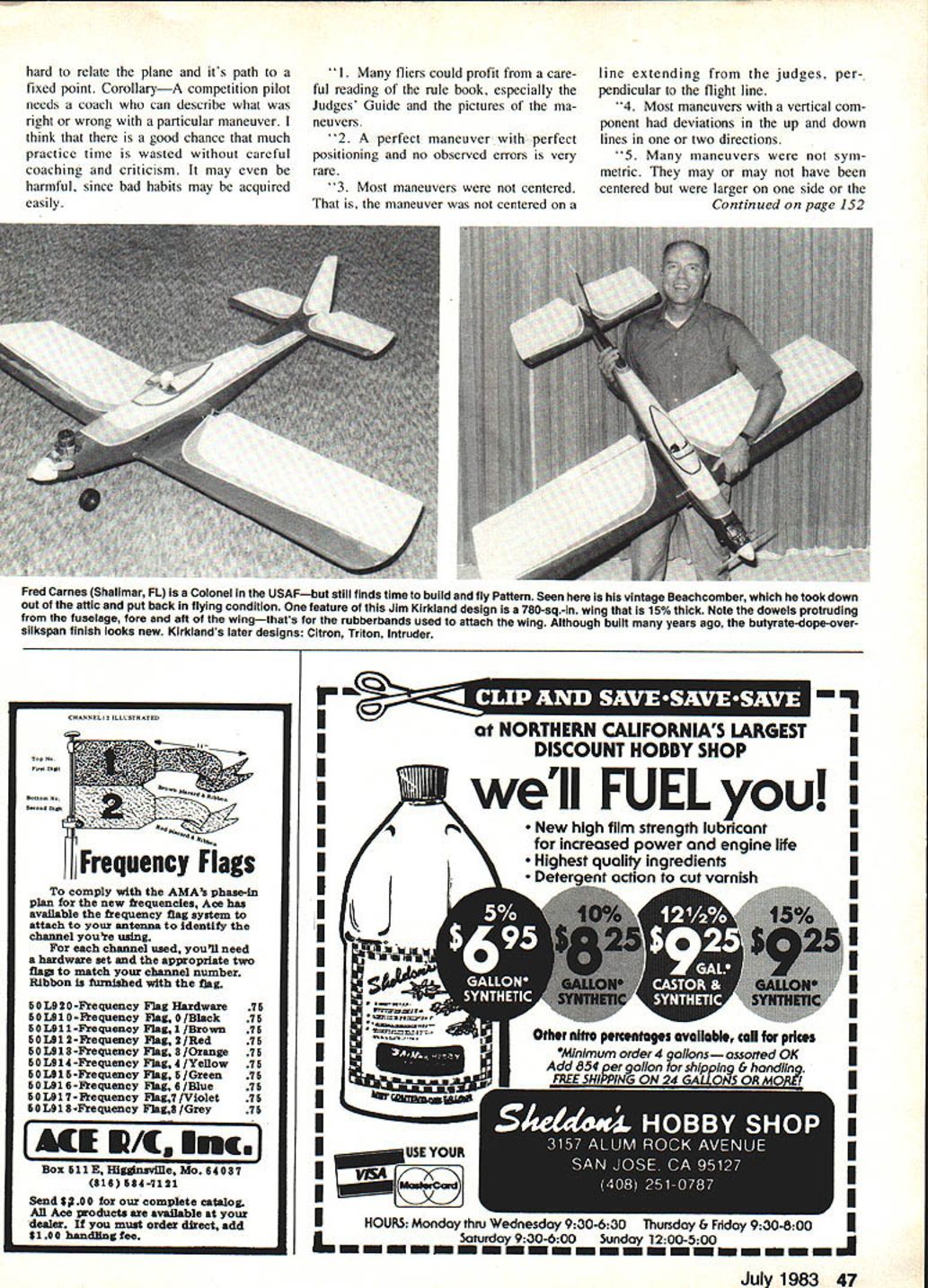
I wrote to Tom and told him that I'd be interested. Then I thought that some Model Aviation readers might want to express their opinion on the viability of such a service. If you do have an opinion, or would like to suggest particular designs, write to him at the address above. Wouldn't it be neat to have crisp, new-looking plans for some designs like Kazmirski's Taurus, Brett's Perigee, or Kirkland's Beachcomber decorating the walls of your shop?
By the time this column appears at your doorstop, we will be in the 1983 contest season. Just about every year at this time, various newsletters have suggestions on how to become a better Pattern competition flier. One of the best evaluations of Pattern flying I've ever read just appeared in the Newsletter of the Florida Pattern Association, which is edited by Jeff Owens (3112 Pleasant Ct.; Tallahassee, FL 32303). Here is what appeared in the March issue of the newsletter.
Guest Comments — Rick Meland (summary)
Rich Meland was one of the judges at the Tangerine, and we had several discussions on judging and flying in a Pattern contest. Following the Tangerine, he sent me a summary of his observations. His comments are presented here in a slightly edited form.
"There is a principle that is not immediately self-evident, but which is of great practical importance to contest Pattern fliers.
Principle — The pilot cannot adequately judge his own maneuvers. I cannot give a rigorous proof, but the pilot's attention is so fixed on his or her aircraft that it becomes hard to relate the plane and its path to a fixed point.
Corollary — A competition pilot needs a coach who can describe what was right or wrong with a particular maneuver. I think that there is a good chance that much practice time is wasted without careful coaching and criticism. It may even be harmful, since bad habits may be acquired easily.
- Many fliers could profit from a careful reading of the rule book, especially the Judges' Guide and the pictures of the maneuvers.
- A perfect maneuver with perfect positioning and no observed errors is very rare.
- Most maneuvers were not centered. That is, the maneuver was not centered on a line extending from the judges, perpendicular to the flight line.
- Most maneuvers with a vertical component had deviations in the up and down lines in one or two directions.
- Many maneuvers were not symmetric. They may or may not have been centered but were larger on one side or the other. Also, maneuvers with rolls on the up line did not have placement of the roll in the middle of that line.
- Most Stall Turns were not well done. The aircraft was either not vertical at the top of the turn or did not come close to a stop.
- Many maneuvers had a change of heading from entry to exit, or had the entry and exit at different altitudes.
- Most loops were not vertical or were horizontal eggs or ovals. Many were not superimposed, and changes in heading gave a corkscrew effect as viewed from one end.
- Many fliers don't know how to call a maneuver.
- Fliers suffer downgrades for a poor entry or exit regardless of the intervening maneuver. A 50-ft. minimum for entry and exit is necessary in order to establish a maneuver baseline.
"How does one arrive at a maneuver score? The AMA Judges' Guide has some suggested downgrades... one or two minor defects result in a downgrade to an eight... while one severe defect should pull it down to a six, as would a combination of three or four minor defects. Any element of poor positioning at the start of the maneuver is also fed into the final score.
"Using this and other suggested downgrades for each maneuver, one can easily arrive at a score of 6–7.5 for an average maneuver, while an 8 would be quite good, and 8.5–9.5 is very good to quite exceptional. We saw many 7.0–7.5 maneuvers, some 8.0 maneuvers, and very few 8.5–9.5 maneuvers. I personally don't believe in scoring inflation, but I realize that the score for each maneuver can vary by 0.5 points and only occasionally by 1 point."
I have to agree with many of Rick's observations, as my experiences have tended to confirm them. I would only add one observation of my own: if one line consistently scores higher by 1–2 points per maneuver, then the scores from that line will determine the winners of the contest. Some type of overall "quality control" is needed to minimize the effects of an "easy set" of judges. A determined and persistent chief judge, who monitors each line, can do much to maintain an even quality of judging. Schools held before a contest can help to do this, too.
Thanks to Rick Meland and Jeff Owens for the valuable observations.
Ron Van Putte 111 Sleepy Oaks Rd. Ft. Walton Beach, FL 32548.
Transcribed from original scans by AI. Minor OCR errors may remain.

