
Radio Control: Sport/Aerobatics
Ron Van Putte
SNOWED UNDER!
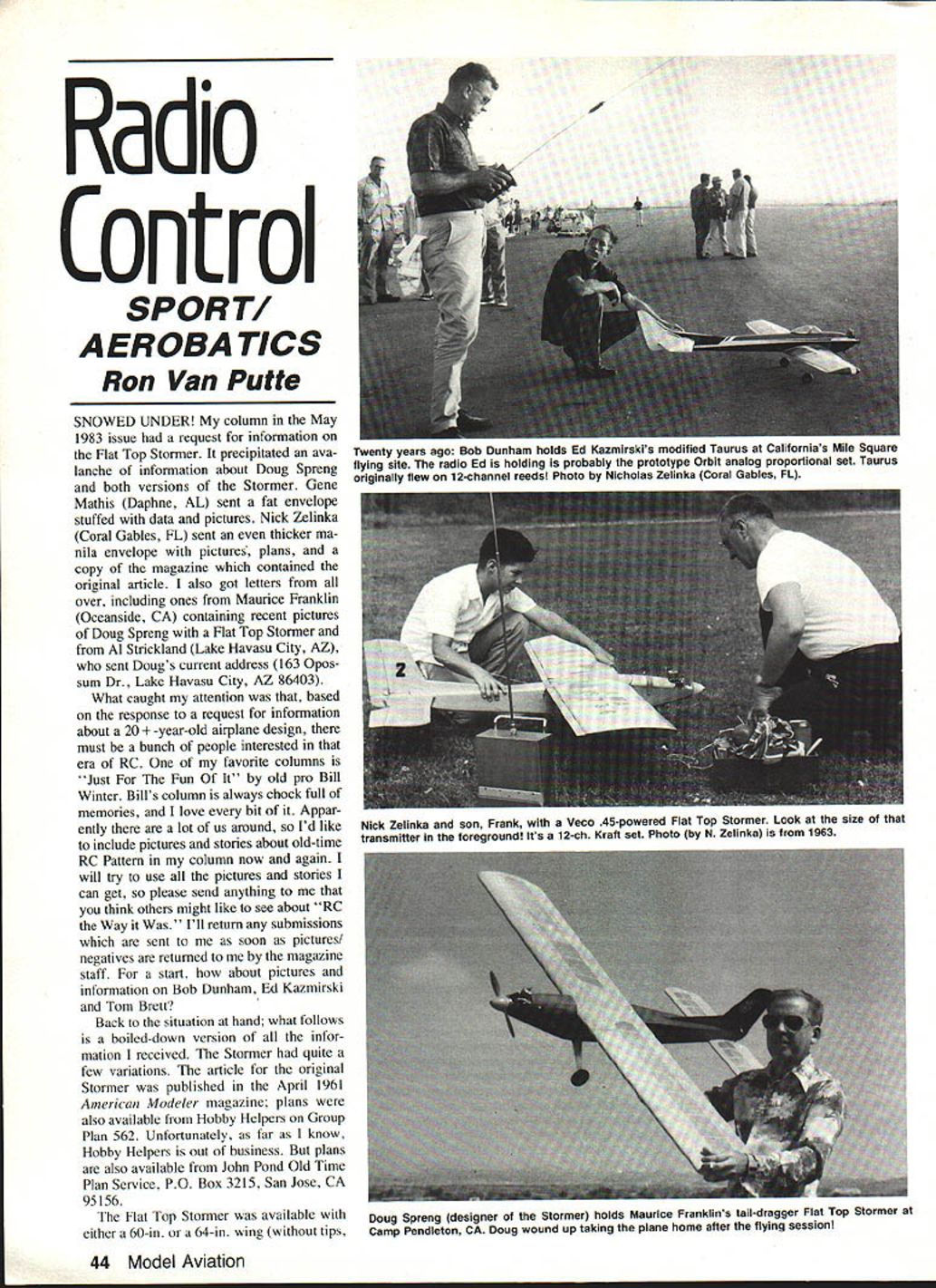
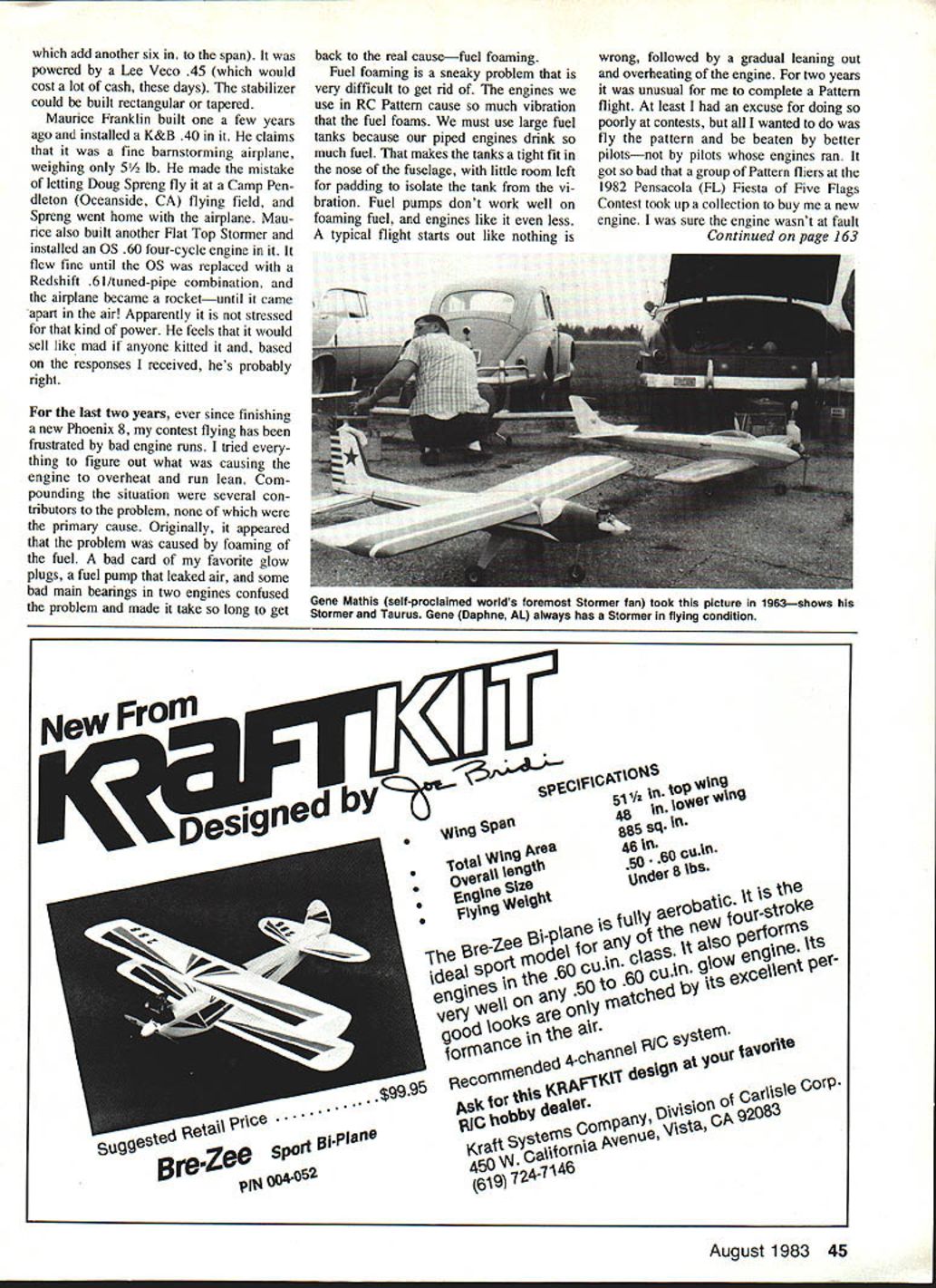
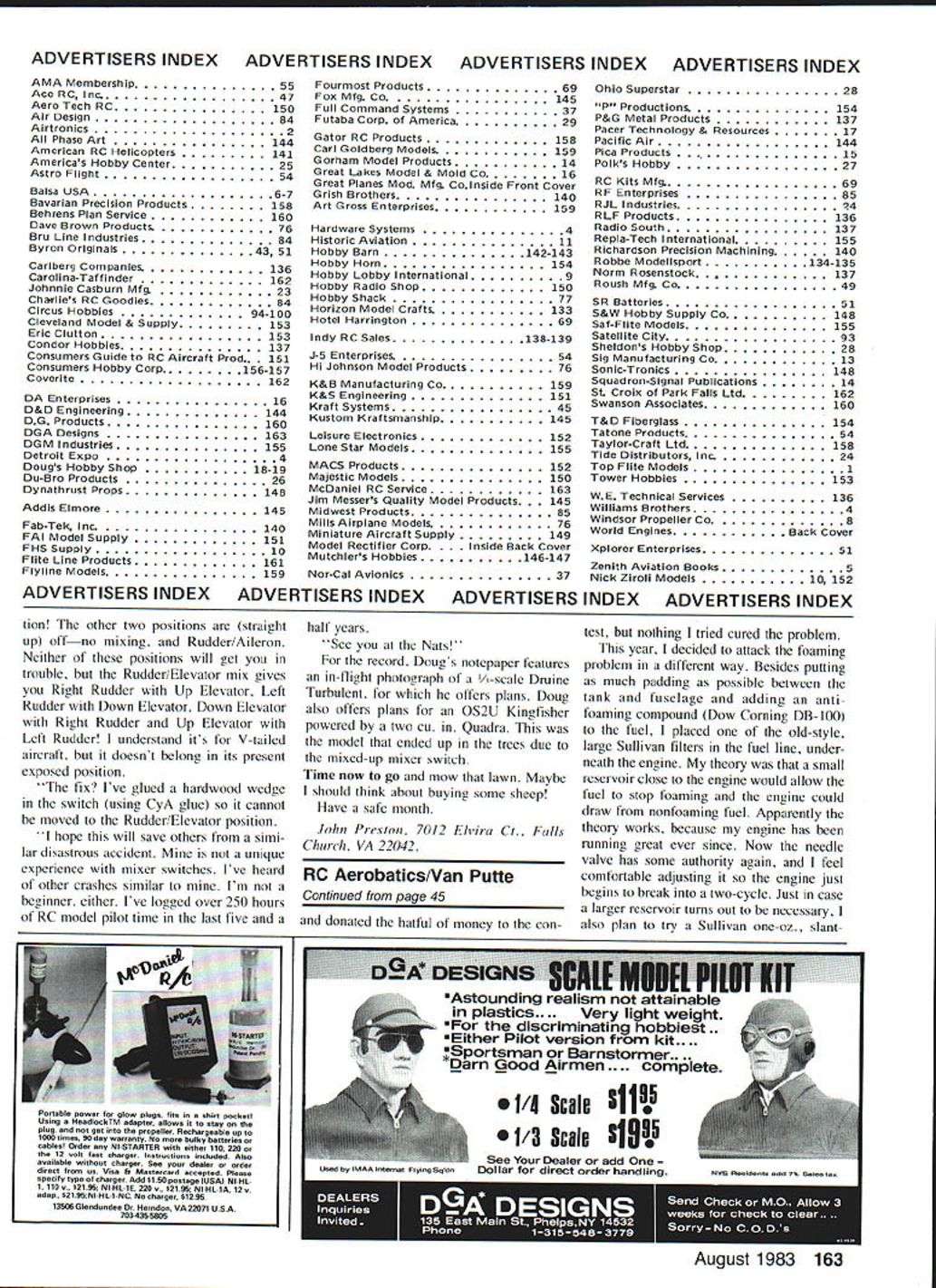
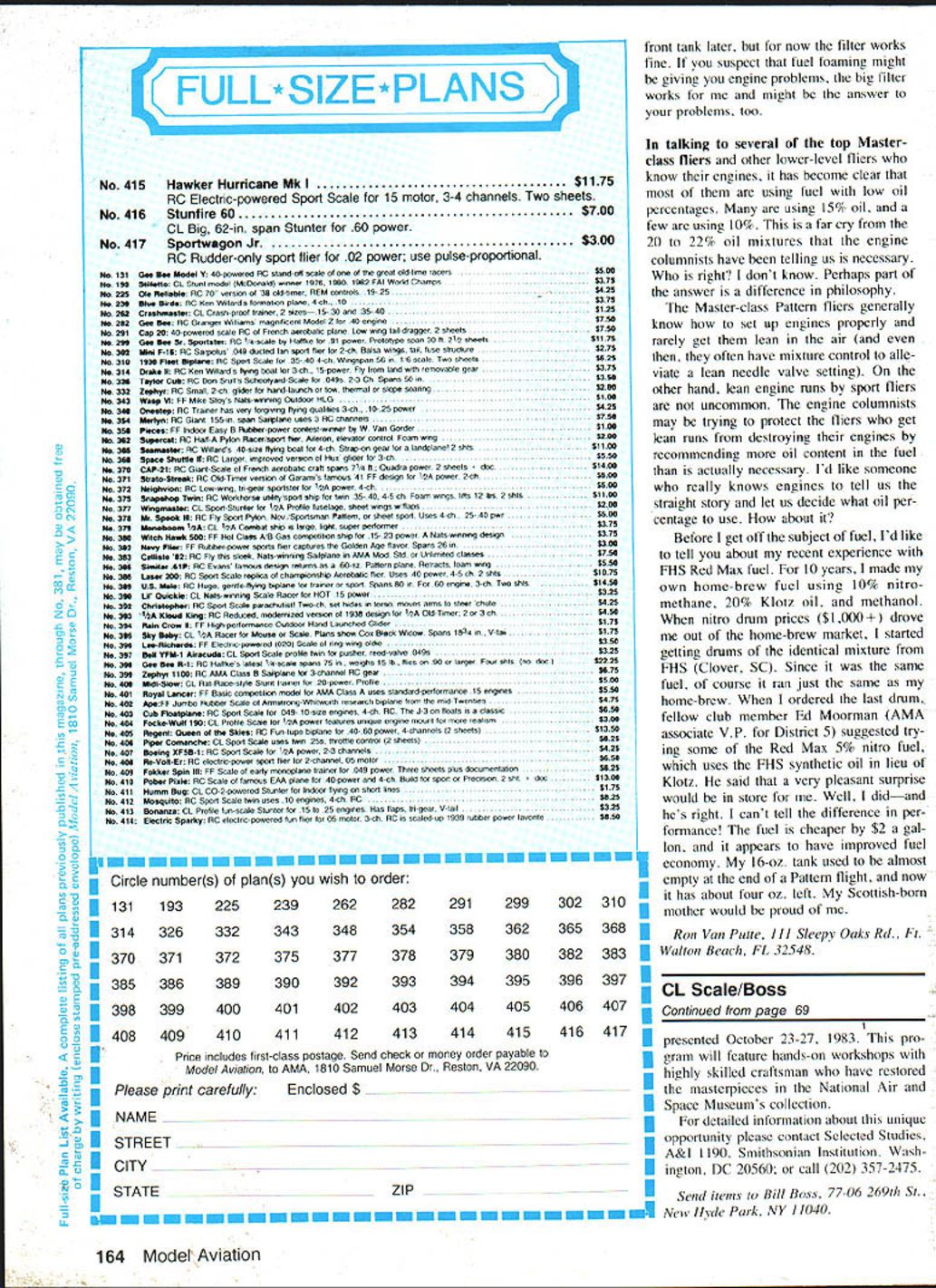
My column in the May 1983 issue had a request for information on the Flat Top Stormer. It precipitated an avalanche of information about Doug Spreng and both versions of the Stormer. Gene Mathis (Daphne, AL) sent a fat envelope stuffed with data and pictures. Nick Zelinka (Coral Gables, FL) sent an even thicker manila envelope with pictures, plans, and a copy of the magazine that contained the original article. I also got letters from all over, including ones from Maurice Franklin (Oceanside, CA) containing recent pictures of Doug Spreng with a Flat Top Stormer and from Al Strickland (Lake Havasu City, AZ), who sent Doug's current address (163 Opossum Dr., Lake Havasu City, AZ 86403).
What caught my attention was that, based on the response to a request for information about a 20+-year-old airplane design, there must be a bunch of people interested in that era of RC. One of my favorite columns is "Just For The Fun Of It" by old pro Bill Winter. Bill's column is always chock full of memories, and I love every bit of it. Apparently there are a lot of us around, so I'd like to include pictures and stories about old‑time RC Pattern in my column now and again. I will try to use all the pictures and stories I can get, so please send anything to me that you think others might like to see about "RC the Way It Was." I'll return any submissions that are sent to me as soon as pictures/negatives are returned to me by the magazine staff.
For a start, how about pictures and information on:
- Bob Dunham
- Ed Kazmirski
- Tom Brett
Flat Top Stormer
What follows is a boiled‑down version of all the information I received. The Stormer had quite a few variations. The article for the original Stormer was published in the April 1961 American Modeler magazine; plans were also available from Hobby Helpers on Group Plan 562. Unfortunately, as far as I know, Hobby Helpers is out of business. Plans are also available from John Pond Old Time Plan Service, P.O. Box 3215, San Jose, CA 95156.
The Flat Top Stormer was available with either a 60‑in. or a 64‑in. wing (without tips, which add another six inches to the span). It was powered by a Lee Veco .45 (which would cost a lot of cash these days). The stabilizer could be built rectangular or tapered.
Maurice Franklin built one a few years ago and installed a K&B .40 in it. He claims that it was a fine barnstorming airplane, weighing only 5½ lb. He made the mistake of letting Doug Spreng fly it at a Camp Pendleton (Oceanside, CA) flying field, and Spreng went home with the airplane. Maurice also built another Flat Top Stormer and installed an OS .60 four‑cycle engine in it. It flew fine until the OS was replaced with a Redshift .61/tuned‑pipe combination, and the airplane became a rocket—until it came apart in the air! Apparently it is not stressed for that kind of power. He feels that it would sell like mad if anyone kitted it, and based on the responses I received, he's probably right.
Fuel Foaming and Engine Problems
For the last two years, ever since finishing a new Phoenix 8, my contest flying has been frustrated by bad engine runs. I tried everything to figure out what was causing the engine to overheat and run lean. Compounding the situation were several contributors to the problem, none of which were the primary cause. Originally, it appeared that the problem was caused by foaming of the fuel. A bad card of my favorite glow plugs, a fuel pump that leaked air, and some bad main bearings in two engines confused the problem and made it take so long to get back to the real cause—fuel foaming.
Fuel foaming is a sneaky problem that is very difficult to get rid of. The engines we use in RC Pattern cause so much vibration that the fuel foams. We must use large fuel tanks because our piped engines drink so much fuel. That makes the tanks a tight fit in the nose of the fuselage, with little room left for padding to isolate the tank from the vibration. Fuel pumps don't work well on foaming fuel, and engines like it even less. A typical flight starts out like nothing is wrong, followed by a gradual leaning out and overheating of the engine. For two years it was unusual for me to complete a Pattern flight. At least I had an excuse for doing so poorly at contests, but all I wanted to do was fly the pattern and be beaten by better pilots—not by pilots whose engines ran.
It got so bad that a group of Pattern fliers at the 1982 Pensacola (FL) Fiesta of Five Flags Contest took up a collection to buy me a new engine. I was sure the engine wasn't at fault and donated the hatful of money back to the contest, but nothing I tried cured the problem.
This year, I decided to attack the foaming problem in a different way. Besides putting as much padding as possible between the tank and fuselage and adding an anti‑foaming compound (Dow Corning DB‑100) to the fuel, I placed one of the old‑style, large Sullivan filters in the fuel line underneath the engine. My theory was that a small reservoir close to the engine would allow the fuel to stop foaming and the engine could draw from nonfoaming fuel. Apparently the theory works, because my engine has been running great ever since. Now the needle valve has some authority again, and I feel comfortable adjusting it so the engine just begins to break into a two‑cycle. Just in case a larger reservoir turns out to be necessary, I also plan to try a Sullivan one‑oz. slant‑front tank later, but for now the filter works fine. If you suspect that fuel foaming might be giving you engine problems, the big filter works for me and might be the answer to your problems, too.
Oil Percentage in Fuel
In talking to several of the top Master‑class fliers and other lower‑level fliers who know their engines, it has become clear that most of them are using fuel with low oil percentages. Many are using 15% oil, and a few are using 10%. This is a far cry from the 20 to 22% oil mixtures that the engine columnists have been telling us are necessary. Who is right? I don't know. Perhaps part of the answer is a difference in philosophy.
The Master‑class Pattern fliers generally know how to set up engines properly and rarely get them lean in the air (and even then, they often have mixture control to alleviate a lean needle valve setting). On the other hand, lean engine runs by sport fliers are not uncommon. The engine columnists may be trying to protect the life of the fliers who get lean runs from destroying their engines by recommending more oil content in the fuel than is actually necessary. I'd like someone who really knows engines to tell us the straight story and let us decide what oil percentage to use. How about it?
FHS Red Max Fuel
Before I get off the subject of fuel, I'd like to tell you about my recent experience with FHS Red Max fuel. For 10 years, I made my own home‑brew fuel using 10% nitromethane, 20% Klotz oil, 1% castor and methanol. When nitro drum prices ($1,000+) drove me out of the home‑brew market, I started getting drums of the identical mixture from FHS (Clover, SC). Since it was the same fuel, of course it ran just the same as my home‑brew.
When I ordered the last drum, fellow club member Ed Moorman (AMA associate V.P. for District 5) suggested trying some of the Red Max 5% nitro fuel, which uses the FHS synthetic oil in lieu of Klotz. He said that a very pleasant surprise would be in store for me. Well, I did—and he's right. I can't tell the difference in performance! The fuel is cheaper by $2 a gallon, and it appears to have improved fuel economy. My 16‑oz. tank used to be almost empty at the end of a Pattern flight, and now it has about four ounces left. My Scottish‑borne mother would be proud of me.
Ron Van Putte 111 Sleepy Oaks Rd. Ft. Walton Beach, FL 32548
Transcribed from original scans by AI. Minor OCR errors may remain.

