
Radio Control: SPORT/AEROBATICS
Ron Van Putte
When you read this, my report on the RC Aerobatics World Championships will be elsewhere in this issue; but as I write, I'm still more than a week away from the opening ceremonies. You can imagine how excited I am about having the World Championships right here in my own backyard! Pensacola is only about 50 miles away, and I'll be able to commute to the competition from home. It'll be a lot more convenient and cheaper than driving hundreds of miles, staying in a motel and eating in restaurants (my Scottish ancestry asserting itself). I look forward to renewing acquaintances with the foreign competitors and meeting new ones. The competition should be great and I can't wait for it to get started!
Much of this column is prompted by a letter I received about the Turnaround Pattern, which I discussed in previous columns, and by an article I extracted from a club newsletter. From time to time I like to do this because it allows others to get their opinions and ideas aired in a public forum. There are a lot of really good opinions and ideas which would otherwise be confined to a very limited audience, and I think it's good for the hobby, even if some opinions disagree with mine.
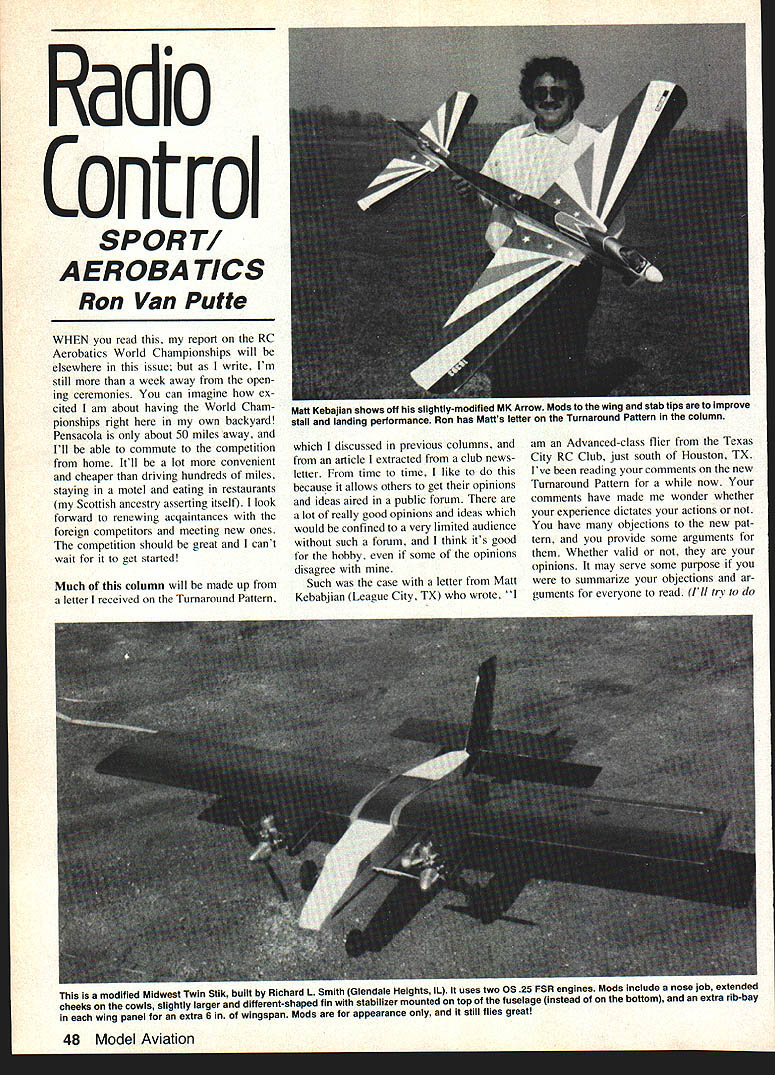
A letter from Matt Kebajian (League City, TX) prompted some of this. He wrote, "I am an Advanced-class flier from the Texas City RC Club, just south of Houston, TX. I've been reading your comments on the new Turnaround Pattern for a while now. Your comments have made me wonder whether your experience dictates your actions or not. You have many objections to the new pattern, and you provide some arguments for them. Whether valid or not, they are your opinions. It may serve some purpose if you were to summarize your objections and arguments for everyone to read." (I'll try to do so.)
TCRCC Turnaround Demonstration (personal observations)
The Turnaround demonstration at the Texas City RC Club (TCRCC) — this is a personal report, not an official comment — has earned and now enjoys an excellent reputation for its annual Pattern contest. Contestants come from Texas, Louisiana, Mississippi, Oklahoma and Monterrey, Mexico. For the last two years I have been honored to judge the contest.
This year the Turnaround/Sport Aerobatics Sportsman schedule was added in place of the Sport Scale event. The event was open to anyone — Master or Novice alike. We used one flight line, with Fred Ivey providing judging assistance. The event was a success with 19 participants. It was obvious that many people had never performed the Turnaround schedule before; it was great fun and exciting to watch, let alone judge. Three rounds were flown, taking less than 50 minutes to complete. The following are the main observations worth noting:
- I obviously don't have all the answers.
- Many models and pilots did a credible flying job, though the models were mostly conventional-pattern types.
- The Sportsman schedule is very, very quick — the 10 maneuvers can be performed in about one minute.
- There was a continuous stream of models; it was very easy to have one plane being judged while a previous plane landed and another took off.
- We used writers for scorekeeping — one writer per judge.
- Judges memorized the pattern and called the maneuvers; the writers scored each maneuver.
- Maneuvers were lost because of lack of coordination between flier and caller. Fliers who memorized the pattern generally did better.
- Spectators were seated about 20 ft behind the pilots' box. Our flight box was too small for some larger pilots and out‑of‑bounds violations occurred.
- The AMA Pattern takes about twice as long per round to complete as the Turnaround.
- It proved that both patterns can be run in the same contest fairly efficiently.
- Pilots were a lot more careful and attentive; they were glad for the exposure.
- The Turnaround reminds one of Control Line Stunt because of the quick timing. The Sportsman schedule is easy to perform but tough to keep within bounds. It's quick, it's fun, and it keeps you on your toes. A model designed to fly super-true at about 15% less speed than a conventional Pattern model would be ideal. Wing loading kept between 18–22 oz/sq ft would probably provide better flying.
(—RVP.)
Personal views on Turnaround vs. conventional Pattern
I liked the Turnaround, both flying it and judging it. However, I can't say that I liked it more than — or even the same as — conventional AMA Pattern. I much prefer flying fast, crisp, and quick conventional Pattern models, even though they are barely short of being guided buzz bombs. They simply feel better, regardless of how unrealistic they may be. That's probably because it's where my experience lies. But if the RC Contest Board decides to adopt Turnaround and make it mandatory for certain classes, it won't be the end of the world. I may not like the change at first, but I'm getting prepared.
A note on rules: the Contest Board voted to add a sixth class to the rule book, giving Contest Directors the option of picking either the conventional AMA Masters class or the new Turnaround FAI Master class. This was the rule proposal submitted by Larry Ott, president of the NSRCA, after a poll of NSRCA members indicated their support. When I wrote this, I hadn't heard the complete Contest Board final vote results; those results were later published in the December "Competition Newsletter." I haven't heard if the other rules proposals passed or failed.
I'm personally against imposing Turnaround from the perspective of a Contest Director faced with administering such an event, but I also realize the appeal of Turnaround Pattern to spectators and fliers alike. Not all opinions have been aired yet, and I am willing to receive and publish opinions (both pro and con) that are pertinent to the issue. Have at it.
Davison Aviators: a human-interest note
In flying RC for more than 29 years in 15 states, I've met a lot of RC fliers and have come to the conclusion that, as a group, we are nice people to be around. We've got our few bad apples, but we've also got a lot of real gems, like the members of the Davison Aviators. The following was published in the Davison Aviator News (MI), edited by Don Parks:
"It's been nice — downwind, crosswind, now on final. Low and slow. Oooops! Engine quit way at the other end of the flying field. I heard a voice from behind me saying, 'Go get it Bill, it's all yours now.' I hear a few more laughs. To me it really sounds good.
"Let me back up a few months — about eight or nine — when I was still a student trying to land on the same property I took off from. I had a circulation problem and was in and out of the hospital for five months and lost my left leg just below the knee.
"I came out to the flying field in a wheelchair to watch the flying. Someone yelled, 'Did you bring your plane?' I said, 'I can't fly from this thing.' Next thing I knew, I was being pushed out on the field. It sure made me feel good, but I know I tired out a lot of people. I missed the field and landed in the trees, out in the cornfield and in the tall grass, but there was always someone there to get it for me. Then I went from the wheelchair to crutches, but I still couldn't do anything but sit on a stool by the runway and try to fly. I won't mention names because everyone helped me so much. I would just like to take this time to thank everyone. It's something I will always remember.
"Well, I've stood here long enough. No one has started out after my plane yet, so me and my new leg will go out and get that plane and I'm happy to do so! Thanks again to all of you. Now I'm a pilot — Bill Hill."
If you're like me, you have a big lump in your throat right now.
Ron Van Putte 111 Sleepy Oaks Rd. Ft. Walton Beach, FL 32548
Transcribed from original scans by AI. Minor OCR errors may remain.

