
Radio Control: Sport/Aerobatics
Ron Van Putte
WHEN MY WIFE and I finished last month's column, we were on the eve of leaving to attend the RC World Championships in Bern, Switzerland. The plan was to fly free on military chartered aircraft in what is called "space available" status, a fringe benefit available to military personnel. Unfortunately, it suddenly became apparent that there was no space available. The prospect of $1200 additional cost to make the trip forced cancellation of our travel plans. This placed Model Aviation in a bind because I was the one who had covered the event for the magazine, and that made the decision even more difficult to make.
This month's column almost didn't get written because of an uninvited female guest named Eloise. The hurricane came marching through here just after daybreak a few days ago and messed up much of the Florida panhandle. My yard is full of broken trees and my aluminum storage shed ended up against several trees two blocks over, but my house was only slightly damaged. So, since my family and I are still in one piece and the sun is shining again, let's move into the column.
Some months ago I promised that future columns would contain discussions of the effects of wind on aircraft. As many of you are aware, this subject is a favorite topic with RC fliers and there has been many a controversy about it. I'm going to attempt to treat the problem rationally by stating some facts, making a few assumptions, and presenting my conclusions. Rational responses from readers of this column are welcomed and solicited, but I reserve the right to ignore bombasts from anyone.
I almost didn't write anything on the subject at all following the publication of an excellent article by Alex Finlay entitled, "Why Airplanes Fly" which appeared in the August 1975 issue of Radio Control Modeler. The article is well written and, while I agree with nearly everything contained in it, there are some facets I want to treat in my own way.
The kind of wind effects to be discussed here are those effects due to a wind whose direction and speed are constant. The effects of wind gusts on airplanes is much more complex and should be discussed after the effects of a steady wind have been covered.
The motion of airplanes is governed by physical laws which must be applied according to a proper frame of reference. The law everyone has heard of, but many misinterpret, is Newton's second law of motion, F = ma. The misinterpretations often occur because of attempts to apply the law to a situation by using an improper frame of reference. Simply stated, the law may be applied only relative to a fixed frame of reference (moving at constant velocity, i.e., constant speed and direction). This enables the law to be applied to a frame of reference which moves at the same velocity as the steady wind. It is for this reason that you can say that an airborne airplane doesn't know that the wind is blowing. It also allows the ground track of an airplane to be plotted by superimposing the effect of the wind on top of the solution for its motion relative to the moving frame.
Let me get a few assumptions established before attempting to describe what happens during some typical maneuvers. It is assumed that the airplane is flying straight and level at full throttle (maximum speed) just prior to starting the maneuver. This means that the airplane must change speed if the altitude or load factor change. For example, if the maneuver involves a climb, pulling g's, the airplane will slow down. Another assumption is that the airplane is performing coordinated maneuvers, generally true of properly flown airplanes, even rudder-only ones, because a severely side-slipping airplane doesn't look natural to the flier.
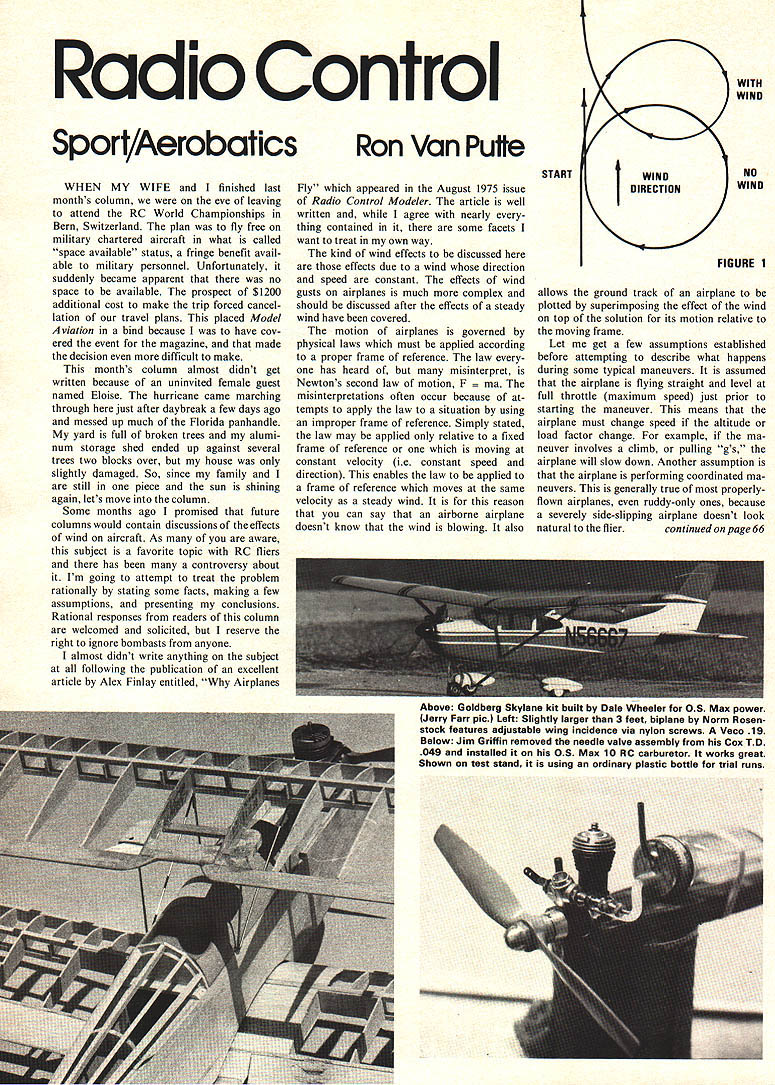
Fig. 1 shows what happens to the ground track of an airplane when it turns under varying wind conditions. Load factor is held constant (i.e., level, coordinated turn). Load factor is directly related to bank angle by a very simple equation: Load factor = 1 / cosine (bank angle). The 360° turn shown demonstrates what happens both downwind and upwind. The figure can also be used to visualize what happens during turns which wind make seem dangerous. Consider first the airplane going downwind; as it starts a 180° turn the pilot notes the airplane going further downwind than desired. So he increases the bank angle (load factor). What may happen next is that the pilot will continue to increase the bank angle until the airplane stalls out and crashes.
Or, what about the airplane that is going upwind and starts a 180° turn? The pilot banks the airplane to a comfortable no-wind bank angle and discovers that the heading and relative speed of the airplane are suddenly changing much more rapidly than expected. He loses orientation and over-rolls his airplane into the ground.
Neither maneuver is inherently dangerous, but lack of understanding about what the airplane will do in wind can severely unsettle a pilot, particularly if he is a beginner with a low-speed trainer airplane since the effects of wind are greater on slower airplanes.
The two things to remember when flying in wind are: (1) Increase the bank angle over the normal amount when a turn from a downwind heading is made. Gradually reduce the bank angle as the airplane swings into the wind and (2) Decrease the bank angle from the no-wind amount when a turn from an upwind heading is made. Gradually increase the bank angle as the airplane comes around downwind. Try it; it works.
Next month I'll present some wind effects on vertical maneuvers.
Transcribed from original scans by AI. Minor OCR errors may remain.

