
Radio Control: Sport/Aerobatics
Ron Van Putte
Retrospection
I've been involved in RC for nearly 30 years, and like most experienced modelers, I tend to overlook the problems that many newcomers have. Occasionally a beginner's question brings me up short when it makes me realize that everyone understands things that a lot of us take for granted.
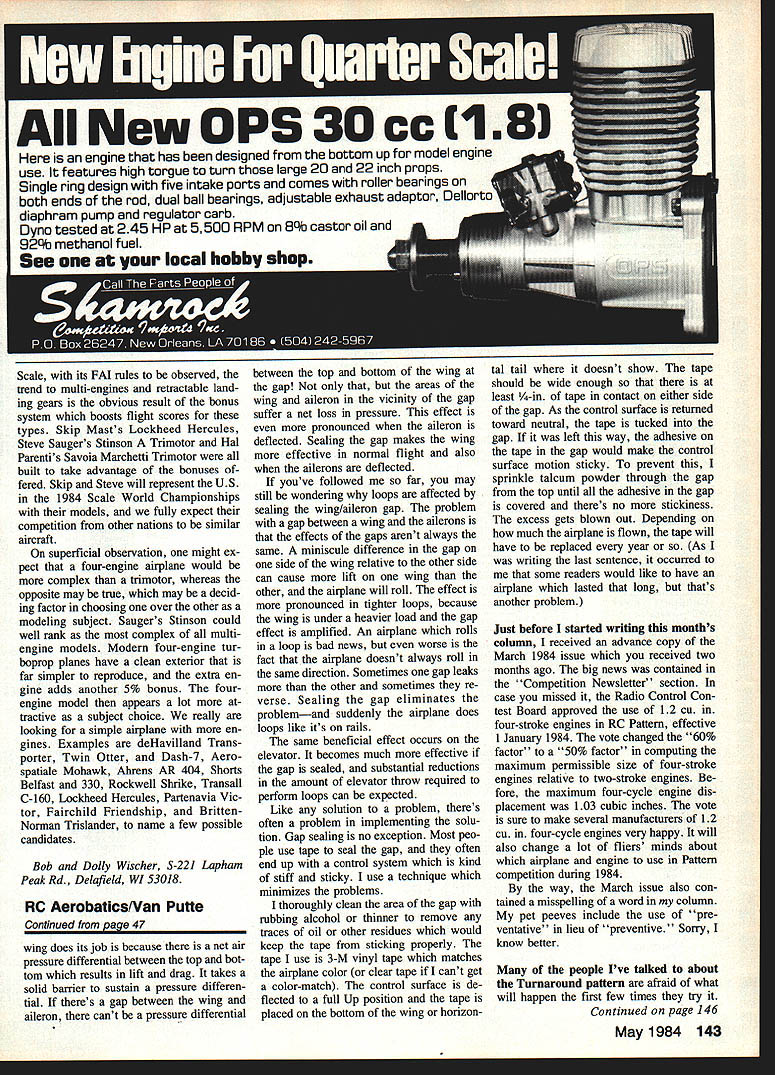
Such was the case when a mature individual—but a novice modeler—asked me if it made any difference whether he had a 1/2‑in. gap between the horizontal tail and the elevator. At that point, I realized a discussion on the aerodynamics of controls was due. It also reminded me of a discussion I had with Don Lowe many years ago about the effects of sealing the gaps between the wing and the ailerons. As I remember, Don was interested in increasing the roll rate of a Phoenix V. After reviewing a couple of technical reports written about wind‑tunnel tests of various wing/aileron combinations, I estimated that he could expect at least a 50% increase in roll rate if he sealed the wing/aileron gap.
Well, he put Scotch tape on the bottom of his ailerons. The increase in roll rate was startling—“startling” is an understatement; he actually had to reduce the amount of aileron throw. An additional benefit he discovered when the gap was sealed was that the airplane performed loops much better. The same reason roll rate is affected by sealing the wing/aileron gap also explains why loops are improved. A simple explanation, in order of reason, follows.
Gap sealing and control effectiveness
- The wing produces lift and drag because there is a net pressure differential between the top and bottom surfaces. It takes a solid barrier to sustain that pressure differential.
- If there's a gap between the wing and the aileron, there can't be a pressure differential between the top and bottom of the wing at the gap. The areas of the wing and aileron near the gap suffer a net loss in effective pressure.
- This effect is more pronounced when the aileron is deflected.
- Sealing the gap makes the wing more effective in normal flight and also when the ailerons are deflected.
You may still be wondering why loops are affected by sealing the wing/aileron gap. The problem with a gap is that its effects aren't always symmetrical. A minuscule difference in the gap on one side of the wing relative to the other can cause more lift on one wing than the other, and the airplane will roll. The effect is more pronounced in tighter loops because the wing is under a heavier load and the gap effect is amplified. An airplane that rolls in a loop is bad news, but worse is that it doesn't always roll in the same direction: sometimes one gap leaks more than the other and sometimes they reverse. Sealing the gap eliminates the problem—and suddenly the airplane does loops like it's on rails.
The same beneficial effect occurs on the elevator. It becomes much more effective if the gap is sealed, and substantial reductions in the amount of elevator throw required to perform loops can be expected.
How I seal gaps
Like any solution, gap sealing can introduce its own problems. Most people use tape and often end up with a sloppy system that is stiff and sticky. I use a technique that minimizes those problems:
- Thoroughly clean the area of the gap with rubbing alcohol or thinner to remove oil and other residues that would keep the tape from sticking properly.
- Use 3‑M vinyl tape that matches the airplane color, or clear tape if you can't get a color match.
- Deflect the control surface to full up (or full in one direction) so you can apply the tape on the bottom of the wing or horizontal tail where it won't show.
- Make the tape wide enough so that at least 1/4 in. of tape is in contact on either side of the gap.
- As the control surface is returned toward neutral, tuck the tape into the gap.
- To prevent the adhesive in the gap from making the control motion sticky, sprinkle talcum powder through the gap from the top until the adhesive in the gap is covered and there's no more stickiness. Blow out the excess.
Depending on how much the airplane is flown, the tape will have to be replaced every year or so.
Competition news
Just before I started writing this month's column, I received an advance copy of the March 1984 issue. The big news in the "Competition Newsletter" section was that the Radio Control Contest Board approved the use of 1.2 cu. in. four‑stroke engines in RC Pattern, effective January 1984. The vote changed the "60% factor" to a "50% factor" in computing the maximum permissible size of four‑stroke engines relative to two‑stroke engines. Before, the maximum four‑cycle engine displacement was 1.03 cubic inches. The vote is sure to please several manufacturers of 1.2 cu. in. four‑cycle engines and will change many fliers' minds about which airplane and engine to use in Pattern competition during 1984.
By the way, the March issue also contained a misspelling of a word in my column. My pet peeve is the use of "preventative" in lieu of "preventive." Sorry, I know better.
Learning the Turnaround pattern
Many people I've talked to about the Turnaround pattern are afraid of what will happen the first few times they try it. Their fear is that they'll get so involved with trying to do the maneuvers that they'll forget to fly the airplane. Their fears are well grounded. Many of us remember with terror the first time we tried certain maneuvers.
My special bugaboo was Three Outside Loops in the old CL B & C schedule. We had to do them from the top and the thought of pushing down elevator would make my heart feel like it was going to thump right out of my chest. It was an exciting time for both the judges and me! Many times there was a question about whether I'd bail out before they did. I finally got the hang of it by starting at high altitude and throttling back just before pushing over so that things weren't happening quite so fast. As I developed confidence, I reduced the altitude of the start of the maneuver until it was finally down where it was supposed to be. In other words, I sneaked up on the maneuver.
Most of us approach a difficult maneuver the same way—we sneak up on it. It makes good sense to develop confidence before trying to do something the "right" way. The Turnaround pattern is no different. In learning the Turnaround pattern, most pilots will probably have to take it apart into pieces and practice these pieces—containing two, three, or four maneuvers—until they are comfortable with them. Gradually, everything can be put together until the pattern is complete.
Of course, the job of learning the Turnaround pattern will take longer if it is broken into lots of small pieces and all are practiced until the pilot is very comfortable with them. The tricky part is when the pilot forces himself to move on before he is so comfortable that continued practice is no longer productive.
Good luck to all you Turnarounds!
Ron Van Putte 111 Sleepy Oaks Rd. Ft. Walton Beach, FL 32548
No additional text from "Radio Control: Sport/Aerobatics" appears on this scanned page. The page contains only photo captions and an advertisement; the article continuation is not present here.
Transcribed from original scans by AI. Minor OCR errors may remain.

