
Radio Control: Sport/Aerobatics
Ron Van Putte
As this was written during the waning days of 1980, I was thinking about all the good things I was supposed to do in RC during the year and never quite got to. If those are added to the things which I shouldn't have done but did, they look disturbingly like topics for resolutions. Perhaps you have been doing similar thinking and also have a bunch of potential resolutions rattling around in your head, too? Let's compare a few notes, because I suspect that many of us share the same thoughts at this time of year.
Resolutions and Pattern Flying
How many of you said to yourselves last winter, "I'm going to finish that Superblivet 6 this winter, practice all spring and knock their socks off on the Pattern contest circuit this summer." Many of us say things like that, but rarely do we carry through. However, two years ago I did live up to my resolution by finishing a Phoenix 6 7/8, practicing two to three times a week, and going to a bunch of contests. Perhaps I didn't "knock anybody's socks off," but I did catapult myself out of the Advanced class into the Expert class by earning a few first-place and second-place trophies. Can you imagine how satisfied I felt with myself after that season? It was great, but it wasn't really all that surprising, because I knew what it took for success on the Pattern contest trail, and I paid my dues, so the success came naturally.
There are no real secrets to success in Pattern flying, but like a lot of endeavors, it takes dedication to the goal in order to obtain success. Several club members asked me during that "golden year" if it wasn't boring to go out and practice the pattern all the time. After I thought about it for a short while, I decided that practicing all those difficult maneuvers wasn't boring at all! It was exciting because it was challenging, but even more important, it was really fun, because my flying was getting better and better. It has long been my view that a flier can always improve his general flying ability by practicing the pattern. With the improvement in flying ability comes the satisfaction of being able to do more things with the airplane—and that's fun. Take the advice of an experienced (older) flier, and get in some serious practice this spring. I guarantee that you'll win some trophies in the summer and have a great time doing it.
Workshop and Equipment
How about some of those other things we meant to do in 1980? Did you vow to get your workshop in shape so that you had more than a square foot of bench area to work on? Me too — only I succeeded. Maybe the fact that I moved had something to do with it. Now all that stuff which was crowding out the working space on my bench is in boxes somewhere in the attic, waiting for me to build a workshop out of what was a two-car garage. However, that is the subject of another resolution.
Is your old field box getting kind of ratty since fuel and battery acid have seeped in and weakened it? Mine too; however, I haven't gotten around to building a new one, either. I ought to pick up a Goldberg Handi-Tote field box, build it, paint it, put on some AMA decals, etc. Then I could pick up a new gel-cell 12-volt battery and not have to worry about battery acid damage again. That's what I ought to do, alright.
Battery Maintenance
One thing I didn't do as much as I should have in 1980 was to perform deep-discharging of my transmitter and receiver battery packs to eliminate any battery memory, and also test the capacity of the batteries. I only managed to do it three times, and during one of the tests I discovered a weak receiver pack in my Nats Pattern airplane! I've been almost inactive as far as RC flying is concerned since the Nats—because of moving to a new home. You can be sure that all my battery packs will receive a good test prior to going out flying again, even though I may not get that new field box built before then.
Midair Collisions and Build Time
In 1981, I vow not to have a midair collision which destroys my Pattern airplane two months before the Nats. You may argue with some of my resolutions, but not this one; very few people want to have to build a new Pattern ship right before the Nats. The exceptions are the few who have told me that they can build a new Pattern airplane in 10 days to two weeks. I often wonder if they get any sleep or go to work during that period. It takes me six weeks of hard work to get one ready, and when it's finished, I'm so burned out that I don't want to build another one for a long, long time.
Helping Beginners
One resolution that's tough for me to keep is to assist more beginners in learning to fly. My problem is that I normally go to the flying field when it is less likely that there will be a lot of other fliers, so my Pattern practice won't interfere with sport flying and vice versa. That doesn't leave me much contact with beginners. In fact, the only time I see many other club members is at a club-sponsored event, like our twice-yearly Fun Fly events.
Fun Fly Events
That reminds me of something you may find interesting. My club likes to put on Fun Fly competitions which are less likely to break airplanes than many of the events you may have heard about. Consequently, the demands on the airplanes are not as high as in those other events. However, we got a bit bold last time and had events like:
- Limbo
- Most Touch Goes (two minutes)
- Bomb Drop
- A couple of other tame events
I competed with a Sig Colt, sported an OS Max 20. Frankly, I thought I'd be outclassed by some hot ships. I was delighted to take second in Bomb Drop. The Sig Colt has always been high on my list of airplanes recommended to beginners, and I'm sure that a number of my fellow club members are also believers that it can do very nicely in many of the less hazardous Fun Fly events.
Canards and Correspondence
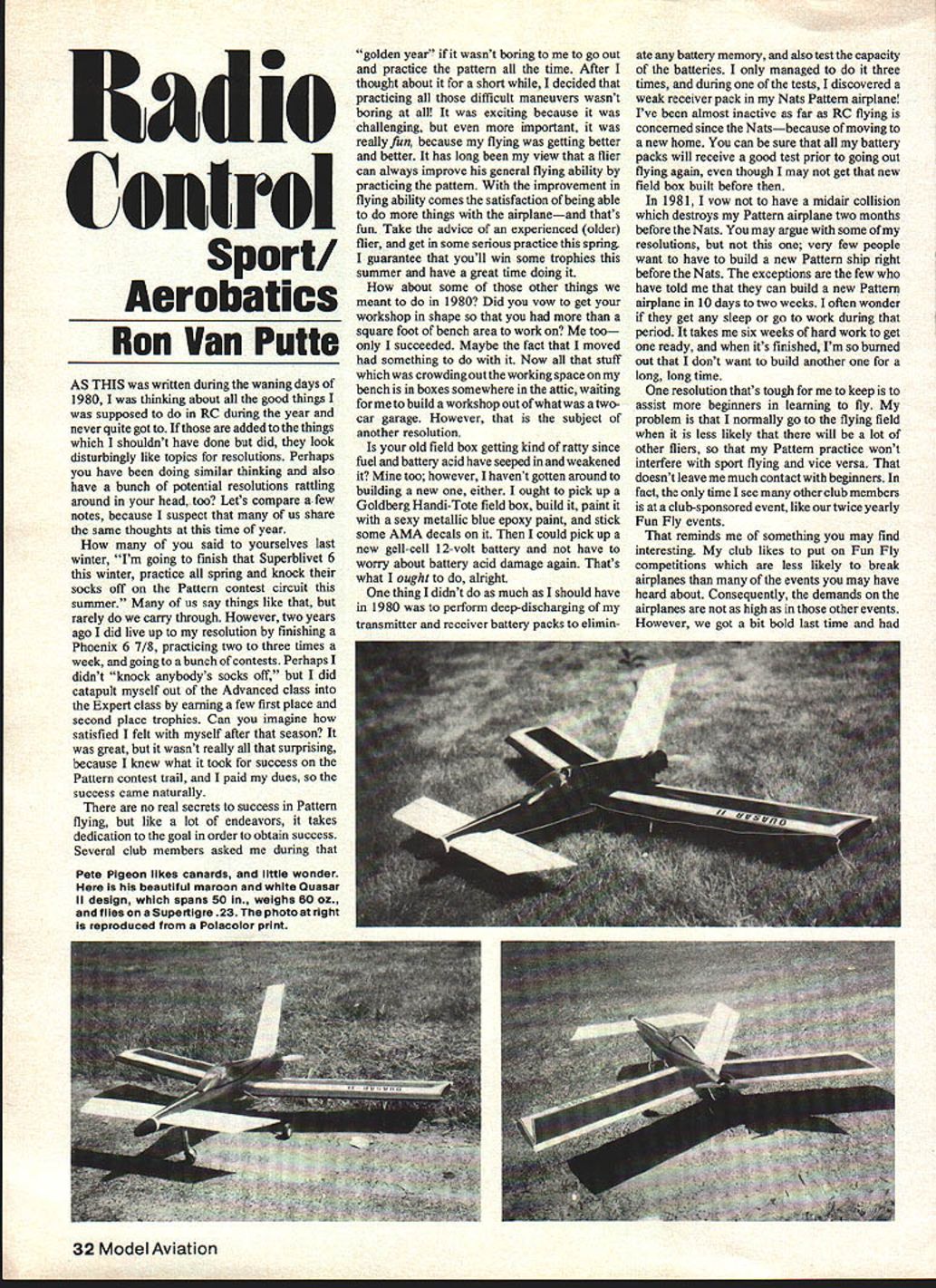
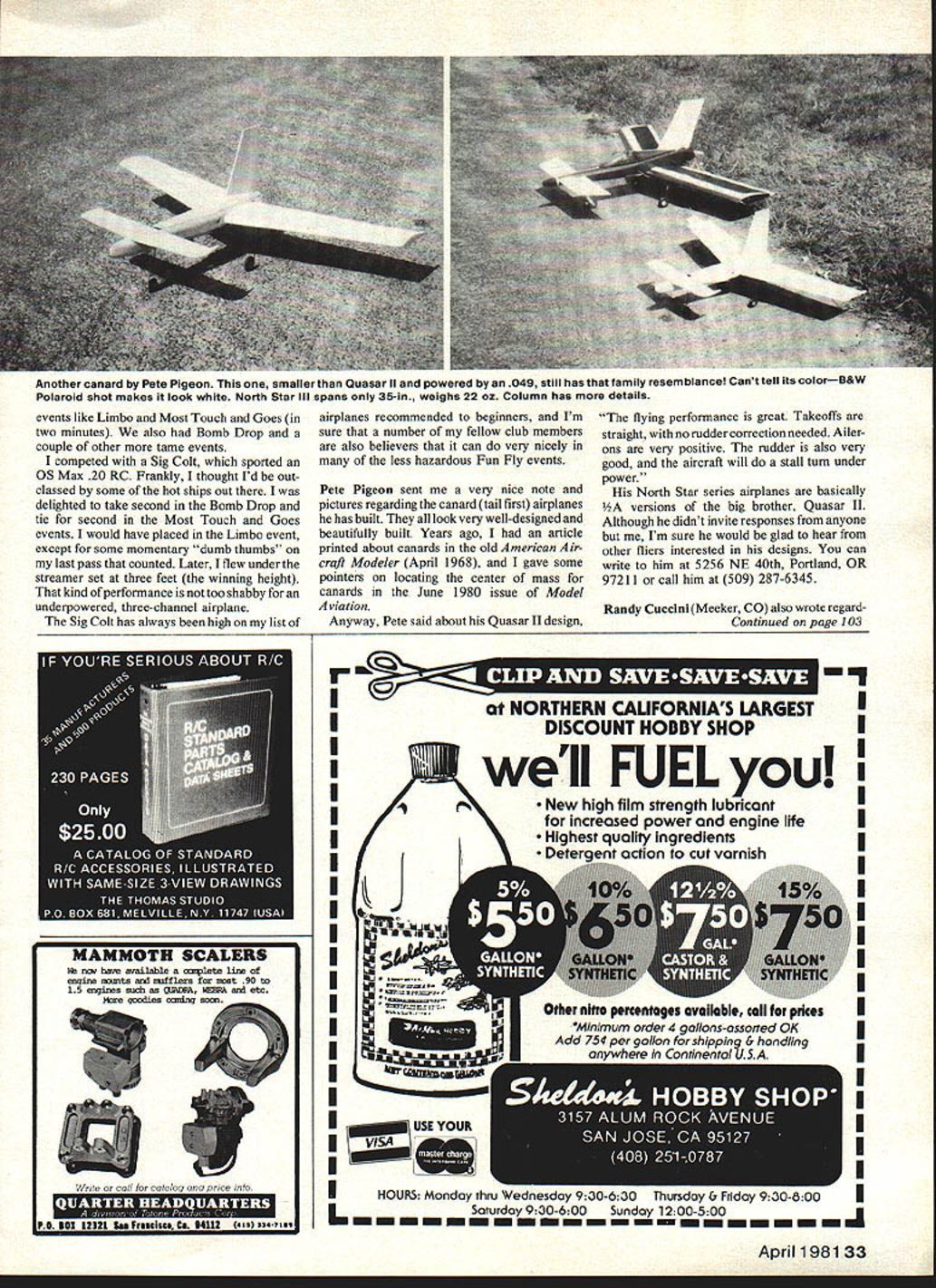
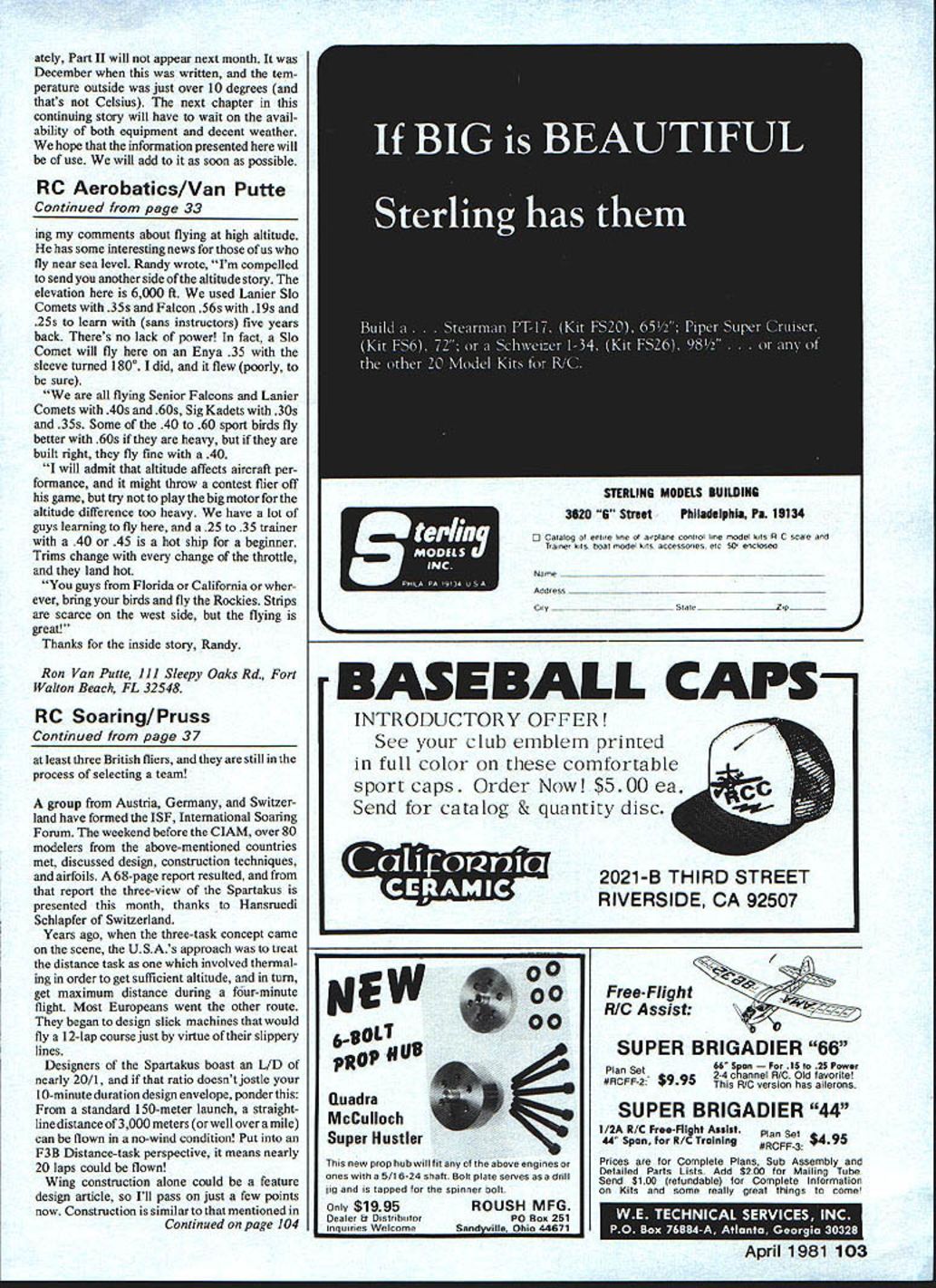
Pete Pigeon sent me a very nice note and pictures regarding the canard (tail-first) airplanes he has built. They all look very well-designed and beautifully built. Years ago, I had an article printed about canards in the old American Aircraft Modeler (April 1968), and I gave some pointers on locating the center of mass for canards in the June 1980 issue of Model Aviation.
Pete said about his Quasar II design, "The flying performance is great. Takeoffs are straight, with no rudder correction needed. Ailerons are very positive. The rudder is also very good, and the aircraft will do a stall turn under power."
His North Star series airplanes are basically 1/4A versions of the big brother, Quasar II. Although he didn't invite responses from anyone but me, I'm sure he would be glad to hear from other fliers interested in his designs. You can write to him at: 5256 NE 40th, Portland, OR 97211 or call him at (509) 287-6345.
High-Altitude Flying
Randy Cuccini (Meeker, CO) also wrote regarding my comments about flying at high altitude. He has some interesting news for those of us who fly near sea level. Randy wrote, "I'm compelled to send you another side of the altitude story. The elevation here is 6,000 ft. We used Lanier Slo Comets with .35s and Falcon .56s with .19s and .25s to learn with (sans instructors) five years back. There's no lack of power! In fact, a .50 Comet will fly here on an Enya .35 with the sleeve turned 180°. I did, and it flew (poorly, to be sure)."
"We are all flying Senior Falcons and Lanier Comets with .40s and .60s, Sig Kadets with .30s and .35s. Some of the .40 to .60 sport birds fly better with .60s if they are heavy, but if they are built right, they fly fine with a .40."
"I will admit that altitude affects aircraft performance, and it might throw a contest flier off his game, but try not to play the big motor for the altitude difference too heavy. We have a lot of guys learning to fly here, and a .25 to .35 trainer with a .40 or .45 is a hot ship for a beginner. Trims change with every change of the throttle, and they land hot."
"You guys from Florida or California or wherever, bring your birds and fly the Rockies. Strips are scarce on the west side, but the flying is great!"
Thanks for the inside story, Randy.
Ron Van Putte 111 Sleepy Oaks Rd. Fort Walton Beach, FL 32548.
Transcribed from original scans by AI. Minor OCR errors may remain.

