
Radio Control: Sport/Aerobatics
Ron Van Putte
Letter from Jeff Rankin (Reasnor, IA)
Recently a letter came to me via Model Aviation's publisher which brought two thoughts to mind as column subjects. The letter came from Jeff Rankin (Reasnor, IA), who reported on problems he had with a new airplane he had finished, flown and crashed. An edited version of Jeff's letter follows:
I have a question concerning engine torque and right thrust. I'm not what you'd call a seasoned flier; however, I can usually get a plane up and back down with no trouble at all. However, I had a little trouble with a plane lately, and I'm not quite sure what happened.
I've noticed before on some airplane plans and in kits they say to point the engine 2° to the right. I always assumed that it was to offset the torque of the engine. My plane is a Lanier Comet II which requires a .45–.60 sized engine. A Fox .60 Hawk is the only engine I had in the size range, so that's what went on it. I had the plane all ready to fly and was anxiously waiting for a fairly nice day.
The day came, but it wasn't exactly nice. The wind was blowing, and it was overcast and cold. I could tell after I had the engine running that it was going to have more than enough power. I got the plane in the air (hand launched) and immediately slowed it down because of the speed it was going. My throttle stick was almost resting at the bottom of its throw, and the plane still seemed to be going faster than anything I'd ever flown. It flew beautifully, even in the strong wind. I had to bring it in early because my hands were getting so cold. So I landed and was extremely pleased with the way things went.
The next day was a beautiful day, sunny, warm, and very little wind. I was really excited and was expecting a good day of flying. I took the plane to a different place where I had a better runway. I started it, checked the controls, opened it up 3/4, and let her go. The speed that it was moving down the runway just amazed me! I've never seen a plane move that fast before. It lifted off, and for the first couple of seconds everything looked all right. Then it started to make a left turn. I just let it go, because I had to turn it around anyway.
However, something happened while it was in the turn. As often happens, when I try to remember what happened, I draw a blank. I do remember trying to level it out and that it wouldn't. What happened after that, I'm not sure. I know it was upside down at least once. I think the process of doing something that resembled an outside loop when it made contact with the ground. It all happened so fast. I can't help but think if I had gotten it slowed down I might have been all right. So, my question: how much does engine torque affect the flight of an airplane?
Engine torque and propeller effects
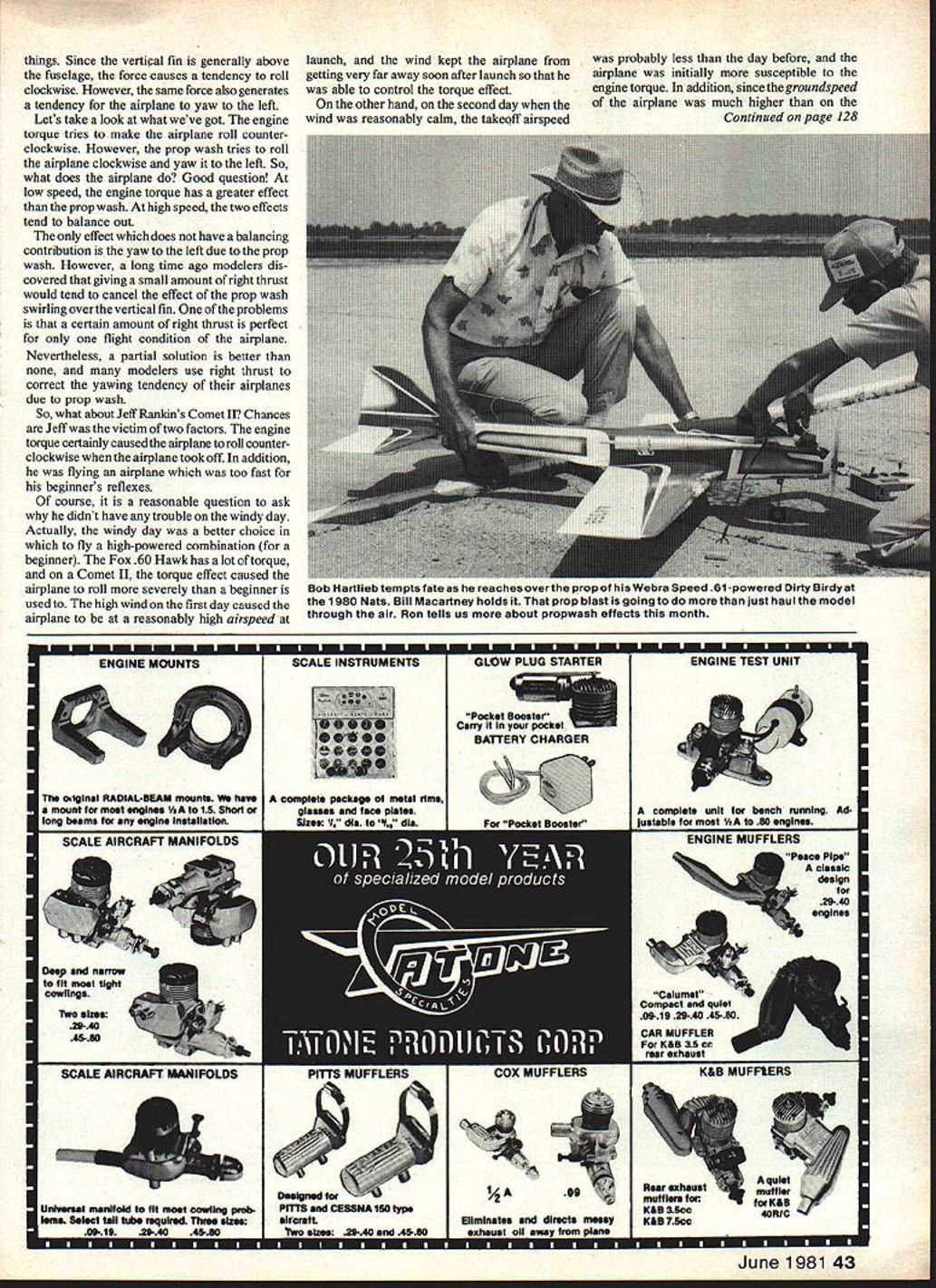
I have written to Jeff about his question, but I thought that perhaps there might be quite a few others who would like to find out about the effects of engines and propellers on airplanes. Jeff wrote about the effects of engine torque, while I write about the effects of engines and propellers because the engine directly affects the airplane by applying torque to the fuselage, while the propeller also indirectly affects the airplane by the way it produces thrust.
Most of our engines turn clockwise as viewed from forward of the cockpit. The torque which the engine applies to turn the propeller must be opposed by the airplane. Consequently, the engine attempts to roll the airplane counterclockwise (to the left), and if there is no trim or control input to oppose the motion, the airplane will roll. Fortunately, it is easy to trim out the effect of torque when the airplane is at normal flying speed.
During takeoff, however, the airplane is traveling slowly and the effect of torque is more difficult to counter. Most pilots apply right rudder during the takeoff run, and perhaps a bit of right aileron just after takeoff to counter the engine torque until the airplane gets up to a decent flying speed. Many beginners, though, just let the airplane roll and only correct the roll when the airplane gets to a more comfortable altitude.
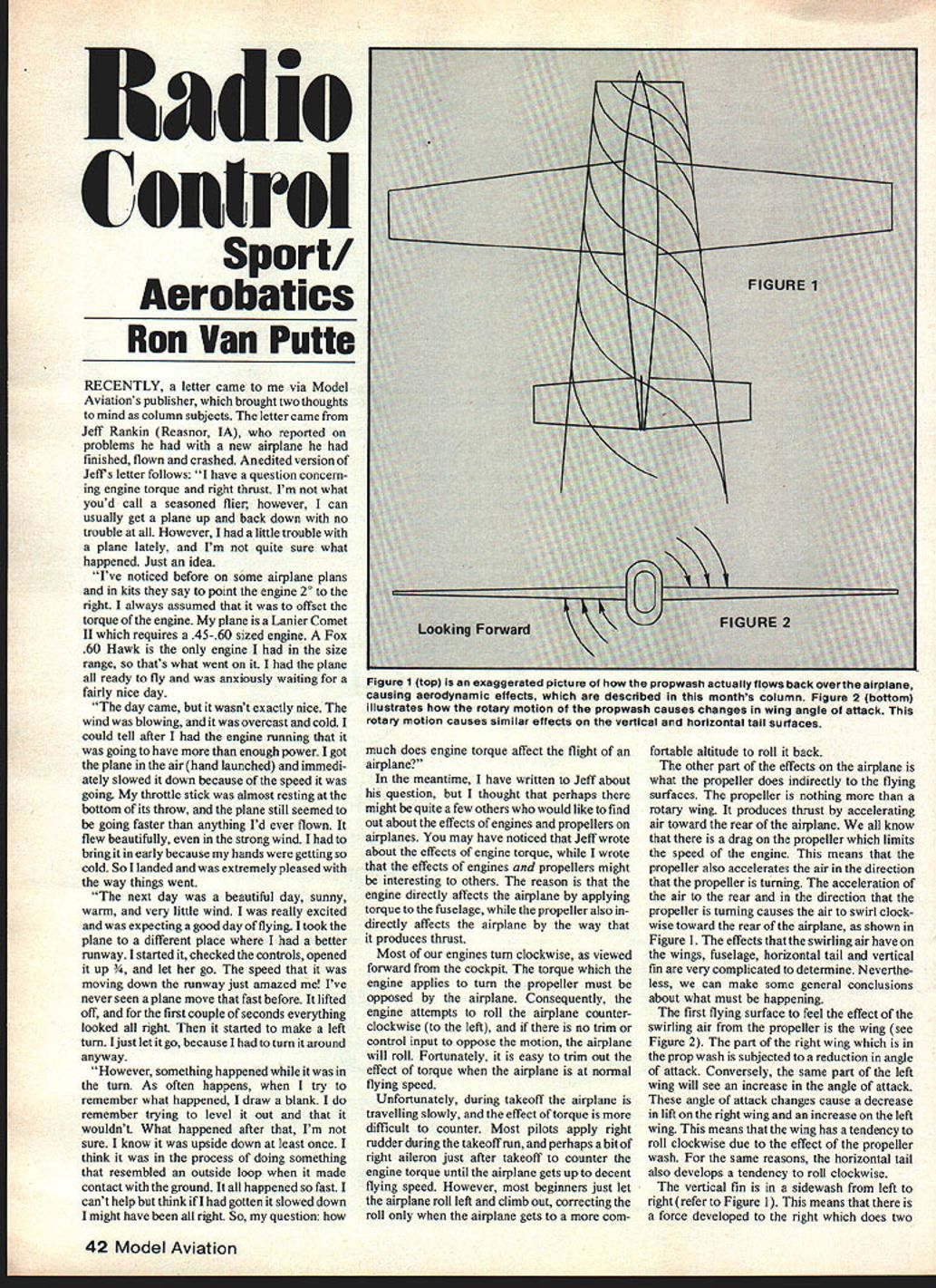
The other part of the effect comes from what the propeller does indirectly to the flying surfaces. The propeller is nothing more than a rotary wing. It produces thrust by accelerating air toward the rear of the airplane. There is a drag on the propeller which limits the speed of the engine, and this means the propeller also accelerates the air in the direction that the propeller is turning. The acceleration of the air to the rear and in the direction that the propeller is turning causes the air to swirl clockwise toward the rear of the airplane (see Figure 1). The effects that the swirling air has on the wings, fuselage, horizontal tail and vertical fin are complicated to determine, but we can draw some general conclusions.
- Wing:
- The right wing area in the propwash is subjected to a reduction in angle of attack.
- The left wing area in the propwash sees an increase in angle of attack.
- These changes decrease lift on the right wing and increase lift on the left wing, producing a tendency to roll clockwise (to the right). The horizontal tail also develops a tendency to roll clockwise for the same reasons (see Figure 2).
- Vertical fin:
- The vertical fin experiences a sidewash from left to right (refer to Figure 1).
- This produces a force to the right which does two things:
- Because the vertical fin is generally above the fuselage, the force causes a tendency to roll clockwise (to the right).
- The same force also generates a tendency for the airplane to yaw to the left.
Putting the pieces together:
- The engine torque tries to make the airplane roll counterclockwise (to the left).
- The prop wash tends to roll the airplane clockwise (to the right) and to yaw it to the left.
- At low speed, engine torque has a greater effect than the prop wash.
- At high speed, the two rolling effects tend to balance out.
- The yaw-to-the-left from prop wash is not balanced by a similar opposing force; modelers long ago discovered that a small amount of right thrust (engine offset to the right) tends to cancel the yawing tendency due to prop wash.
One caveat is that the right-thrust correction is usually perfect for only one flight condition; nevertheless, it is a useful partial solution and is widely used to correct prop-wash-induced yaw.
What likely happened to Jeff's Comet II
Chances are Jeff was the victim of two factors.
- Engine torque caused the airplane to roll counterclockwise when it took off.
- He was flying an airplane that was too fast for his beginner reflexes.
Why didn't he have trouble on the windy day? The windy day was actually a better choice for flying a high-powered combination for a beginner. The Fox .60 Hawk has a lot of torque, and on a Comet II the torque effect caused the airplane to roll more severely than a beginner is used to. On the first (windy) day the airplane was launched at a reasonably high airspeed and the wind kept the airplane from getting far away soon after launch, so he was able to control the torque effect.
On the second day, when the wind was calm, the takeoff airspeed was probably lower and the airplane was initially more susceptible to engine torque. In addition, because the groundspeed was much higher, the airplane moved away faster. The combination of increased torque effect at low airspeed and faster departure likely caused disorientation, and Jeff couldn't think fast enough to prevent the crash.
Practical takeaways
- Be aware of engine torque, especially at low speed during takeoff.
- Apply right rudder on the ground and a little right aileron after takeoff when necessary.
- Consider right thrust (engine offset) to counter prop-wash yaw, but realize it is a compromise for one flight condition.
- If flying a high-powered setup as a beginner, choose a day with enough wind to give a higher launch airspeed and keep the model within a manageable distance.
Our airplanes are sometimes strange beasts, and just when we think we are one step ahead of them, they find a new way to crash. The only moral is to know that the engine torque effect is there and to be ready for it!
Ron Van Putte 111 Sleepy Oaks Rd. Fort Walton Beach, FL 32548.
Transcribed from original scans by AI. Minor OCR errors may remain.

