
Radio Technique
George M. Myers
THIS MONTH we are going to discuss measurement of the most fundamental characteristic of your RC system; How fast your servos move. It is simple to measure, and has practical significance, because it responds to wear and concealed damage of the system.
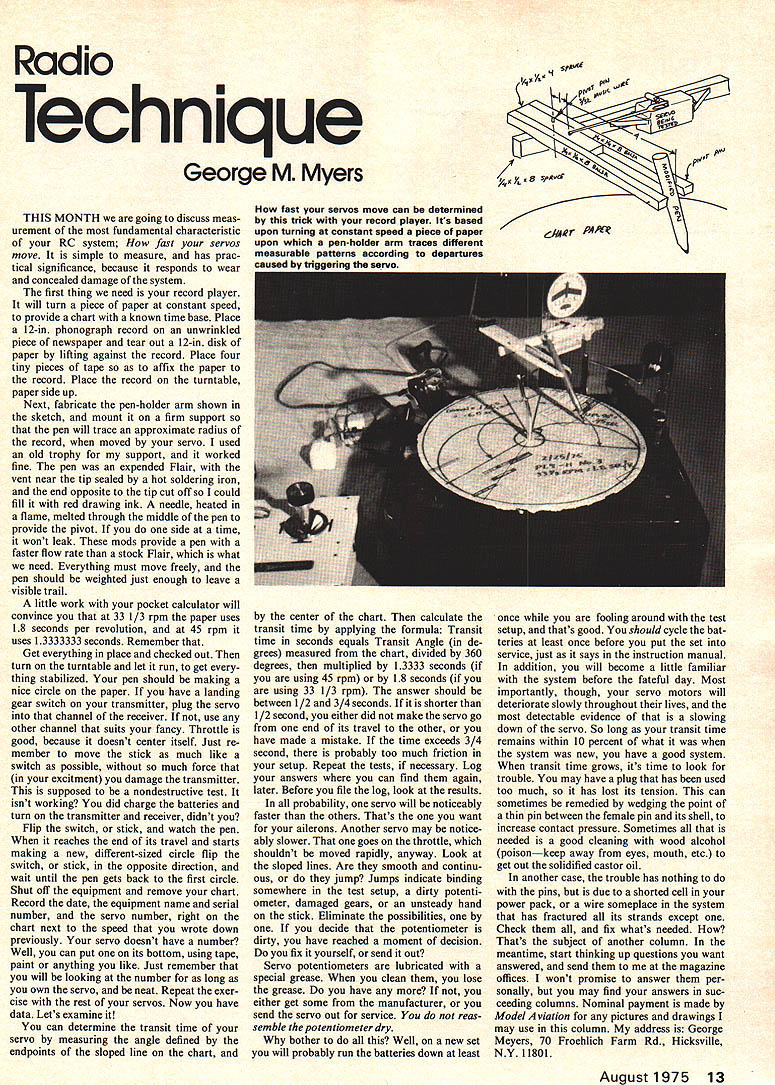
The first thing we need is your record player. It will turn a piece of paper at constant speed, to provide a chart with a known time base. Place a 12-in. phonograph record on an unwrinkled piece of newspaper and tear out a 12-in. disk of paper by lifting against the record. Place four tiny pieces of tape so as to affix the paper to the record. Place the record on the turntable, paper side up.
Next, fabricate the pen-holder arm shown in the sketch, and mount it on a firm support so that the pen will trace an approximate radius of the record, when moved by your servo. I used an old trophy for my support, and it worked fine. The pen was an expended Flair, with the vent near the tip sealed by a hot soldering iron, and the end opposite the tip cut off so I could fill it with red drawing ink. A needle, heated in a flame, melted through the middle of the pen to provide the pivot. If you do one side at a time, it won't leak. These mods provide a pen with a faster flow rate than a stock Flair, which is what we need. Everything must move freely, and the pen should be weighted just enough to leave a visible trail.
A little work with your pocket calculator will convince you that at 33 1/3 rpm the paper uses 1.8 seconds per revolution, and at 45 rpm it uses 1.33333 seconds. Remember that.
Get everything in place and checked out. Then turn on the turntable and let it run, to get everything stabilized. Your pen should be making a nice circle on the paper. If you have a landing gear switch on your transmitter, flip the servo into that channel of the receiver. If not, use any other channel that suits your fancy. Throttle is good, because it doesn't center itself. Just remember to move the stick as much like a switch as possible, without so much force that you (in your excitement) damage the transmitter. This is supposed to be a nondestructive test. If it isn't working? You did charge the batteries and turn on the transmitter and receiver, didn't you?
Flip the switch, or stick, and watch the pen. When it reaches the end of its travel and starts making a new, different-sized circle, flip the switch, or stick, in the opposite direction, and wait until the pen gets back to the first circle. Shut off the equipment and remove your chart. Record the date, the equipment name and serial number, and the servo number, right on the chart next to the speed that you wrote down previously. Your servo doesn't have a number? Well, you can put one on its bottom, using tape, paint or anything you like. Just remember that you will be looking at the number for as long as you own the servo, and be neat. Repeat the exercise with the rest of your servos. Now you have data. Let's examine it!
You can determine the transit time of your servo by measuring the angle defined by the endpoints of the sloped line on the chart, and by the center of the chart. Then calculate the transit time by applying the formula: Transit time in seconds equals Transit Angle (in degrees) measured from the chart, divided by 360 degrees, then multiplied by 1.3333 seconds (if you are using 45 rpm) or by 1.8 seconds (if you are using 33 1/3 rpm). The answer should be between 1/2 and 3/4 seconds. If it is shorter than 1/2 second, you either did not make the servo go from one end of its travel to the other, or you have made a mistake. If the time exceeds 3/4 second, there is probably too much friction in your setup. Repeat the tests, if necessary. Log your answers where you can find them again later. Before you file the log, look at the results.
In all probability, one servo will be noticeably faster than the others. That's the one you want for your ailerons. Another servo may be noticeably slower. That one goes on the throttle, which shouldn't be moved rapidly, anyway. Look at the sloped lines. Are they smooth and continuous, or do they jump? Jumps indicate binding somewhere in the test setup, a dirty potentiometer, damaged gears, or an unsteady hand on the stick. Eliminate the possibilities, one by one. If you decide that the potentiometer is dirty, you have reached a moment of decision. Do you fix it yourself, or send it out?
Servo potentiometers are lubricated with a special grease. When you clean them, you lose the grease. Do you have any more? If not, you either get some from the manufacturer, or you send the servo out for service. You do not reassemble the potentiometer dry.
That's the bottom line. By the way, on a new set you will probably run the batteries down at least once while you are fooling around with the test setup, and that's good. You should cycle the batteries at least once before you put the set into service, just as it says in the instruction manual.
In addition, you will become a little familiar with the system before the fateful day. Most importantly, though, your servo motors will deteriorate slowly throughout their lives, and the most detectable evidence of that is a slowing down of the servo. So long as your transit time remains within 10 percent of what it was when the system was new, you have a good system. When transit time grows, it's time to look for trouble. You may have a plug that has been used too much and has lost its tension. It can sometimes be remedied by wedging a thin pin between the female pin and its shell to increase contact pressure. Sometimes good cleaning is needed.
In another case, the trouble has nothing to do with the pins, but is due to a shorted cell in your power pack, or a wire some place in the system that has fractured all its strands except one. Check them all, and fix what's needed. How? That's the subject of another column. In the meantime, start thinking up questions you want answered, and send them to me at the magazine offices. I won't promise to answer them personally, but you may find your answers in succeeding columns. Nominal payment is made by Model Aviation for any pictures and drawings I may use in this column. My address is: George Myers, 70 Froehlich Farm Rd., Hicksville, N.Y. 11801.
Transcribed from original scans by AI. Minor OCR errors may remain.

