
Radio Technique
George M. Myers
RC Insects, etc.
Dr. Franklin H. Meyer, DDS, 8014 Gowanda State Rd., Eden, NY 14057 wrote a letter that just has to be shared:
"Dear George:
"...I am especially interested in ultraminiature RC. The problem is to find a source of ultra-miniature equipment. Remember the Albin Superregen receiver (May 1968 AAM)? I built one for a .010 aircraft, using MS76 Silver Oxide batteries and a Bentert actuator and never did get consistent enough control to be happy, but the receiver only weighed six and the actuator 6.5 grams. Surely, there have been advances in the state of the art, but I haven't found them. Can you help? My goal is CO2-powered Peanut Scale RC. I'll keep you posted when I put it all together. Thanks."
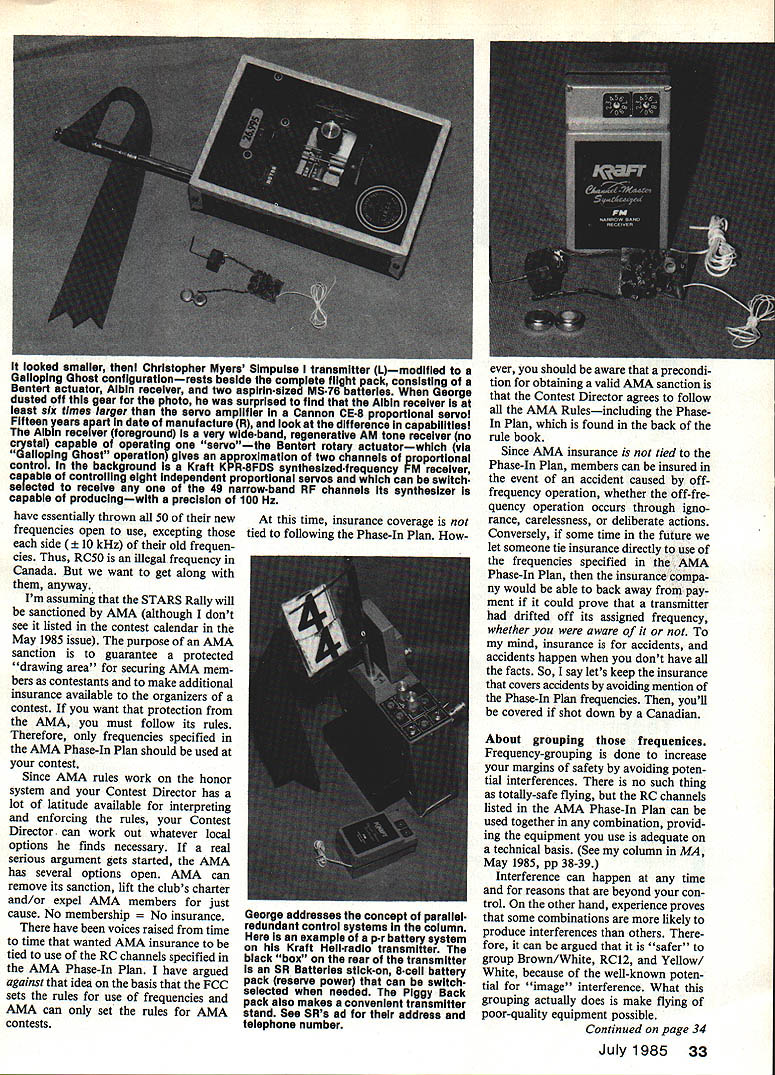
Now, here is a letter that strikes a responsive chord in my heart! My son, Christopher, was 12 years old when I built an Albin receiver and put it into service with Chris' Testors Simpulse I transmitter. Chris designed his first successful RC model around that rig, which was a Cox .010-powered Curtis Robin built from 1/16 sheet balsa profiles copied from a Guillow rubber-scale plan. Chris copied standard RC construction techniques, using a balsa box for a fuselage, plywood firewall, etc. The flight pack was mounted on a stick, so it could be easily moved from plane to plane. We modified the stick on the transmitter so that Chris had rudder and elevator control rather than by way of a Galloping Ghost setup. The wings plugged into the fuselage, and the lift struts were functional (held by balsa pins).
We had a lot of fun with that model. The .010 was too powerful for the plane, so I made an exhaust restrictor for the engine, and we flew with a 4.25 x 2 prop meant for an .020 engine. Later, Chris designed and built a sailplane with an 18-inch wingspan which also flew with that radio for control. The great guru of micro-RC in those days was Dave Robelin, and his Peanut Scale RC Sperry Messenger was always supposed to be the next project for the rig (which we still own), but I keep misplacing the book with the plans. Frank, you're bringing back a lot of pleasant old memories.
Today, Bill Cannon is your best bet for micro-RC. Contact him at Cannon R/C Systems, 13400-26 Saticoy Street, North Hollywood, CA 91605, (213) 764-1488.
Oh well, that's enough reminiscing, I suppose. It's time to get back to work.
Frequency-board question (Norm Orcutt)
The next letter is from Norm Orcutt (Olean, NY), but it represents several, including one from my old friend Art Cervenka in Florida. I'll let Norm state the problem:
"Dear George,
"...I work on the STARS Frequency Board during our Scale Rally, which is held each year at the Olean airport. My problem ... to group new, old, and Canadian frequencies in a manner that avoids clashing. What is the safest way to set up the board?
"...In the past, we have grouped several frequencies on one pin (e.g., Purple/White, RC50, 72.800 [Canada]). With 150 fliers present last year, we had 20 fliers on that one pin. Our system worked, but there was quite a wait for the use of that pin.
"...I guess what I really want to know is, 'Do we have to bunch the frequencies, or would it be safe to operate with one pin per frequency?'
"...What got me wondering about this is the fact that nobody at our weekly club flying sessions gives frequency groupings a second thought.
"Come up and see us July 6 and 7. Thanks."
Norm, you're trying to put me on the spot!
AMA rules and the Phase-In Plan
In the first place, Canadians aren't following the AMA Phase-In Plan. They have essentially thrown 50 new frequencies open to use, excepting sidebands of old frequencies. Thus RC50 is an illegal frequency in Canada. We want to get along anyway. I'm assuming the STARS Rally will be sanctioned by the AMA, although I don't see it listed in the contest calendar in the May 1985 issue.
The purpose of an AMA sanction is to guarantee a protected flying area, securing AMA members and contestants and to make additional insurance available to organizers who want protection. AMA must follow its rules. Therefore the frequencies specified by the AMA Phase-In Plan should be used in contests.
Since AMA rules work on the honor system, the Contest Director has a lot of latitude available in interpreting and enforcing rules. The Contest Director can work out whatever local options he finds necessary. If a real serious argument gets started, the AMA has several options open. The AMA can remove its sanction, lift a club's charter and/or expel AMA members for just cause.
Voices have been raised from time to time wanting AMA insurance tied to the use of RC channels specified in the AMA Phase-In Plan; I have argued against that idea. At this time, insurance coverage is not tied to following the Phase-In Plan. However, you should be aware that a precondition for obtaining a valid AMA sanction is that the Contest Director agrees to follow all the AMA Rules — including the Phase-In Plan, which is found in the back of the rule book.
Since AMA insurance is not tied to the Phase-In Plan, members can be insured in the event of an accident caused by off-frequency operation, whether the off-frequency operation occurs through ignorance, carelessness, or deliberate actions. Conversely, if some time in the future we let someone tie its insurance directly to the use of the frequencies specified in the AMA Phase-In Plan, then the insurance company would be able to back away from paying if it could prove that a transmitter had drifted off its assigned frequency, whether you were aware of it or not. To my mind, insurance is for accidents, and accidents happen when you don't have all the facts. So, I say let's keep the insurance that covers accidents by avoiding mention of the Phase-In Plan frequencies. Then, you'll be covered if shot down by a Canadian.
Frequency-grouping: safety and practical guidelines
Frequency grouping is done to increase your margins of safety by avoiding potential interference. There is no such thing as totally safe flying, but the RC channels listed in the AMA Phase-In Plan can be used together in any combination, provided the equipment you use is adequate on a technical basis.
Interference can happen at any time and for reasons that are beyond your control. On the other hand, experience proves that some combinations are more prone to interference than others. Therefore, it can be argued that it is "safer" to group Brown/White (BN/WH), RC12, and Yellow/White (Y/WH) because of the well-known potential for "image" interference. What this grouping actually does is make flying of poor-quality equipment possible.
Similarly, you might tie together the following to avoid potential interferences generated by frequency differences at half the most common IF (i.e., at 227.5 kHz, which is half of 455 kHz):
- Brown/White and RC38
- Blue/White (BL/WH) and RC42
- Red/White (R/WH) and RC46
- Purple/White (PUR/WH) and RC50
- Orange/White (OR/WH) and RC54
If you have a strong local TV4, you might want to tie together Orange/White and RC40, and discontinue the use of RC44 entirely. In addition, you may want to avoid the situation of three adjacent RC channels operating at the same time (like RC38, RC40 and RC42), so you might consider tying pairs of pins together, as in:
- RC38 and RC40
- RC42 and RC44
- RC46 and RC48
- RC50 and RC52
- RC54 and RC56
This would ensure that three in sequence would never operate at the same time, thus avoiding possible third-order intermodulation problems on takeoff and landing.
Do all the above and you may avoid a lot of possible trouble, but you will only need five (5) pins to cover the whole 72 MHz spectrum:
- BN/WH, Y/WH, RC12, RC38
- BL/WH, RC42, RC44
- R/WH, RC46, RC48
- PUR/WH, RC50, RC52
- OR/WH, RC40, RC54, RC56
Since five large, powered airplanes in the air at the same time might be considered a lot, five pins might be enough. You would have a larger margin of safety than would be the case with uncoupled pins, but the difference between "safe" and "safer" is hard to quantify. Most of the interferences we encounter seem to be generated by other modelers (as in unattended transmitters that have been left turned on). Then there are the car and boat people that use Aircraft Only frequencies. What can be done about them? I gave you some ideas last month.
Parallel redundancy and multiple transmissions
Another good solution to the "car and boat problem" would be multiple parallel RF transmissions. It is possible to use several RC transmitter frequencies simultaneously to control a model (the Grumman X-29 carries three parallel computers and a pilot to work its flight controls). With a little work, one transmitter could be made to radiate on all the RC channels tied together above (e.g., BN/WH + RC12 + Y/WH + RC38) and an on-board computer could compare the signals coming out of four receivers, to detect and discard signals from any receivers suffering from interference. It would cost more, but would be "safer." The chances of finding another transmitter working on every one of your four operating frequencies is very much less than the chance of finding it on just one, if that's all you've got.
The point is that there are many ways to get away from the present RC system design, which is a string of "single-point-of-failure" sites. If we use our wealth of RC channels to begin parallel-redundant operation, RC flying will become "safer." For best results, everything should be parallel redundant, from the transmitter batteries to the servos in the plane.
Closing
Well, friends and readers, we've covered a lot of ground in this column. We started with an ultra-simple receiver no larger than your thumbnail and have progressed through a discussion of possible advantages to be obtained from grouping RC channels into concepts of a "safer" RC system with an on-board sampling computer and multiple parallel redundancy that doesn't even exist, yet. We've looked at what is, and what might be (with a tip of the hat to John Preston) and have talked a little philosophy. I hope you've enjoyed it. Keep writing.
— George M. Myers, 70 Froehlich Farm Rd., Hicksville, NY 11801.
Transcribed from original scans by AI. Minor OCR errors may remain.

