
Radio Technique
George M. Myers
Who is responsible for your RC transmitter?
Who is responsible for your RC transmitter? Our AMA, acting in its capacity as National Representative of Aeromodeling for the United States, has two missions:
- To promote aeromodeling.
- To keep records.
What AMA does
In performing those missions, our AMA does the following:
- Advertises the benefits of model aviation and the accomplishments of AMA members.
- Codifies and publishes rules for competition.
- Sanctions contests conducted by members.
- Conducts national and international contests.
- Homologates (certifies) records, both nationwide and worldwide.
Homologating records and contest responsibilities
In homologating records, it is sometimes necessary to certify the characteristics of the equipment used in competition. Individual Contest Directors are required, for example, to certify the physical dimensions of a model which are essential to competition, such as total weight, wing area, displacement of engines, etc., when required.
When we consider the RC system, the only thing a Contest Director has been required to do is to assure that every RC system used in sanctioned competition carries the appropriate AMA-designated RC channel identification flag (Official Model Aircraft Regulations, 1984–85 edition, pp. 128–129). For special events, like Class A RC Sailplanes, the CD has to monitor how the RC system is used (i.e., rudder and elevator or aileron and elevator only).
The important point is that it has always been, and still remains, the responsibility of the contestant to assure the AMA, the contest organizers, and the other contestants that the radio he or she proposes to use in AMA-sanctioned competition is operating on the frequency designated by the flag on its antenna and has the technical characteristics required by the Federal Communications Commission (FCC).
Accidents and liability
The situation is the same as when RC flying is done away from a contest. If one person's RC system interferes with another's and an accident occurs as a result, the fault and liability may belong to the operator of the offending transmitter, the operator of the receiver being interfered with, neither, or both. Accidents do happen, and AMA has arranged for liability insurance, so we can still be friends after one occurs.
Contest Director responsibilities and safety
Contest Directors assume responsibility to conduct a "safe" contest, within the limits of the rule book and prudent activities. This responsibility justifies the AMA Safety Code (page 133 of the rule book) and rules like pull tests for Control Line models. Though it isn't written down as a specific rule, RC contestants depend on the Contest Director's good judgment to organize activities so that no two contestants are asked to operate on one particular RC channel at the same time. This is a commonsense safety requirement.
The use of transmitter impound areas, frequency-clip boards, and RF monitors is strongly recommended by AMA but not required (page 129 of the rule book). You may wonder why they are not required. The answer is that safety is every member's business (this is stated in the "AMA Member Responsibility" section of the rule book—page 1). It is possible to operate safely without frequency-clip boards, etc., and AMA is willing to accept any method that works.
Providing service to all contestants as a group, AMA representatives may, at their discretion, ask for permission to check the electromagnetic performance of any RC system presented for use in an AMA-sanctioned contest. A contestant may refuse to permit that check, and the Contest Director can then refuse to accept that person into the contest. AMA will back a CD in arguments of this type. The key is prudence: if it is prudent to ask for such a check, the Contest Director should ask.
Checking transmitters
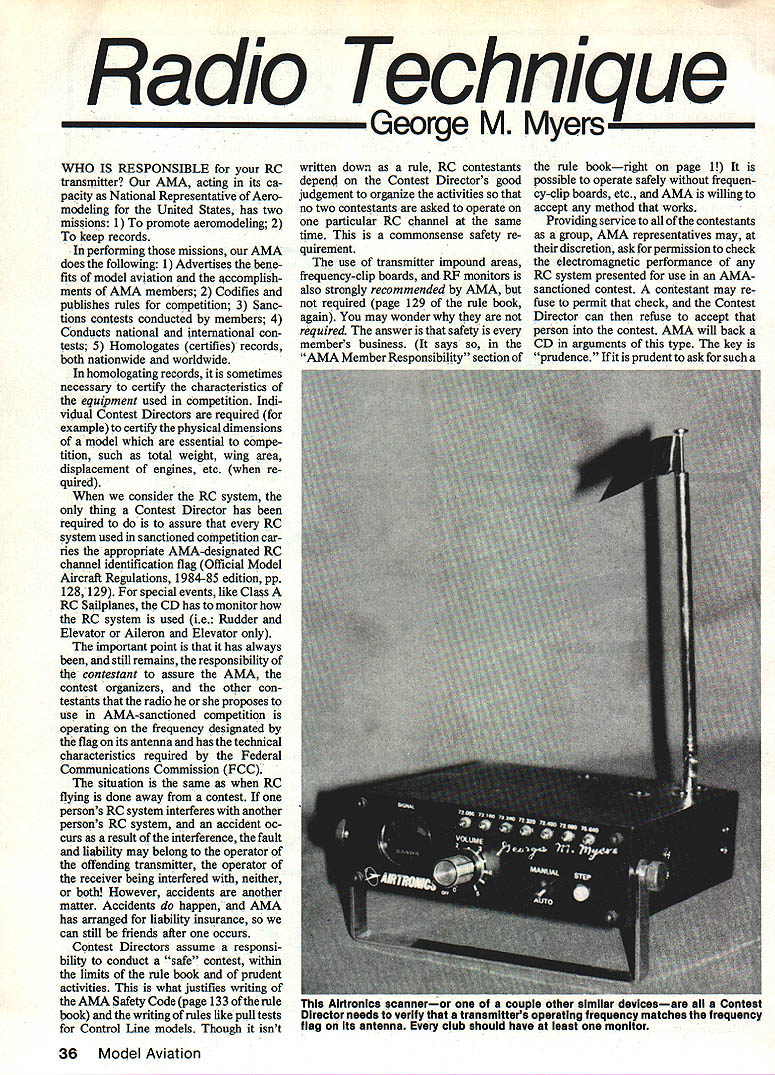
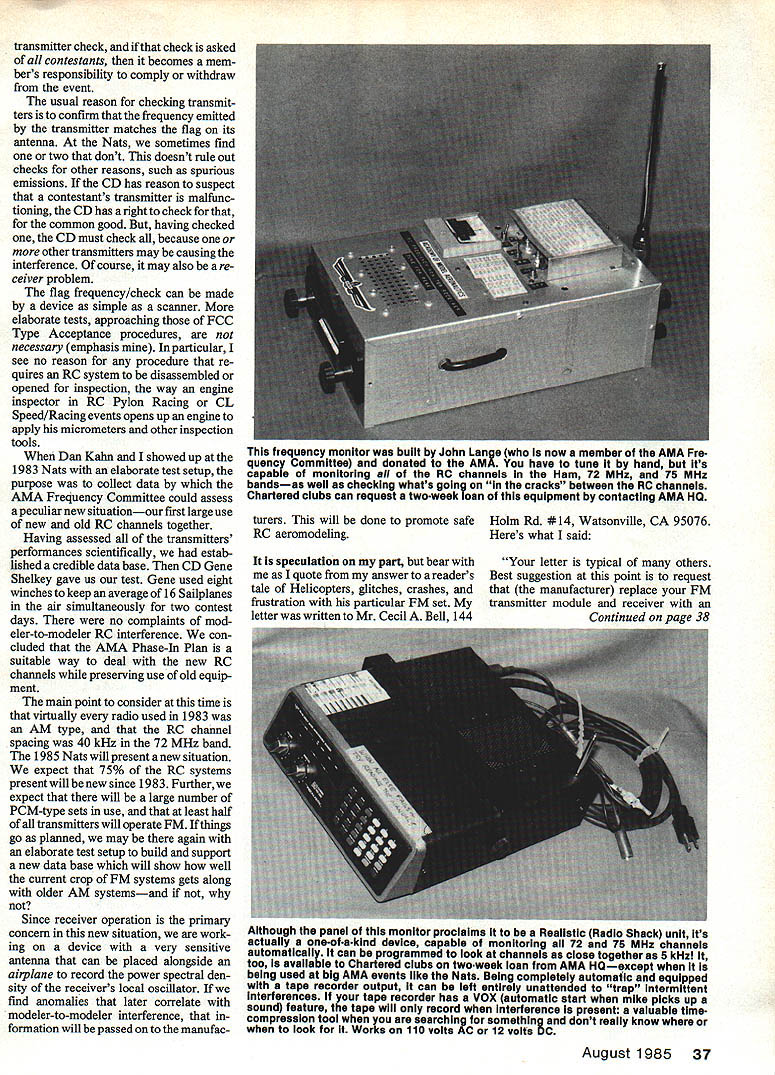
The obvious devices for checking a transmitter's operating frequency are a scanner or a frequency monitor. An Airtronics scanner—or one of a couple other similar devices—are all a Contest Director needs to verify that a transmitter's operating frequency matches the frequency flag on its antenna. Every club should have at least one monitor.
There are other reasons for checking transmitters, such as spurious emissions. If a CD has reason to suspect a contestant's transmitter is malfunctioning, the CD has the right to make the check in the common good. Having checked, the CD must remember that other transmitters may be causing interference—or it may be a receiver problem. Flag frequency/check can be made with a device as simple as a scanner; elaborate tests approaching FCC Type Acceptance procedures are not necessary. In particular, there is no reason the procedure should require the RC system to be disassembled or opened for inspection the way an engine inspector for RC Pylon Racing or CL Speed/Racing events opens up an engine and applies micrometers and other inspection tools.
1983 Nats testing and the Phase-In Plan
Dan Kahn showed up at the 1983 Nats with an elaborate test setup for the purpose of collecting data the AMA Frequency Committee could assess in our first large use of new and old RC channels together. Having assessed all of the transmitters' performances scientifically, we established a credible database. Then CD Gene Shelkey gave us our test: Gene used eight winches to keep an average of 16 sailplanes in the air simultaneously for two contest days. There were no complaints of modeler-to-modeler RC interference. We concluded that the AMA Phase-In Plan is a suitable way to deal with the new RC channels while preserving use of old equipment.
The main point to consider at that time is that virtually every radio used in 1983 was an AM type, and that the RC channel spacing was 40 kHz in the 72 MHz band.
1985 Nats expectations and receiver testing
The 1985 Nats will present a new situation. We expected that 75% of the RC systems present would be new since 1983. Further, we expected a large number of PCM-type sets in use, and that at least half of all transmitters would operate FM. If things went as planned, we might be there again with an elaborate test setup to build and support a new database to show how well the current crop of FM systems gets along with older AM systems—and if not, why not.
Since receiver operation is the primary concern in this new situation, we are working on a device with a very sensitive antenna that can be placed alongside an airplane to record the power spectral density of the receiver's local oscillator. If we find anomalies that later correlate with modeler-to-modeler interference, that information will be passed on to the manufacturers. This will be done to promote safe RC aeromodeling.
Advice to a frustrated helicopter owner
It is speculation on my part, but bear with me as I quote from an answer to a reader's tale of helicopters, glitches, crashes, and frustration with his particular FM set. My letter was written to Mr. Cecil A. Bell, 144 Holm Rd. #14, Watsonville, CA 95076. Here's what I said:
"Your letter is typical of many others. Best suggestion at this point is to request that the manufacturer replace your FM transmitter module and receiver with an AM version, if they have them in stock. I would expect that it will cost around $100 per radio system, and it might satisfy you.
From your description, and from solutions found to similar problems, the difficulty with your single-conversion FM receiver could be its SO42P chip. RC system designers have told me that its mixer section just isn't good enough for 72 MHz FM. That defect showed up rather clearly when production units went into service. Most likely, the prototypes worked better because the engineers and technicians concentrated on making them work. We have heard that generic SO42P, 5044, and 5045 chips are now being used, and that they just aren't as good as the original branded manufacturer's products. RC manufacturers are just as upset with the situation as you are. Use of generic chips may explain why some radios lose just one channel when everything else seems to check out OK.
Since I'm guessing that the receiver is your problem, a second alternative might be to replace your current FM receiver with a true narrow-band FM receiver from someone else. Your manufacturer will have one, soon. I've been told that they already have a narrow-band receiver for their PCM system, but I haven't actually seen it. Futaba, Kraft, and Airtronics have narrow-band receivers for PCM already, and others such as Ace R/C have announced their intentions to offer them. Initially, the price for a true narrow-band receiver may be over $100.
FM isn't inherently poorer than AM, but it has to be done right. How many folks remember what commercial FM was like back in the 1950s? I do—receivers drifted like a boat in a strong wind. I remember that I had to add a voltage regulator tube to my expensive 'Hi‑Fi' kit tuner to stop it from drifting. Today, any $10 pocket FM radio is drift-free. The problem now is to create a narrow-band design for RC that works.
Don't give up on helicopters! Even experts crash. You will reach a point where the crashes are due to wearout or outside influences, so you don't feel as upset by them."
Be fair to the Contest Director
Have some pity on the poor CD! Recently, a dispute erupted over a foreign-made RC system which was operated by an AMA member at the F3B team trials. It was reported that the system in question was operating properly on an FCC-designated and AMA-sanctioned RC channel and bore the appropriate flag. If these are the facts, then the CD could have no objection to use of that RC system.
Another modeler, not entered in the trials, protested that the RC system in question was not Type Accepted by the FCC, and therefore should be disqualified from the competition. The Contest Director disagreed. (There is nothing in the 1984–85 AMA rule book about disqualifying transmitters that are not Type Accepted.) (Editor's note: At press time, the July issue of AMA News arrived, and John Grigg's "President's Corner" column has more information on this situation. RMcM.)
AMA Frequency Committee meeting and proposed rule additions (April 13, 1985)
On April 13, 1985, the AMA Frequency Committee met in an all-day session at AMA HQ to discuss many matters. Among them, the committee proposed to the Executive Council that the following be added to the "RC GENERAL" section of the AMA rule book to cut off future debates of that type:
- The AMA endorses compliance with FCC regulations by AMA members.
- Contest Directors may, at their discretion, perform tests on RC systems and/or make special RC channel use accommodations to suit local conditions.
- Foreign contestants intending to enter U.S. contests with foreign RC systems should contact AMA HQ in advance of the contest date.
Rule 1 should be self-explanatory. I believe every citizen should follow the law, but recognize that AMA is not chartered to act as an unpaid police force for any government authority. Specifically, AMA has not been invested with authority to police the 72 MHz band for the FCC. The correct procedure for any citizen who believes that another citizen is breaking a law is to complain to the proper authority. That applies whether a presumed infraction is driving at excessive speed, public intoxication, or using an illegal radio transmitter. The proper place to complain about illegal radios is your local Field Service Engineer office of the FCC.
We should note that AMA President John C. Grigg stated a policy for Type Acceptance stickers on RC transmitters in the January 1985 issue of MA ("Competition Newsletter," page 115: "Attention All RC Fliers") and withdrew that policy in his "President's Corner" column in AMA News for March 1985 (also MA, page 93). AMA's legal counsel, Jeremiah Courtney, advised that only FCC Type Accepted or Type Approved equipment may be used legally on the 72 MHz frequencies. You should read about it in John Worth's column, Model Aviation, June 1985, page 100. It would be interesting to compare these references with those for Minute XV of the AMA Executive Council meeting (as reported on page 100 of the May 1985 issue of MA).
Rule 2 specifically allows CDs to check contestants' assurances that the frequency and flag match and that the RC system has appropriate performance characteristics; as well as to do things like group frequency pins together or prohibit use of specific channels to deal with local interference problems. It also gives the CD authority to set up flight lines, transmitter impound areas, and/or make whatever RC channel use procedures he or she deems appropriate for the situation.
Rule 3 allows for such situations as a World Cup competition, in which we might expect to have European contestants operating on their 35 and 40 MHz channels. AMA HQ can usually get a waiver from the FCC for such uses (which would include a waiver of the need for Type Acceptance). However, and this is very important, the waiver doesn't guarantee non-interference. Foreign competitors must operate under the same Secondary User restrictions as we do.
Canadians and frequency reciprocity
How about the Canadians? When considering Canadians in U.S. contests, which I discussed last month, we have a long history of reciprocal usage: they let us use our RC channels in Canada, and we let them use theirs in the U.S. AMA Executive Director John Worth says reciprocity was official at one time, and we haven't been told that it was revoked. But we can't prove that it is still in effect, either.
The issue is a bit clouded. In the first case, we never got permission from the FCC to use 72.720, 72.760, 72.800, or 72.840 MHz, but the Canadians did get permission from their government. They still use them, so we have to ride the clip for 72.720 to RC46, 72.760 to RC48, 72.800 to RC50, and 72.840 to RC52 if we let Canadians use their frequencies here.
Next, the Canadians chose to activate all the interstitial channels (72.01, 72.03, 72.05 ... 72.99 MHz) rather than follow the AMA Phase-In Plan. This puts Canadian RC channels on a 20 kHz spacing—as ours are intended to be in 1991. The AMA Phase-In Plan was designed to protect old equipment as long as possible. The Canadian plan apparently is designed to press for "narrow-band equipment, now!" which is the position we seem to be getting pushed into by the AM/FM controversy. If you live in Canada, pay attention to their clipboard, because it's different from ours.
The following formulas for converting between RC channel number and the corresponding frequency in MHz may be of interest to those who fly with Canadians:
- Frequency in MHz = 72.01 + (RC Channel number − 11) / 50
- RC Channel number = 11 + 50 × (Frequency in MHz − 72.01)
See how much easier it is when everyone just uses RC channel numbers? Last-minute flash: The New Flag proposal (which I now think should be called the Narrow-Band Flag) was accepted and passed by the Executive Council. Watch for details in the "Competition Newsletter."
George M. Myers 70 Froehlich Farm Rd. Hicksville, NY 11801
Transcribed from original scans by AI. Minor OCR errors may remain.

