
Radio Technique
George M. Myers
WHAT INTERFERENCE? For the past two years I have been loaning out (on request) an AMA frequency monitor to clubs in District II. You know what they have found? Nothing!
They haven't found any interference on the new RC channels. Oh sure, they have found a bridge tender here and a pocket pager there, located on the old, even-numbered channels (72.080, 72.160, 72.240, 72.320, 72.400, 72.960, 75.640 MHz). But we knew that would happen. It was happening before we got the new channels. That's why we got the new channels!
By law, there shouldn't be any interference on the new RC channels, which we have for our exclusive use (except for interference we get from other modelers). According to this small set of tests, we have what is expected.
I know it is small comfort to you, but as Bob Aberle observed, "RC is the real testing-ground for techniques that will make cellular radio, pocket pagers, etc., feasible." We stand side-by-side when we operate our systems. They don't. We are forced to deal with the intermodulation problems. They can ignore them. If intermodulation spoils their communication, all they have to do is repeat the last transmission. We glitch and crash!
So, guess where the big bucks are being spent? You've got it... in pocket pagers and cellular radios. How do we make them understand that RC model aviation is the best place to develop their new chips and circuits?
While perusing another two-inch stack of newsletters (which I receive from AMA HQ from time to time), I was struck by the frequent reprinting of my old June 1983 column on interference. That was the column with the four-station flight card in color, and it is apparently being included with some Circus Hobbies radios. It contains one well-known flaw! If you use the card, you should move 72.080 (BN/WH) from the Red flight line to the Yellow flight line to avoid the possibility of image interference. (Sorry about that.)
At the same time, I must point out that "possible interference" doesn't mean "guaranteed." Most clubs use every combination of channels possible and wonder, "Why is this guy Myers always talking about interference? We never have any." When you check them out, you find that those clubs are doing about three things right:
- They use an impound area for unused transmitters.
- They fly from spots that are over 30 feet apart.
- Practically everyone is still using AM radios.
Now that FSK sets (frequency-shift keying—labeled FM) are becoming so common, I'd like everyone to add one more step to the above:
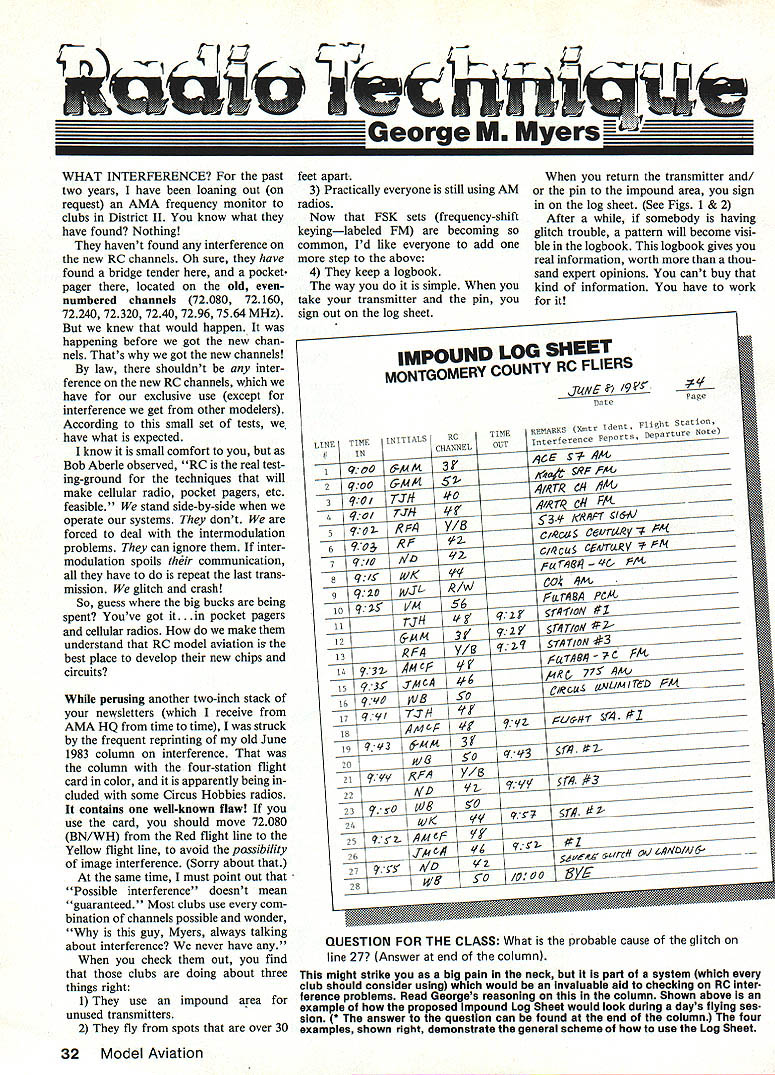
- They keep a logbook. The way you do it is simple. When you take your transmitter and the pin, you sign out on the log sheet. When you return the transmitter and/or the pin to the impound area, you sign in on the log sheet. (See Figs. 1 & 2)
After a while, if somebody is having glitch trouble, a pattern will become visible in the logbook. This logbook gives you real information, worth more than a thousand expert opinions. You can't buy that kind of information. You have to work for it!
QUESTION FOR THE CLASS: What is the probable cause of the glitch on line 27? (Answer at the end of the column.)
This might strike you as a big pain in the neck, but it is part of a system (which every club should consider using) that would be an invaluable aid to checking on RC interference problems. Shown below is an example of how the proposed Impound Log Sheet would look during a day's flying session. The examples shown demonstrate the general scheme of how to use the Log Sheet.
Several people have written questioning my advice to turn the receiver on before the transmitter. Of course use the receiver to monitor the channel you intend to use. The following reply from reader Eugene Babin, 1106 Maplewood Dr., Normal, IL 61761, follows his friends' advice:
"Turn the transmitter first because, trying to save charge in the flight battery pack, you prevent damage to receiver servos. Turn the receiver on, see no response, walk off, forget; someone else may later turn something—like an electric fuel pump—which will drive servos beyond tolerable limits and cause damage. Be alert to that possibility. Remember: turn the receiver off, turn the transmitter on before damage is done. On the other hand, a quiet system should not be forgotten; a left-on transmitter may interfere with someone else. That's a common form of interference."
Procedure
1) Load impound before transmitter—find out if someone else is using the RC channel before takeoff. You may even find out airborne; you must know what to look for. The fact that your servos aren't moving doesn't mean that no one is using the channel. The other fellow might have forgotten and left his transmitter turned on. He also might be flying a sailplane! The thing to do is to grab the rudder and try to move it. If someone is on your channel, the servo will fight you. If no one is there, the servo will move easily.
"The difference is in knowing what to look for."
Bear in mind that a poor arrangement of servo leads can bring on short ground range and can make the servos move around when no one else is affecting them. You should rearrange the components until such problems go away. Your airborne system should be absolutely quiet when the transmitter is turned off, assuming you are in an RF-free environment. If it's not quiet, then find out why, and fix it. Otherwise, you will be flying along someday when your receiver will enter a 'null' area, then start doing its own thing. You will immediately complain about 'interference'—but nobody will be able to find any, because you will be carrying it around inside the fuselage of your model!
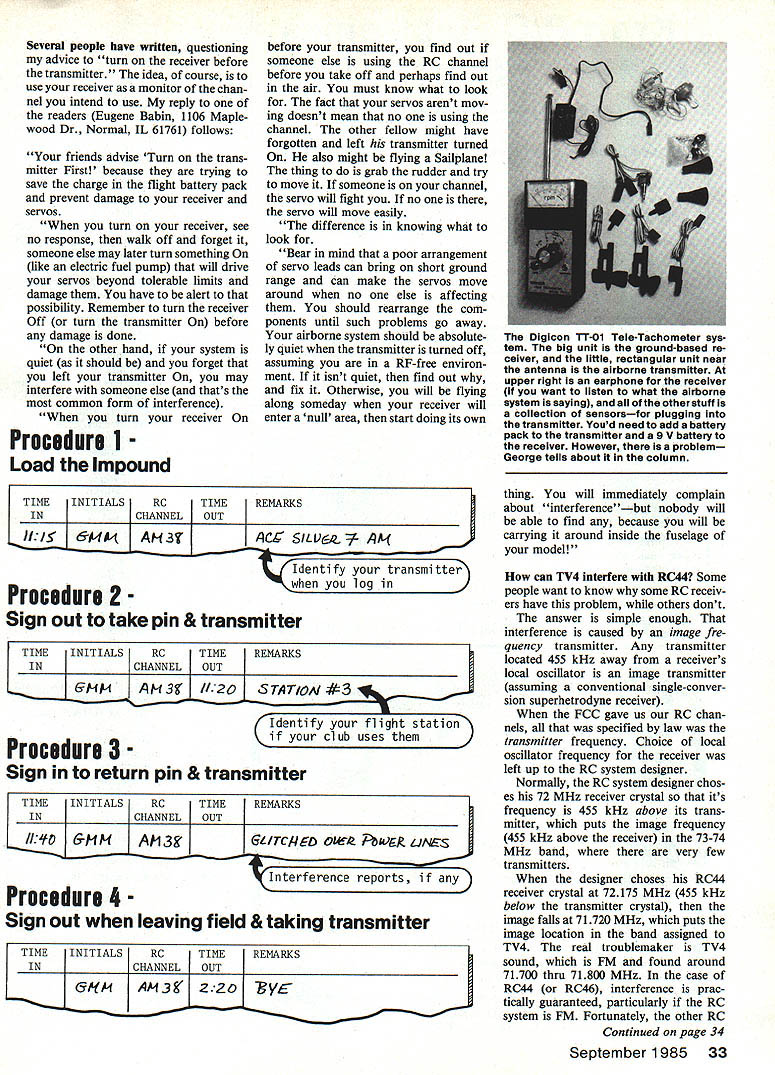
Procedure 1 - Load the Impound
TIME IN INITIALS RC CHANNEL TIME OUT REMARKS 11:15 GMM AM 38 ACE SILVER 7 AM
Identify your transmitter when you log in.
Procedure 2 - Sign out to take pin & transmitter
TIME IN INITIALS RC CHANNEL TIME OUT REMARKS 11:20 GMM AM 38 STATION #3
Identify your flight station if your club uses them.
Procedure 3 - Sign in to return pin & transmitter
TIME IN INITIALS RC CHANNEL TIME OUT REMARKS 11:40 GMM AM 38 GLITCHED OVER POWER LINES
Record interference reports, if any.
Procedure 4 - Sign out when leaving field & taking transmitter
TIME IN INITIALS RC CHANNEL TIME OUT REMARKS GMM AM 38 2:20 BYE
How can TV4 interfere with RC44? Some people want to know why some RC receivers have this problem, while others don't.
The answer is simple enough. That interference is caused by an image-frequency transmitter. Any transmitter located 455 kHz away from a receiver's local oscillator is an image transmitter (assuming a conventional single-conversion superheterodyne receiver).
When the FCC gave us our RC channels, all that was specified by law was the transmitter frequency. Choice of local oscillator frequency for the receiver was left up to the RC system designer.
Normally, the RC system designer chooses his 72 MHz receiver crystal so that its frequency is 455 kHz above its transmitter, which puts the image frequency (455 kHz above the receiver) in the 73–74 MHz band, where there are very few transmitters.
When the designer chooses his RC44 receiver crystal at 72.175 MHz (455 kHz below the transmitter crystal), then the image falls at 71.720 MHz, which puts the image location in the band assigned to TV4. The real troublemaker is TV4 sound, which is FM and found around 71.700–71.800 MHz. In the case of RC44 (or RC46), interference is practically guaranteed, particularly if the RC system is FM. Fortunately, the other RC channels don't have the problem.
The fix is simple. Replace the offending RC44 receiver crystal with the proper one (73.085 MHz for a single-conversion 455 kHz IF receiver for RC44) and retune the receiver. This will put the image frequency up into the Radio Astronomy band and the problem will go away.
Now you are going to ask the $64 question, "How does one find out if the receiver local oscillator is on the high side or low side?"
Usually, all you have to do is read the number printed on the crystal case (not the one printed on the plastic pull tab). If you see a receiver crystal frequency 72.465 MHz or higher, it's usually a "high-side" crystal. There are other tests (like having TV4 interference), but we won't go into them now.
Thanks to Frequency Committee member Jack Albrecht for the explanation.
My friend Norm Rosenstock went to Toledo and bought one of those Digicon TT-01 Tele-Tachometers from Condor Hobbies, then loaned it to me. Norm's unit is on 40.615 MHz and, "No, that isn't one of our frequencies." I see it proclaimed as a "Government Exclusive Frequency, Fixed and Mobile." The literature says you can get a TT-01 on the 27 MHz RC channels, if you wish (also illegal for telemetering). Naturally, there isn't any Type Acceptance sticker on the airborne transmitter, either.
In defense of the unit, RF output is listed as 30 milliwatts, which is probably low enough so that no one will care if or how you use it. But don't blame me if some FBI-type decides to pay you a visit.
Also listed on the data sheet is a note, "Coming soon! Official U.S.A. telemetering frequency: 49.0 MHz." Maybe there is such a thing, but I haven't heard about it.
It seems a shame that such a useful device hasn't been blessed by FCC designation of usable telemetering channels. Another chore for the AMA Frequency Committee.
Airspeed reads out on a dual-scale meter to 150 and 300 kilometers per hour, which you can convert to miles per hour by multiplying the readings by 0.6214 (using 0.62 is close enough). The readout for rpm is 3,000, 15,000, or 30,000 rpm full scale. Provision is made for switching between sensors in flight, so you can read propeller rpm and airspeed in the same flight, alternately.
It looks like a nice tool. Too bad it is illegal.
Give the Impound Log a try. You might learn something!
Answer to the question posed on the sample Transmitter Impound Log sheet illustration:
- Station No. 1 (AM46) arrived at 9:52.
- Station No. 2 (FM44) arrived at 9:51.
- Station No. 3 (FM42) arrived at 9:44 and left at 9:55.
The probable cause of the interference is third-order intermodulation, aggravated by the fact that the late arrival on Station No. 1 is an AM set. This data tells you what test setup will prove or disprove it.
George M. Myers 70 Froehlich Farm Rd. Hicksville, NY 11801
Transcribed from original scans by AI. Minor OCR errors may remain.

