
Radio Technique
George M. Myers
More on Micro RC
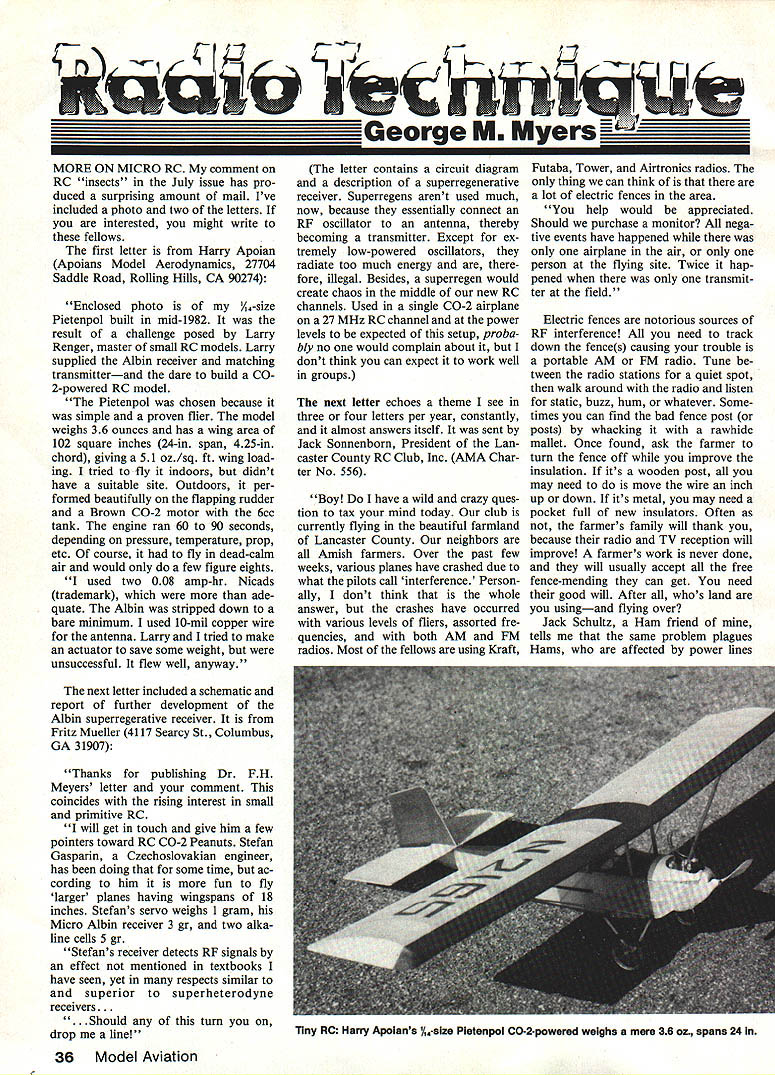
My comment on RC "insects" in the July issue has produced a surprising amount of mail. I've included a photo and two of the letters. If you are interested, you might write to these fellows.
Letter from Harry Apoian
Harry Apoian (Apoian's Model Aerodynamics, 27704 Saddle Road, Rolling Hills, CA 90274) writes:
"Enclosed photo is of my 1/4-size Pietenpol built in mid-1982. It was the result of a challenge posed by Larry Renger, master of small RC models. Larry supplied the Albin receiver and matching transmitter—and the dare to build a CO2-powered RC model.
"The Pietenpol was chosen because it was simple and a proven flier. The model weighs 3.6 ounces and has a wing area of 102 square inches (24-in. span, 4.25-in. chord), giving a 5.1 oz./sq. ft. wing loading. I tried to fly it indoors, but didn't have a suitable site. Outdoors, it performed beautifully on the flapping rudder and a Brown CO2 motor with the 6 cc tank. The engine ran 60 to 90 seconds, depending on pressure, temperature, prop, etc. Of course, it had to fly in dead-calm air and would only do a few figure eights.
"I used two 0.08 amp-hour Ni-Cad batteries, which were more than adequate. The Albin was stripped down to a bare minimum. I used 10-mil copper wire for the antenna. Larry and I tried to make an actuator to save some weight, but were unsuccessful. It flew well, anyway."
Letter from Fritz Mueller
Fritz Mueller (4117 Searcy St., Columbus, GA 31907) sent a schematic and report of further development of the Albin superregenerative receiver:
"Thanks for publishing Dr. F.H. Meyers' letter and your comment. This coincides with the rising interest in small and primitive RC.
"I will get in touch and give him a few pointers toward RC CO2 Peanuts. Stefan Gasparin, a Czechoslovakian engineer, has been doing that for some time, but according to him it is more fun to fly 'larger' planes having wingspans of 18 inches. Stefan's servo weighs 1 gram, his Micro Albin receiver 3 grams, and two alkaline cells 5 grams.
"Stefan's receiver detects RF signals by an effect not mentioned in textbooks I have seen, yet in many respects similar to and superior to superheterodyne receivers.
"...Should any of this turn you on, drop me a line!"
(The letter contains a circuit diagram and a description of a superregenerative receiver. Superregens aren't used much now, because they essentially connect an RF oscillator to an antenna, thereby becoming a transmitter. Except for extremely low-powered oscillators, they radiate too much energy and are, therefore, illegal. Besides, a superregen would create chaos in the middle of our new RC channels. Used in a single CO2 airplane on a 27 MHz RC channel and at the power levels to be expected of this setup, probably no one would complain about it, but I don't think you can expect it to work well in groups.)
Letter from Jack Sonnenborn (Lancaster County RC Club)
Jack Sonnenborn, President of the Lancaster County RC Club, Inc. (AMA Charter No. 556), writes about interference problems at his club's flying site:
"Boy! Do I have a wild and crazy question to tax your mind today. Our club is currently flying the beautiful farmland of Lancaster County. Our neighbors are all Amish farmers. Over the past few weeks, various planes have crashed due to what the pilots call 'interference.' Personally, I don't think that is the answer, but the crashes have occurred with various levels of fliers, assorted frequencies, and with both AM and FM radios. Most of the fellows are using Kraft, Futaba, Tower, and Airtronics radios. The only thing we can think of is that there are a lot of electric fences in the area.
"You would be appreciated. Should we purchase a monitor? All negative events have happened while there was only one airplane in the air, or only one person at the flying site. Twice it happened when there was only one transmitter at the field."
Electric fences are notorious sources of RF interference. All you need to track down the fence(s) causing your trouble is a portable AM or FM radio. Tune between the radio stations for a quiet spot, then walk around with the radio and listen for static, buzz, hum, or whatever. Sometimes you can find the bad fence post (or posts) by whacking it with a rawhide mallet. Once found, ask the farmer to turn the fence off while you improve the insulation. If it's a wooden post, all you may need to do is move the wire an inch or two, or install some new insulators. Often as not, the farmer's family will thank you, because their radio and TV reception will improve. A farmer's work is never done, and they will usually accept all the free fence-mending they can get. You need proof too. After all, whose land are you using—and flying over?
Jack Schultz, a ham friend of mine, tells me that the same problem plagues hams, who are affected by power lines, cracked insulators, and the like. Hams can sometimes be seen late at night whacking lighting poles in an attempt to locate interference sources.
Before anyone asks, yes, it is illegal under FCC regulations for a fence, power line, motorcycle, etc., to radiate whatever is necessary to interfere with radio reception. Enforcement, however, is another matter, and local solutions—such as locating and repairing the offending wiring or insulators—are often the most effective.
Another reader: David Bryant (Coram, N.Y.)
Another reader writes: "I sent the RC system back to the manufacturer twice, tried flying at a field 20 miles from the place where the first interference happened—and still the problems occur. Is my receiver supposed to receive signals from radio transmitters on other channels?" — David Bryant, Coram, N.Y.
Simple answer: No, it isn't!
Real-world answer: Most of them do, given the wrong conditions, some of which are:
- Standing with the transmitters too close together (keep 30 feet apart).
- Letting your airplane get closer to the other guy's transmitter than to yours. (We're not talking about a 1% difference, but if he is at 1/40th of your distance, trouble can be expected.)
- Occasionally—but not often—we see a bad transmitter or receiver. These days most of the bad receivers are FM types.
Correction on Simprop PCM-20
Back in the June 1985 issue, which reviewed Altech Marketing's Simprop PCM-20, I went on about it not having a dual-conversion, narrow-band receiver. I was wrong. It has exactly that. Sorry about misleading you. I still believe that the Simprop plug-in module, which customizes the transmitter for a particular airplane, helicopter, boat, etc., is a good way to deal with the fact that each type of model requires its own peculiar mixing features, control-throw settings, trims, etc. With the Simprop, you can get it right, then unplug the module and store it with the model. When you want to fly the model, you plug in the matching module and you are ready. Eventually, someone will come out with a transmitter with an EEPROM that can be downloaded from a tape recorder or offline computer. Until then, it's either Simprop PCM-20 or multiple transmitters.
Remarks on FCC Type Acceptance and Competition
I had a long letter and a following telephone call from Dave Peltz, AMA 968, member of the AMA RC Soaring Contest Board. We talked of many things, but Dave's main message was that I should have emphasized that only FCC Type-Accepted transmitters should be allowed in AMA soaring contests. The burden of proof of Type Acceptance is on the modeler.
Dave is upset because AMA, as represented in international aeromodelling activities (in accordance with the AMA Bylaws) by its president, John C. Grigg, did not disqualify those contestants who used the illegal Becker RC systems in the 1984 F3B RC Soaring team selection Finals. Thereby, Dave says, they secured an unfair advantage over other competitors by way of special control-mixing functions built into the Becker transmitter. As Dave puts it, Federal regulations were ignored in order to gain a place on an RC Soaring team representing the United States in World competition.
(Editor's note: Because of the situation described, plus other purported irregularities at the Finals, the AMA president declared the team finals to be null and void, naming three U.S. team members by presidential directive—this was explained in considerably greater detail in the "President's Corner" column in the July 1985 issue of "AMA News." George Myers went on to point out that in AMA-sanctioned competition, paragraph 1.17 of the AMA rule book asserts that abusing any kind of regulation is supposed to lead to a contestant's disqualification. Of course, there is the basic question of whether this—or other—AMA competition rules are applicable when the event is operated by FAI rules to select members for a team representing the U.S. at an FAI World Championships. R.C.M.)
On the other hand, if you want to experiment with special controls, the way to go about it (without breaking any federal law) is to first get yourself a ham license. Then, you can build anything the rules allow. If that gives you an advantage, so be it. To my mind, you should use anything that helps you fly better, and you have no one to blame but yourself if you fail to do so and then you get beat. But, if you aren't ambitious enough to work for the advantage you seek (by getting a ham license, then developing the equipment, in this case), then you really don't deserve to have it.
Now I'll tell you what I told Dave: All of the above is very important, but what the world really wants is a Type-Accepted RC system that is trustworthy. AMA, represented by the Frequency Committee, is working to define parameters for the FCC's Type Acceptance procedure that will secure just that.
Contact
George M. Myers 70 Froehlich Farm Rd. Hicksville, NY 11801
Transcribed from original scans by AI. Minor OCR errors may remain.

