
Radio Technique
George M. Myers
1985 Nats — overview
- About 900 transmitters were processed for the 1985 Nationals.
- Radio types by event:
- Helicopter: predominantly PCM.
- Pattern: about 50% PCM, 50% other (more AM than FM).
- Pylon and Sailplane: about 70% AM, very few PCM.
- Scale: about 85% old AM; the remainder split between newer AM and FM.
Interference problems were minimal, largely due to the Contest Directors' planning and precautions. Pylon, Pattern, and Scale used frequency groupings that avoided the usual problems, and a 2½‑minute walking route between the Sailplane launch site and the landing circles (set up by Jeff Troy) reduced intermod issues. The few crashes that occurred were, for the most part, due to pilot error or equipment failure rather than interference.
Interference and frequency observations
- A cement‑truck dispatcher active in Springfield (as in 1983) was present on 72.16 (Blue/White).
- A new pocket pager was detected on 72.320 (Purple/White) at the Sailplane site; it was also discovered about the same time at the Helicopter site, some 12 miles away.
- A police radio on 75.64 (Green/White) was heard but caused no reported problems.
- There were no independently verifiable interferences on the new RC channels reported to me.
Equipment testing and repairs
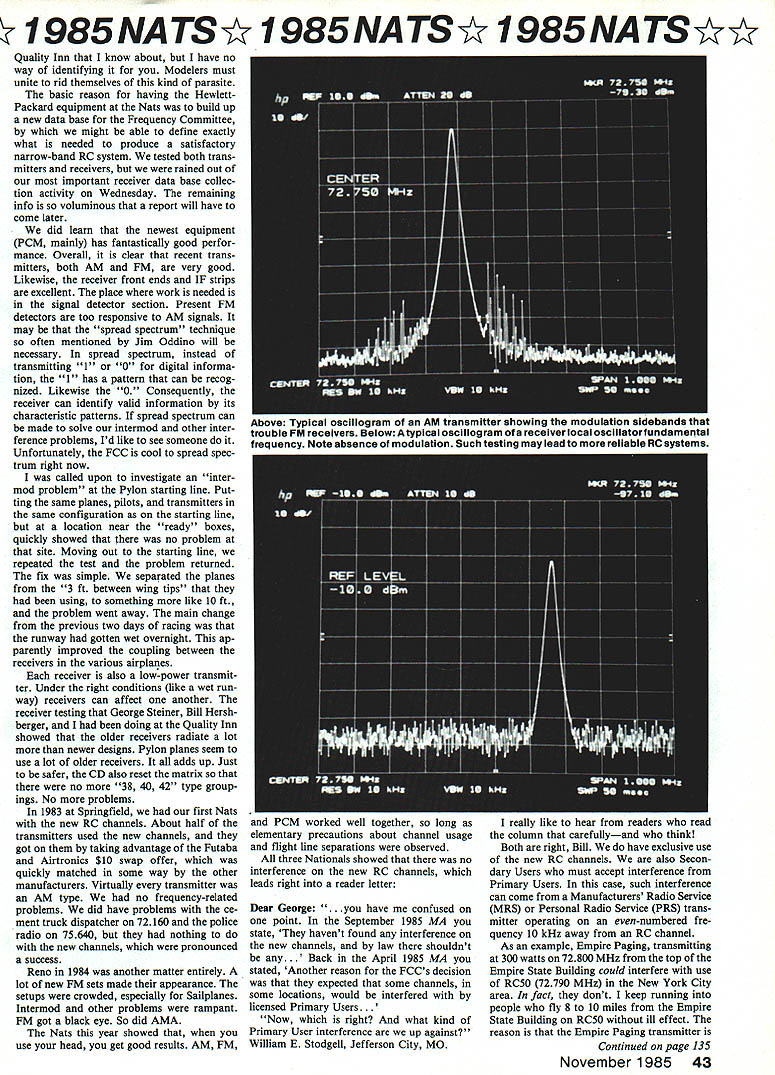
George P. Steiner processed contestants' transmitters through his custom-built scanner/tester and set aside the "interesting" units for more careful inspection on Hewlett‑Packard equipment. The HP gear was set up and programmed by Dan Kahn and operated by Bill Hershberger and myself. We tested both transmitters and receivers and found a couple of sets badly in need of repair or retuning.
Pete Waters (District VII VP, Kraft Midwest) and Paul Holsten (Ace R/C, Inc.) set up a repair shop in a room at the Quality Inn and fixed the problems we found, even when the sets were not from Ace, Pro‑Line, or Kraft lines. Unfortunately, someone broke into the room and stole two of Pete's transmitters and his supplies (including about 150 crystals). The suspected thief was later apprehended by the Chicopee police. Another transmitter and a charger were stolen from the Quality Inn lobby.
Purpose of the Hewlett‑Packard tests and preliminary findings
The primary purpose of bringing the Hewlett‑Packard equipment to the Nats was to build a new database for the Frequency Committee to define what is needed for a satisfactory narrow‑band RC system. Our most important data-collection activity was rained out on Wednesday, so the remaining information is extensive and will require a later, fuller report.
Preliminary findings:
- The newest equipment (mainly PCM) showed fantastically good performance.
- Recent transmitters (AM and FM) and receiver front ends/IF strips are overall very good.
- Work is needed in the signal detector section: present FM detectors are too responsive to AM signals.
- Spread spectrum was discussed as a possible solution. In spread spectrum, the digital "1" and "0" are represented by recognizable patterns, allowing the receiver to identify valid information by its characteristic pattern. If spread spectrum can be made to solve intermod and other interference problems, it would be desirable — though the FCC was not favorably disposed toward spread spectrum at the time.
Pylon intermod investigation
I was asked to investigate an intermod problem reported at the Pylon starting line. Testing the same planes, pilots, and transmitters near the "ready" boxes produced no problem. Repeating the test at the starting line reproduced the problem. The fix was simple: reduce the separation between planes. They had been positioned with about 35 ft. between wing tips; moving them closer to roughly 10 ft. eliminated the issue.
The main change from the previous two days of racing was that the runway had gotten wet overnight, which apparently improved coupling between receivers in the various airplanes. Each receiver can act as a very low‑power transmitter; under the right conditions receivers can affect one another. Tests at the Quality Inn by George Steiner, Bill Hershberger, and myself showed that older receivers radiate substantially more than newer designs. Pylon planes commonly used older receivers, which increased the likelihood of interaction. As a precaution, the Contest Director reset the matrix to eliminate groupings like "38, 40, 42," and no further problems were reported.
Historical comparison
- 1983 Springfield:
- First Nats with the new RC channels.
- About half the transmitters used the new channels (many via the Futaba and Airtronics 5% swap offer).
- Virtually every transmitter was AM type; no frequency‑related problems attributable to the new channels. There were unrelated issues with a truck dispatcher on 72.16 and the police radio on 75.64.
- 1984 Reno:
- Many new FM sets appeared.
- Setups were crowded (especially for Sailplanes), and intermod/other problems were rampant.
- FM gained a bad reputation that year, as did the AMA in the eyes of some.
- 1985 Nats:
- Demonstrated that with sensible planning and precautions, AM, FM, and PCM can operate together effectively.
Reader letter — Primary users and new channels
Dear George: "...you have me confused on one point. In the September 1985 MA you state, 'They haven't found any interference on the new channels, and by law there shouldn't be any.' Back in the April 1985 MA you stated, 'Another reason for the FCC's decision was that they expected that some channels, in some locations, would be interfered with by licensed Primary Users.' . . . Now, which is right? And what kind of Primary User interference are we up against?" — William E. Stodgell, Jefferson City, MO.
Reply: Both statements are correct. We have exclusive use of the new RC channels in the sense that RC users are authorized to operate there, but we are Secondary Users and must accept interference from Primary Users. Such interference can come from a Manufacturers Radio Service (MRS) or Personal Radio Service (PRS) transmitter operating on an even‑numbered frequency 10 kHz away from an RC channel. For example, a high‑power pager or paging transmitter operating on 72.800 MHz could, in theory, interfere with RC50 (72.790 MHz) in its immediate area. In practice, such interference is not commonly observed.
(Article continued beyond the provided text.)
Transcribed from original scans by AI. Minor OCR errors may remain.

