
Radio Technique
George M. Myers
MERRY CHRISTMAS. It seems a bit odd to be composing the Christmas column in the dog days of summer, but I am, with the temperature in the high eighties and the humidity likewise. The magazine business is a peculiar business.
From time to time it has been remarked (usually by someone unhappy with something I have written) that what I write in this column is just my own opinion, and not Official AMA Policy. That's right. Official AMA policy is obtained from the deliberations of the Executive Council.
This column is a personal letter from me to you, and I want to keep it that way. The intention is to share ideas, enthusiasms, philosophies and concerns. I also dig around to find newsworthy items for you, keeping in mind the deadlines in this peculiar business. If you want AMA policy, look in the back of the magazine or in the AMA rule book. The only authority I claim is truth and accuracy.
You can guess how many friends I've made among the RC manufacturers by publishing some of your letters complaining about the way that current FM sets are being interfered with by old AM sets, and—vice versa. Check the magazine's advertising to see who pulled out of the magazine and cite the reason. Pulling the ads didn't make the problem go away, did it?
FM, AM, PCM and interference
The FM technique can support use of closer-spaced RC frequencies than does AM, when they get it right. Consider that virtually all of the MRS (Manufacturers' Radio Service) and PRS (Personal Radio Service) systems—which operate successfully 10 kHz from our AM sets—are FM. They use dual-conversion receivers with additional coding schemes to verify reception of valid signals. They don't seem to have any complaints about our AM sets.
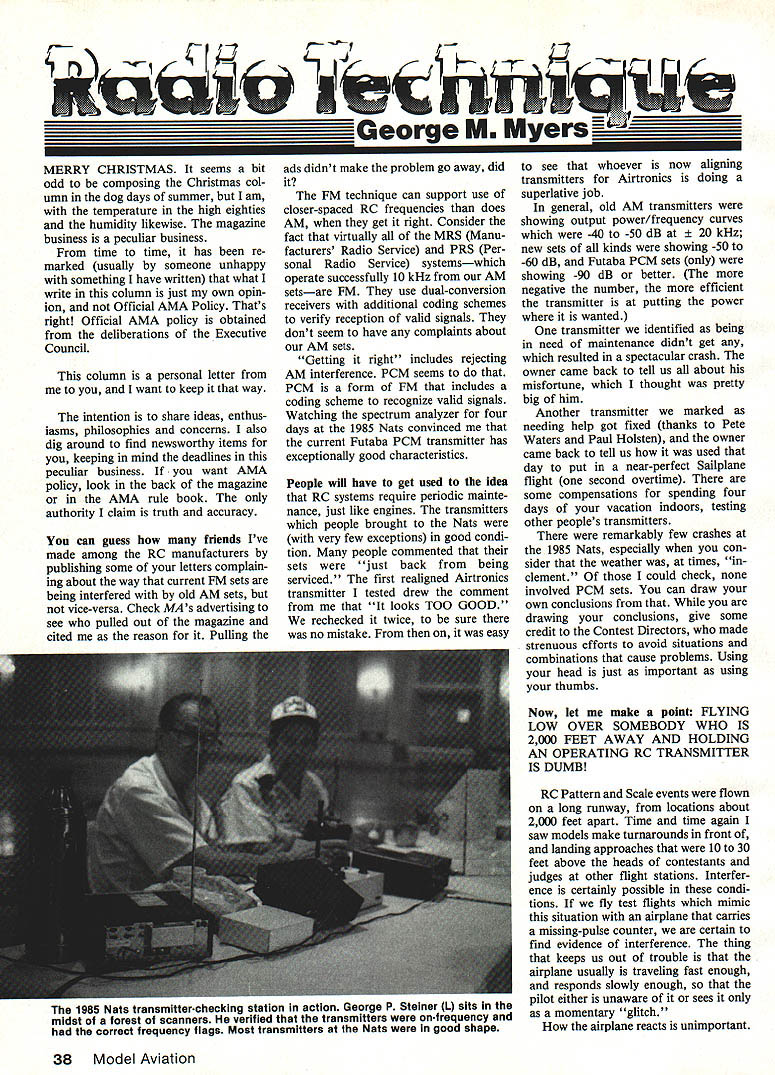
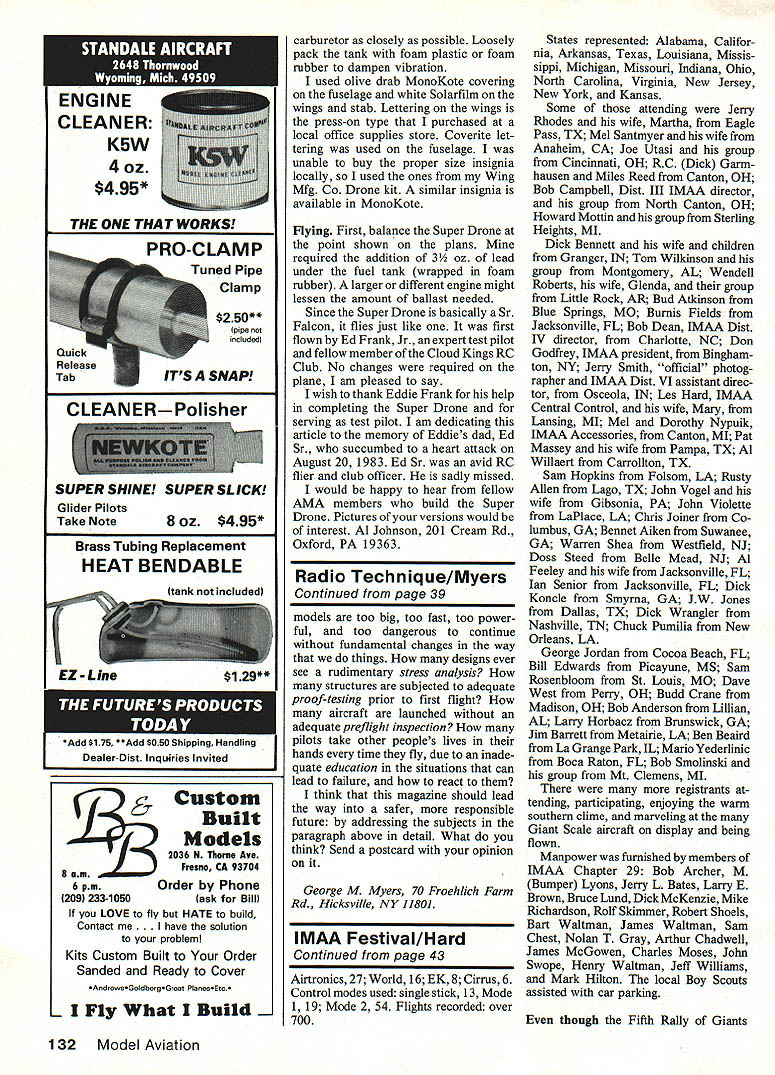
"Getting it right" includes rejecting AM interference. PCM seems to do that. PCM is a form of FM that includes a coding scheme to recognize valid signals. Watching the spectrum analyzer for four days at the 1985 Nats convinced me that the current Futaba PCM transmitter has exceptionally good characteristics.
In general, old AM transmitters showed output power/frequency curves which were −40 to −50 dB at ±20 kHz; new sets of all kinds were showing −50 to −60 dB; and Futaba PCM sets (only) were showing −90 dB or better. (The more negative the number, the more efficient the transmitter is at putting the power where it is wanted.)
Transmitter maintenance and the 1985 Nats
People will have to get used to the idea that RC systems require periodic maintenance, just like engines. The transmitters people brought to the Nats were, with very few exceptions, in good condition. Many people commented that their sets were "just back from being serviced."
The first realigned Airtronics transmitter I tested drew the comment from me that "It looks TOO GOOD." We rechecked it twice to be sure there was no mistake. From then on, it was easy to see that whoever is now aligning transmitters for Airtronics is doing a superlative job.
One transmitter we identified as being in need of maintenance didn't get any, which resulted in a spectacular crash. The owner came back to tell us all about his misfortune, which I thought was pretty big of him. Another transmitter we marked as needing help got fixed (thanks to Pete Waters and Paul Holsten), and the owner came back to tell us how it was used that day to put in a near-perfect sailplane flight (one second overtime).
There are some compensations for spending four days of your vacation indoors testing other people's transmitters. There were remarkably few crashes at the 1985 Nats, especially when you consider that the weather was, at times, inclement. Of those I could check, none involved PCM sets. You can draw your own conclusions from that. While you are drawing your conclusions, give some credit to the Contest Directors, who made strenuous efforts to avoid situations and combinations that cause problems. Using your head is just as important as using your thumbs.
Safety, flying practices and responsibility
Now, let me make a point: FLYING LOW OVER SOMEBODY WHO IS 2,000 FEET AWAY AND HOLDING AN OPERATING RC TRANSMITTER IS DUMB!
RC Pattern and Scale events were flown on a long runway, from locations about 2,000 feet apart. Time and time again I saw models make turnarounds in front of, and landing approaches that were 10 to 30 feet above the heads of contestants and judges at other flight stations. Interference is certainly possible in these conditions. If we fly test flights which mimic this situation with an airplane that carries a missing-pulse counter, we are certain to find evidence of interference. The thing that keeps us out of trouble is that the airplane usually is traveling fast enough, and responds slowly enough, so that the pilot either is unaware of it or sees it only as a momentary "glitch." How the airplane reacts is unimportant.
It is important to see that human beings in remote locations are not exposed to unnecessary risk. A Giant Scale Laser came vertically about 10 feet left of the scale judges seated on the runway right in front of them. Nobody moved. Nobody had time to move. It doesn't matter whether the crash was caused by some kind of failure inside the airplane or by interference; the point is there is no way to justify the situation. No excuse will absolve the pilot of responsibility.
Part of the problem is created by the practice of seating the judges on the pavement. The judges would be cooler (and safer) if they were seated on the grass alongside the runway. I think that only the contestants doing the flying should be out there on the runway centerline.
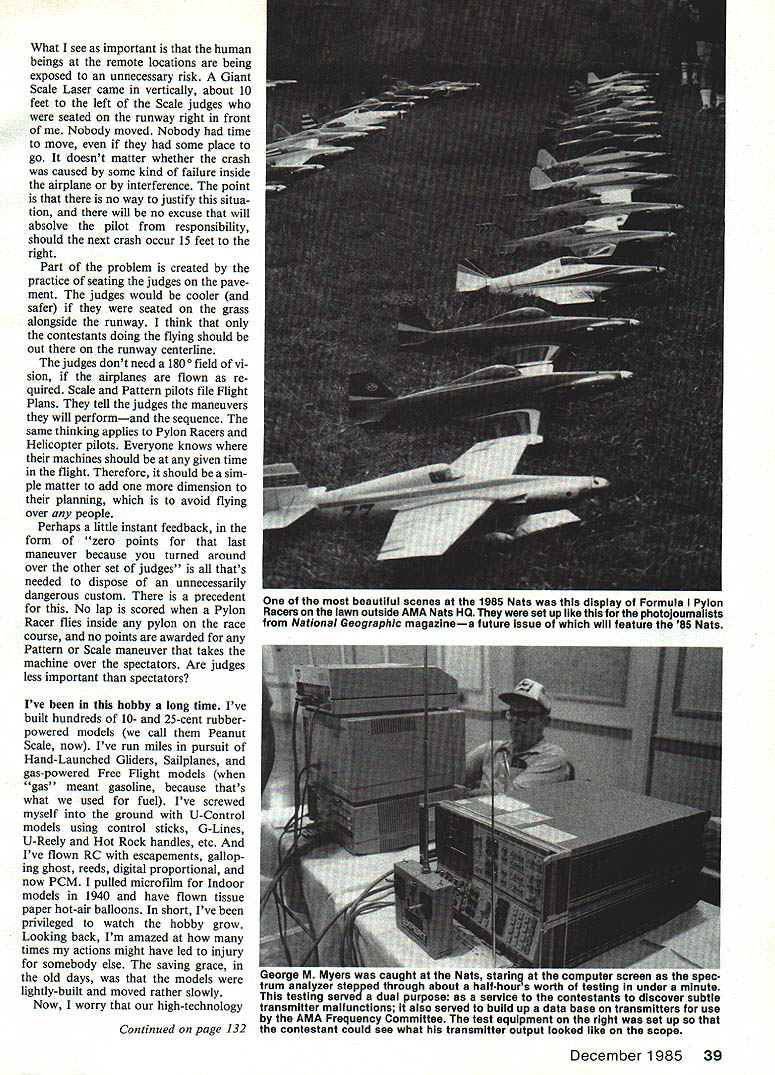
The judges don't need a 180° field of vision if the airplanes are flown as required. Scale and Pattern pilots file Flight Plans; they tell the judges the maneuvers they will perform—and the sequence. The same thinking applies to Pylon Racers and Helicopter pilots. Everyone knows where their machines should be at any given time in the flight. Therefore, it should be a simple matter to add one more dimension to their planning: avoid flying over any people.
Perhaps a little instant feedback, in the form of "zero" points for that last maneuver because you turned around over the other set of judges, is all that's needed to dispose of an unnecessarily dangerous custom. There is a precedent for this: no lap is scored when a Pylon Racer flies inside any pylon on the race course, and no points are awarded for any Pattern or Scale maneuver that takes the machine over the spectators. Are judges less important than spectators?
A call for safer practices
I've been in this hobby a long time. I've built hundreds of 10- and 25-cent rubber-powered models (we call them Peanut Scale, now). I've run miles in pursuit of Hand-Launched Gliders, Sailplanes, and gas-powered Free Flight models (when "gas" meant gasoline). I've flown U-Control models using control sticks, G-lines, U-Reely and Hot-Rock handles, etc. I've flown RC with escapements, galloping ghosts, reeds, digital proportional, and now PCM. I pulled microfilm for Indoor models in 1940 and have flown tissue paper hot-air balloons. In short, I've been privileged to watch the hobby grow. Looking back, I'm amazed at how many times my actions might have led to injury for somebody else. The saving grace, in the old days, was that the models were lightly built and moved rather slowly.
Now I worry that our high-technology transmitters and larger, faster models will require periodic maintenance and safer practices, just like engines do. Models are becoming too big, too fast, too powerful, and too dangerous to continue without fundamental changes in the way we do things.
Consider these questions:
- How many designs ever see a rudimentary stress analysis?
- How many structures are subjected to adequate proof-testing prior to first flight?
- How many aircraft are launched without an adequate preflight inspection?
- How many pilots take other people's lives in their hands every time they fly, due to an inadequate education in the situations that can lead to failure, and how to react to them?
I think that this magazine should move toward a safer, more responsible future by addressing the subjects above in detail. What do you think? Send a postcard with your opinion.
George M. Myers 70 Froehlich Farm Rd. Hicksville, NY 11801
Transcribed from original scans by AI. Minor OCR errors may remain.

