
Radio Technique
George M. Myers
AMA's Gold Star Program
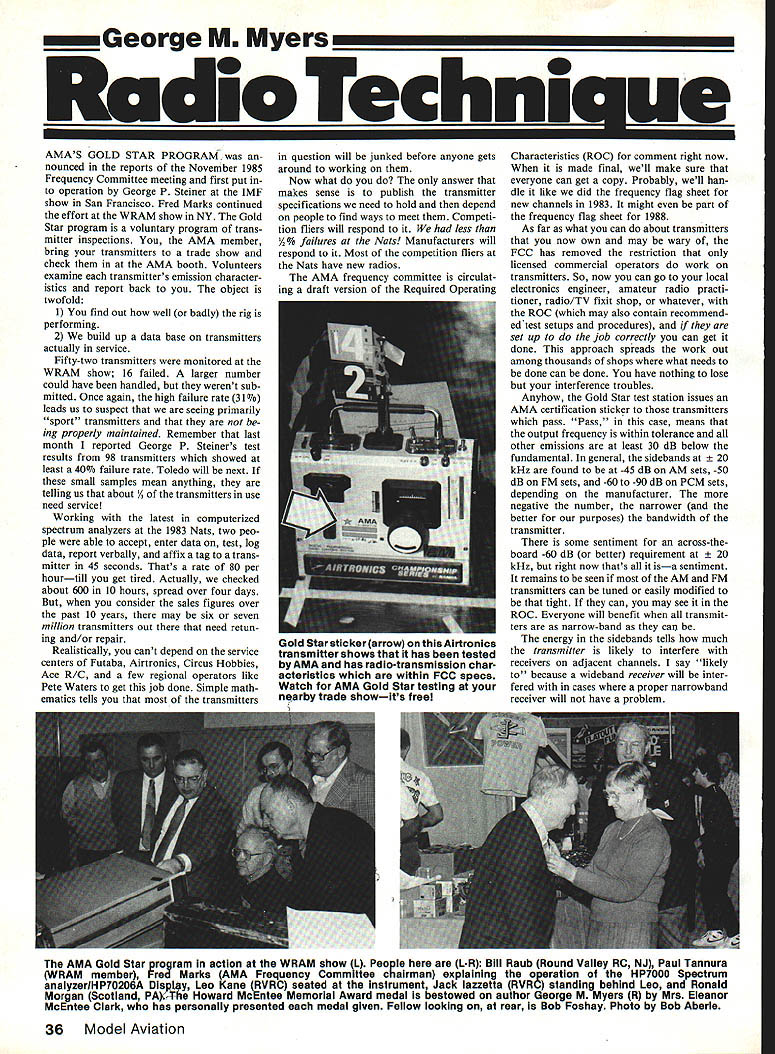
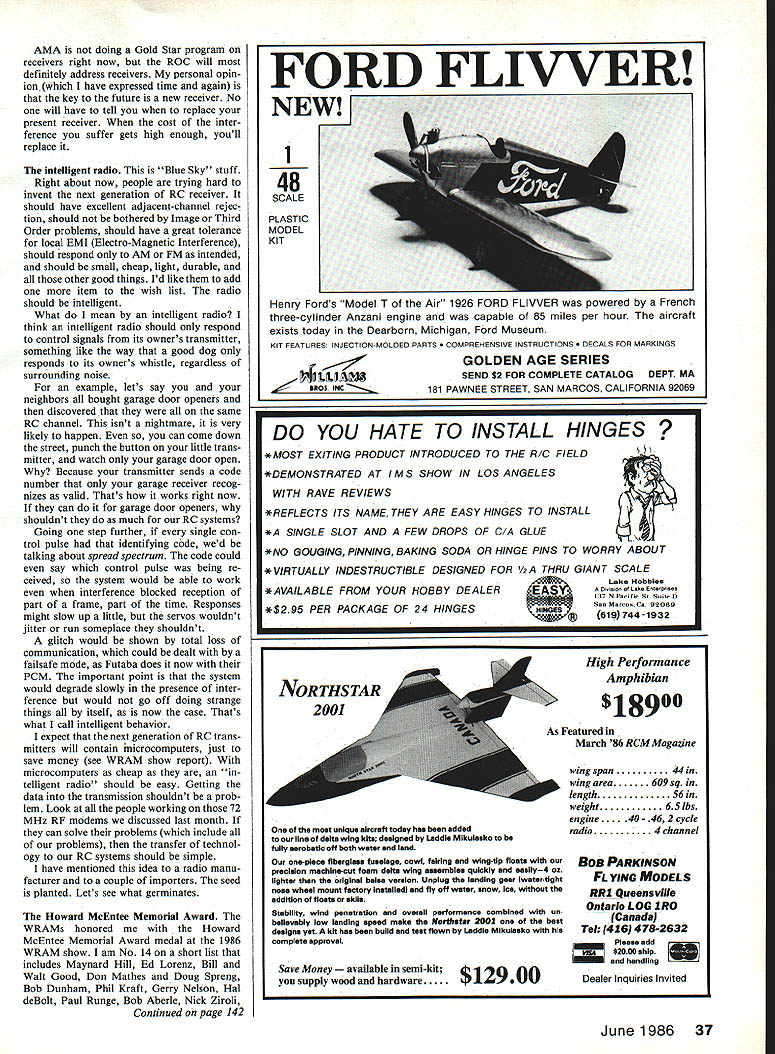
AMA's Gold Star program was announced in the reports of the November 1985 Frequency Committee meeting and first put into operation by George P. Steiner at the IMAC show in San Francisco. Fred Marks continued the effort at the WRAM show in New York. The Gold Star program is a voluntary program of transmitter inspections. You, the AMA members, bring your transmitters to a trade show and check them in at the AMA booth. Volunteers examine each transmitter's emission characteristics and report back to you. The object is twofold:
- You find out how well (or badly) the rig is performing.
- We build up a data base on transmitters actually in service.
Fifty-two transmitters were monitored at the WRAM show; 16 failed. A larger number could have been handled, but they weren't submitted. Once again, the high failure rate (31%) leads us to suspect that we are seeing primarily "sport" transmitters and that they are not being properly maintained. Remember that George P. Steiner's test results from 98 transmitters showed at least a 40% failure rate. Toledo will be next. If these small samples mean anything, they are telling us that about one-third of the transmitters in use need service.
Working with the latest computerized spectrum analyzers at the 1983 Nats, two people were able to accept, enter data on, test, log data, report verbally, and affix a tag to a transmitter in 45 seconds. That's a rate of 80 per hour—until you get tired. Actually, we checked about 600 in 10 hours, spread over four days. If you consider the sales figures over the past 10 years, there may be six or seven million transmitters out there that need retuning and/or repair. Realistically, you can't depend on the service centers of Futaba, Airtronics, Circus Hobbies, Ace R/C, and a few regional operators like Pete Waters to get this job done. Simple mathematics tells you that most of the transmitters in question will be junked before anyone gets around to working on them.
Now what do you do? The only answer that makes sense is to publish the transmitter specifications we need to hold and then depend on people to find ways to meet them. Competition fliers will respond to it. We had less than 1/2% failures at the Nats! Manufacturers will respond to it. Most of the competition fliers at the Nats have new radios.
The AMA Frequency Committee is circulating a draft version of the Required Operating Characteristics (ROC) for comment right now. When it is made final, we'll make sure that everyone can get a copy. Probably, we'll handle it like we did the frequency flag sheet for the new channels in 1983. It might even be part of the frequency flag sheet for 1988.
As far as what you can do about transmitters that you now own and may be wary of, the FCC has removed the restriction that only licensed commercial operators do work on transmitters. So now you can go to your local electronics engineer, amateur radio practitioner, radio/TV fix-it shop, or whatever, with the ROC (which may also contain recommended test setups and procedures), and if they are set up to do the job correctly you can get it done. This approach spreads the work out among thousands of shops where what needs to be done can be done. You have nothing to lose but your interference troubles.
The Gold Star test station issues an AMA certification sticker to those transmitters which pass. "Pass," in this case, means that the output frequency is within tolerance and all other emissions are at least 30 dB below the fundamental. In general, the sidebands at ±20 kHz are found to be at about -45 dB on AM sets, -50 dB on FM sets, and -60 to -90 dB on PCM sets, depending on the manufacturer. The more negative the number, the narrower (and the better for our purposes) the bandwidth of the transmitter. Some sentiment across the board calls for a -60 dB requirement at ±20 kHz, but right now that is sentiment only.
It remains to be seen if most of the AM and FM transmitters can be tuned or easily modified to meet that tight figure. If they can, you may see it in the ROC. Everyone will benefit when all transmitters are as narrow-band as reasonably possible.
The energy in the sidebands tells how much the transmitter is likely to interfere with receivers on adjacent channels. I say "likely" only because a wideband receiver will be interfered with in cases where a proper narrowband receiver will not have a problem.
The Intelligent Radio
Right about now, people are trying hard to invent the next generation of RC receiver. It should have excellent adjacent-channel rejection, should not be bothered by image or third-order problems, should have a great tolerance for local EMI (electromagnetic interference), should respond only to AM or FM as intended, and should be small, cheap, light, durable—everything on the wish list. I'd like them to add one more item: the radio should be intelligent.
What do I mean by an intelligent radio? I think an intelligent radio should only respond to control signals from its owner's transmitter, something like the way a good dog only responds to its owner's whistle, regardless of surrounding noise.
For example, suppose you and your neighbors all bought garage door openers and then discovered that they were all on the same RC channel. This isn't a nightmare; it is very likely to happen. Even so, you can come down the street, punch the button on your little transmitter, and watch only your garage door open. Why? Because your transmitter sends a code number that only your garage receiver recognizes as valid. That's how it works right now. If they can do it for garage door openers, why shouldn't they do as much for our RC systems?
Going one step further, if every single control pulse had that identifying code, we'd be talking about spread spectrum. The code could even say which control pulse was being received, so the system would be able to work even when interference blocked reception of part of a frame, part of the time. Responses might slow up a little, but the servos wouldn't jitter or run someplace they shouldn't.
A glitch would be shown by total loss of communication, which could be dealt with by a failsafe mode, as Futaba does now with their PCM. The important point is that the system would degrade slowly in the presence of interference but would not go off doing strange things all by itself, as is now the case. That's what I call intelligent behavior.
I expect that the next generation of RC transmitters will contain microcomputers, just to save money (see WRAM show report). With microcomputers as cheap as they are, an "intelligent radio" should be easy. Getting the data into the transmission shouldn't be a problem. Look at all the people working on those 72 MHz RF modems we discussed last month. If they can solve their problems (which include all of our problems), then the transfer of technology to our RC systems should be simple.
I have mentioned this idea to a radio manufacturer and to a couple of importers. The seed is planted. Let's see what germinates.
The Howard McEntee Memorial Award
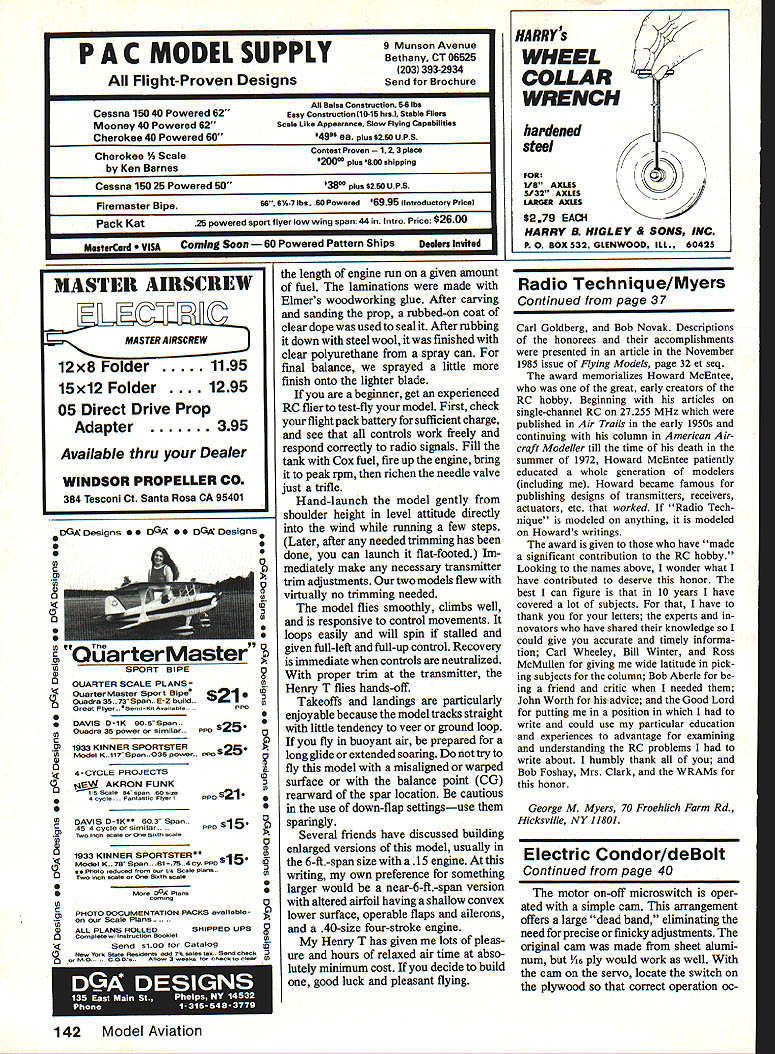
The WRAMs honored me with the Howard McEntee Memorial Award medal at the 1986 WRAM show. I am No. 14 on a short list that includes Maynard Hill, Ed Lorenz, Bill and Walt Good, Don Mathes and Doug Spreng, Bob Dunham, Phil Kraft, Gerry Nelson, Hal deBolt, Paul Runge, Bob Aberle, Nick Ziroli, Carl Goldberg, and Bob Novak. Descriptions of the honorees and their accomplishments were presented in an article in the November 1985 issue of Flying Models (page 32 et seq.).
The award memorializes Howard McEntee, who was one of the great early creators of the RC hobby. Beginning with his articles on single-channel RC on 27.255 MHz published in Air Trails in the early 1950s and continuing with his column in American Aircraft Modeller until his death in the summer of 1972, Howard McEntee patiently educated a whole generation of modelers (including me). Howard became famous for publishing designs of transmitters, receivers, actuators, etc. that worked. If "Radio Technique" is modeled on anything, it is modeled on Howard's writings.
The award is given to those who have "made a significant contribution to the RC hobby." Looking at the names above, I wonder what I have contributed to deserve this honor. The best I can figure is that in 10 years I have covered a lot of subjects. For that, I have to thank you for your letters; the experts and innovators who have shared their knowledge so I could give you accurate and timely information; Carl Wheeler, Bill Winter, and Ross McMullen for giving me latitude in picking subjects for the column; Bob Aberle for being a friend and critic when I needed him; John Worth for his considerable help in getting me in a position in which I had to write and could use my particular education and experience to advantage for the magazine and for the RC problems I had to write about. I humbly thank all of you; and Bob Foshay, Mrs. Clark, and the WRAMs for the honor.
George M. Myers 70 Froehlich Farm Rd. Hicksville, NY 11801
Transcribed from original scans by AI. Minor OCR errors may remain.

