
George M. Myers
Radio Technique
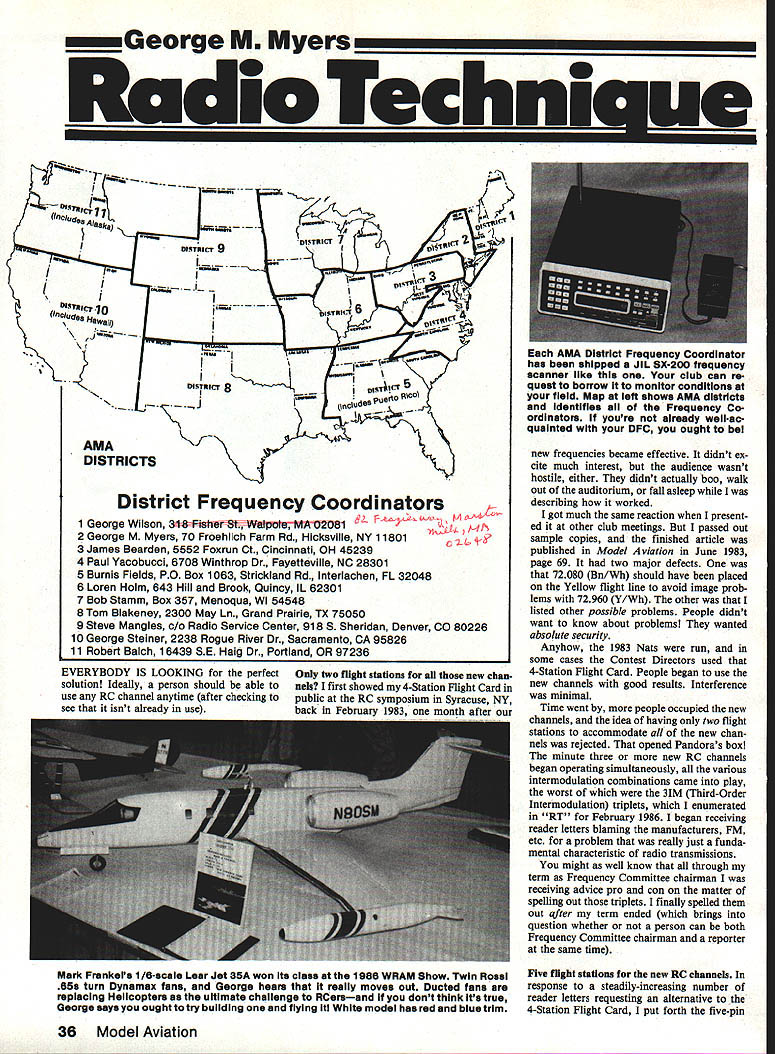
District Frequency Coordinators
- George Wilson, 318 Fisher St., Walpole, MA 02081
- George M. Myers, 70 Froehlich Farm Rd., Hicksville, NY 11801
- James Bearden, 5552 Foxrun Ct., Cincinnati, OH 45239
- Paul Yacobucci, 6708 Winthrop Dr., Fayetteville, NC 28301
- Burnis Fields, P.O. Box 1063, Strickland Rd., Interlachen, FL 32048
- Loren Holm, 643 Hill Brook, Quincy, IL 62301
- Bob Stamm, Box 357, Minocqua, WI 54548
- Tom Blakeney, 2300 May Ln., Grand Prairie, TX 75050
- Steve Mangles, c/o Radio Service Center, 918 S. Sheridan, Denver, CO 80226
- George Steiner, 2238 Rogue River Dr., Sacramento, CA 95826
- Robert Balch, 16439 SE Haig Dr., Portland, OR 97236
Everybody is looking for the perfect solution! Ideally, a person should be able to use any RC channel anytime (after checking to see that it isn't already in use).
Only two flight stations for all those new channels? I first showed my 4-Station Flight Card in public at the RC symposium in Syracuse, NY, in February 1983, one month after our new frequencies became effective. It didn't excite much interest, but the audience wasn't hostile, either. They didn't actually boo, walk out of the auditorium, or fall asleep while I was describing how it worked.
I got much the same reaction when I presented it at other club meetings. But I passed out sample copies, and the finished article was published in Model Aviation in June 1983, page 69. It had two major defects. One was that 72.080 (Bn/Wh) should have been placed on the Yellow flight line to avoid image problems. The other was that 72.960 (Y/Wh) was listed incorrectly, leading to other possible problems. People didn't want to know about problems; they wanted absolute security.
Anyhow, the 1983 Nats were run, and in some cases the Contest Directors used the 4-Station Flight Card. People began to use the new channels with good results. Interference was minimal.
Time went by, more people occupied the new channels, and the idea of having only two flight stations to accommodate all of the new channels was rejected. That opened Pandora's box! The minute three or more new RC channels began operating simultaneously, all the various intermodulation combinations came into play, the worst of which were the 3IM (Third-Order Intermodulation) triplets, which I enumerated in "RT" for February 1986. I began receiving reader letters blaming the manufacturers, FM, etc., for a problem that was really just a fundamental characteristic of radio transmissions.
You might as well know that all through my term as Frequency Committee chairman I was receiving advice pro and con on the matter of spelling out those triplets. I finally spelled them out after my term ended (which brings up the question whether or not a person can be both Frequency Committee chairman and a reporter at the same time).
Five flight stations for the new RC channels
In response to a steadily increasing number of reader letters requesting an alternative to the 4-Station Flight Card, I put forth the five-pin grouping published in July 1985 (page 34). It wasn't perfect either, but responses from people who used it were good. I have letters that indicate hundreds of flights with no interference problems. If you look, you can find that I missed a couple of 3IM triplets.
More flight stations than that
People wanted still more flight stations. I received a couple of letters from people operating at Mile Square in Los Angeles. I've never seen Mile Square but have spoken with people who have flown there. (Somebody should do a video on the place.) Anyhow, I showed, in the February 1986 column, how you could make up any number of flight line groupings taking into account those triplets. The simple way to calculate which channels are at risk goes like this:
- Double the channel number of any operating transmitter (e.g., RC46 is operating, so you calculate 2 × 46 = 92).
- Subtract the channel number of any other operating transmitter (e.g., RC44 is operating, too, so you calculate 92 − 44 = 48).
- What's left is the channel number of the receiver which might be affected by 3IM; in this case RC48.
(Thanks to Fred Marks, current Frequency Committee chairman, for the simple calculation method.)
ALTECH Marketing is the name!
Apologies are due because of a slipup in last month's WRAM Show article. The wrong importer was credited with providing the Simpson PCM-20 RC system and Acorn wheel radio for surface models. ALTECH Marketing is the source for these products in the U.S. Also, the price the Acorn wheel radio should have been given as $164.95.
Third-Order Intermodulation (3IM)
I'd like to make a point about Third-Order Intermodulation (3IM). It can take place within transmitters which are too close together (inches apart). Solution: separate them a little (a couple of feet).
It can also take place within the mixer stage of a receiver. When that happens, there can be a 3IM product signal directly on your channel, as demonstrated above. However, the power of that 3IM product will usually be only −30 dB (1/1,000th of the power of the foreign transmitter's signals). Now the only way such a weak signal can hurt you is if the signal from your transmitter becomes small enough to permit interference. Since receiver power falls off as the square of the distance between the transmitter and receiver, the distance factor is simple: don't let the interferers get closer to your receiver than your transmitter is.
The whole point of the M-factor (January 1986 "RT") is that it is a multiplier. If you see that your type of receiver has an M of 3.0 for 3IM, then you can expect trouble every time your transmitter is three times farther from your receiver than the interfering pair is. Solution to 3IM problems: stand close to the interferers (20 feet) and don't fly over their antennas.
With any luck at all the whole question will go away soon. Good transmitter design can practically eliminate transmitter 3IM. Good receiver design can reduce mixer-generated 3IM products to very low levels. The AMA Frequency Committee can generate the ROC (Required Operating Characteristics), and if the ROC has the desired effect, then by 1988 (or shortly thereafter) it should be possible to fly any combination of channels without concerning ourselves with image, second- or third-order intermodulation, adjacent-channel, or other interferences.
What do you do about known interference?
I am not a lawyer and cannot give legal advice. But that doesn't stop me from having opinions. The issue now is interference. What can a Contest Director do about a person who shows up at a contest and insists on flying on an RC channel known to be subject to outside interference?
- You can refuse to admit the person to the contest. The AMA Official Model Aircraft Regulations, 1986–1987, page 1, Contest Directors Authority, state: "In addition, the CD at an AMA-sanctioned event has the authority to perform safety inspections of any equipment and to prevent any participant from using equipment which, in the CD's opinion, is deemed unsafe." (Emphasis added.) It doesn't say that the CD must perform any safety inspections. It doesn't even say that the CD's opinion has to be correct. It only says that the CD has to be of the opinion that the equipment is unsafe.
- Suppose the person insists on flying anyway, not as a contestant, but as a private citizen using the same field? What could the CD do? He might call for the police to have the person ejected or arrested as a disorderly person. That approach isn't calculated to make many friends, and who needs more enemies?
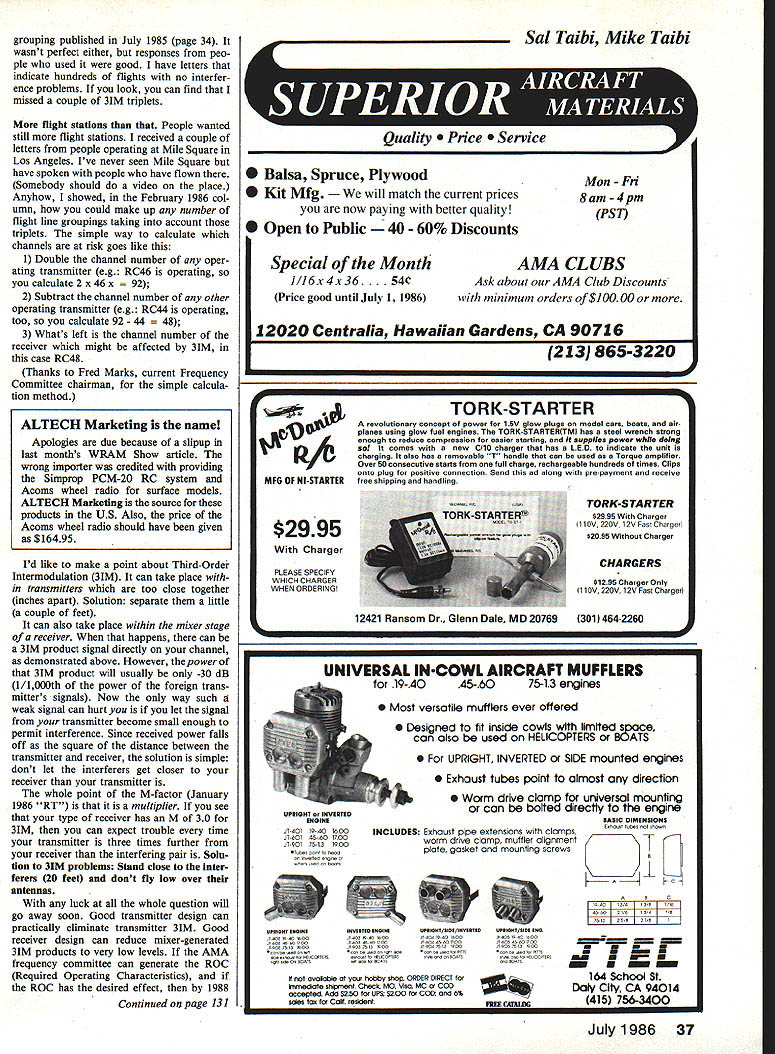
- There is another way. For instance, you may have borrowed the district's frequency scanner (see the photo) or bought one of your own. In that case all you need do is tune the scanner and let your problem child listen. Then he can be made aware of the problem.
Over the years, I've talked a lot about scanners. To be of any value, someone has to listen to them. The best time to listen is the time when people will be flying! That should be obvious, but a surprising number of people seem to miss the point. Businesses that are on the air during the week will often shut down for weekends and holidays as well as at night. So if you do all your monitoring after 11:00 p.m. (because it is convenient for you), it just may be that you will miss the signals you are looking for.
In the same vein, a scanner on the flight line is mainly useful for four things:
- Verifying the channel a transmitter radiates on. Does the flag match?
- Verifying channels in use. Do the pins match?
- Finding transmitters left on in the impound area.
- Catching two transmitters operating on one channel.
If you want to scan for outside interference in the vicinity of the flight line, the best way to do it is to put the scanner in your car, or attach it to an outside antenna, and drive around the perimeter of the field with the scanner turned on. Plan your route to stay a mile or so away from the flight line to minimize interference from transmitters in use there. That is what Bill Hershberger and I did at the '85 Nats, and we found a new pocket pager on 72.320 MHz.
I almost forgot to say that you should know what you are looking for. An easy way to get that information is to perform some tests. Have people operate AM, FM, and PCM sets for you on known channels so you can become accustomed to the sound. Make sure that you listen in both the AM and FM detector modes, because it makes a difference. You may be surprised to discover that some RC "FM" sets make clearer sounds when the scanner is put in the AM mode. On the other hand, the tones of a pocket pager will almost always sound mushy on AM but be perfectly clear on FM.
Contact your District Frequency Coordinator for information and the loan of a scanner. His name will be found in the AMA News section, right under your District VP's name and picture. You don't know what district you are in? Look for your state listed above the VP columns in AMA News.
George M. Myers 70 Froehlich Farm Rd., Hicksville, NY 11801
Transcribed from original scans by AI. Minor OCR errors may remain.

