
Radio Technique
George M. Myers
NEW TOOL
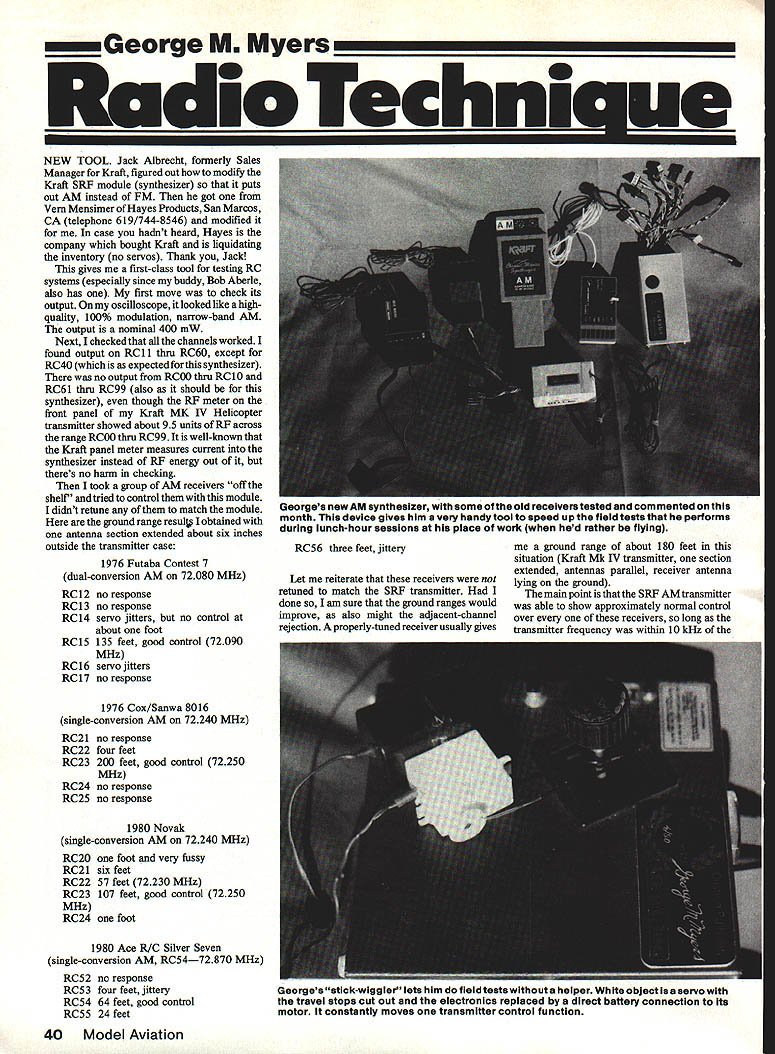
Jack Albrecht, formerly Sales Manager for Kraft, figured out how to modify the Kraft SRF module (synthesizer) so that it puts out AM instead of FM. He obtained a unit from Vern Mensimer of Hayes Products, San Marcos, CA (telephone 619/744-8546) and modified it for me. Hayes is the company that bought Kraft and is liquidating the inventory (no servos). Thank you, Jack!
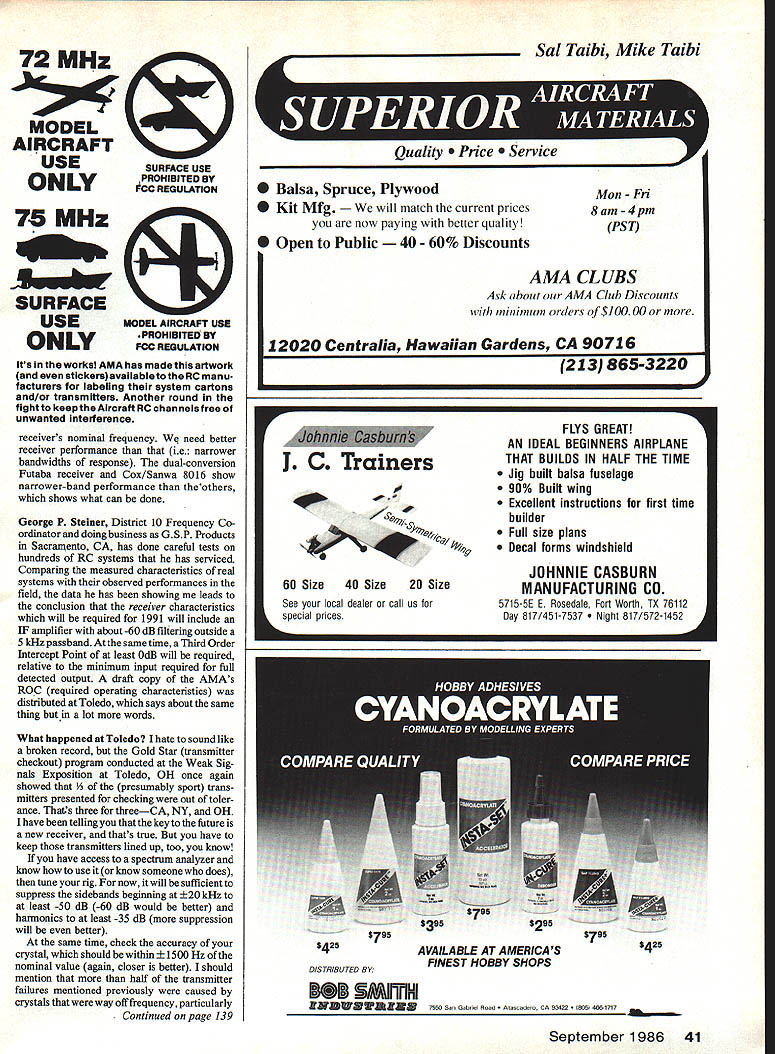
This gives me a first-class tool for testing RC systems (especially since my buddy Bob Aberle also has one). On my oscilloscope the output looked like a high-quality, 100% modulation, narrow-band AM. The output is a nominal 400 mW.
I checked that all channels worked. I found output on RC11 through RC60, except for RC40 (which is as expected for this synthesizer). There was no output from RC00 through RC10 and RC61 through RC99 (also as it should be for this synthesizer), even though the RF meter on the front panel of my Kraft MK IV helicopter transmitter showed about 9.5 units of RF across the range RC00 through RC99. It is well known that the Kraft panel meter measures current into the synthesizer instead of RF energy out of it, but there's no harm in checking.
Then I took a group of AM receivers "off the shelf" and tried to control them with this module. I did not retune any of them to match the module. With one antenna section extended about six inches outside the transmitter case, here are the ground range results with the receiver antenna lying on the ground:
1976 Futaba Contest 7
(dual-conversion AM on 72.080 MHz)
- RC12: no response
- RC13: no response
- RC14: servo jitters, but no control at about one foot
- RC15: 135 feet, good control (72.090 MHz)
- RC16: servo jitters
- RC17: no response
1976 Cox/Sanwa 8016
(single-conversion AM on 72.240 MHz)
- RC21: no response
- RC22: four feet
- RC23: 200 feet, good control (72.250 MHz)
- RC24: no response
- RC25: no response
1980 Novak
(single-conversion AM on 72.240 MHz)
- RC20: one foot and very fussy
- RC21: six feet
- RC22: 57 feet (72.230 MHz)
- RC23: 107 feet, good control (72.250 MHz)
- RC24: one foot
1980 Ace R/C Silver Seven
(single-conversion AM, RC54 — 72.870 MHz)
- RC52: no response
- RC53: four feet, jittery
- RC54: 64 feet, good control
- RC55: 24 feet
- RC56: three feet, jittery
I reiterate that these receivers were not retuned to match the SRF transmitter. Had I done so, ground ranges would almost certainly improve, as might adjacent-channel rejection. A properly tuned receiver usually gives me a ground range of about 180 feet in this situation (Kraft MK IV transmitter, one section extended, antennas parallel, receiver antenna lying on the ground).
The main point is that the SRF AM transmitter was able to show approximately normal control over every one of these receivers so long as the transmitter frequency was within about 10 kHz of the receiver's nominal frequency. We need better receiver performance than that — i.e., narrower bandwidths of response. The dual-conversion Futaba receiver and the Cox/Sanwa 8016 show narrower-band performance than the others, which illustrates what can be done.
George P. Steiner, District 10 Frequency Coordinator (doing business as G.S.P. Products, Sacramento, CA), has done careful tests on hundreds of RC systems he has serviced. Comparing measured characteristics of real systems with their observed field performances leads me to conclude that the receiver characteristics required for 1991 will include:
- An IF amplifier with about -60 dB filtering outside a 5 kHz passband.
- A Third Order Intercept Point of at least 0 dB relative to the minimum input required for full detected output.
A draft copy of the AMA's ROC (required operating characteristics) being distributed at Toledo says about the same thing but in more words.
Toledo and transmitter checks
What happened at Toledo? The Gold Star (transmitter checkout) program conducted at the Weak Signals Exposition in Toledo, OH once again showed that one third of the (presumably) sport transmitters presented for checking were out of tolerance. That's three of three—CA, NY and OH.
I have been telling you that the future is a better receiver; that's true. But you have to keep those transmitters lined up, too. If you have access to a spectrum analyzer and know how to use it (or know someone who does), tune your rig. For now, it will be sufficient to:
- Suppress the sidebands beginning at ±20 kHz to at least -50 dB (−60 dB would be better).
- Suppress harmonics to at least -35 dB (more suppression is even better).
Also check the accuracy of your crystal, which should be within ±1500 Hz of the assigned nominal value (closer is better). More than half of the transmitter failures mentioned previously were caused by crystals that were way off frequency, particularly in the old even-numbered frequencies.
A look at my Cox/Sanwa 8016 test results above should convince you that that receiver (and by implication, its matched transmitter) must be considerably off frequency to respond so well to a signal 10 kHz away from the crystal's nominal value. Crystals with an accuracy of 0.001% (±725 Hz) are easily obtainable today (most transmitters with plug-in crystals use them), so fixing this part of the problem should be quite easy.
Frequency meeting and scanners
A meeting of hobby and industry representatives was called at Toledo by Frequency Committee Chairman Fred Marks to discuss the problem of "crossover" users — specifically car and boat operators using aircraft frequencies. One thing revealed by the meeting: we aren't the only ones upset by misuse of frequencies. Several useful suggestions were developed, and it was obvious that major sales outlets want to cooperate in a program to educate (and, it is hoped, control) abusers of the RC operating privilege. Expect to start seeing labels on transmitters specifying what they are to be used for (surface-only or aircraft-only).
About those scanners: the July issue has only been out for a couple of weeks, and I have been swamped with calls about scanners. Please contact your District Frequency Coordinator to borrow the scanner assigned to your AMA district. You can learn a lot that way.
While on the subject, take out the July 1986 issue of Model Aviation, turn to page 36, and correct George Wilson's address to:
- 82 Frazier Way, Marstons Mills, MA 02648.
Believe it or not, two of my calls came because he had moved from the published address.
RF modems (ESTeem)
Recently I received a package of literature from G. F. Vargo, VP Engineering at EST, Kennewick, WA 99336, manufacturers of the ESTeem wireless modem. Mr. Vargo explains that the ESTeem Wireless Modem is "licensed under Part 90, Subpart K of FCC regulations" and is "the only RF modem on the market" that he is aware of. Furthermore, the ESTeem modem "utilizes a digital phase lock loop in conjunction with an adaptive frequency generator. The frequencies start at 72.040 and continue to 72.960 in 40 kHz steps."
From the ESTeem brochure I gleaned that the receiver runs on 12 VDC, uses dual conversion, and has a sensitivity of five microvolts. A press release in another magazine had quoted as fact that ESTeem used both odd- and even-numbered RC frequencies, which I doubted (May 1986) could be the case. Mr. Vargo's letter continues: "To insure that modem users are aware of the possible conflict with the RC modeler, a note stating this fact is displayed on the transmitter and receiver frequency-select charts in the ESTeem Operating Manual, encouraging the non-usage of the (6) RC frequencies." A copy of that page of the manual was included, and the shared channels are marked, exactly as he claims.
"ESTeem frequencies are interstitial to the RC frequencies," he continues. "This device was approved by the FCC in July 1985 through normal channels. There was no intent then, there is no intent now, nor will there ever be an intent to infringe on the frequencies used by the RC modeler."
Mr. Vargo listed his long history in AMA, including posts as Contest Director and Past President of the Tri-City RC Modelers. He also included correspondence with Carl Maroney, Special Services Director for AMA, in which he states: "We at ESTeem understand the importance of RC modeling to the individual and to the community. We stand behind the AMA and its endeavors to the modeling society. EST will cooperate in any way we can for a mutual benefit in safely sharing America's air waves."
I thank Mr. Vargo for the information and for his concern with avoiding RFI on the RC channels. I hope other RF modem manufacturers will show as much concern for avoiding interference with RC channels.
George M. Myers 70 Froehlich Farm Rd. Hicksville, NY 11801
Transcribed from original scans by AI. Minor OCR errors may remain.

