
Radio Technique
George M. Myers
Question of the Day
How do we improve interference resistance?
Some people believe that we have more interference today than we had 10 years ago. Well, they are wrong! We actually have a lot less interference than before. We also have more people trying to use fewer flying fields, which pushes us closer together and makes modeler-to-modeler interference more noticeable.
Ten years ago we had seven RC channels on 72 and 75 MHz. Four were assigned to Aircraft Only, and three were shared with cars and boats. All channels were shared with other services. Given today's explosion of interest in RC cars and boats of all kinds, what sort of interference do you suppose we'd have if the old situation had continued?
More significantly, there has been a tremendous increase in non-hobby users on the "even-numbered" frequencies (72.080, 72.240, etc.) which we must "share" with them until 1988. The fundamental issue of our petition to the FCC for new channels was that the concept of sharing was made ridiculous when "they" were permitted 300-watt transmitters and antennas located 1,000 feet above ground, while "we" were restricted to 3/4 watt and a hand-held, 1/4-wave whip antenna. The FCC listened to our argument and agreed. We got a bonanza.
AMA critics ignore these facts
- The FCC gave us exclusive use of the new odd-frequency channels (72.01 thru 72.99 MHz). We still have that exclusivity, which means that every non-hobby RC user is excluded, and that all hobby transmitters on the new RC channels must radiate approximately the same level of power from similar antennas. That situation defines less interference.
- The AMA gave us a Phase-In Plan that created a controlled environment in which continued use of existing equipment was protected while a market for improved equipment was provided. The Phase-In Plan prevented many kinds of interference that would have occurred if we had moved immediately from the old channels spaced at 80 kHz to the new ones spaced at 20 kHz.
- The place where interference-resistance hasn't changed much is 3IM (third-order intermodulation). What we have now is what we had before. But with more channels to choose from, we have more opportunities for 3IM, and that is a consequence of the uniform channel spacing.
Supporting the bonanza
Right from the beginning we knew that some of the new channels would be unusable. We also knew that better receivers were required to take best advantage of what we had been given. RC system manufacturers jumped into the market created by the AMA Phase-In Plan with packages offering features not even dreamed of a few years before. They might have done so even without the new RC channels.
Some new systems were pretty bad. Others were very good. For a good example, my low-priced 1983 Tower Gold 500 transmitter is part of a very early "new" system. Yet it passed the AMA tests with each and every one of its plug-in crystals (RC12, RC40, RC50, RC56). That's better performance than anyone expected, and it illustrates the point that satisfactory transmitters are easier to obtain than are satisfactory receivers.
Some systems reached the market in the period 1983–1986 with worse receivers than we had before. The vendors usually worked hard to replace them. During the same period, some very advanced receivers also appeared. We now have PCM systems and the Kraft Channel Max synthesized-RF equipment (although Kraft itself is gone).
Just this week we tested a prototype receiver which shows the best performance we've ever seen. If it survives the transition into production, you will be able to buy a medium-priced, high-performance system (transmitter and receiver) in 1987.
Reducing interference by way of careful channel selections
Time and again, the detractors delight in reciting "We don't need 50 channels because there's no way we can use 50 channels simultaneously." Baloney! We could have used all of them beginning with the worst of yesterday's radios. All we'd have had to do was break up the 50 channels into appropriate groups, each group to be used at only one flying field. By keeping the flying fields about a mile apart and observing the frequency assignments carefully, there wouldn't have been any interference — either 3IM or other kinds.
It is possible right now to fly Pattern, Pylon, Scale, and Helicopters simultaneously at the same Nats site. All that is needed is preassignment of RC channels. Here's how it could be done: no 3IM or image at any airport, 80-kHz channel separation, and using any number of channels assigned to an airport without restrictions on combinations.
- Pattern airport: RC12, 17, 21, 28, 32, 37, 41, 47, 51, 56, 60
- Sailplane airport: RC11, 16, 20, 27, 31, 36, 40, 46, 50, 55, 59
- Pylon airport: RC15, 19, 26, 30, 35, 39, 45, 49, 54, 58
- Helicopter airport: RC14, 18, 25, 29, 34, 38, 44, 48
We have to thank Owen S. Black out there in Carmichael, CA for the scheme that produced these assignments. Owen is the first person that I know of who figured the way to avoid 3IM and keep an 80-kHz minimum spacing to accommodate continued use of old radios. To get these benefits, we have to avoid using eight of our channels: RC13, 22, 23, 24, 33, 42, 43, and 52, and somehow arrange that only specific RC channels be used at specific locations.
How likely is it that people will observe those restrictions to make it safer for all? Would the competition fliers accept preassigned channels? They do now, essentially. Would sport fliers select a group of preassigned frequencies for their airport and observe the restrictions voluntarily? Not likely! We're talking self-discipline here. That's why the AMA is keeping the pressure on the manufacturers to come up with radio systems that don't need this kind of protection. Most new systems work very well at 20-kHz spacing, and the best of the new receivers are showing some improved 3IM resistance.
Now let's look at some of the "facts of life" in the RC business:
- No matter how good the RC systems are, and no matter how carefully people observe the above restrictions, there still will be interference when two people try to use the same frequency at the same time.
- When the one system you have stops working, your plane is out of control.
Reducing interference by means of redundancy
Redundant-channel usage
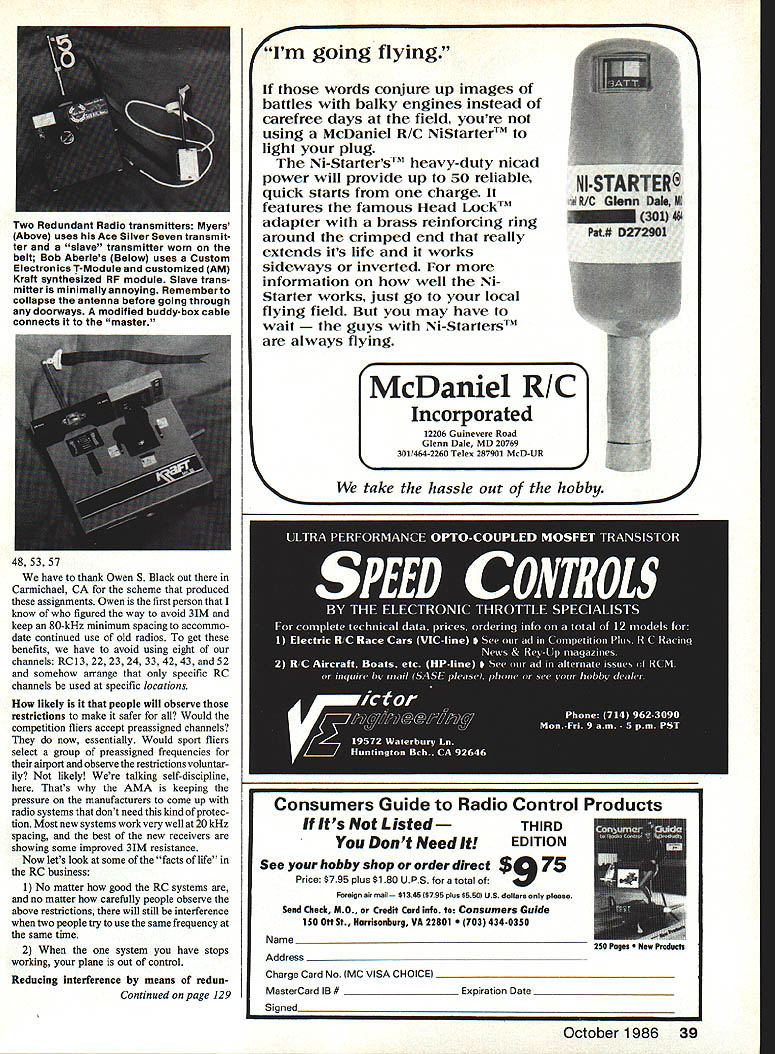
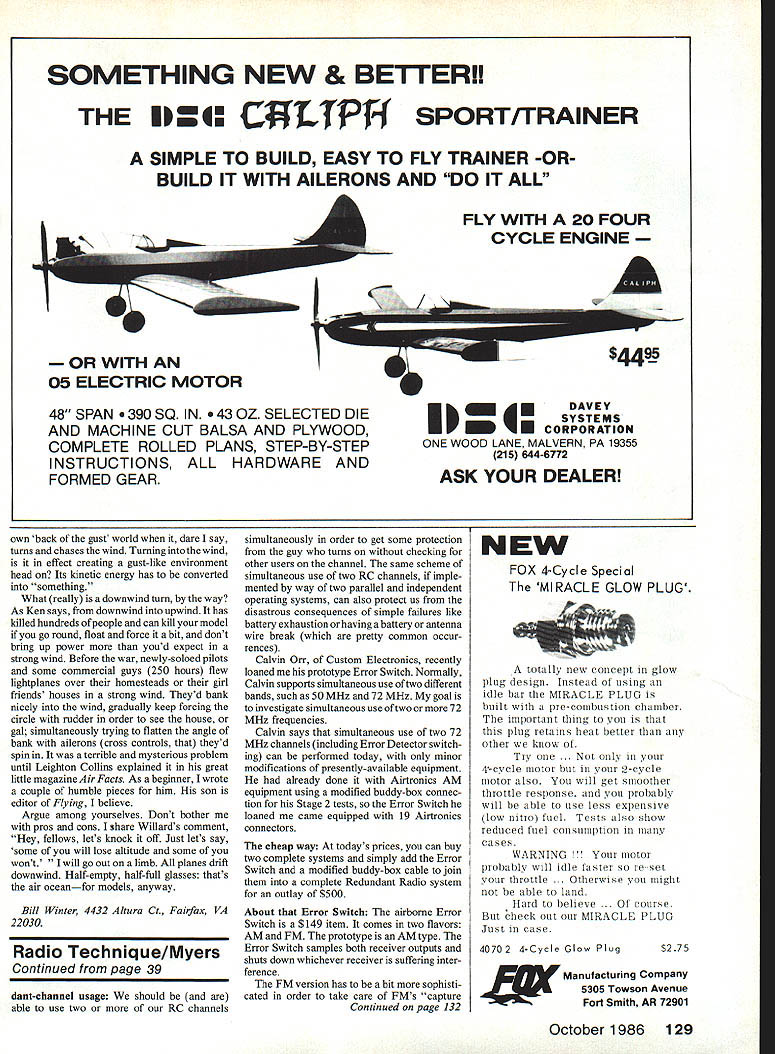
We should be (and are) able to use two or more of our RC channels simultaneously in order to get some protection from the guy who turns on without checking for other users on the channel. The same scheme of simultaneous use of two RC channels, if implemented by way of two parallel and independent operating systems, can also protect us from the disastrous consequences of simple failures like battery exhaustion or having a battery or antenna wire break (which are pretty common occurrences).
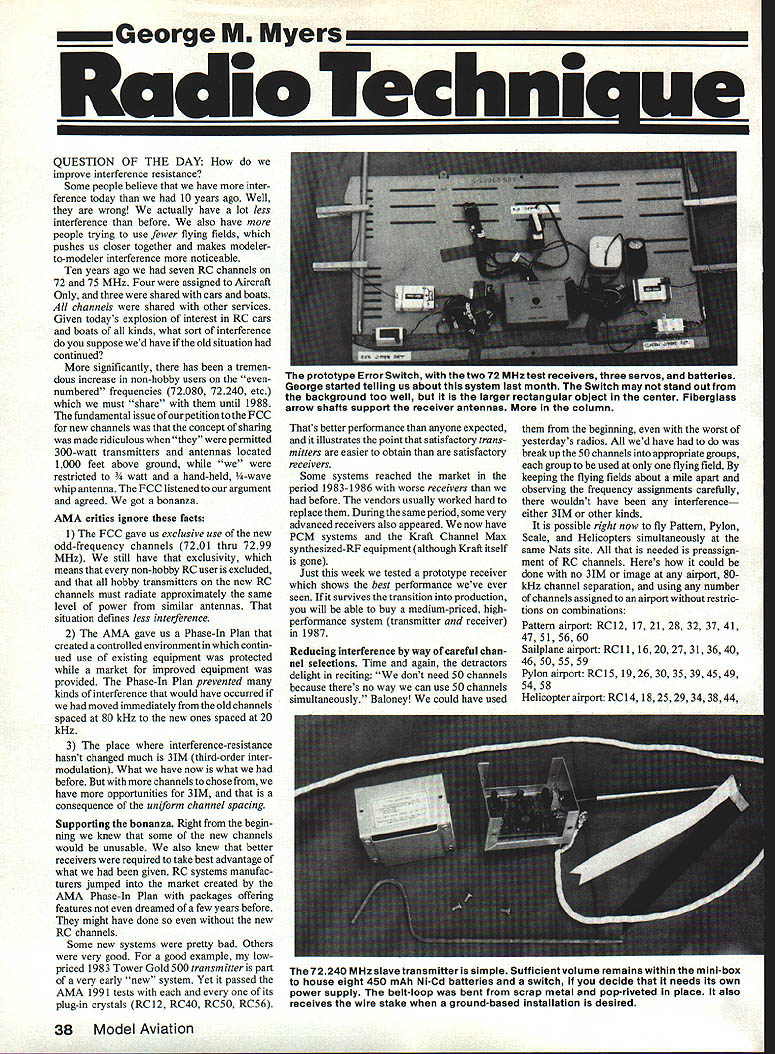
Calvin Orr, of Custom Electronics, recently loaned me his prototype Error Switch. Normally, Calvin supports simultaneous use of two different bands, such as 50 MHz and 72 MHz. My goal is to investigate simultaneous use of two or more 72 MHz frequencies.
Calvin says that simultaneous use of two 72 MHz channels (including Error Detector switching) can be performed today, with only minor modifications of presently-available equipment. He had already done it with Airtronics AM equipment using a modified buddy-box connector for his Stage 2 tests, so the Error Switch was loaned to me complete with 19 Airtronics connectors.
At today's prices, you can buy two complete systems and simply add the Error Switch and a modified buddy-box cable to join them into a complete Redundant Radio system for about $500.
About that Error Switch
The airborne Error Switch is a $149 item. It comes in two flavors: AM and FM. The prototype is an AM-type. The Error Switch samples both receiver outputs and shuts down whichever receiver is suffering interference.
The FM version has to be a bit more sophisticated in order to take care of FM's capture-ratio problems. Capture ratio refers to the characteristic of FM receivers which allows them to switch their allegiance to the strongest transmitter in the vicinity. With FM (and without a Redundant Radio system), it is possible (rare, but possible) for someone operating in the vicinity on your channel to take control of your airplane when his signal is stronger to the receiver than your signal is. When you are flying a Redundant Radio system to gain freedom from interference, having half your system captured by a foreign transmitter doesn't help, so the FM Error Switch has to deal with that possibility.
The tests
Using an oscilloscope, I set up the Error Switch to my transmitter as instructed. Then I ran a few tests.
- The two receivers attached to the Error Switch are attached via a Red port and a Green port. An LED in the center of the device indicates which system is the source of the signals being used to control the servo. With both transmitters working (Green on 72.790 MHz — RC50, and Red on "old" 72.240 MHz), the servo worked normally, and the Error Switch usually showed that the Green system was in control.
- When I turned off the Green transmitter, the LED indicated that the Red system (72.240 MHz) was in use, and the servo acted normally.
- When I turned off the Red transmitter, the LED indicated that the Green system was in use, and the servo acted normally.
- When I turned off both transmitters, the LED indicated that the Red system was selected, but (of course) the servo did nothing.
- With both transmitters operating, I turned on another RC50 (Green) transmitter. The LED flickered Green and Red and the servo continued to respond to control inputs, but it also exhibited some jitter. The oscilloscope showed that pulses from the Green port were erratic in timing and pulse widths. Red pulses looked normal. I reset the timing of the Error Switch to get a solid switch to Red, with no jitters.
- Continuing the interference, I turned off the Red transmitter. The LED indicated that the Green system was selected, and the servo continued to respond to the Green system, though in a jittery fashion. This makes good sense. It's better to have some control jitters than to switch to a dead channel.
As you can easily see, addition of the redundant radio made the dual system almost "bullet-proof." However, using two 72 MHz channels leaves us vulnerable to the same defect mentioned earlier when we discussed splitting channels into groups so they could be used at specific locations — you can't be sure that everyone will cooperate with the system and use the right channel at the right location.
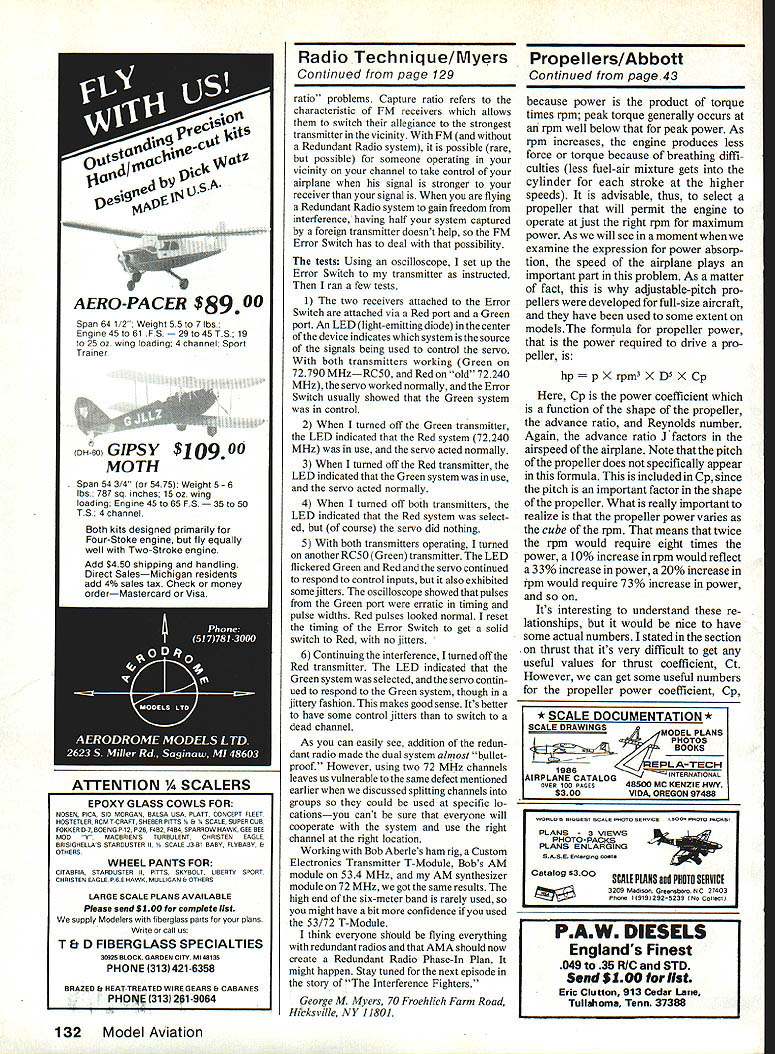
Working with Bob Abele's ham rig, a Custom Electronics Transmitter T-Module, Bob's AM module on 53.4 MHz, and my AM synthesizer module on 72 MHz, we got the same results. The high end of the six-meter band is rarely used so you might have a bit more confidence if you used the 53/72 T-Module.
I think everyone should be flying everything with redundant radios and that AMA should now create a Redundant Radio Phase-In Plan. It might happen. Stay tuned for the next episode in the story of "The Interference Fighters."
George M. Myers 70 Froehlich Farm Road, Hicksville, NY 11801.
Transcribed from original scans by AI. Minor OCR errors may remain.

