
George M. Myers
Radio Technique
Interference-free group
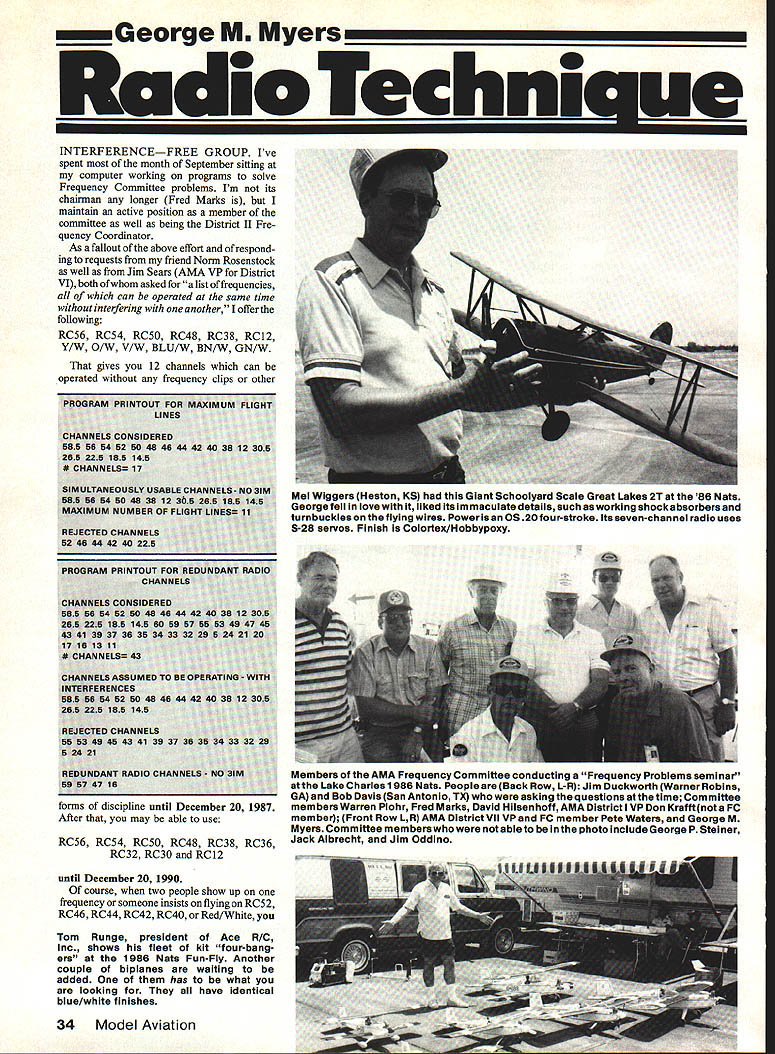
I've spent most of September working on programs to solve Frequency Committee problems. I'm no longer the committee chairman (Fred Marks is), but I remain an active member and serve as District II Frequency Coordinator.
In response to requests for "a list of frequencies, all of which can be operated at the same time without interfering with one another," I offer the following interference-free group (good until December 20, 1987):
- RC56, RC54, RC50, RC48, RC38, RC12, Y/W, O/W, V/W, BLU/W, BN/W, GN/W
After December 20, 1987 you may be able to use the following until December 20, 1990:
- RC56, RC54, RC50, RC48, RC38, RC36, RC32, RC30, RC12
What the Frequency Committee decided
An important decision made at the August 5, 1986 meeting requires narrow-band characteristics for equipment used on RC channels below RC38 beginning in 1988. This will be implemented by four actions:
- AMA wants to convert old sets still using the old channels (BN/W, BLU/W, R/W, V/W, O/W, Y/W, GN/W) to RC channels RC38 and above. Plenty of people already have done so.
- AMA will activate the even-numbered RC channels RC12 through RC36 (narrow-band radio) for use in sanctioned competition beginning January 1, 1988. Precise channel numbers are still being debated; write for information. Remember these channels will require narrow-band equipment — don’t try to cheat by crystal-swapping wideband gear.
- The AMA will retain the following "wide-band" channels for sanctioned competition: RC12, RC38, RC40, RC42, RC44, RC46, RC48, RC50, RC52, RC54, RC56; 26.995, 27.045, 27.095, 27.145, 27.195, 27.255 (not recommended); 33.773 and 33.8 MHz; and the 49 MHz channels for auxiliary functions like thermal sniffers.
- RC importers/manufacturers will cooperate by supplying only soldered-in crystals for the new RC channel assignments — or, where exchangeable crystals are used, only in packages suitable for narrow-band receivers that conform to the AMA guidelines (the guidelines will be published and distributed).
The intent is to provide a three-year testing ground for narrow-band equipment in advance of full implementation planned for 1991.
Special channels for Redundant Radio
Using the same program, I located channels for Redundant Radio systems assuming all frequencies sanctioned in the 1986 AMA rule book were in use simultaneously (a possible but unlikely situation). The program found:
- RC59, RC57, RC47, RC16
I now use RC16 for the Redundant system and don't worry about modeler interference on that channel. This lets me make test flights over groups of pilots who are deliberately trying to interfere with my primary channel (identified on the control transmitter as RC50).
Those channels should be good for Redundant Radio until December 20, 1987. After that date and until December 20, 1990, you might be able to use RC19, RC23, and RC31 for Redundant Radio (subject to Frequency Committee plans, which may change).
Old-frequency equivalences
When calculating interference possibilities with the old (even) frequencies, remember these equivalences:
- 72.080 (BN/W) = RC14.5
- 72.160 (BLU/W) = RC18.5
- 72.240 (R/W) = RC22.5
- 72.320 (V/W) = RC26.5
- 72.400 (O/W) = RC30.5
- 72.960 (Y/W) = RC58.5
- 75.640 (GN/W) = RC72.5
I have these numbers marked on my old Airtronics pocket card (the new one doesn’t show these channels for aircraft, which is wrong).
The program
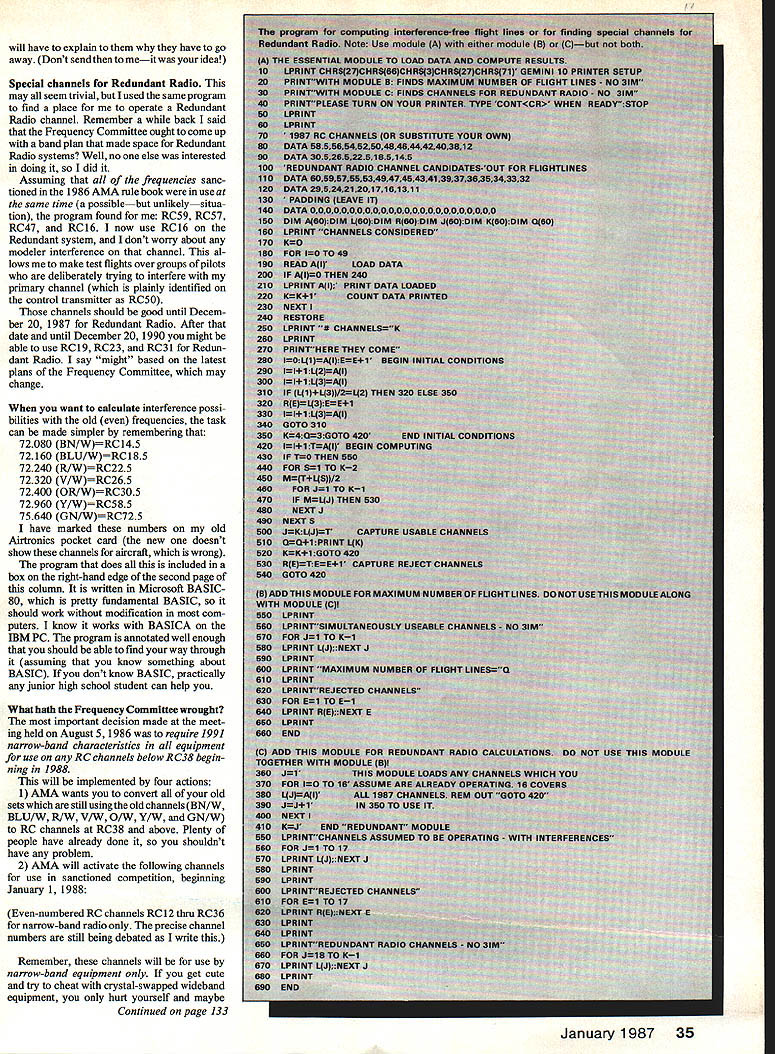
The program that finds interference-free channels is written in Microsoft BASIC-80 and was printed in the original column. It should run without modification on most computers; I know it works with BASICA on the IBM PC. The program is annotated well enough that you should be able to use it if you know something about BASIC. If you don’t, any junior high school student can probably help.
Testing and equipment
Tests performed by Frequency Committee members show that many PCM sets (not recommended) will not meet the narrow-band requirements. You will not be permitted to use old, wideband equipment in the narrow-band channels in 1988 or at subsequent Nats or in any other competition run by the AMA.
Based on transmitter tests at three Nats and three trade shows, some AM and FM transmitter designs can be qualified by slight modifications. However, transmitters currently on old channels (BN/W through GN/W) are unlikely to be qualified because of conversion costs.
Receivers are another matter. Very few existing receivers qualify except for the Kraft-8FD and -8FDS and dual-conversion PCM receivers like the Simprop PCM-20 and the Multiplex. By the time this prints, I expect other qualified receivers will be in circulation from Ace R/C, Airtronics, Circus, Futaba, and others. Do your own homework; I leave equipment reviewing to my friend Bob Archer.
It will be up to you to keep the low band occupied by good equipment by persuading rebels to comply and by servicing your gear periodically.
Safety and shop tips
A few words about safety and order. Despite its small size, the Dremel table saw can do serious damage. I always wear eye protection and have begun using ear protection as well — it preserves hearing, makes cutting more pleasant, and helps concentration. Before each cut, check finger placement and consider the possibility of slipping. Use a push stick when required.
Most of the accessory designs can be adapted to other makes of saw. As you make more tools, the work becomes easier. I hope these ideas help you get started or inspire your own designs.
George M. Myers 70 Froehlich Farm Rd. Hicksville, NY 11801
Transcribed from original scans by AI. Minor OCR errors may remain.

